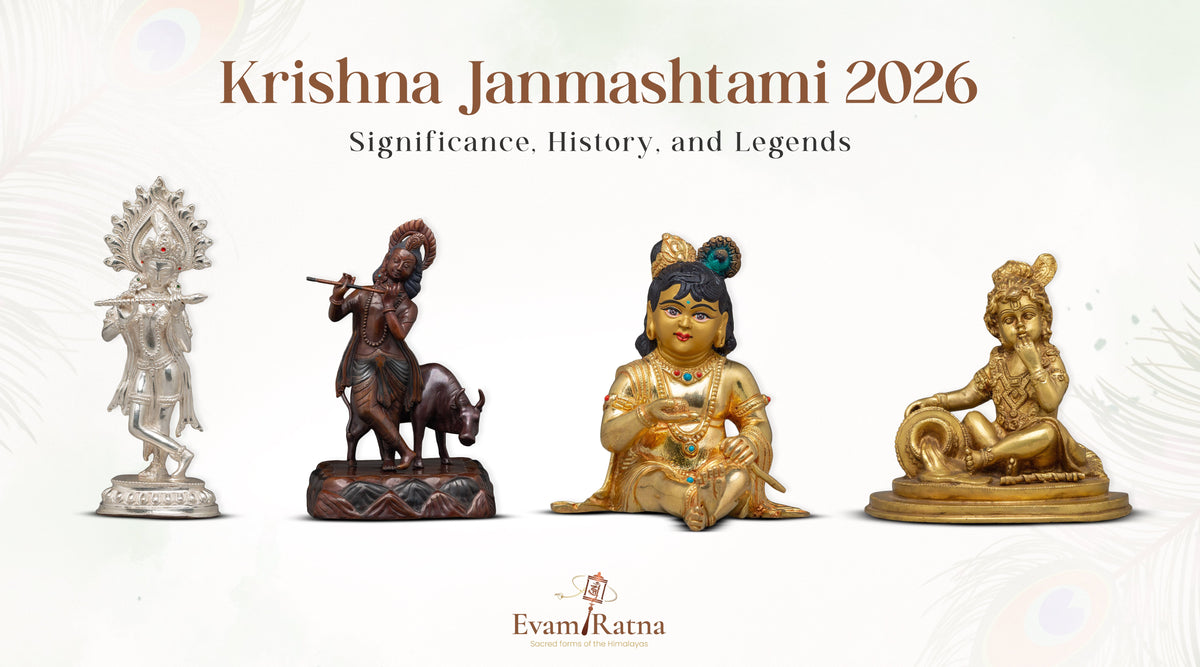
The Story of Janmashtami: Why We Celebrate Lord Krishna’s Birth
Celebrate Krishna Janmashtami 2026 on Friday, September 4, marking the 5253rd birth anniversary of Lord Krishna. This festival is celebrated on the Ashtami Tithi of Krishna Paksha during the holy month of Bhadrapada. Millions of devotees gather worldwide in temples and homes for fasting, midnight Puja rituals, and vibrant Dahi Handi celebrations. At the heart of these celebrations lies one extraordinary story: the birth of Lord Krishna. Therefore, it is a festival of devotion, dharma, divine protection, joy, and the possibility of spiritual transformation.
What is Krishna Janmashtami?

Krishna Janmashtami is the Hindu festival that celebrates the birth of Lord Krishna, revered as the eighth avatar of Vishnu and, in several Vaishnava traditions, as the Supreme Being descending in human form. Every year, on the eighth day of the dark fortnight (Krishna Paksha) of the Bhadrapada moon, people around the world pay their tribute to Mathura, the place where Krishna is said to have been born more than 5000 years ago. Krishna Janmashtami 2026 is an auspicious day on Friday, 4 September, and the Ashtami Tithi starts on 5 September 2026.
Midnight holds special weight in this festival because scripture describes Krishna's birth as occurring at exactly that hour, inside a prison cell, during a raging storm. The Nishita Kaal, the auspicious midnight period, is when temples perform the symbolic re-enactment of his birth: bathing the infant deity, ringing bells, blowing conch shells, and breaking the day-long fast that devotees have observed since dawn. Within Hindu tradition, Janmashtami sits alongside Diwali and Holi as one of the most widely observed festivals, but it carries a uniquely sacred, devotional character, centred less on spectacle and more on personal remembrance of Krishna as a beloved, ever-present child of the household.
What Does “Janmashtami” Mean?
The name itself explains the occasion. “Janmashtami” is a compound of two Sanskrit words: Janma means birth, while Ashtami refers to the eighth lunar day. Together, Janmashtami means “the eighth-day birth,” a direct reference to the date on which Krishna is said to have entered the world. According to the Bhagavata Purana, the great Vaishnava scripture that recounts his life in detail, Krishna was born under the Rohini Nakshatra on the Ashtami tithi of Krishna Paksha in Bhadrapada, an alignment of the lunar day and the lunar mansion that devotees consider especially sacred. This is also why the festival travels under a handful of regional names, including Krishna Jayanti, Gokulashtami, Ashtami Rohini, and Sri Krishna Jayanthi, depending on where in India or Nepal it is celebrated.
The Story of Lord Krishna’s Birth

The story begins in Mathura, ruled by the tyrant king Kamsa. When his sister Devaki married the noble Vasudeva, a disembodied voice from the sky warned Kamsa that Devaki's eighth child would bring about his death. Gripped by fear, Kamsa imprisoned the newlyweds and, one by one, killed the couple's first six children as they were born.
Devaki and Vasudeva endured their imprisonment with quiet faith. Their seventh child, Balarama, was mystically transferred to the womb of Rohini, Vasudeva's other wife, sparing him from Kamsa's wrath. Then came the eighth pregnancy, the one the prophecy had long pointed toward.
At the stroke of midnight, in the depths of the prison, Devaki gave birth to Krishna. As it is written in the scriptures, the time was filled with wonder: the prison guards fell into a deep sleep, Vasudeva's chains loosened on their own, and the heavy iron doors swung open without a hand touching them. Outside, thunder rolled, and rain fell in sheets, as if the heavens themselves were marking the occasion.
Vasudeva knew what had to be done and lifted the baby and went out into the storm, crossing the swollen river Yamuna on foot. Tradition holds that the great serpent Shesha rose from the waters to shield the child from the downpour, and that the river itself parted just enough to let Vasudeva pass safely to the other river bank.
Vasudeva arrived at the home of Nanda, the chief of the cowherds of Gokul, and his wife Yashoda, who had that same night given birth to a daughter. In an exchange arranged by divine will, Vasudeva left the infant Krishna in Yashoda's care and carried the newborn girl back to the prison in Mathura. When Kamsa tried to kill this child, she revealed herself as a form of the goddess Yogamaya and warned him that his true adversary was already safe, growing up far beyond his reach. And so Krishna spent his childhood in Gokul and Vrindavan, raised with the tenderness of foster parents who loved him as their own, unaware for years that the mischievous, butter-loving boy in their home was divinity itself.
Why is Krishna’s Birth Spiritually Significant?
Beyond its place in mythology, Krishna's birth carries a theological claim that shapes how millions of Hindus understand the relationship between the divine and the world. In the Bhagavad Gita, Krishna himself explains why he appears on earth, telling Arjuna on the battlefield of Kurukshetra that whenever dharma, righteousness, moral order, one's rightful duty, declines and adharma rises, he manifests himself to protect the good, destroy the wicked, and restore balance. This is the meaning of the avatar: the Divine does not appear only once, but returns again and again throughout different ages to restore balance and guide beings.
Krishna's birth in a prison cell, under threat of death, at the hour of deepest night, becomes more than a dramatic origin story. It is read by devotees as a template for how divine grace tends to arrive: quietly, in the middle of hardship, often unrecognised at first by the very people it is meant to save. Kamsa represents the arrogance and cruelty that dharma must eventually answer; Krishna's survival against impossible odds is taken as reassurance that righteousness is never permanently defeated. This is part of why Janmashtami feels less like a historical commemoration and more like an annual renewal of faith, a reminder, each Bhadrapada, that light finds a way into the darkest rooms.
Understanding Lord Krishna’s Iconography

Lord Krishna is one of the most revered figures in Hindu art, represented through distinctive symbols that reflect his divine nature, his childhood in Vrindavan, and his teachings on devotion and dharma. From the flute in his hands to the peacock feather on his crown, each element in Krishna’s imagery carries a connection to stories found in Hindu sacred literature, especially the Bhagavata Purana.
The Flute (Venu or Bansuri)
The flute is one of the most important attributes associated with Krishna, especially in his form as Venugopala, the divine cowherd who plays music among the forests of Vrindavan. In devotional traditions, Krishna’s flute represents the irresistible call of the Divine and the awakening of devotion within the hearts of beings. The sound of his flute is often described as enchanting, attracting the gopis, animals, and all of nature toward him. In art, Krishna is frequently shown standing in a graceful posture while playing the flute, surrounded by cows and cowherds. This form is especially common in temple sculpture and paintings.
The Peacock Feather (Mayur Pankh)
The peacock feather is one of Krishna’s most recognizable symbols. Sacred texts such as the Bhagavata Purana describe Krishna wearing a peacock feather ornament while entering the forests of Vrindavan. In devotional understanding, the feather is often associated with Krishna’s connection to nature, beauty, and his playful cowherd life. Over centuries, artists have incorporated the peacock feather into Krishna’s crown or hair ornament, making it an essential feature of his visual identity.
The Cow: Krishna as Govinda and Gopala
Krishna’s association with cows comes from his childhood spent among the cowherd community of Gokul and Vrindavan. He is often called Govinda and Gopala, names connected with his role as a protector and caretaker of cows. In paintings and sculptures, cows, calves, and cowherds often accompany Krishna, especially when he is shown playing the flute. These images represent his pastoral life and his close relationship with the natural world.
The Tribhanga Posture
Many Krishna sculptures portray him standing in the tribhanga posture, a graceful three-bend stance where the body bends slightly at the neck, waist, and knees. This elegant posture is especially associated with flute-playing Krishna, creating a sense of movement, rhythm, and divine beauty. Traditional Indian sculpture texts and artistic traditions frequently use this posture when depicting Venugopala forms.
The Crown and Royal Ornaments
Although Krishna is often remembered as a playful cowherd of Vrindavan, he is also depicted with royal ornaments, reflecting his divine status. His crown, jewelry, yellow garments, and decorative elements vary depending on the form being represented. In many artistic traditions, Krishna’s ornaments combine his identities as both a divine figure and a beloved youthful cowherd.
The Blue or Dark Complexion
Krishna is commonly represented with blue or dark-colored skin in Hindu art. The name Krishna itself is connected with meanings such as “dark” or “dark-colored,” and artists developed the tradition of portraying him with a blue complexion over centuries. This distinctive appearance helps identify Krishna in paintings, sculptures, and temple art.
The Yellow Garment (Pitambara)
Krishna is often shown wearing yellow clothing, known as pitambara. This garment is one of the traditional visual features associated with his divine form. Together with the flute, peacock feather, and pastoral setting, the yellow garment helps artists represent Krishna’s joyful and compassionate presence.
Krishna’s Raised Hand and Other Forms
Krishna appears in many different forms across Hindu art. While the flute-playing Krishna is among the most popular, other representations include:
- Bala Krishna: the divine child form celebrated during Janmashtami
- Govardhana Krishna: Krishna lifting Govardhan Hill to protect the people of Vrindavan
- Parthasarathi Krishna: Krishna as the charioteer and guide of Arjuna in the Mahabharata
Each form highlights a different aspect of Krishna’s life, teachings, and relationship with devotees.
The Meaning Behind Krishna’s Visual Form
Krishna’s iconography brings together many aspects of his story: the wisdom of the divine teacher, the affection of the beloved child, the joy of the flute-playing cowherd, and the protector who restores dharma. For devotees, a Krishna statue is a reminder of devotion, compassion, and the spiritual teachings associated with Krishna’s life.
Bala Krishna: Krishna as the Divine Child

As Janmashtami specifically commemorates a birth, the image of Krishna as an infant and small child, known as Bala Krishna, sits at the centre of the festival. Bala Krishna iconography draws heavily from the tenth canto of the Bhagavata Purana, which lingers lovingly over Krishna's early years: crawling on hands and knees, dancing with unrestrained joy, or caught mid-mischief with a ball of stolen butter in his hands.
The most beloved of these forms is Makhan Chor, “the butter thief,” which shows Krishna reaching into a pot of curd or butter with a clueless, delighted expression. Devotees also worship him as Laddu Gopal, holding a sweet in one hand, or simply as a crawling toddler with a rounded belly and a peacock feather tucked into his hair. These images are found in many Krishna-devotee households; a small Bala Krishna murti is dressed, fed, and put to sleep daily, much like a living member of the family. On Janmashtami, this everyday intimacy is heightened: the child form of God is bathed at midnight, dressed anew, and gently rocked in a cradle, inviting devotees to relate to the divine not through awe alone, but through the tenderness of caring for a beloved child.
Krishna and the Cow
Krishna's association with cows runs through nearly every stage of his early life. Raised among the cowherd community of Vrindavan, he is remembered as Govinda, “protector of cows,” and Gopala, “cow-herd” or “cow-protector,” titles that appear throughout the Bhagavata Purana and remain among his most widely chanted names today. As a boy, he is said to have known every cow in the herd by name, searching for any that wandered off and playing his flute to call them home, music so enchanting that even the cows are described as pausing mid-graze to listen.
In Hindu tradition more broadly, the cow is revered as Gau Mata, “Mother Cow,” a living symbol of nourishment, non-violence (ahimsa), and selfless giving. Krishna's bond with cows reinforces this reverence: in one of the tradition's best-known episodes, he lifts the Govardhan hill on his fingertip to shelter the cows and villagers of Vrindavan from Indra's punishing storm, choosing to protect the humble herders and their cattle over appeasing a proud god. The lesson devotees draw from this episode, and from Krishna's pastoral childhood in general, is one of humility, care for the natural world, and the sanctity found in simple, daily acts of tending to other living beings.
How is Krishna Janmashtami Celebrated?
Janmashtami customs vary by region and by sampradaya (spiritual lineage), but a shared rhythm runs through almost every celebration:
- Fasting (vrat): Many devotees observe a day-long fast, some abstaining from grains and taking only fruit or milk, breaking their fast only after the midnight puja or the following morning.
- Midnight prayers and Nishita Kaal puja: The moment of Krishna's birth is marked with bells, conch shells, and a symbolic re-enactment of his arrival.
- Temple visits and night vigils (jagran): Temples such as those in Mathura and Vrindavan stay illuminated through the night, hosting continuous devotional programs.
- Bhajan and kirtan: Communities gather to sing devotional songs celebrating Krishna's life and teachings, often continuing until dawn.
- Reading Krishna's stories or the Bhagavad Gita: Passages from the Bhagavata Purana or the Gita are read aloud as part of the night's devotion.
- Abhishekam: A ritual bathing of the Krishna murti with milk, curd, honey, and holy water, followed by fresh garments and ornaments.
- Offerings of flowers, sweets, fruits, butter, and milk: Dairy-based sweets such as makhan-mishri, panjiri, and shrikhand are especially popular, honouring Krishna's fondness for butter and milk.
- Decorating Krishna's shrine: Home altars are adorned with flowers, lamps, and small props recreating scenes from Krishna's childhood in Vrindavan.
- Dressing a Bala Krishna image: The infant form of Krishna is bathed, dressed in new clothes, and adorned with a peacock feather, as an act of tender, personal devotion.
- Jhulan or cradle rituals: A small cradle holding the Krishna image is gently rocked by family members, echoing Yashoda's care for the infant Krishna.
Simple Ways to Celebrate Janmashtami at Home

Janmashtami's customs travel well beyond Mathura and Vrindavan, and devotees living far from India and Nepal often keep the spirit of the festival with a few simple, meaningful steps:
- Clean and decorate a prayer area, even a small corner of a shelf or table.
- Place an image or statue of Krishna at the centre of the space.
- Light a lamp or diya to mark the sacredness of the evening.
- Offer fruit, sweets, or a little fresh butter as a simple bhog.
- Chant Krishna's names: Govinda, Gopala, and Hari, quietly or as a family.
- Read a passage from the Bhagavad Gita or a favourite story from Krishna's childhood.
- Spend a few quiet minutes reflecting on Krishna's teachings on duty, devotion, and letting go of ego.
None of these require elaborate arrangements. Janmashtami, at its heart, celebrates a child born into hardship and raised in a humble cowherd's home, a reminder that devotion has never depended on grandeur, only on sincerity.
Read More About Lord Krishna in Buddhism: A Crossroads of Spiritual Influence
Krishna Janmashtami: Welcoming the Divine Presence into Our Homes
Krishna Janmashtami is the celebration of Lord Krishna’s birth and also a reminder of the timeless values he represents: dharma, compassion, devotion, wisdom, and the triumph of light over darkness. From his miraculous birth in Mathura to his joyful childhood as Bala Krishna in Gokul and Vrindavan, Krishna’s story continues to inspire millions of devotees across generations.
Whether through fasting, midnight prayers, chanting Krishna’s names, reading sacred teachings, or offering devotion at a home altar, Janmashtami provides an opportunity to reconnect with these deeper spiritual values. The loving image of Bala Krishna reminds devotees that the Divine can be experienced not only through reverence but also through care, affection, and everyday acts of devotion. For those wishing to create a sacred space at home, a Krishna statue or Bala Krishna murti can become a meaningful centre of worship and reflection. Handcrafted sacred sculptures preserve not only artistic traditions but also the stories, symbols, and devotion that have surrounded Krishna worship for centuries.
As Krishna Janmashtami 2026 approaches, may this festival inspire us to welcome greater compassion, harmony, and spiritual awareness into our lives while remembering Krishna’s eternal message of dharma and devotion.