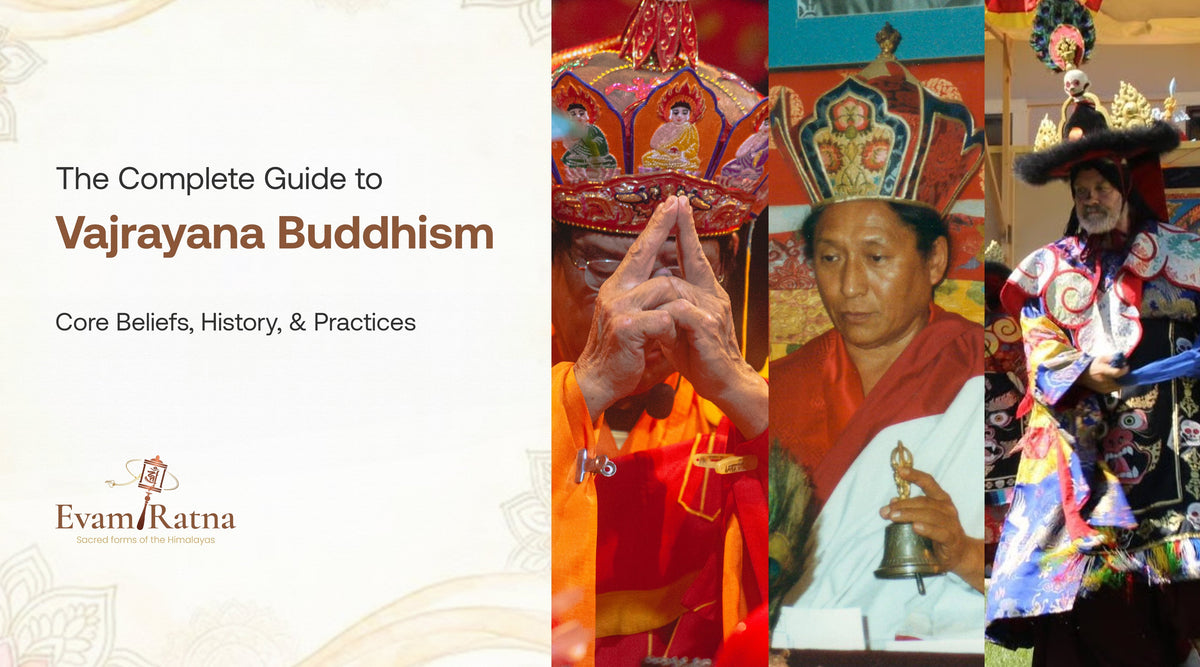
Vajrayana Buddhism: The Diamond Vehicle Explained
Vajrayana Buddhism is the tantric branch of Buddhism that arose in India and flourished above all in Tibet, Nepal, Bhutan, and Mongolia. It absorbs the ethical and philosophical foundation of Mahayana Buddhism, compassion for all beings and the wisdom of emptiness, and adds a toolkit of advanced practices: visualization, mantra, mudra, and ritual, all designed to transform ordinary experience into the path itself rather than treating the path as something separate from daily life.
What is Vajrayana Buddhism?

(Image from Sukhasiddhi Foundation)
Vajrayana translates from Sanskrit as the "Diamond Vehicle" or "Thunderbolt Vehicle," vajra meaning both diamond and thunderbolt, symbols chosen for qualities that cut through illusion instantly and cannot themselves be destroyed. It is also known as Tantric Buddhism, Mantrayana, and the Esoteric Vehicle.
Vajrayana is one of the three principal vehicles, or yanas, of Buddhism, alongside Theravada and Mahayana. It did not arise as a rival to Mahayana but grew out of it: Vajrayana accepts Mahayana's core commitment to bodhicitta, the aspiration to liberate all beings, and builds on it with tantric methods, mantra recitation, visualization, ritual, and ceremony, intended to accelerate the path toward enlightenment, potentially within a single lifetime rather than across countless rebirths.
Where Theravada emphasizes avoiding afflictive emotions and Mahayana emphasizes applying an antidote to them, Vajrayana takes a third approach: working directly with those emotions to reveal their pure essence. This is why Vajrayana iconography includes wrathful as well as peaceful deities; both are read as expressions of the same awakened energy, approached differently.
Is Vajrayana the Same as Tibetan Buddhism?
Not exactly, though the two terms are often used interchangeably. Vajrayana is the broader category of tantric Buddhist practice; Tibetan Buddhism is the most complete and best-known living expression of Vajrayana, having preserved and systematized it more thoroughly than any other culture. Japan's Shingon school is another surviving Vajrayana lineage, and elements of tantric practice also persisted historically within Chinese and Newar Buddhism, including the Newar Buddhist tradition of the Kathmandu Valley, where hereditary Vajracharya priests have maintained tantric ritual and the associated arts for over a thousand years. So while every Tibetan Buddhist is a Vajrayana practitioner, not every Vajrayana practitioner is Tibetan.
Why does Vajrayana rely on Mahayana?
None of Vajrayana's advanced techniques function without the Mahayana groundwork beneath them. Bodhicitta, the aspiration to attain enlightenment for the benefit of all beings, is the motivation that keeps tantric practice oriented toward compassion rather than personal power. Shunyata, the wisdom of emptiness, is the understanding that no phenomenon (including the self) exists independently or permanently. Traditional teachers are emphatic that tantric methods practiced without a genuine grounding in bodhicitta and shunyata lose their meaning entirely and can even reinforce the ego they are meant to dissolve. This is one reason serious Vajrayana study always begins with, and continually returns to, standard Mahayana training.
Origination and Evolution of Vajrayana
Vajrayana's roots reach back to shifts within Indian Mahayana Buddhism between roughly the 6th and 7th centuries CE, as tantric ideas already circulating in Indian religious life began entering Buddhist monastic universities such as Nalanda. Buddhist tradition places its scriptural emergence during what is called the third turning of the Wheel of the Dharma. By around 700 CE, Vajrayana had coalesced into a distinct path and remained central to Indian Buddhist thought for nearly five centuries, developing its own scriptural class, the tantras, alongside practical ritual manuals called sadhanas that guided daily practice.
Two broad currents shaped these teachings: action tantras, centered on venerating external representations of a deity such as a statue or painting, and yoga tantras, which turned practice inward by having the meditator visualize themselves as the enlightened being. Later texts from the 8th to 10th centuries introduced increasingly advanced practices built around specific tantric deities and their mandalas.
Buddhist institutions in India went into decline through the 12th and 13th centuries under a combination of pressures, including the loss of major monastic universities. By then, however, Vajrayana had already spread well beyond India, into the Himalayan regions of Nepal, Bhutan, and Sikkim, into Tibet, and across East Asia, where it merged with Daoist and Confucian elements to form what became known as esoteric Buddhism in China, and later took root in Japan through the Shingon and Tendai schools.
Guru Padmasambhava and the Transmission to Tibet

Guru Padmasambhava, revered as Guru Rinpoche, "the Precious Guru," is deeply respected as the master who established Vajrayana teachings and helped spread Buddhism throughout Tibet. Traditional accounts place his arrival in the 8th century, at the invitation of the Tibetan king Trisong Detsen, who sought to establish Buddhism in his kingdom.
The invitation followed real obstacles. The Indian abbot Shantarakshita had already begun teaching in Tibet and laying the foundations for what would become Samye, Tibet's first monastery, but construction was repeatedly disrupted, and local spiritual forces were blamed for the setbacks. Padmasambhava was brought in for his mastery of tantric methods, and tradition holds that he subdued these obstructing forces and bound them by oath to protect the dharma rather than obstruct it. With the way cleared, Samye monastery was completed, and Padmasambhava, together with Shantarakshita and the translator-scholar Vairotsana, oversaw a vast project translating Buddhist scriptures into Tibetan.
Padmasambhava is credited with founding the Nyingma, or "Ancient," school of Tibetan Buddhism, the oldest of its major lineages. He is also central to the terma tradition, teachings said to have been hidden by Padmasambhava and his spiritual consort Yeshe Tsogyal for discovery by future generations at the right moment, ensuring the tantric teachings would neither be lost nor corrupted over time. Because he is credited with fully revealing the Vajrayana teachings to Tibet, he is honored with the title Buddha of the Vajrayana and remains one of the most widely depicted and invoked figures across Himalayan Buddhist art to this day.
Core Beliefs, Meditation, and Practices
At the philosophical center of Vajrayana sits buddha-nature, the conviction that the potential for full awakening already exists within every being and needs to be uncovered rather than manufactured. Vajrayana's tantric methods exist to accelerate that uncovering.
Preliminary practices (ngondro): Before advanced tantric training, students typically undertake foundational practices, prostrations, mantra recitation, and purification exercises that build the discipline and merit needed for what follows.
Buddha-nature: Central to Vajrayana is the view that every being already possesses an intrinsic, uncorrupted enlightened nature, often called tathagatagarbha, or "buddha-womb." Confusion and suffering are understood not as permanent defects but as temporary obscurations layered over something that was whole to begin with. Practice, in this view, is less about building enlightenment from nothing and more about recognizing what has been present all along, the way clouds part to reveal a sky that was never actually missing.
Pure perception: Ordinary experience is colored by habitual judgments: this person is difficult, this place is unpleasant, this moment is a problem. Vajrayana trains practitioners in pure perception, deliberately viewing the environment, other beings, and even one's own body as already sacred, as the display of enlightened qualities rather than as flawed raw material to be fixed. This is not naive positive thinking; it is a disciplined shift in the lens through which experience is met, intended to gradually dissolve the boundary between "sacred" and "ordinary."
The alchemy of tantra: Perhaps the most distinctive philosophical move in Vajrayana is its treatment of difficult emotions. Where some contemplative paths recommend suppressing or slowly extinguishing anger, desire, and pride, tantra treats these energies as raw material, intense, potent, and unusable in their raw form, but transformable, the way alchemy claims to turn base metal into gold. Anger, worked with skillfully under proper guidance, is said to reveal mirror-like clarity; pride reveals equanimity; desire reveals discerning wisdom. This is precisely why the tradition insists so strongly on qualified supervision: engaging combustible material without training is considered genuinely risky, not merely against the rules.
Key Practices and Rituals
Deity yoga: The signature practice of Vajrayana is deity yoga, in which the practitioner visualizes themselves, not a figure outside themselves, as an enlightened being, complete with that deity's qualities, mantra, and mandala environment. This is a significant shift from earlier Buddhist practice, where deities were primarily venerated as external figures. In deity yoga, the practitioner "tries on" enlightenment, rehearsing its qualities so thoroughly through visualization that ego-bound identity gradually loosens its grip. Peaceful deities such as Avalokiteshvara or Tara cultivate compassion and gentleness; wrathful deities such as Mahakala or Vajrakilaya embody the same enlightened wisdom directed with ferocious energy against inner obstacles like ego-clinging and doubt.
The power of sound and gesture: mantras and mudras: A mantra is a sacred sound formula, often just a handful of syllables, understood to carry the vibrational essence of a particular deity or enlightened quality. Reciting a mantra, silently, aloud, or on a mala of prayer beads, is a way of aligning speech with awakened intention. A mudra is a precise hand gesture that performs the same alignment through the body: the earth-touching mudra recalls the Buddha's enlightenment, while the mudra of teaching signals the turning of the wheel of Dharma. Together, mantra, mudra, and visualization engage speech, body, and mind simultaneously, which is why Vajrayana is sometimes described as a path of unifying the "three doors" of practice rather than working with the mind alone.
Mandalas: A mandala is a symmetrical, often breathtakingly intricate diagram, painted, drawn in colored sand, or constructed as a three-dimensional model, that maps the palace and surrounding world of an enlightened being. It is simultaneously a work of sacred art, a meditation aid, and a philosophical statement: that the enlightened and the ordinary world share the same underlying structure, differing only in how they are perceived. Practitioners use mandalas as a focus for visualization during deity yoga, entering the diagram mentally as though walking into the deity's own environment.
The role of the guru (lama): Vajrayana teachings are traditionally transmitted through direct oral instruction and formal empowerment (abhisheka) from a qualified teacher to a student, rather than through independent study of texts alone. This is not a matter of hierarchy for its own sake. The methods involved are considered powerful enough that misapplication carries real psychological and spiritual risk, and a qualified guru is the safeguard that ensures a practice is suited to the individual student and applied correctly. The guru-disciple relationship, once formally entered, is treated with the same seriousness as any other vow in the tradition.
The Role of Ritual Items in Vajrayana Practice

If art is a way of showing meditation, ritual objects are a way of bringing meditation into the physical world. In Vajrayana Buddhism, practice involves many sacred tools and objects, each with a specific purpose. They help practitioners connect with teachings, rituals, and deeper states of awareness.
- The vajra and bell, held together in the hands during ritual, are perhaps the most emblematic pair in the tradition. The vajra represents skillful means and the indestructible nature of the awakened mind; the bell represents wisdom and emptiness. Held together, they express the union the practitioner is working to realize.
- Mandala offering sets allow practitioners to physically construct a symbolic universe as an act of generosity, offered up in the course of daily practice as a tangible complement to the mandala visualizations described above.
- Prayer wheels, filled with mantras, let practitioners set the same sacred words into motion with each turn, understood as a way of extending the practice's benefit outward.
- Mala beads, most often counted in sets of 108, keep track of mantra recitation and steady the mind through repetitive, physical counting, turning a mental practice into a tactile one.
- Singing bowls, ritual drums, and incense shape the sensory environment of practice itself, settling the space and the practitioner before meditation begins.
In Kathmandu Valley, these objects have been shaped for centuries by Newar artisan families in Patan, whose lost-wax casting and repoussé metalwork techniques were themselves developed to serve this Vajrayana ritual tradition. When you hold a hand-cast vajra or a hammered singing bowl from Patan, you are holding a craft lineage built specifically to support this path, not a generic decorative object borrowing Buddhist imagery, but a tool made the way it has always been made, for the purpose it has always served.
Read More About Introduction To The Profound Symbols of Vajrayana Buddhism
What Is Empowerment (Wang) in Vajrayana Buddhism?
In Vajrayana Buddhism, an initiation, commonly known as empowerment (wang in Tibetan), is a traditional ceremony through which a qualified teacher introduces a student to a specific tantric practice and grants permission to engage in that practice. The Sanskrit term is abhisheka, often translated as "empowerment" or "initiation."
Unlike general Buddhist teachings that can often be studied through texts, lectures, and meditation instructions, Vajrayana practices are traditionally transmitted through a direct relationship between teacher and student. Empowerment establishes the connection, authorization, and foundation needed for practices such as deity yoga, mantra recitation, and visualization meditation.
Why Is Initiation Important in Vajrayana Buddhism?
Vajrayana considers tantric practices to be powerful methods that require proper preparation and guidance. Empowerment is important because it allows practitioners to enter a specific practice lineage and receive the instructions associated with a particular deity, meditation system, or tantric cycle.
During an empowerment ceremony, the teacher introduces the practitioner to the symbolic world of the practice, including:
- The enlightened deity and its qualities
- The associated mantra
- The visualization practice
- The commitments connected with the practice
According to traditional Vajrayana explanations, empowerment does not simply mean receiving an external blessing. Rather, it helps awaken and recognize the enlightened potential already present within the practitioner, often described as Buddha-nature.
A common analogy in Vajrayana teachings is that empowerment prepares the practitioner like a seed being planted. The practice, meditation, and discipline that follow allow that seed to develop into realization.
The Difference Between General Buddhist Teachings and Vajrayana Empowerment
Vajrayana Buddhism shares the foundations of all Buddhist traditions, including:
- Taking refuge in the Buddha, the Dharma, and the Sangha
- Understanding karma
- Developing compassion (bodhicitta)
- Realizing emptiness (shunyata)
However, Vajrayana adds specialized tantric methods that work directly with perception, emotions, and the nature of mind.
|
General Buddhist Teachings |
Vajrayana Tantric Practice |
|
Focus on ethical discipline, meditation, and wisdom. |
Uses additional tantric methods and symbolic practices. |
|
Can often be studied through teachings and texts. |
Traditionally requires empowerment from a qualified teacher. |
|
Meditation may focus on mindfulness, compassion, or insight. |
Includes deity yoga, mantra, mudra, and mandala visualization. |
|
Gradual cultivation of qualities. |
Transformation of ordinary experience into enlightened awareness. |
Vajrayana does not replace earlier Buddhist teachings. Instead, it builds upon the foundation of Mahayana Buddhism, especially bodhicitta and emptiness, before introducing tantric methods.
The Relationship Between Teacher and Student

The teacher-student relationship (guru-disciple relationship) is one of the central features of Vajrayana Buddhism.
A Vajrayana teacher, often called a lama or vajra master, provides:
- Oral transmission of teachings
- Instructions for meditation practices
- Explanation of symbolic meanings
- Guidance in maintaining commitments
The reason this relationship is emphasized is that tantric practices involve complex visualization, rituals, and inner transformations. Traditional teachings state that these methods should be learned under proper guidance rather than practiced only through personal interpretation.
Before accepting a teacher, Vajrayana traditions traditionally encourage students to carefully examine the teacher’s qualities, lineage, knowledge, and conduct. The relationship is not simply that of a student receiving information from an instructor. It is considered a spiritual connection based on trust, commitment, and transmission of an authentic lineage.
What Happens During a Vajrayana Empowerment Ceremony?
Although ceremonies vary between traditions, many empowerments include several elements:
1. Preparation
The teacher explains the meaning of the practice, the qualities of the deity, and the commitments involved.
2. Ritual Introduction
The student is symbolically introduced to the mandala or enlightened environment connected with the practice.
3. Transmission
The teacher grants the empowerment, allowing the student to begin the specific meditation practice.
4. Commitments and Practice Instructions
The student receives instructions regarding:
- Mantra recitation
- Visualization
- Meditation methods
- Ethical commitments (samaya)
Empowerments may differ depending on the tantric tradition and deity. Some systems describe multiple levels of empowerment, including vase empowerment, secret empowerment, wisdom empowerment, and word empowerment.
Common Misconceptions About Vajrayana Buddhism
Is Tantra About Magic or Mystery?
In popular culture, Tantra is sometimes misunderstood as being focused on supernatural powers or exotic rituals. In Buddhist traditions, Tantra refers to a system of meditation and transformation. Its purpose is to develop wisdom and compassion through specialized methods.
Why Is Vajrayana Called “Secret Buddhism”?
The term “secret” refers mainly to teachings that are traditionally transmitted privately because they require preparation, initiation, and proper understanding. The purpose is not secrecy for mystery, but ensuring that powerful meditation methods are practiced responsibly.
Conclusion: Understanding Vajrayana Buddhism and Its Transformative Path
Vajrayana Buddhism represents one of the most profound and intricate expressions of Buddhist philosophy, combining wisdom, compassion, meditation, ritual, and sacred art into a path of inner transformation. Known as the Diamond Vehicle, it builds upon the Mahayana foundation of bodhicitta (the wish to benefit all beings) and shunyata (the understanding of emptiness), while introducing unique methods such as deity yoga, mantra recitation, mudras, mandala visualization, and tantric practices.
From its origins in ancient India to its preservation across Tibet, Nepal, Bhutan, and Mongolia, Vajrayana has continued through authentic lineages of teachers and practitioners. Figures such as Guru Padmasambhava played a central role in establishing Vajrayana teachings in Tibet, while generations of masters preserved its meditation systems, rituals, and artistic traditions. Through proper guidance, meditation practice, and ethical development, practitioners work toward recognizing the awakened nature of mind. Whether expressed through a thangka painting, a Buddhist statue, a mantra, or a ritual object, every element of Vajrayana serves as a reminder of the path toward wisdom, compassion, and liberation.
Understanding Vajrayana Buddhism requires looking beyond its symbolic imagery and rituals to appreciate its deeper purpose: transforming ordinary perception into enlightened awareness and using every aspect of experience as a path toward awakening.