How to Perform Buddhist Prostration: Steps, Meaning, and Mental Benefits
For many people, Buddhist prostration may appear to be a simple act of bowing before a statue, stupa, teacher, or sacred place. However, especially within Tibetan Buddhism, prostration is a profound practice that involves the transformation of body, speech, and mind. It is a method for cultivating humility, purifying negative tendencies, and creating the profound foundation for spiritual realization. This sacred practice continues to guide practitioners toward inner transformation and awakening.
What is Buddhist Prostration?

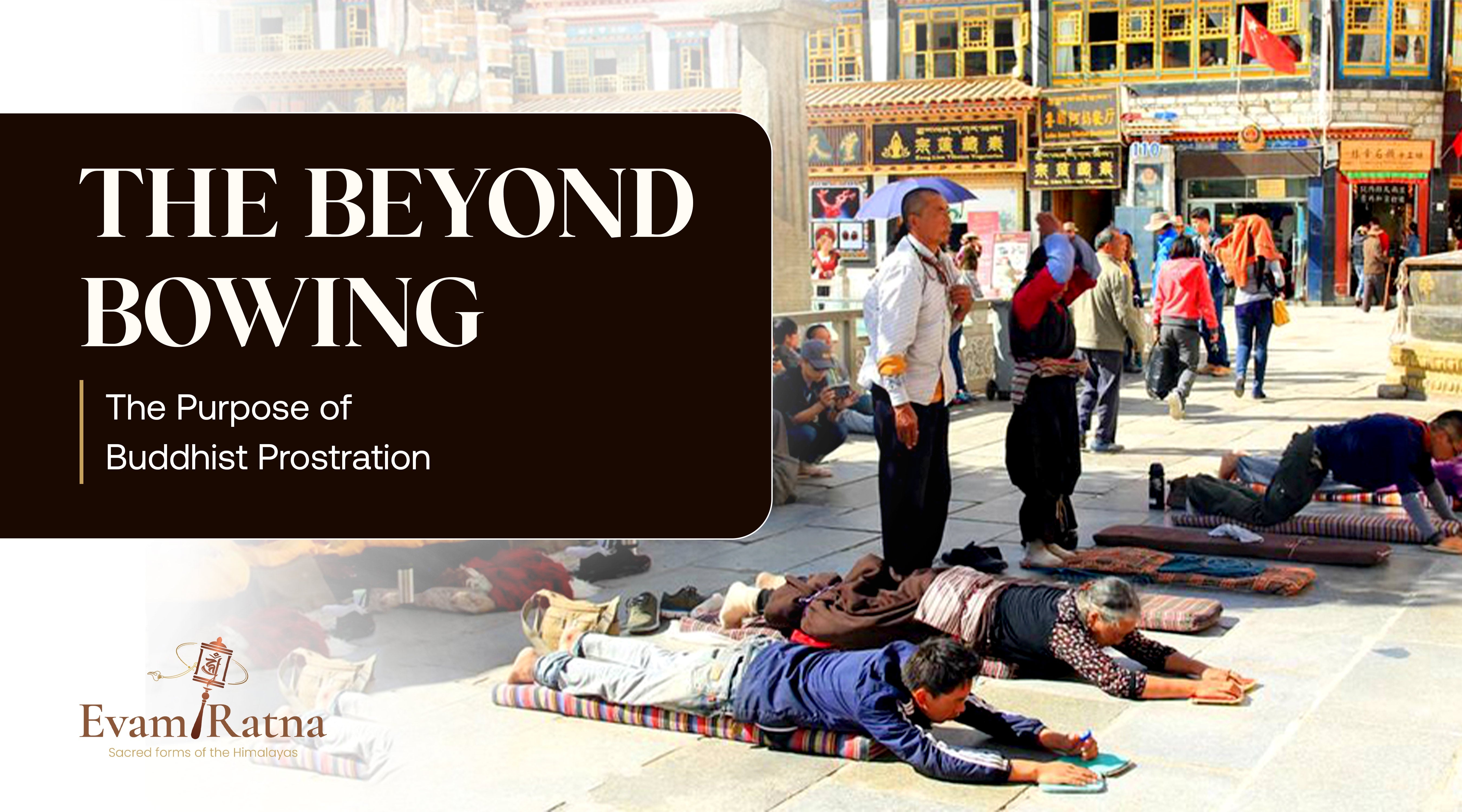
(Image from Tibet Discovery)
Buddhist prostration is one of the most recognizable devotional practices across Tibetan Buddhism. Prostration is a profound practice, a physical gesture of bowing that engages the body, speech, and mind in cultivating humility, devotion, mindfulness, and purification. It represents the practitioner’s respect for the Three Jewels, the Buddha, Dharma, and Sangha, while creating a deeper connection with the path toward awakening. The movement of lowering oneself toward the ground symbolizes letting go of pride, ego, and self-centered attitudes while opening the mind toward wisdom and compassion. Although it may appear to be a simple physical action, Buddhist masters explain that the true meaning of prostration lies within the motivation behind it. When performed with sincere faith and awareness, each movement becomes a method for transforming the body, speech, and mind into instruments of spiritual growth.
Origin and History of Prostration

- Roots older than Buddhism itself: Bowing fully to the ground was already an established way of showing respect to kings, elders, and teachers in ancient Indian society. Buddhism inherited this gesture and gave it new spiritual meaning, a pattern scholars trace through early Vinaya texts, which instructed monks and nuns to bow before the Buddha, senior monastics, and sacred objects as part of formal monastic conduct.
- Prostration in the earliest Buddhist texts: The practice appears in the earliest layers of the Buddhist canon. Several Pali suttas describe laypeople and monks alike joyfully prostrating before the living Buddha, and the custom of daily prostration to the Triple Gem, Buddha, Dharma, and Sangha, is described by teachers as dating back to this period, well before the elaborate visualized forms later developed in Tibet.
- The Buddha and the teaching seat: Among Tibetan Buddhist teachers and guides, a well-known account holds that the Buddha himself prostrated before his own seat before sitting down to give his first sermon, a gesture meant to guard against the pride that might otherwise arise from taking a high, honored seat. In this telling, the act set the example that Buddhist practitioners have followed ever since: even the Buddha, before teaching for the first time, modeled humility rather than assuming it was beneath him. While this story circulates primarily as oral teaching and travel-guide tradition rather than a fixed line in the earliest canonical suttas, it remains one of the most commonly cited explanations for why prostration holds such a central place in Buddhist practice, an antidote to ego offered by the very figure the practice honors.
The Meaning and Purpose of Buddhist Prostration
At its simplest, prostration is a gesture of respect. But in Tibetan Buddhism, the word used for it, chak tsal, carries a significant meaning that goes well beyond a polite bow. According to the oral lineage explanation recorded by Rigpa Wiki, chak means something like "sweeping away", clearing out harmful actions and obscurations, the way a broom clears dust, while tsal refers to receiving the blessings of enlightened body, speech, and mind. Prostration, in other words, is understood simultaneously as an act of humility and an act of purification. Lama Thubten Yeshe explains that prostration helps practitioners purify negative karma and accumulate merit by engaging their entire being in the practice.
Connection with Buddha, Dharma, and Sangha
Traditionally, prostration is directed toward the Triple Gem, the Buddha as the enlightened teacher, the Dharma as his teachings, and the Sangha as the community that upholds and transmits them. Bowing before a statue, a stupa, a text, or a teacher is a way of formally orienting oneself toward these three sources of refuge, rather than an act of worship directed at an object.
Prostration as a practice of body, speech, and mind
What distinguishes Buddhist prostration from an ordinary bow is that it is deliberately practiced on three levels at once. The body performs the physical movement; the speech recites a mantra, refuge formula, or prayer; and the mind holds the visualization and motivation. Teachers describe this union as central to why the practice is so effective, as Lama Gendün Rinpoche put it, prostration engages body, speech, and mind together, so that the purification reaches every level on which negative karma was originally created.
The Spiritual Significance of Prostration in Tibetan Buddhism
In Tibetan Buddhism, prostration carries several layers of meaning. It is practiced as a method of:
- Developing humility
- Purifying negative habits and karmic imprints
- Accumulating spiritual merit
- Strengthening devotion and refuge
- Preparing the mind for meditation
One of the main purposes of prostration is overcoming pride, which is considered one of the obstacles preventing spiritual development. Pride creates separation by reinforcing the idea of a fixed and independent self. By physically lowering the body to the ground before an object of veneration, the part of us most associated with self-importance symbolically releases this attachment and cultivates openness.
The gesture of placing the hands together and touching the crown, throat, and heart represents purification and transformation of the three doors of action:
- Body: represented by physical actions
- Speech: represented by words and communication
- Mind: represented by thoughts and intentions
By dedicating these three aspects to the path of awakening, practitioners gradually align their actions with enlightened qualities. Prostration is also closely connected with taking refuge. Before beginning many Tibetan Buddhist practices, practitioners take refuge in the Buddha, Dharma, and Sangha while performing prostrations as an expression of trust in the path.
Types of Prostration
Not every prostration looks the same, and Tibetan Buddhist practice recognizes a few distinct forms, chosen mainly according to available space, time, and physical capacity.
Full-body prostration (Kyang-chag/Gyangchag):

In the full-length form, the practitioner lowers all the way down and stretches the body flat on the ground, arms extended forward, in full contact with the earth from forehead to feet. This is the form most associated with ngöndro practice and with pilgrims seen prostrating their way around sacred sites such as the Barkhor in Lhasa or the kora route around Mount Kailash, where the practitioner marks the spot their fingertips reached, rises, walks to that mark, and prostrates again, repeating the sequence for the length of the journey.
Half-body prostration (Kum-chag):

In the half-length form, the practitioner kneels and brings the forehead down to touch the floor without extending the body flat. This version requires less space and time, making it the more practical choice for a quick prostration at a temple entrance, before a home altar, or whenever a full-length prostration isn't feasible.
Symbolic prostration:
A third, more abbreviated form is also recognized: simply performing the crown-throat-heart mudra sequence while standing, without lowering the body to the ground at all. This is typically used according to space, time, or physical ability, for instance, when passing a shrine in a crowded space or for practitioners whose physical condition makes bowing to the floor difficult.
Across all three forms, the core sequence, joining the palms at crown, throat, and heart to mark body, speech, and mind, stays the same. What changes is only how far the body itself extends toward the ground; the underlying gesture and motivation remain identical.
How to Perform Buddhist Prostration Correctly
Buddhist prostration is practiced in different forms depending on the tradition and circumstance. In Tibetan Buddhism, the most common form is the full-length prostration, where the practitioner extends the entire body forward until touching the ground.
A traditional prostration generally follows these stages:
Preparing the body and mind:
Before beginning, practitioners generate a positive motivation. They reflect on the qualities of Bodhicitta and develop the aspiration to overcome suffering and cultivate wisdom for the benefit of all beings.
The three stages of prostration:

- Standing and joining the palms at the crown, throat, and heart, marking body, speech, and mind in turn.
- Lowering the body to the ground, traditionally with knees, hands, and forehead all touching the earth (in the full-length form, the body stretches out completely, arms extended forward).
- Rising promptly rather than lingering on the ground, teachers note this rising motion is itself symbolic, representing the aspiration to rise up out of samsara rather than remain caught in it.
The importance of posture, hand gestures, and visualization:
Correct posture matters more than speed or sheer repetition. Fingers are kept together rather than spread, and the hands are not flattened palm-to-palm. Teachers such as Pabongkha Dechen Nyingpo, as recorded in Lama Zopa Rinpoche's commentary, emphasized that a small number of prostrations done correctly and with full attention is more valuable than a large count performed carelessly.
The Symbolism Behind Buddhist Prostration Mudra
Every part of Buddhist prostration carries symbolic meaning. The joined palms, called the "lotus bud" mudra, represent respect, devotion, and the integration of opposing qualities such as wisdom and compassion. According to Lama Zopa Rinpoche's teachings on the practice, the empty space between the palms represents dharmakaya, the truth body of a buddha, while the two thumbs tucked inside that hollow represent rupakaya, the form body.
Keeping the thumbs folded inside the joined palms is described as symbolically "offering a jewel." The dharmakaya-rupakaya pairing formed by the mudra points to a core Vajrayana theme: the union of wisdom and method (or means). Lama Zopa Rinpoche's commentary explains that this union spans both sutra-level practice and tantric practice, encompassing, on the tantric side, the completion-stage attainments of illusory body and clear light.
The act of touching the crown, throat, and heart reminds practitioners that enlightenment involves the transformation of every aspect of existence. The crown symbolizes the purification of physical actions. The throat symbolizes the purification of speech. The heart symbolizes the purification of thoughts and emotions. Through this awareness, prostration becomes a practice of mindfulness with a simple ritual gesture.
The Role of Visualization During Prostration Practice
In teachings on the Ganden Lha Gyäma preliminary practice, Lama Zopa Rinpoche describes a traditional visualization in which the practitioner imagines countless bodies from all their previous lives, in both human and deity form, surrounding them and prostrating together, alongside visualized forms of all sentient beings. This visualization expands the meaning of each prostration. Instead of viewing the practice as a single individual bowing down, practitioners imagine infinite forms of themselves making offerings and expressing devotion throughout the universe. The purpose of visualization is to train the mind to move beyond ordinary limitations and develop qualities such as generosity, devotion, and compassion. When combined with refuge prayers, visualization, and sincere motivation, prostration becomes a powerful meditation method.
The Benefits of Buddhist Prostration Practice
Buddhist teachings describe many benefits associated with prostration practice. These benefits are understood as a physical, emotional, and spiritual transformation.
- Purification of body, speech, and mind: As outlined above, each of the three physical touch-points in the mudra sequence, crown, throat, and heart, is traditionally associated with purifying obscurations tied to actions of body, speech, and mind, respectively, while simultaneously planting the causes to realize an enlightened being's body, speech, and mind.
- Development of faith and devotion: Teachers on the practice, including those cited by the Martsang Kagyu community's guidance on prostration, describe the repeated physical and mental engagement of prostration as steadily deepening a practitioner's faith and devotion toward the Three Jewels, qualities considered essential fuel for sustained practice.
- Creating causes for spiritual realization: Traditional sources go further, describing specific karmic results tied to prostration, from a well-formed body to inner qualities like courage in facing mental afflictions. Lama Zopa Rinpoche's teaching notes that the sutra literature describes prostration as creating the causes for favorable rebirth, and ultimately for progress along the arya path toward enlightenment itself.
Prostration as a Preliminary Practice (Ngöndro) in Vajrayana Buddhism
In the Vajrayana preliminary practices known as ngöndro, prostration is one of several practices traditionally repeated 100,000 times combined with refuge prayers.
Through repetition, practitioners develop:
- Stronger commitment to the Dharma
- Greater humility
- Purification of obstacles
- Deeper understanding of refuge
The ngöndro prostrations are understood as groundwork: they tone the body, purify obscurations that would otherwise interfere with meditative clarity, and perhaps most importantly, visibly demonstrate to the practitioner their own capacity for sustained discipline, which is considered essential before undertaking higher tantric practices.
Buddhist Prostration in Daily Practice and Sacred Places

Prostration before statues, stupas, and teachers: Beyond formal ngöndro, prostration is woven into ordinary Tibetan Buddhist life. It is customary to prostrate, often three times, echoing the Triple Gem, upon entering a temple or shrine room, before an image of the Buddha, or before one's teacher at the beginning and end of a teaching session.
Pilgrimage traditions in Tibetan Buddhism: Prostration also takes a dramatic, sustained form during pilgrimage. Devout practitioners are known to prostrate their full body length, mark the spot reached with their fingertips, rise, walk to that mark, and prostrate again, repeating this for entire pilgrimage routes, sometimes covering hundreds of miles over months or years toward destinations such as Lhasa or Mount Kailash. This practice is a striking public demonstration of the same body-speech-mind unity described throughout this guide, simply extended across vast distances.
Maintaining mindfulness and devotion: Whether performed as a brief gesture before a home altar or as a months-long pilgrimage practice, the essential instruction remains consistent across sources: prostration is meant to be done with full presence, sincere motivation, and correct form. As Pabongkha Dechen Nyingpo's lamrim advice puts it, a small number of prostrations done correctly outweighs a large count performed without attention.
Conclusion: Prostration as a Journey from Humility to Enlightenment
Buddhist prostration is much more than a physical gesture of respect. It is a complete spiritual practice that unites body, speech, and mind in the pursuit of awakening. Through lowering the body, practitioners learn humility. Through prayer and recitation, they cultivate devotion. Through visualization and mindfulness, they transform ordinary actions into a path toward wisdom and compassion.
In Tibetan Buddhism, prostration remains one of the most powerful practices for purifying obstacles, accumulating merit, and preparing the mind for deeper realization. Whether performed thousands of times as part of Ngöndro practice or as a simple daily gesture before a Buddhist altar, prostration continues to express one of Buddhism’s most essential teachings: the willingness to let go of ego and open oneself to the possibility of enlightenment.