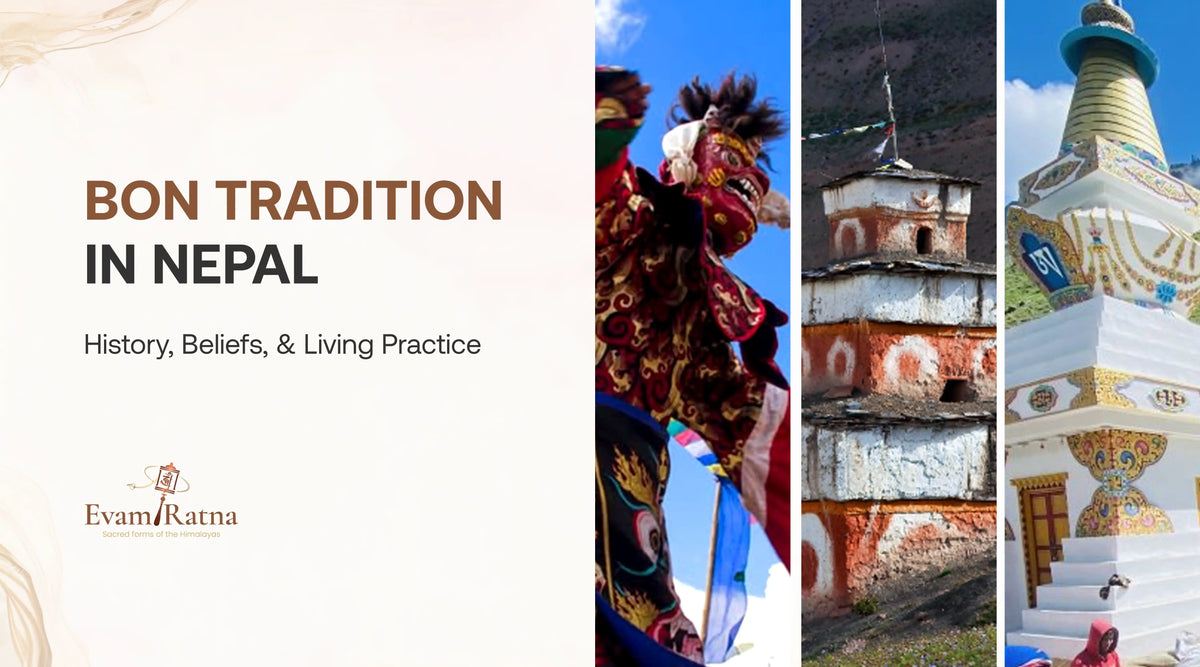
The Bon Religion in Nepal: Ancient Roots of the Himalayas
Beneath the prayer flags and chorten of the Himalaya lies a much older spiritual current. Bon, the tradition that many describe as the indigenous religion of the Himalayan world, still breathes in Nepal today. You can hear it in the monastic debates of a Kathmandu hillside, see it in the counterclockwise turn of a prayer wheel in Mustang, and walk it along the pilgrim paths of Dolpo. For devotees of Himalayan sacred art and ritual culture, understanding Bon is a quiet but rewarding step. It explains why certain symbols, directions, and ceremonies feel familiar yet distinct across the mountain valleys.
Bon: An Introduction to the Indigenous Faith of the Himalayas

(Image from Nepal Tourism Board)
Bon is a spiritual tradition that preserves beliefs and practices said to predate the arrival of Buddhism in the Himalayan region. Its followers, known as Bonpo, trace their teachings to an enlightened being named Tonpa Shenrab Miwoche, who is regarded as the founder and the teacher of the present age.
The tradition today is generally called Yungdrung Bon, meaning "Eternal Bon", after its central symbol, the Yungdrung. It is a complete religious system, with monasteries, a scriptural canon, a graded path of teachings, philosophical debate, tantric practice, and a Dzogchen tradition of its own.
Bon is sometimes dismissed as just another Buddhist sect, but this view overlooks how Bonpo understand themselves. They hold that their teachings come from their own enlightened source, preserved in their own texts and lineages. At the same time, centuries of exchange with Buddhism have left the two traditions with many overlapping ideas, images, and practices, which is part of what makes Bon so fascinating to study.
Origins: Tonpa Shenrab, Zhangzhung, and the Land of Olmo Lungring

According to Bonpo tradition, the teachings first appeared in a sacred land called Olmo Lungring, part of a larger realm known as Tazik, which lies to the west of Tibet. At its centre rises Mount Yungdrung Gutseg, the "Pyramid of Nine Swastikas," which many Bonpo identify with Mount Kailash in western Tibet. The number nine and the swastika both carry deep significance in Bon for this reason.
Tonpa Shenrab is said to have taught there before bringing the teachings to the ancient kingdom of Zhangzhung. Followers place his life many thousands of years in the past, though the traditional dates vary widely. His life story is told in three major scriptures, known as the Dodü, the Zermik, and the Zijid.
Zhangzhung was a powerful kingdom of the western Tibetan plateau, and Mustang once formed part of it. In the mid-seventh century the Tibetan Empire conquered Zhangzhung, and as Buddhism was adopted at the imperial court, native priests lost their status and many of their practices were suppressed. Some of those practices were later absorbed into Tibetan Buddhist traditions.
Bon did not disappear. In the centuries that followed, surviving communities organised monastic centres and recovered or revealed scriptures. The eleventh century was a turning point, when figures such as Shenchen Luga (996 to 1037) helped establish the organised tradition known today as Yungdrung Bon. During this period, Bon texts and practices also integrated many ideas that had arrived with Buddhism, producing what scholars sometimes call "New Bon." Monasteries such as Yeru Wensakha, Menri, and Yungdrung Ling later became centres of learning, and hundreds of Bon monasteries flourished in Tibet before the mid-twentieth century.
Meditational Deities: Trowo Tsochog Khagying

Bon has its own pantheon of enlightened beings and meditational deities, known as yidams, whom practitioners visualise during tantric practice. Among the most important is Trowo Tsochog Khagying, whose name is usually rendered "the Wrathful Supreme Lord Towering in the Sky." He is one of the five fortress deities associated with the Father Tantras of Bon.
In sacred art he appears in fearsome form, blue-black in colour, with three faces (blue, white, and red) and six hands holding ritual implements. He embraces his consort, Khala Dugmo, "the Fierce Lady in the Sky," who is red with one face and two hands, and the pair are surrounded by the flames of wisdom fire. Their wrathful appearance expresses power rather than cruelty: together they clear the path to liberation. Like many Bon deities, he is also linked with death and with guiding the departed toward a favourable rebirth.
Thangkas often place him at the centre of a mandala, surrounded by an entourage of fierce, warlike, and half-animal deities. This is a vivid reminder that Bon gathered many older powers of the land into one ordered cosmos. For anyone studying Himalayan art, he is a clear example of how Bon imagery can look familiar, with its mandalas, consorts, and flames, while remaining distinct from Buddhist iconography.
How Bon Took Root in Nepal's Mountain Valleys?
Nepal's Bonpo communities live mainly in the high, culturally Tibetan borderlands of the north-west, in regions such as Mustang and Dolpo. These valleys sat within or beside the old Zhangzhung world, so Bon had deep roots there long before modern borders were drawn.
In Mustang, Bonpo families settled the village of Lubra (Tibetan: Klu brag) in the eleventh century, many of them coming from northern Mustang. Its monastery is regarded as the first Bonpo monastery founded in Nepal. In Dolpo, one of Nepal's remotest Tibetan enclaves, a large community follows Bon, and its landscape is dotted with Bon monasteries, shrines, and pilgrimage routes.
The twentieth century brought a second chapter. After 1959 and the upheavals in Tibet, many Bonpo lamas and families went into exile. Nepal became both a refuge and a gateway, and in the following decades Bon institutions were rebuilt in India and in the Kathmandu Valley. Today Nepal is one of the few places where the tradition can be seen both as a village faith passed down through generations and as a scholarly monastic system.
Core Beliefs and Teachings: The Nine Ways of Bon
Bon teachings are organised into the Nine Ways of Bon, a graded path suited to different capacities and dispositions. They are traditionally grouped into three sets:
- The Four Causal Ways include practices of divination, astrology, ritual, and diagnosis, along with rites for dealing with harmful forces.
- The Four Resultant Ways cover the path of the lay practitioner who follows ethical conduct and the perfections, monastic discipline, and the tantric path with its need for a qualified teacher.
- The Ninth Way is Dzogchen, the Great Perfection, regarded as the highest and most direct teaching on the nature of mind.
Like Buddhism, Bon teaches karma, rebirth, and liberation from the cycle of suffering. It places great emphasis on compassion, on the interdependence of all life, and on the spiritual and physical well-being of the individual and community. The five elements (earth, water, fire, air, and space) feature prominently in its cosmology, medicine, and meditation.
Bon also preserves a rich body of knowledge beyond doctrine, including Tibetan medicine, astrology, and ritual science. This practical side helps explain why Bonpo lamas have long served villagers as ritual specialists, healers, and guides for births, marriages, illness, and death.
Symbols, Rituals, and Sacred Practices
The Yungdrung
The most recognisable Bon symbol is the Yungdrung, a swastika whose arms turn counterclockwise. It represents permanence, indestructibility, and the nature of mind, and it holds a place in Bon similar to that of the vajra in Tibetan Buddhism. In its Bon form it is a sacred sign of eternity, entirely distinct from the meanings later attached to the symbol in other parts of the world.
Counterclockwise Devotion
Bonpo traditionally circumambulate stupas, temples, and sacred sites in a counterclockwise direction and spin their prayer wheels the same way. For travellers in Mustang or Dolpo, this is one of the easiest ways to recognise a Bon site, and a gentle reminder to follow the local custom when walking around shrines and mani walls.
Ritual, Offerings, and Community Ceremonies
Bon rituals range from daily monastic liturgies to seasonal community ceremonies. Ritual practice often addresses the balance between humans and the local spirits and deities of mountains, rivers, and fields. In Lubra, for example, a community ceremony weaves together ritual, popular games, and the village's agricultural and economic life, showing how religion and daily life are deeply entwined in these high valleys.
Monastic communities also practise meditation, deity yoga, mantra recitation, sacred dance, and the study of philosophy through debate. Bon has its own canon, its own meditational deities, and its own cycle of festivals and observances.
Bon vs Buddhism: Shared Roots, Distinct Paths

Because the two traditions grew side by side for more than a thousand years, comparisons are natural. Here are the main points readers usually ask about:
- Source of teachings: Buddhists look to Shakyamuni Buddha, while Bonpo regard Tonpa Shenrab as the true Buddha of this age and the source of their sutras and tantras.
- Direction of devotion: Bon turns counterclockwise, while Tibetan Buddhism turns clockwise, with some exceptions in esoteric practice.
- Central symbol: Bon uses the left-facing Yungdrung, while Buddhism's emblems include the vajra and the eight-spoked wheel.
- Scriptures and lineages: Bon maintains its own canon and monastic lineages, such as those of Menri and Triten Norbutse.
- Shared ground: Both teach karma, rebirth, compassion, meditation, and liberation, and both use mandalas, mantras, and deity practice. Many scholars note an especially close overlap with the Nyingma school.
- Shared imagery: Symbols such as the Eight Auspicious Symbols are revered in both traditions.
It helps to hold both truths at once. Bon and Buddhism have borrowed from each other, and they are also separate traditions with their own histories. Bonpo and Buddhists in Nepal have, in many places, lived as neighbours who respect one another's rituals.
Where Bon Lives Today in Nepal
Triten Norbutse Monastery, Kathmandu
The most accessible Bon centre for visitors is Triten Norbutse, on a hill facing the great stupa of Swayambhu on the western edge of Kathmandu. The original Triten Norbutse was founded in Tibet in the fourteenth century and was destroyed during the Cultural Revolution. Yongdzin Lopon Tenzin Namdak Rinpoche, one of the most revered Bon masters of recent times, founded the monastery in Kathmandu in 1987 after first visiting the area in 1977.
At the time, there was no school of dialectics or complete daily course of Bon study in all of Nepal. Triten Norbutse changed that. Today it is home to a large community of monks, including Nepali and Tibetan students, and it hosts scholars and practitioners from around the world. Together with Menri Monastery in India, it is considered one of the two principal Bon monasteries outside Tibet.
The monastery has also supported the wider Bonpo community in Nepal, including a herbal medical school it helped start in a remote area of western Nepal in 1990. A new temple was consecrated in recent years, marking the hundredth birth anniversary of its founder. His passing was mourned across the Bon world, and the institutions he built continue his work.
Lubra, Mustang
Lubra lies a short walk north of Jomsom, on the bank of the Panda Khola. It is the only village in Mustang where everyone still practises Bon, and its monastery is the only Bonpo monastery in Mustang that remains active. Local tradition recalls the founding of the village by a great monk some twenty generations ago, and the community continues to preserve its ritual calendar, sacred texts, and religious art. Like many mountain communities, it now faces new pressures from migration and a changing climate.
Dolpo
Dolpo is the heartland of Bon in Nepal. Here the tradition shapes the sacred geography, and scholars have documented a number of Bon pilgrimage routes that link monasteries, caves, lakes, and mountains. Monasteries such as Thasung at Phoksundo Lake (Ringmo village) and Samling in the north-west are important centres. In many villages, Bonpo and Buddhist families have lived side by side with a long history of cooperation, and local people continue to honour older mountain and territorial deities alongside Bon teachings.
Dhorpatan and Other Communities
Further south, the Dhorpatan area has also been home to a Bon monastery visited by many great masters, and villages such as Khaliban have many Bonpo households, served by lamas from neighbouring monasteries. These smaller communities show how widely, if thinly, Bon is spread across Nepal's hills and mountains.
Bon in Nepal Today: Numbers, Challenges, and Continuity
In 2021, 67,223 people in Nepal, or 0.23 percent of the population, identified Bon as their religion. A decade earlier the figure was 13,006, or 0.05 percent. That fivefold increase signals how much more visible the tradition has become in national records, even though Bonpo remain a very small minority.
The challenges are real. Remote villages face migration, climate change, and the loss of younger generations to cities and overseas work. Texts, rituals, and local knowledge depend on a small number of lamas. There is also a lingering prejudice that treats Bon as a lesser or derivative faith, which can make communities hesitant to speak openly about their traditions.
Yet there are strong signs of continuity. Monastic education in Kathmandu, community ceremonies in the mountains, and growing scholarly and public interest all help ensure that Bon remains a living tradition rather than a relic.
Visiting Bon Sites in Nepal: Respectful Travel Notes
- Contact ahead: If you wish to visit Triten Norbutse, check in advance with the monastery. It welcomes students, practitioners, and scholars, and visiting hours and ceremonies can vary.
- Walk counterclockwise: At Bon sites, keep sacred structures on your left and turn prayer wheels in the local direction.
- Dress and behave modestly: Remove hats and shoes as required, speak softly, and ask before photographing people, rituals, or interiors.
- Plan permits carefully: Mustang and Dolpo are remote and some areas require special trekking permits arranged through a registered agency.
- Support communities fairly: Buy from local artisans, stay in village homestays where possible, and make offerings respectfully.
Bon and the World of Himalayan Sacred Art
Himalayan sacred art has always been a conversation between traditions. Bon thangkas, mandalas, and statues share an artistic language with Buddhist art, from lotus thrones and mandala structures to the Eight Auspicious Symbols, while differing in deities, symbols, and direction of devotion.
Knowing this helps you look at ritual objects with more care. When you see a swastika that turns counterclockwise, or a deity that does not appear in the Buddhist pantheon, you may be looking at Bon heritage. At Evamratna, our collections of Himalayan Buddhist and Hindu ritual art are handcrafted by Newar artisans in Patan, and we encourage every collector to learn the tradition behind an object before bringing it into their sacred space.
Conclusion
The Bon religion in Nepal represents an ancient and enduring spiritual heritage deeply connected to the history, culture, and traditions of the Himalayas. Rooted in the teachings of Tonpa Shenrab Miwoche, Bon has preserved its distinctive beliefs, sacred symbols, rituals, and meditation practices through generations. From the remote valleys of Mustang and Dolpo to Triten Norbutse Monastery in Kathmandu, the tradition continues to flourish through the dedication of Bonpo communities and spiritual practitioners. Although Bon and Tibetan Buddhism share many philosophical teachings and artistic traditions, Bon maintains its own unique religious identity, scriptures, and spiritual lineages. Its emphasis on compassion, karma, spiritual liberation, and harmony with nature continues to inspire practitioners today. Understanding the Bon religion offers valuable insight into Nepal's diverse religious landscape while highlighting the importance of preserving the ancient spiritual wisdom and sacred cultural heritage of the Himalayas for future generations.