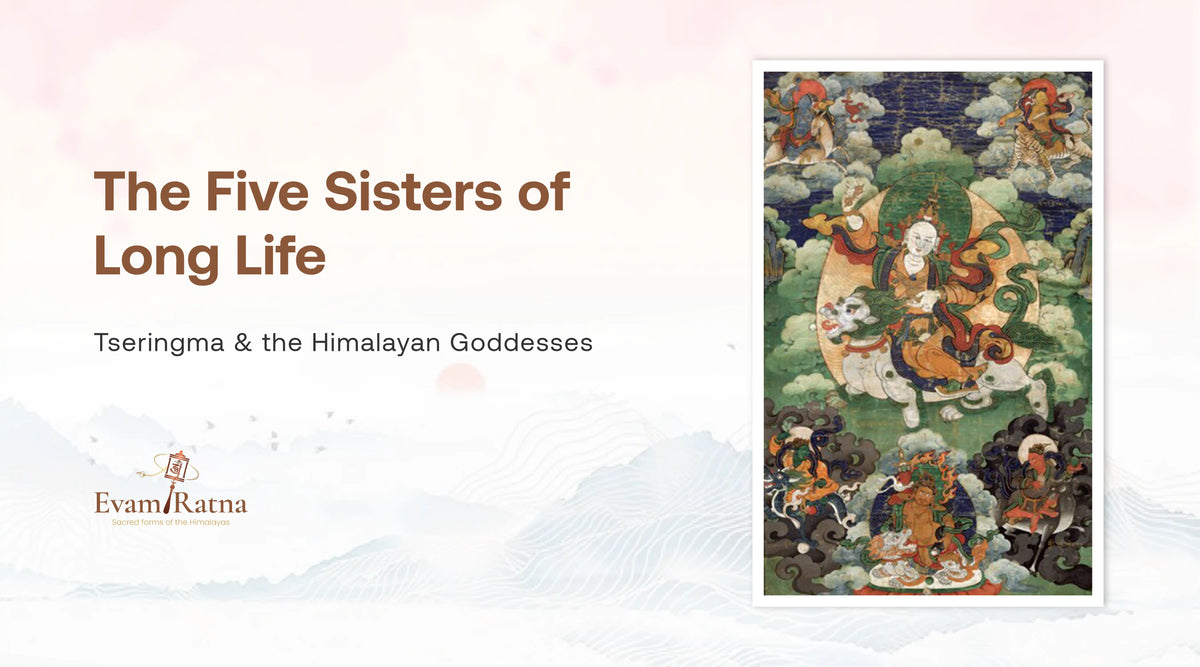
Tseringma and Her Sisters: Iconography, Attributes, and Symbols
The Five Sisters of Long Life, known in Tibetan as Tseringma Chenga, are among the most beloved Himalayan goddesses in Tibetan Buddhism. Led by Tashi Tseringma, the “Auspicious Lady of Long Life,” these five mountain protectors guard the Dharma, bless practitioners with longevity, and watch over sacred peaks from Gaurishankar to Mount Everest. Once wild mountain spirits of the Tibet–Nepal borderlands, they were bound by Guru Padmasambhava and later tested and taught by the yogi Milarepa. Today, their images appear in thangkas, statues, and monastery shrines, each color, mount, and emblem carrying a teaching. This guide explores Tseringma’s iconography, attributes, and symbols, and how to recognize each sister.
Introduction: Goddesses of the Snow Peaks
In the high Himalayas, mountains are never only mountains. A glacier-fed ridge may be the palace of a goddess, a turquoise lake her mirror, a mountain pass her threshold. Among the many beings who share this sacred landscape, few are as widely loved as Tseringma and her four sisters, known together as the Five Sisters of Long Life, or in Tibetan, Tseringma Chenga.
Painted on thangkas, cast in metal, and invoked in monastery rituals from Bhutan to the Tibet–Nepal borderlands, these five goddesses embody the Himalayan vision of a living, protective earth. They grant longevity, abundance, clarity, steadiness, and swift accomplishment, and they guard the Buddhist teachings and the practitioners who follow them.
Understanding their iconography is a quiet pleasure in itself. Every color, every mount, every held object has a meaning, and learning to read them transforms a beautiful painting into a teaching. This guide walks through who the sisters are, how they came to serve the Dharma, how each one is depicted, and why their symbols continue to resonate across the Himalayan Buddhist world.
Who Are the Five Sisters of Long Life?

The Five Sisters of Long Life are a group of female protectors venerated across Tibet, Nepal, and Bhutan. Their collective name in Tibetan, Tashi Tseringma Chenga, is often rendered in English as the "Auspicious Mistresses of Long Life." Though honored by all schools of Tibetan Buddhism, they hold a particularly cherished place in the Kagyu lineages because of their close bond with the great yogi Milarepa.
In the order most commonly given, the five sisters are:
- Tashi Tseringma, the eldest and leader of the group, the "Auspicious Lady of Long Life"
- Tingi Shalzangma, often rendered as the "Lady of the Beautiful Blue Face"
- Miyo Lozangma, also spelled Miyolangsangma, the "Immovable Noble-Minded Lady"
- Chopen Drinzangma, the lady of the wish-fulfilling jewel
- Takar Drozangma, the lady of the green, life-giving earth
Names and spellings vary across texts, regions, and transliteration systems. You will see Tsheringma, Tseringma, Tshering Che Nga, and many other forms. What remains constant is the family: five sisters, five colors, five distinct gifts, and one shared vow to protect the Dharma and uphold life.
From Mountain Spirits to Dharma Protectors
The sisters did not begin as Buddhist deities. In their earliest form, they were mountain spirits of the sman class, a category of worldly deities native to the Tibetan plateau. They lived along the Tibet–Nepal border, in the high country where snow peaks meet the sky, and they were powerful, proud, and not easily commanded.
When Buddhism took root in Tibet in the eighth century, the great tantric master Guru Padmasambhava traveled through the land and bound such local powers by oath. The sisters were among those subdued by him, and they became avowed protectors of the Buddhist teachings. This pattern is one of the defining features of Himalayan Buddhism: rather than erasing indigenous spirits, the tradition invited them into a larger cosmology, transforming potential obstacles into allies.
The story of their training did not end there. Tradition holds that the sisters traveled to India and received further instruction in a charnel ground from the teacher Lobpon Chogyi Gocha and the mahasiddha Kanha. Lineage accounts from the Kagyu tradition describe several rounds of vows, taken first in a great charnel ground, then before Padmasambhava in Kham, then before an Indian siddha, and finally before Milarepa himself. Each renewal deepened their commitment, and each is remembered in the practice texts still recited today.
The Three Encounters with Milarepa

The most beloved chapter in the sister's story takes place in the eleventh century, when they crossed paths with Jetsun Milarepa, the poet-yogi of Tibet.
Wishing to test his resolve, the sisters conjured a series of apparitions meant to pull him away from meditation. Milarepa remained unshaken. Because of the vows they had already made to Guru Rinpoche, the sisters could not cause real harm, and the contest ended quickly. Three days later they returned, this time humbled, and bowed before the yogi.
They vowed again to protect the Dharma and offered their life-essence in the form of mantras, a gesture of complete trust. In return they requested teachings, and Milarepa bestowed the Thought of Enlightenment along with Vajrayana practices, including the two special yogas of the Hevajra Tantra, inner heat and mudra yoga. Some months later, at the same place, the sisters returned to request detailed instruction on karma mudra, which Milarepa gave.
These are known as the three encounters between Milarepa and the Tseringma sisters. Through Milarepa's students, the practices flowed into many lineages and eventually into all schools of Tibetan Buddhism. The sisters came to be counted among his most important non-human disciples, entrusted especially with protecting his lineage.
Iconography of the Five Sisters: At a Glance
| Tseringma Chenga | Body Color | Right Hand | Left Hand | Mount |
|---|---|---|---|---|
| Tashi Tseringma | White | Golden vajra | Long-life vase with auspicious knot and swastika | White snow lioness |
| Tingi Shalzangma | Blue | Silver mirror | Banner of the gods | Mare |
| Miyo Lozangma | Yellow | Bowl of delicious food | Mongoose | Tigress |
| Chopen Drinzangma | Red | Wish-fulfilling jewel | Jewel-encrusted casket | Hind (female deer) |
| Takar Drozangma | Green | Bundle of durva grass | Snake noose | Turquoise dragon |
Iconography of the Five Sisters: In Details
Each of the four younger sisters is also painted with one face and two arms, yet each carries a distinct color, emblem, and mount. In the common Karma Kagyu description, they appear as follows.
Tashi Tseringma: The Eldest Sister

Click Here To View Our Collection of The Guardian of Life Tsheringma Thangkas
Tashi Tseringma is the heart of the group and the figure most often painted at the center of the composition. In the Kagyu tradition, she is depicted as follows:
- Form and color: White, with one face and two arms, youthful in appearance.
- Right hand: Raised, holding a golden vajra, a nine-pronged form in some descriptions, symbolizing indestructible power and wisdom.
- Left hand: Held at the heart, cradling a long-life vase decorated with an auspicious knot and a swastika, an ancient emblem of well-being
- Adornments: Gold ornaments and silks of many colors, signs of her noble and radiant nature
- Mount: A white snow lioness, the mythical snow lion of Tibet, white with a green mane
The white of her body speaks of purity and of the snow mountains that are her home. The vajra expresses the unbreakable strength of her protection, while the vase holds the nectar of long life she freely pours out to those who call on her. Some artists add a jewel resting on the mouth of the vase, a reminder that longevity is meant to serve spiritual fulfillment and not simply a longer span of years. The snow lion is the Tibetan emblem of fearlessness, joy, and confidence, qualities she shares with every devotee who relies on her.
Tingi Shalzangma: The Blue Sister of Clarity

Tingi Shalzangma is the sister of clear seeing, often painted beside the central goddess as a calm, sky-colored presence. In the Karma Kagyu description, she is depicted as follows:
- Form and color: Deep blue, with one face and two arms, peaceful and composed.
- Right hand: Holding a silver mirror.
- Left hand: Holding a banner of the gods (Victory flag).
- Mount: a mare
- Role: Insight, discernment, and the clearing of confusion.
Her blue body is the color of open sky, a traditional sign of vast, unobstructed awareness. The silver mirror is one of the oldest Buddhist emblems of clear perception: it reflects everything exactly as it is, without clinging to any of it. For a practitioner, it is a reminder to look honestly at the mind and let illusion fall away. The banner of the gods is a sign of victory, the triumph of wisdom over delusion. Her mount, the mare, adds the qualities of steadiness and swift, reliable movement along the path.
Miyo Lozangma: The Golden Sister of Abundance

Miyo Lozangma, also spelled Miyolangsangma, is the sister most closely tied to Mount Everest in Sherpa tradition. In the Karma Kagyu description, she is depicted as follows:
- Form and color: Golden yellow, with one face and two arms, serene and nurturing.
- Right hand: Holding a bowl of delicious food.
- Left hand: Holding a mongoose
- Mount: A tigress.
- Role: Sustenance, abundance, and steadfast, immovable strength.
Yellow is the color of earth and richness, and her golden form speaks of generosity that is both material and spiritual. The bowl of food is a direct and tender image of nourishment, a promise that those who rely on her will not go hungry in body or in spirit. Her name, which carries the sense of "immovable," points to a strength that stays steady however the world shifts.
The mongoose in her left hand is a familiar companion of wealth deities such as Vaishravana in Himalayan art, and it is associated with abundance and with mastery over hidden threats. Paired with the tigress, a powerful and quietly watchful animal, it gives her image a double meaning: she gives freely, and she protects what she gives. It is fitting that the Sherpas, who live beneath the great peak, pray to her before they climb.
Chopen Drinzangma: The Red Sister of Wishes

Chopen Drinzangma is the sister of fulfilled aspirations, a vivid figure in red among the five. In the Karma Kagyu description, she is depicted as follows:
- Form and color: Red, with one face and two arms, graceful and authoritative.
- Right hand: Holding a wish-fulfilling jewel.
- Left hand: Holding a jewel-encrusted casket
- Mount: A hind, a female deer.
- Role: Fulfillment of spiritual and worldly aspirations; in some accounts, graceful speech.
Red is the color of vitality, warmth, and magnetizing power, and her form radiates the energy that draws blessings toward those who call on her. The wish-fulfilling jewel is one of the most cherished emblems in Buddhist art, standing for the granting of every genuine need, and her casket is read as a treasury holding wisdom, blessings, and the promise of long life.
Her mount is perhaps the gentlest of the five. The hind is swift, delicate, and at home in wild country, and in Himalayan symbolism the deer is a peaceful traveler. Together, jewel, casket, and deer present a goddess whose power is warm and generous rather than fierce: she helps wishes ripen, and she does so with grace.
Takar Drozangma: The Green Sister of Swift Action

Takar Drozangma is the sister of movement and renewal, the one who turns stagnation into momentum. In the Karma Kagyu description, she is depicted as follows:
- Form and color: Green, with one face and two arms, calm and refined.
- Right hand: Holding a bundle of durva grass.
- Left hand: Holding a snake noose.
- Mount: A turquoise dragon.
- Role: Swift accomplishment, clearing of obstacles, and renewal.
Green is the color of growth and of nature's endless capacity to begin again. The durva grass in her right hand is a classic emblem of longevity and resilience: it is prized in offerings because it springs back so readily after being cut or trampled. It is a quiet symbol of life that cannot be easily diminished.
The snake noose in her left hand is a tool for binding obstacles, and the turquoise dragon beneath her lends speed and sky-borne power. Together they show her role as a protector who acts quickly, binding what hinders and freeing what is stuck. When the five sisters are painted together, her green form often completes the circle, reminding the viewer that long life is not only about enduring, but about moving forward with energy and purpose.
Sacred Landscapes: Gaurishankar, Everest, and the Paro Valley
The sisters are not remote figures confined to paintings. They are said to dwell in actual places, and pilgrims continue to honor them there.
- The five-peaked mountain: Tradition describes their residence as a snow mountain with five peaks on the border of Tibet and Nepal, known in Tibetan as Thon Thing Gyalmo and identified with Gaurishankar, called Jomo Gangkar in Tibetan. This is the sister's home in the high Himalayas, the seat from which they watch over the valleys below.
- Mount Everest: Among the Sherpas of Nepal, Mount Everest is Chomolungma, the "Goddess Mother of the World." Many Sherpas regard the mountain as the abode of Miyo Langzangma, the second of the five sisters. Climbers and expedition crews offer prayers and incense to her before setting out, asking for safe passage. For those who live in her shadow, Everest is not a summit to be conquered but a goddess to be respected.
- The Paro Valley, Bhutan: In Bhutan's Paro Valley, each of the five sisters is believed to have a dwelling. Tashi Tseringma, riding her lioness, resides at Drangje Gönpa at the center, while her four sisters are associated with temples around the valley, including Tengchen Gönpa, Ramna, Dzongdrakha, and Gangteng. Accounts differ on which sister belongs to which direction, but the heart of the tradition is consistent: the valley is prosperous because it is held by the five. Local belief says that a pilgrim who visits all five sites in a single day receives the blessing of wealth and good fortune.
Elsewhere in Bhutan, communities honor Tashi Tseringma as a "birth deity," the protector especially connected to a particular village and its people, and regard her as chief among the powerful earth goddesses.
Tseringma in Practice: Long-Life Rituals and Lineages
For practitioners, the Five Sisters are not only objects of admiration but living presences invoked in ritual. They are called upon for long life, health, prosperity, and the removal of obstacles, and their practice is especially valued before long retreats, during illness, and at moments of transition.
The transmission is remarkably well documented. Their practices passed from Milarepa to his disciple Gampopa, and from there were handed down through the Kagyu schools. The first Karmapa, Dusum Khyenpa, received the transmission and had repeated visions of the sisters, and later masters, including the third Karmapa Rangjung Dorje and the ninth Karmapa Wangchuk Dorje, are recorded as having encountered them. Jamgön Kongtrul compiled accounts of their appearances to various lineage holders, and a main offering text in use among Karma Kagyu monastic communities was composed by the sixth Shamar Rinpoche. A shorter text suited to daily practice was written by the fifteenth Karmapa, Khakyab Dorje.
Today, the Five Tseringma rituals continue to be performed alongside White Tara practice as two of the principal long-life rites of the tradition. In monastery shrine rooms, a thangka of Tashi Tseringma on her snow lion, flanked by her four sisters, may hang above the altar during such ceremonies.
Their influence also extends beyond the Kagyu schools. In the Gelug tradition, the Five Tseringma Sisters sometimes appear in the retinue of the protectress Palden Lhamo (Shri Devi Magzor Gyalmo), grouped with the Twelve Goddesses of Tibet. This shows how thoroughly the sisters have woven themselves into the fabric of Tibetan religious life.
Three Tseringmas: Clearing Up Common Confusion
Anyone searching for "Tseringma" will soon notice something that puzzles many newcomers: the name belongs to more than one figure. Scholars of Himalayan art distinguish at least three forms of the worldly protector called Tseringma.
- Tseringma of Shalu Monastery, a protector associated with the Sakya-related Shalu tradition
- Tashi Tseringma of the Five Sisters, the famous mountain goddess with her four sisters, the subject of this article
- Tseringma of the Longchen Nyingtig, a much later form arising from the eighteenth-century revealed treasure tradition of the Nyingma school
Bringing the Five Sisters into Your Sacred Space
For many practitioners and collectors, a thangka or statue of Tashi Tseringma is a way to welcome the energy of long life, steadfastness, and protection into the home. Because her iconography is so precise, authenticity matters: the colors, the vajra and vase, and the snow lion mount should all follow the canon. A well-made image is a support for contemplation, designed to remind the viewer, every time they look at it, of the qualities the goddess embodies.
If you place an image of Tashi Tseringma in your home, choose a clean, elevated, respectful location, such as a dedicated altar or a high shelf, and keep the space tidy. Many practitioners offer fresh water, a butter lamp, or incense before the image, and recite a long-life prayer or simply sit in quiet reflection. Offerings made with a sincere heart carry the meaning of the practice.
Conclusion: Guardians of Life and Landscape
The Five Sisters of Long Life tell a story that is as much about the land as about the sky. They began as wild mountain spirits, were welcomed into the Dharma by Padmasambhava, were tested and taught by Milarepa, and now watch over pilgrims, practitioners, and whole valleys. Their colors, mounts, and emblems form a visual teaching on clarity, abundance, fulfillment, swift action, and the vigor of a life well lived.
To look at a thangka of Tashi Tseringma is to see all of this at once: the snow lion's fearless joy, the vase of nectar, the vajra of unbreakable resolve, and the four sisters gathered around her like peaks around a central summit. May their image remind us that long life is not only a matter of years, but of wisdom, generosity, and a heart in harmony with the world.