How to Read a Palden Lhamo Thangka or Statue: The Five Weapons Guide
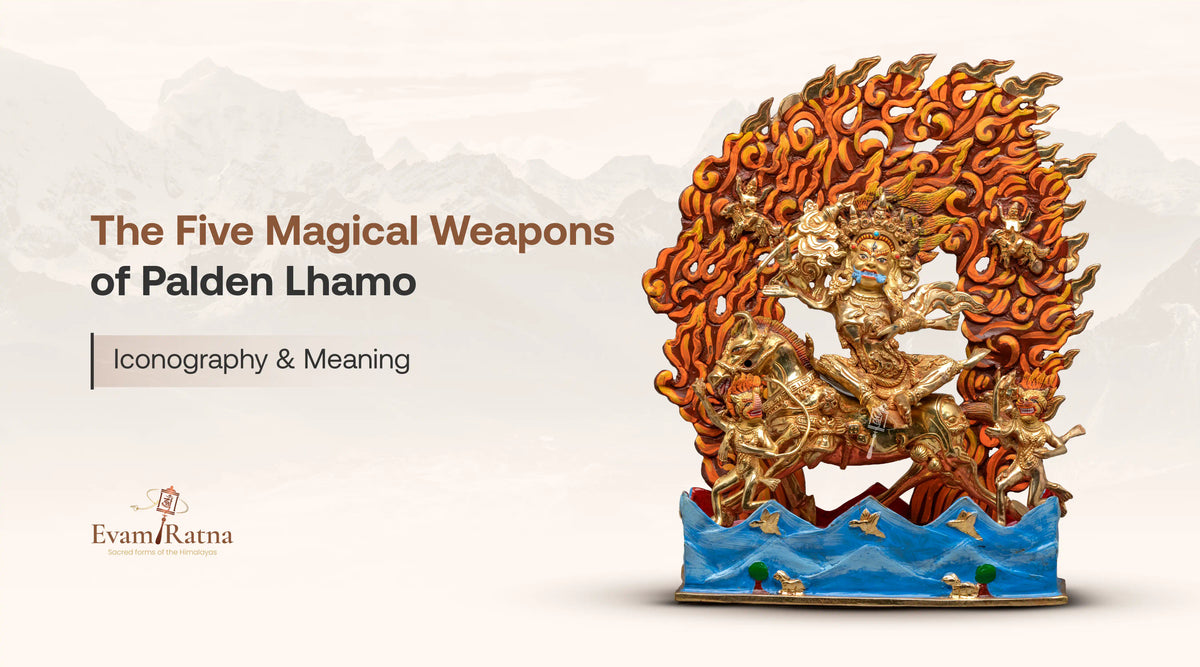
Palden Lhamo, the Tibetan form of Shri Devi and the only female among the eight great Dharma protectors, carries five symbolic weapons: the crossed tally stick, the bundle of red curses, the black and white spotted dice, the bag of diseases, and the ball of thread. In a Palden Lhamo thangka or statue, these objects hang from her serpent girdle and her mule's saddle, and each one expresses a different side of her protective power: karmic accountability, binding law, divination, confronting affliction, and the containment of harmful forces.
Who is Palden Lhamo?

Palden Lhamo, whose name means "Glorious Goddess", is the Tibetan form of the Sanskrit Shri Devi, also known as Remati. She holds a singular place in the Tibetan pantheon: she is the only female among the eight great Dharma protectors, and she is regarded as the principal guardian goddess of Tibet and of the Dalai Lama's lineage. In some forms, such as Magzor Gyalmo ("Queen Who Repels Armies"), she is understood as a wrathful expression of the wisdom goddess Sarasvati.
Her appearance is deliberately terrifying. She is dark blue, with flaming hair, bulging eyes and four sharp canine teeth, and she bites on a human corpse. She sits side-saddle on a mule, whose trappings are made of snakes. According to a well-known legend, she fled the kingdom of Lanka and the cannibal husband who opposed the Dharma. He fired an arrow at her, and where it struck the mule's rump, a third eye opened spontaneously. That single eye, gazing backwards, is said to watch over the underworlds and times past, while the mule's other two eyes survey the present and future.
Everything about her imagery tells one story: a mother's compassion turned fierce in order to protect the Buddhadharma. Her weapons are not ornaments. They are the working tools of that protection.
Where the Five Weapons Appear in Her Iconography

Before examining each weapon, it helps to know where to look for them. In classical depictions:
- The notched tally stick is usually tucked into the serpent girdle at her waist.
- The bundle of red curses, the bag of diseases and the pair of dice hang together from a serpent at the front of the saddle, often from a rakshasa's skull.
- The ball of thread hangs from a serpent's tail at the back of the saddle.
The First Weapon: The Crossed Tally Stick

The first weapon is the short notched stick, called khram shing or khram bam in Tibetan, often translated as the "crossed stick of the demons" or "tally stick". It is shown as a short baton with notches cut along its edge, and in some drawings a longer version is laid horizontally across the composition.
Historical roots: Notched sticks were a practical record-keeping tool in Tibet before the Tibetan alphabet was introduced, used to keep track of trade agreements and debts. Palden Lhamo's stick takes this humble object and gives it cosmic authority: a tally of karmic accounts that must be settled.
Two main varieties: In the iconography of fierce spirit-deities, two colours of tally stick are described: a black one associated with the düd (demon) class and a yellow one associated with the sinpo (rakshasa) class. Both carry red notches, commonly numbering seven, nine or thirteen. Ritual literature says that when such a stick is used against a specific adversary, the notches correspond to that person's age in years, which shows how personal and exact the imagery is meant to be.
Symbolism: Read symbolically, the tally stick is the goddess's ledger. It speaks of accountability, of harmful actions being counted, and of the unavoidable ripening of karma for those who attack the Dharma. This weapon and the bag of diseases are the two that, in legend, Palden Lhamo took from her mother before setting out to subdue the gods and nagas.
The Second Weapon: The Bundle of Red Curses

The second weapon is the byad dmar gyi khres po, the "bundle of red curses". Its shape surprises many first-time viewers. Rather than a physical blade or club, it is most often drawn as a red-covered text, bound with red cloth or with serpents. In reference drawings, three out of four common variants show the curses as books or bound texts, while the fourth shows a pair of red cylindrical scrolls.
How it is used: With this bundle, Palden Lhamo casts binding spells and delivers fierce curses against those who threaten the Buddhist teachings. It is attached by serpents to the bag of diseases and the dice, so that the three weapons are read together as a single compound emblem at the front of the saddle.
Why a text: In Tibetan culture, the written and spoken word carries real force, whether as scripture, mantra or oath. A bundle of red texts suggests that the goddess's power is not blind violence but the enforcement of a binding spiritual law. The colour red, associated with wrathful activity, signals that this is the realm of "fierce" enlightened action, directed only at forces of obstruction.
The Third Weapon: The Black and White Spotted Dice

The third weapon is the pair of black and white spotted dice (sho rde'u dkar nag), threaded on a serpent and hanging from the saddle. They are among the most recognisable emblems of Palden Lhamo, and they carry some of the richest symbolism.
A legend of origin: One tradition holds that she obtained the dice from her human consort, who was a dice player. In her hands, a gambler's toy becomes a sacred tool of divination.
Divination and karma: The dice are a means of determining the karmic outcome of any situation. In the dice divination system (mo) attributed to Palden Lhamo, three dice are used, giving results from three to eighteen. The practitioner reads the number combination through a divination text, depending on the question asked, in a manner that resembles the Chinese I Ching. This is why she is so closely associated with oracles and with the practice of seeking guidance in matters of state and spiritual life.
Reading the artwork: In well-executed paintings, the white die is placed above and the black die below. Often the white die shows its highest face, a six, and the black die its lowest, a one. This is a deliberate visual code. The two extremes symbolise the full range of her karmic judgement, from the brightest fortune to the darkest retribution. Nothing falls outside the scope of her sight.
The Fourth Weapon: The Bag of Diseases

The fourth weapon is the nad kyi rkyal pa, the bag or sack of diseases. It is perhaps the most startling item on the saddle, and it is drawn in many ways: as a simple tied bag of green skin, as a flayed human figure bound at the wrists and ankles like a sacrificial victim, or as the knotted skin of a demon or a woman, with the limbs tied around the neck to form a sack. Some versions show a serpent-noose around the neck threaded with divination dice, tying two weapons into one image.
What is inside: The bag is described as made of diseased human skin and filled with the tissue of those who died from the most virulent contagious diseases, including plague, typhoid, cholera, hepatitis, leprosy, smallpox and dysentery. It has often been described as an early example of "germ warfare". Historians have suggested that the image may echo an ancient Indian siege tactic in which pestilence was spread in a besieged city, for instance by contaminating a well.
Symbolism: On the literal level, the bag is the threat of epidemic turned against the enemies of the Dharma. On a deeper level, practitioners often read illness as a symbol of the afflictions that sicken the mind: hatred, craving and ignorance. A goddess who can unleash the "bag of diseases" is one who can, in the language of Vajrayana, cure the mind by confronting its poisons head-on. This is why the image sits so close to Buddhist healing practices, even though its surface appearance is fearsome.
The Fifth Weapon: The Ball of Thread

The fifth weapon is the mtshon kyi gru gu, the ball of thread that hangs from the tail of a serpent at the back of her saddle. It looks gentle, almost domestic, which makes its meaning all the more intriguing.
A thread that embodies weapons. The ball is wound from five-coloured threads (gzungs thag), said to embody the essence of all wrathful weapons. The Tibetan term also refers to a cord that holds mystical power or spells. In Palden Lhamo's hands, the thread is used to bind enemy-demons and malignant spirits with invoked curses of subjugation and destruction.
Styles of depiction. Artists portray the ball in a surprising variety of designs:
- a three-coloured "wheel of joy" (dga' 'khyil), in red, green and yellow, or blue-black
- a ball divided into four directional quadrants of blue, yellow, red and green
- a plaited ball of blue, yellow, red and green threads with a black silk ribbon
- wound balls in five colours or in alternating red and green
- Echoes in Indian tradition. The idea of a sacred thread is widespread. In India, protective threads are tied at the rakshabandha festival, when sisters tie threads around their brothers' wrists, and at Guru Purnima, when a guru gives protective threads to disciples. Another group of lunar festivals, known as panchami, includes a spring rite called ayudhapuja, the "worship of weapons", in which a five-coloured ball of variegated thread is used to protect tools and weapons from possession by evil spirits. The Sanskrit prefix raksha means protection, especially from evil spirits.
Symbolism: The five colours link the thread to the five wisdoms and the five elements, while the act of winding suggests binding and containing negative forces. It is the quietest of the five weapons, yet it is the one that turns destructive power into disciplined, directed protection.
Other Ritual Implements Seen With Palden Lhamo
Traditional plates of ritual implements do not stop at the five weapons. They include a wider vocabulary of tools that appear in the cycles of Palden Lhamo and other wrathful deities. Knowing a few of them deepens your reading of any wrathful protector image.
- Needle and thread: The attributes of the goddess Marichi, who holds the needle and thread in her right and left hands as a symbol of method and wisdom united. She sews up the mouths and eyes of harmful spirits and binds their limbs. In one Palden Lhamo ritual cycle, a copper needle and red thread are described.
- Wind-wheel and fire-wheel: Destructive discs unleashed from a vajra or trident to blow away or burn the demons of the five poisons: ignorance, desire, anger, jealousy and pride.
- Head of Brahma: The severed four-faced head of Brahma, held in the left hand of deities such as Chakrasamvara, Kalachakra and Vajrabhairava. It signifies cutting through conceptual thought and cultivating the four immeasurables of compassion, loving-kindness, sympathetic joy and equanimity.
- Feathers: Owl, vulture, raven and peacock feathers are used in protective rites. Peacock feathers symbolise the transformation of the three poisons, and the peacock-feather parasol crowns Palden Lhamo's head. The owl, a bird of ill omen, is a messenger of the protector Begtse.
- Mount Meru: The world mountain, shown as a stepped base with Indra's palace above or as a mandala-style disc, which appears as the hand-held emblem of certain deities.
What the Five Weapons Teach: A Symbolic Reading
It is tempting to see the five weapons as little more than an arsenal. In the Vajrayana view, they are better understood as a map of how enlightened compassion deals with obstruction:
- Accountability (the tally stick): every action is counted.
- Binding law (the red curses): wrongdoing meets spiritual consequence.
- Insight into fate (the dice): karma, not chance, shapes outcomes.
- Confronting affliction (the bag of diseases): the poisons of the mind are named and overcome.
- Protective containment (the ball of thread): harmful forces are bound, not left to roam.
Seen together, they show a goddess whose ferocity is the form that compassion takes when it must defend something precious. This is why practitioners do not approach her with fear alone, but with reverence and the wish to be protected from inner and outer obstacles.
How to Recognise the Five Weapons in a Thangka or Statue
A quick guide for collectors, students and devotees:
|
Weapon |
Tibetan name |
Typical appearance |
Usual placement |
|
Crossed tally stick |
khram shing |
Short black or yellow stick with red notches |
Tucked into the serpent girdle |
|
Bundle of red curses |
byad dmar gyi khres po |
Red-covered text or red scrolls bound with cloth or serpents |
Front of saddle |
|
Spotted dice |
sho rde'u dkar nag |
White die above, black die below, on a serpent thread |
Front of saddle |
|
Bag of diseases |
nad kyi rkyal pa |
Tied sack of green skin, or a flayed figure knotted as a sack |
Front of saddle |
|
Ball of thread |
mtshon kyi gru gu |
Ball of five-coloured or variegated thread |
Back of saddle, on a serpent's tail |
When looking at a statue, notice how the serpents link the objects together. At the front, the compound of curses, disease bag and dice often hangs from a skull. At the rear, the ball of thread balances the composition. In a thangka, the tiny details of colour and form are where a painter's lineage and training show most clearly.
Sacred Art From the Artisans of Patan
The strength of Palden Lhamo imagery lies in its details: the angle of a die, the knot of a serpent, the five colours of a thread. In the workshops of Patan, Newar artisans have shaped sacred forms like these for generations, following iconographic measurements and traditions handed down from master to apprentice. Whether in a hammered copper statue or a painted thangka, it is this attention to the small symbolic elements that allows an image to function as a true support for practice, and not merely as decoration.
Conclusion
The five magical weapons of Palden Lhamo (the tally stick, the red curses, the dice, the bag of diseases and the ball of thread) form one of the most intricate symbolic systems in Tibetan Buddhist art. Behind their frightening surface lie ideas of karmic accountability, binding protection, divination, healing through confrontation and the transformation of destructive energy into guardianship.
The next time you see Palden Lhamo on a thangka or a sculpted altar piece, look first at her saddle. Every object hanging there has been placed with intention, and reading them one by one is a quiet way of entering her world.