The Hidden Symbolism of the Crowned Shakyamuni Buddha Explained
The Crowned Shakyamuni Buddha, one of the most recognizable and most debated images in Himalayan Buddhist art. The historical Buddha, Siddhartha Gautama, gave up a palace, a family and a throne to search for liberation. Why would sacred art show him crowned again? The answer is not a single idea but a layered one. The crown speaks of spiritual sovereignty, of the place of awakening at Bodh Gaya, of the union of an earthly teacher with a boundless cosmic buddha, and of the Tibetan Buddhist view that enlightenment does not abandon the world but transforms how we meet it.
What Is the Crowned Shakyamuni Buddha?

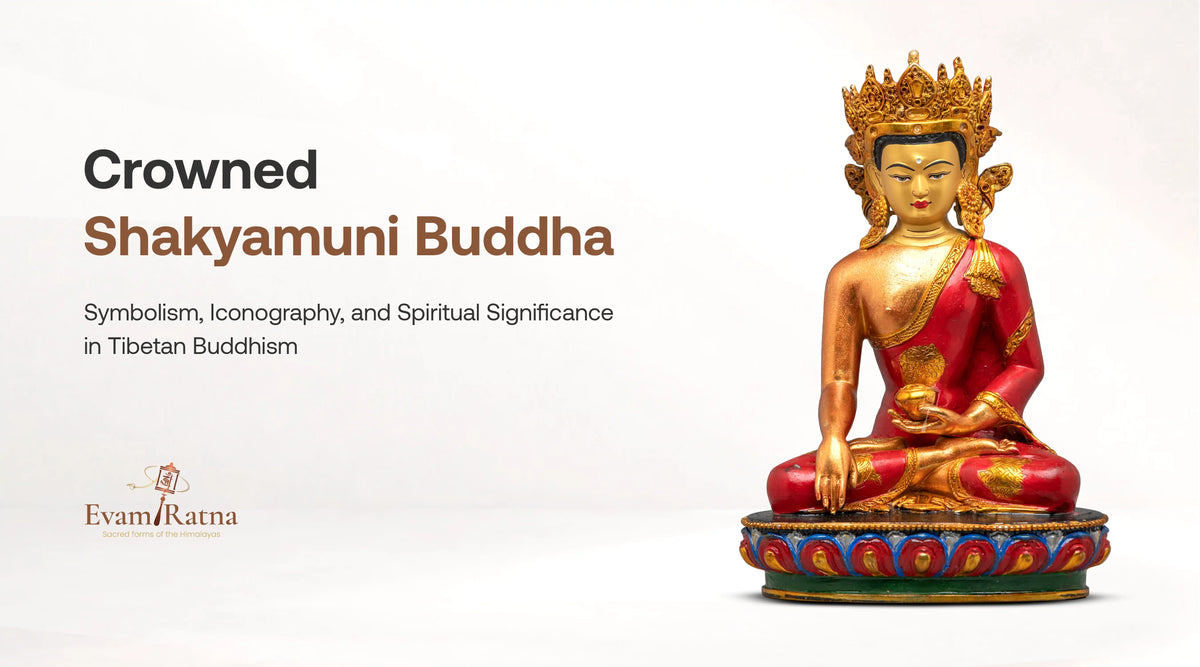
The Crowned Shakyamuni Buddha is an image of the historical Buddha, Shakyamuni ("Sage of the Shakya Clan"), shown with one added attribute: a crown. In most examples he is seated in the vajra (full lotus) posture, his right hand extended over the knee in the earth-touching gesture and his left hand resting in his lap in meditation. What makes the form distinctive is what it keeps and what it adds. The Buddha retains his monastic appearance: simple robes, a bare right shoulder and the signs of a fully awakened being. Onto this familiar figure is placed a five-pointed crown, often with flowers above the ears and flowing ribbons.
Images of the crowned Buddha have been found across India, Kashmir, Nepal, Tibet, China and Mongolia. In Tibet the most venerated Buddha statue of all, the Jowo Shakyamuni enshrined in the Jokhang Temple in Lhasa, is a crowned Buddha. That single fact explains why this form carries such authority in Tibetan devotional life.
Why Does the Buddha Wear a Crown? Five Layers of Meaning

Art historians have debated the crowned Buddha for decades, and Buddhist communities themselves read the image in more than one way. Rather than a single "correct" answer, it helps to think of five overlapping layers of meaning.
1. Spiritual sovereignty, not worldly power
The most direct reading is the simplest. The Buddha was born a prince, and kingship was the language of authority his world understood. Texts describe him as a chakravartin, a universal ruler, in the spiritual sense: one who has conquered not territory but ignorance, craving and fear. The crown signals that his sovereignty is complete, and that it is turned entirely toward the welfare of beings.
2. The place of enlightenment at Bodh Gaya
Some of the earliest crowned images are linked to the sacred seat of awakening in Bodh Gaya, known as the Vajrasana, the "diamond throne." Crowned figures in monk's robes became known as Vajrasana Buddhas, evoking a celebrated image at the Mahabodhi Temple. When you look at a crowned Buddha, you are in a sense looking at the pilgrimage center itself, brought home in metal and gold.
3. Two bodies, one image
In esoteric Buddhist thought, a buddha can be understood on several levels at once. One scholarly interpretation reads the crowned figure as showing the cosmic Buddha Vairochana in a celestial realm and Shakyamuni in his earthly, historical form at the moment of enlightenment, a duality typical of Buddhist iconography of the period. The crown becomes a bridge between the human teacher and the timeless buddha-nature he reveals.
4. The five wisdoms
In the Tibetan tradition the five points of the crown are commonly read as a reminder of the five wisdoms and the five buddha families. Each point stands for a transformed aspect of mind, so that the head of the Buddha holds, in symbolic form, the complete spectrum of awakened awareness.
5. Samsara and nirvana are not separate
Perhaps the most striking lesson is the paradox itself. A crown is a symbol of the very world the prince renounced, yet it sits comfortably on the head of the awakened one. For Mahayana and Vajrayana practitioners, this expresses a central view: enlightenment is not an escape from ordinary life but the transformation of how we perceive it. Nothing needs to be thrown away; everything can be purified.
From Bodh Gaya to the Himalayas: The History of the Crowned Buddha
The crowned Buddha flourished in eastern India during the Pala period (roughly the 8th to 12th centuries), when the monastic universities of Bihar and Bengal were centers of both scholarship and artistic innovation. Bronzes from Bihar of the 10th and 11th centuries show the Buddha seated in the earth-touching gesture, wearing a crown and necklace, sometimes inlaid with silver, lapis lazuli and rock crystal. Many include a small vajra on the base, signaling that the pedestal itself represents the diamond seat at Bodh Gaya.
From there, the image traveled. Crowned and jeweled Buddhas became popular in Thailand and Cambodia in the 12th and 13th centuries, likely inspired by Pala sculptures. Westward and northward, the form moved into Kashmir, Nepal and Tibet. In the Himalayas, images of the crowned Buddha were among the earliest to arrive in Tibet and remained popular for centuries, appearing in gilt copper alloy sculptures from the 11th century onward.
The Jowo Shakyamuni of Lhasa
No account of the crowned Buddha is complete without the Jowo Shakyamuni. According to tradition, this life-size image of the Buddha as a twelve-year-old prince was brought to Tibet by the Chinese princess Wencheng in the 7th century as part of her marriage to King Songtsen Gampo. It is believed by devotees to have been blessed by the Buddha himself, and it came to rest in the Jokhang Temple, the spiritual heart of Tibet. Pilgrims have circled the temple and the inner sanctum for centuries to see it. Because the Jowo wears a crown and jeweled ornaments, it set a powerful precedent for how Tibetans imagine the Buddha in majesty.
Iconography Decoded: Reading the Image Feature by Feature

Tibetan iconography is precise. Each element of the crowned Buddha follows centuries-old guidelines, and each carries meaning. Here is how to "read" the image from top to bottom.
The Crown
The crown is usually five-pointed, set with turquoise, coral, lapis lazuli or other gems, and often accompanied by flowers above the ears and jeweled ribbons. It marks the Buddha's spiritual kingship and, in Tibetan readings, the five wisdoms. Unlike the full regalia of a celestial being, it is the only royal ornament added to his otherwise simple, monastic form.
The Ushnisha and Hair
Beneath the crown, the Buddha's blue-black hair is arranged in a topknot, and the cranial protuberance known as the ushnisha rises from the crown of the head. It is one of the thirty-two major marks of a great being and symbolizes the limitless wisdom of enlightenment.
The Urna
Between the eyebrows is a small dot or curl of white hair, the urna, another major mark. It represents the light of wisdom and the clear, penetrating vision of a fully awakened mind.
The Long Earlobes
The earlobes are elongated and pierced, a reminder of the heavy earrings the prince once wore. Artists keep this detail even after the jewels are gone to preserve the memory of the renunciation: the Buddha has let go of ornament, but the trace remains.
The Neck Lines
Three gentle horizontal lines on the neck are among the few features singled out in Tibetan paintings and sculptures, drawn from the traditional list of thirty-two major and eighty minor marks of a great being. They are often associated with the beauty and resonance of the Buddha's voice and the three trainings of ethics, concentration and wisdom.
The Robes
The robes are the monastic garments of a renunciant, draped over the left shoulder and leaving the right arm bare. They express his nirmanakaya aspect, the form in which he appeared in the world as a teacher. The simplicity of the cloth, set beside the crown, is exactly where the image creates its meaning.
The Seat: Vajra Posture, Lotus and Moon
The Buddha sits in the vajra posture (full lotus), a position of stability and unshakable concentration. His seat is typically a lotus flower with a moon disc above it, itself supported by a throne. The lotus signifies purity arising from the mud of samsara, while the moon disc represents bodhichitta, the compassionate aspiration to awaken for the benefit of all beings.
The Halo and Throne Backing
Behind the Buddha, a halo and an arch (torana) often frame the figure. In Himalayan art the arch is composed of auspicious and mythical beings such as the garuda, nagas, makara, lions and elephants, each representing a different force or quality brought into harmony by the Buddha's presence.
The Mudras: Earth-Touching and Meditation
The hands of the crowned Shakyamuni tell a story of their own.
- The right hand: Bhumisparsha, the earth-touching gesture. The right hand reaches over the knee to touch the ground. This commemorates the moment before enlightenment, when the demon Mara challenged the Buddha's right to sit on the seat of awakening. In reply, the Buddha touched the earth and called upon the earth goddess to bear witness to his countless lives of generosity and discipline. The gesture symbolizes resolve, truthfulness and victory over fear and doubt.
- The left hand: Dhyana, the meditation gesture. The left hand rests in the lap, palm up. It embodies deep concentration and the stillness of a mind at rest. Together with the right, it unites two complementary qualities: skillful means (the active, compassionate engagement of the right hand) and wisdom (the quiet, receptive stillness of the left).
Quick Reference: Symbols at a Glance
|
Feature |
Symbolism |
|
Five-pointed crown |
Spiritual sovereignty, the five wisdoms, mastery over ignorance |
|
Ushnisha |
Limitless wisdom, sign of a great being |
|
Urna |
The light of wisdom and clear insight |
|
Long earlobes |
Memory of princely youth, renunciation of ornament |
|
Three neck lines |
Marks of a great being, resonant voice, three trainings |
|
Monastic robes |
Renunciation; the earthly teacher (nirmanakaya) |
|
Bhumisparsha mudra |
Earth as witness, victory over Mara; enlightenment |
|
Dhyana mudra |
Meditative absorption, wisdom |
|
Lotus and moon disc |
Purity and bodhichitta |
|
Halo and torana |
Radiant enlightenment, harmony of mythic forces |
Crowned Buddha vs. the Five Symbolic Buddhas
Newcomers often confuse the crowned Shakyamuni with the Five Symbolic Buddhas (Vairochana, Akshobhya, Ratnasambhava, Amitabha and Amoghasiddhi). The two are easy to tell apart once you know what to look for.
The Five Symbolic Buddhas appear in sambhogakaya form, the "enjoyment body." They wear the full dress of a heavenly being: flowing garments, long hair, and rich ornaments such as earrings, necklaces and bracelets. The crowned Shakyamuni, by contrast, remains in his nirmanakaya, or monastic, appearance. His only addition to the simple robe is the crown.
This is why the crowned Shakyamuni is such a rich teaching image. It sits at the meeting point between the historical Buddha and the transcendent buddhas, between the human and the cosmic, the monastic and the regal.
Spiritual Significance in Tibetan Buddhism
For Tibetan Buddhists, an image of the Buddha is never mere decoration. It serves as a support for practice and a field of merit.
- A focus for meditation: The image is a visual anchor for mindfulness and for the practice of recollecting the Buddha's qualities. Practitioners may begin a session by bringing the image to mind or looking at it, then resting in the stillness it embodies.
- A reminder of the path: The Buddha's journey from palace to awakening, and the crown that proclaims his final victory, offer a map for any practitioner: let go of attachment, face the obstacles of the mind, and awaken.
- A field of merit: In Tibetan tradition, making offerings of light, water and incense before the Buddha creates positive potential, which is then dedicated to the welfare of all beings. A crowned Shakyamuni often occupies the central place on a shrine for this reason.
- A bridge between the sutra and tantra traditions: In Vajrayana, practitioners visualize themselves and the world as pure. The crowned Buddha, with his simple robes and his regal crown, makes that vision concrete: the ordinary can be seen as sacred without being renounced.
Newar Craftsmanship: How a Crowned Buddha Is Made in Patan
A crowned Buddha is not just designed; it is built, step by step, by artists who treat the work as a form of devotion. In the Kathmandu Valley, Newar artisans in Patan have refined this craft across many generations.
Statues are traditionally made by lost-wax casting. The sculptor first models the figure in wax, adding the folds of the robe, the curve of the crown and the details of the face. The model is then coated in clay and heated, so the wax melts away and leaves a mold. Molten copper alloy is poured in; when the mold is broken, the rough metal figure appears. The surface is then chased and refined by hand.
Finishing is where the sacred character of the image emerges. Many statues are gilded with gold, a process that lends the warm glow associated with the Buddha's "body radiant like a mountain of gold." The crown may be set with turquoise, coral or lapis lazuli, and the face is painted last, as the eyes are opened in a final act of care. Evamratna works with Newar artisans in Patan to bring this living tradition to practitioners and collectors who value authenticity in sacred art.
Honoring a Crowned Shakyamuni Buddha at Home
If you bring a statue like this into your home or meditation space, a few traditional guidelines can help you treat it respectfully:
- Place it high and clean: Choose an elevated, uncluttered surface such as a shrine or altar shelf, never the floor or a place where it might be stepped over.
- Face the room: The statue is traditionally positioned to look into the space rather than turned away.
- Keep it visible and respected: Avoid storing it in a closet, a drawer or among everyday clutter.
- Offer simply: Fresh water, a lamp or a stick of incense are traditional offerings, and a quiet moment of reflection or recitation is enough.
- Dust gently: Use a soft, dry cloth, and avoid harsh chemicals on gilded surfaces.
If you wish to build a complete altar, [Evamratna's Buddha statue collection] pairs naturally with offering bowls, butter lamps and a vajra and bell.
Conclusion
The Crowned Shakyamuni Buddha invites us to look twice. On first glance, it appears to hold a contradiction: a renunciant in royal headgear. On closer inspection, it reveals a profound teaching. True sovereignty belongs not to those who rule others but to those who have mastered themselves; and enlightenment does not require us to abandon the world, only to see it clearly. Whether you meet this image in a Lhasa temple, a museum gallery, or on the altar of your own home, it carries the same message across more than a thousand years of Himalayan art: awakening is a kind of kingship, and its throne is the seat of calm, compassion and wisdom that each of us may one day take.