Yangdak Heruka and Vajrakilaya: The Practices Behind the Pilgrimage
Pharping is a small village on a hillside about 18-20km southwest of Kathmandu. Tibetans often call the whole area "Yangleshö," although the name belongs more precisely to the lower cave. For centuries devotees have come here to honour the place where Guru Rinpoche accomplished the siddhi of Mahamudra, the Great Seal.
The site is widely considered the single most sacred place connected with Guru Padmasambhava outside the land of Tibet. Masters such as Kathok Rikdzin Tsewang Norbu (1698-1755) emphasized that these caves are as important as Bodh Gaya for Vajrayana practitioners, so vast was the Mahaguru's attainment here. Bodh Gaya marks the enlightenment of the historical Buddha; Pharping marks where the Vajrayana path reached its ultimate fruition in the life of Guru Rinpoche.
Yangleshö and Asura Cave at a Glance

- Yangleshö (the Lower Cave): Located just below the village of Pharping, beside the road and a series of water ponds. This is where Guru Rinpoche began his retreat on Yangdak Heruka. The cave stands next to Kyabjé Chatral Rinpoche's monastery but is not part of the monastery grounds, so no official monastery acts as its caretaker. There is no accommodation here.
-
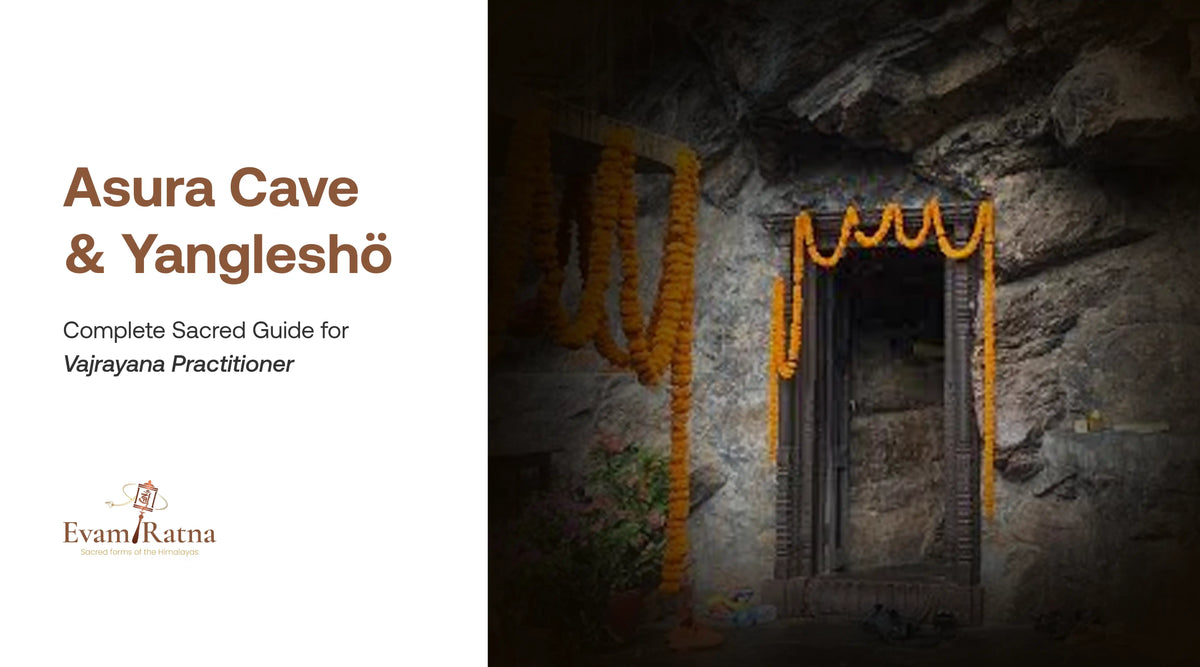
Asura Cave (the Upper Cave of Yangleshö): Set in forest on the hill directly behind Pharping. This is where Guru Rinpoche united Yangdak Heruka with Vajrakilaya and attained Mahamudra. At the request of His Holiness the 16th Karmapa, Kyabjé Tulku Urgyen Rinpoche built a monastery and retreat centre here, and since the early 1980s both lay and ordained sangha have used it for short and long retreats. The cave itself is looked after by resident lamas and is open to the public.
Guru Rinpoche's Retreat at Pharping: The Story of Awakening

According to the tradition, Guru Rinpoche practised in two caves, moving with the seasons. During the winter months he stayed at the sunny upper Asura Cave, and during the hot summer months he retreated to the cooler lower cave of Yangleshö.
His retreat unfolded in stages. He began by focusing on Yangdak Heruka, a wrathful form of the Buddha's wisdom mind, while at the lower cave of Yangleshö. Later, at Asura Cave, he combined Yangdak Heruka with the practice of Vajrakilaya, the deity of the Buddha's enlightened activity, renowned for removing obstacles to awakening. It was here, through this union of practices, that he attained the ultimate fruition of Mahamudra.
Traditional biographies also recount that hostile forces brought drought, famine, and disease to the land while he practiced, and that teachings sent from India pacified the obstacles the moment the messengers arrived. Guru Rinpoche did not only realize these teachings; he preserved them. He compiled, revised, and systematized the Vajrakilaya teachings, and for this scholarly work the Barché Lamsel prayer praises him as the Pandita of Yangleshö. He is also invoked as Guru Mawé Sengé, the Lion of Speech, indivisible from Manjushri, the Buddha of Wisdom. Here he is also remembered in his wrathful form as Dorje Tötreng Tsal, one of his Eight Manifestations.
Yangdak Heruka and Vajrakilaya: The Practices Behind the Pilgrimage
Understanding the two deities transforms a visit from sightseeing into pilgrimage. Both are among the Eight Kagyé deities, the eight great sadhana cycles of Mahayoga in the Nyingma tradition.
- Yangdak Heruka is a wrathful expression of the Buddha's wisdom mind, a reminder that wrathful form in Vajrayana is never aggression but the fierce compassion that cuts through ignorance.
- Vajrakilaya, the Diamond Dagger, embodies the Buddha's enlightened activity. The kila, or phurba, symbolizes pinning down every obstacle, inner and outer, so that realization can ripen. Together the pair express a complete path: wisdom that sees clearly and activity that removes whatever blocks that vision.
A note for practitioners: both deities are practised through empowerment, oral transmission, and the guidance of a qualified teacher. The caves are places of extraordinary blessing, but they do not replace a living lineage. Speak with your teacher before and after your pilgrimage.
What to See at Asura Cave?

Asura Cave rewards a slow, attentive visit. Look for these features.
- The yogi's handprint: On the left side of the entrance is a clearly visible handprint. It was made by a student of Chimé Dorjé, the father of Kyabjé Tulku Urgyen Rinpoche, who immediately regretted it, saying that people would one day mistake it for Guru Rinpoche's own.
- The three main images: Inside the cave are statues of Guru Rinpoche in the centre, Yangdak Heruka to his right, and Vajrakilaya to his left. They were made by Kunzang Tekchok Tenpai Gyaltsen, a student of the three Jamgöns (Khyentsé, Kongtrul, and Mipham Rinpoche), who practised these two deities here and had direct visions of them.
- The secret passage: Tulku Urgyen Rinpoche taught that deep in the cave a narrow tunnel runs to the lower Yangleshö Cave, about half a mile away. A draft of wind can be felt near it. Though Guru Rinpoche could pass freely through solid rock, he is said to have used this tunnel to travel between the two caves.
- The naturally arisen "A" syllable: On the left side of the cave, just below an electric light that has been installed, a self-arisen Tibetan "A" (ཨ) appears in the rock.
- The kila formations: In the small passage between the monastery and the bare rock, small blackish kila-shaped formations can be seen. Tradition holds that when Guru Rinpoche accomplished Vajrakilaya, a rain of kilas fell from the sky, and some remain visible today.
What to See at Yangleshö?

(Image from Flickr)
The lower cave is easy to find, yet its surroundings hold several quiet treasures.
- The cave and shared sacred ground: Yangleshö is known to Nepali Hindus as the shrine of Sekh Narayan, a reminder of how Buddhist and Hindu devotion share the Valley's sacred places.
- The naturally arisen conch: Just inside the main gate of Kyabjé Chatral Rinpoche's monastery, beside the cave, a boulder pocked with holes contains a self-arisen conch which, if blown with skill, will sound.
- Chumik Changchub, the Spring of Enlightenment: Ponds below the steps are fed by a pristine spring that Kyabjé Chatral Rinpoche identified as a second Chumik Changchub. Local farmers use the flow to irrigate their fields.
- Rikdzin Jikmé Lingpa's reliquary stupa: Walk around the monastery and up a short flight of steps to find a small black stupa holding relics of the great treasure revealer Jikmé Lingpa.
Other Sacred Sites in Pharping
Several nearby sites deepen the pilgrimage.
- Self-arisen Tara images: At Ralo Rinpoche's monastery, two naturally arisen Tara images appear in the rock beside a small Ganesh shrine. Drubthob Rinpoche recognized them in 1979 and built a protective temple, which also holds the Twenty-One Taras. Only one image is clearly visible now; the other is said to come and go. Butter lamps, flowers, and milk are traditional offerings.
- Pharping Vajrayogini temple: In the 11th century, the Newar brothers Dharmamati and Vagishvara, disciples of the Mahasiddha Naropa, settled here and helped carry the Vajrayogini teachings from India to Tibet. The translator Marpa Lotsawa (1012–1097) received teachings from them and visited at least three times. The shrine is often closed, but caretakers will gladly open it. Photography of the statue is prohibited.
- Mandala Temple of the Hundred Peaceful and Wrathful Deities: Built by Khenchen Namdrol at the wish of Kyabjé Jigmé Phuntsok Rinpoche, it is one of only two temples of its kind in the world. Only those who have received the empowerment may enter its perimeter.
- Reliquary stupas: The golden stupa of Kyabjé Chatral Rinpoche (1913–2015) stands in the main temple of his former home. In the hills above, Chagdud Tulku Rinpoche's three-year retreat centre and reliquary stupa can be reached by a 45-minute footpath. Please stay quiet there.
- Dolu: In the neighbouring village, a giant Guru Rinpoche statue stands among several important Nyingma monasteries.
The "A" Syllable Pilgrimage Route
Kyabjé Jamyang Khyentsé Chökyi Lodrö described Asura Cave as lying within a naturally formed "A" syllable, shaped by the surrounding mountains. Walking the ridge is the "long" pilgrimage route, a clockwise circumambulation of the sacred sites of Pharping.
There are two entry points. The first is on the ridge, marked by a stupa, about 15 to 20 minutes' walk along the road past Asura Cave. The second follows the steps uphill past the Asura Cave monastery and a small Hindu shrine to the summit, known as Champadevi, where there is another stupa and Hindu shrine. On the descent the path passes Kyabjé Dudjom Rinpoche's retreat centre and ends at Hattiban Resort, where you will find food and drink and, on clear days, magnificent views of the distant Himalayan peaks.
Please take this route seriously. It can take up to five hours, the terrain can be dangerous, and the path is easy to lose along an exposed ridge with little shade. Never walk it alone, and bring a hat, sun protection, food, and water.
How to Get to Pharping and Find the Caves?
Pharping lies about 16 km southwest of Kathmandu.
- By taxi: The easiest option, taking roughly one to two hours depending on your starting point and traffic.
- By bus: Local buses leave from Ratna Park. Say "Pharping" and someone will point you to the right one.
The journey can take two to three hours and costs far less than a taxi, though fares change, so confirm locally.
- Finding Yangleshö: Buses usually stop at the football field. Walk back down the main road until you see water ponds with a monastery slightly behind and above; that is Yangleshö. You can also ask a driver for "Sekh Narayan."
- Finding Asura Cave: From the football field, take the paved road uphill through the village, passing Sakya Tharik Monastery on your right. Steps lead to a terrace with Ralo Rinpoche's monastery and a small Tara shrine, and the same steps continue up to the cave. A second route begins at the Vajrayogini temple, reached by a small unpaved road that is easy to miss, so ask a driver who knows the area.
Food, Accommodation, and Retreat Options
The main road through Pharping has cafes, restaurants, shops, and supermarkets. If you plan to stay at a monastery beside the caves, bring some food.
The monastery at Asura Cave offers food and accommodation for personal retreat. Rooms are few, so reserve well in advance. Other options include the Utpala Retreat Guest House (associated with Ka-Nying Shedrub Ling), Benchen Monastery, and Khenpo Namdrol's retreat centre near the lower cave. Hotels on the main road usually have rooms at short notice. The Yangleshö Cave and its neighbouring monastery do not offer accommodation.
Pilgrim Etiquette and Practical Tips
A few simple courtesies keep the pilgrimage respectful for everyone.
- Dress modestly, speak softly, and circumambulate shrines clockwise.
- Ask before photographing, and never photograph the Vajrayogini statue.
- Bring offerings such as butter lamps, flowers, or a small donation to caretakers.
- Respect the Mandala Temple's entry rule and the quiet of three-year retreat sites.
- Carry water, sun protection, and sturdy shoes for the steps and trails.
Respect also extends to your Hindu neighbours. Dakshinkali, close to Pharping, is one of the Valley's most important Hindu sites, and non-Hindus may not enter beyond the perimeter of its lower temple. Tibetan Buddhists regard it as an old charnel ground and the home of the protectress Durtrö Lhamo. The upper temple, Dakshinkali Mata, allows no blood sacrifice and has been identified by several masters as the residence of a protectress of the Vajrakilaya Mandala.
Sacred Sites on the Way to Pharping
The journey itself is part of the pilgrimage. Chobhar Adinath Lokeshvara, one of four Valley temples dedicated to Avalokiteshvara, houses a duplicate of Patan's Arya Bukham statue that was used to protect the original during the Gorkha invasions. Nearby Chobhar Gorge is said to be where Manjushri drained the Valley's great lake, and the lakes of Taudaha and Nagdaha are said to be what remained, home to the naga king Karkotaka.
For those who wish to go further, Kyabjé Chatral Rinpoche also identified a second Yangleshö in the sacred valley of Yolmo, northeast of Kathmandu, one of Guru Rinpoche's prophesied beyul, or hidden lands.
How to Practice at the Caves
A pilgrimage is most fruitful when it is also a practice. Begin each visit by taking refuge and generating bodhicitta. Make simple offerings, light a butter lamp, and recite the Seven-Line Prayer and the Vajra Guru mantra, Om Ah Hum Vajra Guru Padma Siddhi Hum. Many pilgrims also recite the Barché Lamsel, the prayer for removing obstacles from the path, composed by Chokgyur Dechen Lingpa.
Before you go, consider reading Kyabjé Jamyang Khyentsé Chökyi Lodrö's In Praise of Yangleshö and A Short Guide to Yangleshö in Nepal, and Kyabjé Jigmé Phuntsok Rinpoche's Upon Arriving at Yangleshö. Close each session by dedicating the merit to all beings.
Conclusion: A Place Where Awakening Still Echoes
Asura Cave and Yangleshö are more than historical sites. They are places where, by tradition, Guru Padmasambhava accomplished Mahamudra through Yangdak Heruka and Vajrakilaya, and where masters of every generation since have practised, taught, and built. To climb the steps above Pharping, sit where the wind moves through the hidden passage, and circle the "A"-shaped ridge is to step, however briefly, into that living stream. Prepare with care, travel with respect, and let the pilgrimage deepen your practice long after you return home.