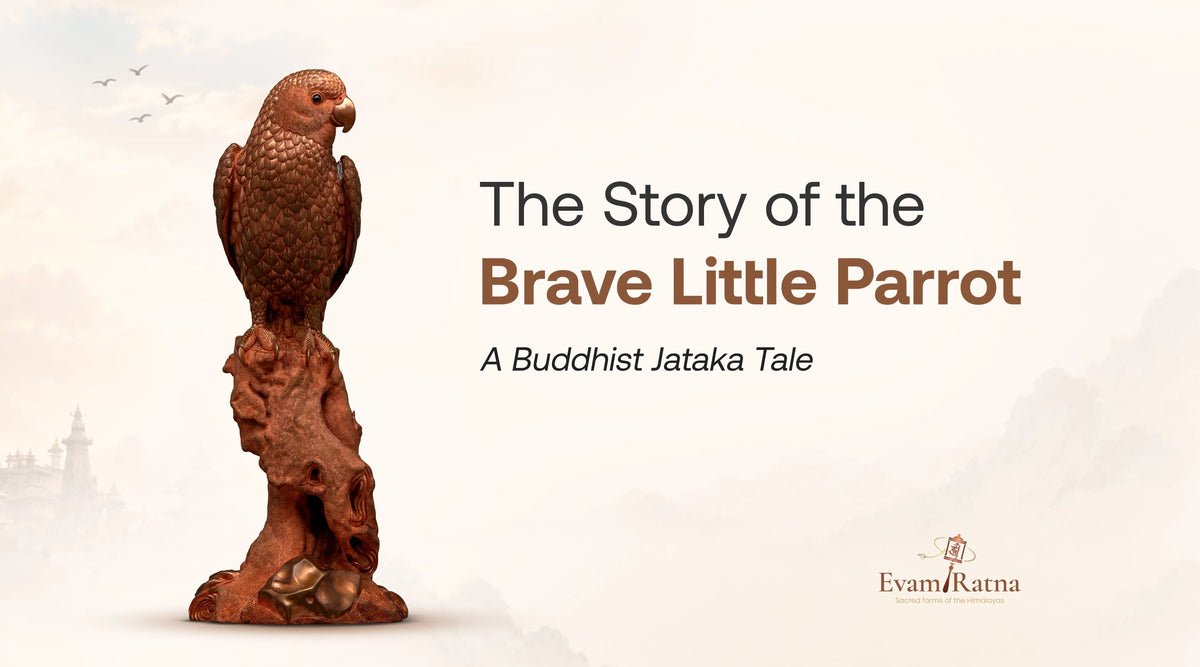
The Jataka Tale of the Selfless Effort: Meaning, Moral, and Summary
The Story of the Brave Little Parrot stands out as one of the most inspiring narratives among traditional Buddhist jataka tale. The word jataka means "birth" in both Pali and Sanskrit. Jataka tales are stories of the Buddha's former lives, told about the long journey before he became Siddhartha Gautama and awakened. In them the future Buddha, called the bodhisattva, may appear as a king, an outcast, a god, an elephant, a monkey, or a bird. Whatever form he takes, he shows some virtue that the story teaches.
These tales are cherished in every branch of Buddhism. A classic jataka opens by naming the occasion that prompted the telling and closes with the Buddha revealing who each character was in the past, which is how a humble animal fable can end with the news that the parrot was the Buddha himself. Jatakas have been carved and painted since the earliest centuries of Buddhist art, and they remain a staple of sermons, festivals, and storytelling. Many are built around one of the perfections, or paramitas, the qualities a bodhisattva cultivates over countless lifetimes. The parrot's story teaches two of them above all: compassion and joyful, tireless effort.
The Story of the Brave Little Parrot: A Summary

Long ago, a small parrot lived in a green forest, where birds and animals shared the trees in peace. One day a fire broke out, in many retellings sparked by a lightning strike. Flames raced through the dry grass and leapt from tree to tree. Smoke thickened, and the creatures of the forest scattered in terror, many of them trapped with nowhere to go. The parrot had wings. She could have risen above the smoke and been safe within moments. But she heard the cries of the animals below, and she could not leave them. Some said that nothing could be done. The parrot decided she would do what she could.
She flew to the river, soaked her feathers in the cool water, and flew back over the blaze. There she shook herself, and a few drops fell into the roaring fire and vanished. Again she flew to the river, and again she returned. Her feathers scorched, the smoke stung her eyes and lungs, and still she went back and forth. High above, the gods looked down. Some laughed. What could a few drops from the wings of one small bird do against a forest fire? But the parrot would not stop. She answered that she could not stand by while her friends suffered, and that if she could save even one life, the effort was worth it.
Moved beyond words, one of the gods came down. In the best-loved telling he is Indra, king of the gods, and his tears of compassion poured over the forest like rain. The fire went out. The green returned, the animals were saved, and in many modern retellings the same tears healed the parrot's burned feathers, which grew back in brilliant colors.
Then, as in every jataka, the Buddha reveals the connection: that little parrot was the bodhisattva, his own former self, practicing compassion long before he ever sat beneath the Bodhi tree.
Where the Parrot Story Comes From?
The parrot tale is older and more widely traveled than many readers realize. Several early written versions survive in Chinese translations of Indian Buddhist texts. An early collection of parables attributed to the translator Kang Senghui, who died in 280 CE, tells it. The Sutra of Miscellaneous Treasures (Zabaozang jing), translated in the fifth century, includes it. The sixth-century anthology Jinglü yixiang, compiled in 516 CE, preserves it as a story drawn from a sutra associated with Saṃgharakṣa. The Chinese writer Liu Yiqing (403-444) also recorded it in a collection of tales of Buddhist wonders.
Those early versions are plainer than the popular retellings. The parrot has stayed for a time on a mountain where the animals were kind to her, so when fire strikes she cannot bear to watch her hosts suffer. The gods mock her, and she answers with gratitude and loyalty. Moved, they put out the fire with rain. There is no eagle, and the parrot is not always named as the Buddha. The Sutra of Miscellaneous Treasures pairs the tale with a scene in which the Buddha himself calms a village fire by speaking of the three fires within beings, greed, anger, and ignorance, which the water of wisdom can quench.
Later tellers added color: a grey or green parrot, a god disguised as an eagle, tears that fall as rain, feathers restored in rainbow hues. These differences do not contradict one another. They show a living story, polished by centuries of tellers. Whichever version you meet, the spine is the same: a small being, a great fire, and an act of compassion that cannot be talked out of itself.
The Meaning and Moral of the Brave Little Parrot Jataka

At its simplest, the moral is this: do what you can, with a whole heart, even when it seems too small to matter. Four themes run beneath that message.
Compassion Does Not Wait for Strength
The parrot is among the smallest creatures in the forest, yet she is the one who acts. The story quietly rejects the idea that help belongs only to the powerful. In Buddhism, karuna, compassion, is the heartfelt wish to relieve suffering, and here it moves her body before her mind can calculate the odds.
Effort Matters More Than Outcome
The parrot never knows that the fire will go out. Her measure of success is faithfulness to the act itself. This is virya, the joyful vigor that keeps a practitioner going when results are invisible. The Zen master Hakuin is said to have taught that water gathered cup by cup can in time become a sea, and the parrot lives that teaching one wingful at a time.
Courage Means Staying
She is not fearless. The smoke is real, and so are the flames. Her courage lies in returning to the river again and again, in choosing compassion over comfort while afraid. The gods' laughter is the voice of ordinary realism. The parrot's reply is the voice of the bodhisattva.
Sincere Intention Opens the Door
The rain does not fall because the parrot bargained for it. It falls because a pure heart moves those who witness it. Buddhist tradition reads this as the natural fruit of wholesome intention, which ripens in ways we cannot predict or control. The lesson is not that good deeds guarantee miracles, but that we should never underestimate what a sincere act sets in motion.
The Bodhisattva Ideal: Karuna and Virya in Action
The parrot embodies the heart of the bodhisattva vow: to work for the freedom of all beings from suffering. A bodhisattva does not wait for conditions to become perfect. The vow is taken in the face of the impossible, since the number of beings is endless and the vow is made anyway. The burning forest is that vow in miniature.
Several perfections appear in the story at once. Effort (virya) is the most obvious. Generosity (dana) shows in the way she gives up her own safety. Patience (kshanti) shows in how she endures heat, smoke, and ridicule without anger. Compassion drives them all. Mahayana lists six perfections and Theravada lists ten, but the parrot shows that none of them is abstract. Each looks like flying to the river one more time.
The tale also corrects a common misunderstanding of selflessness. Selflessness here does not mean self-erasure or being blown about by every wind. It means that self-concern loosens its grip, so that care for others can arise without hesitation. Letting go in this way tends to leave a person more present and more whole, not less.
Symbolism: Fire, Water, Rain, and Tears
Every image in the story carries more than one layer of meaning.
- Fire: Buddhist teaching often describes greed, hatred, and delusion as three fires, and Buddhist literature likens the realms of existence to a burning house. The forest fire is suffering on a scale no single being can put out alone.
- Water: Water cools, cleanses, and sustains. In the Sutra of Miscellaneous Treasures it becomes the "water of wisdom" that extinguishes the fires within. Each drop on the parrot's wings stands for a single act of kindness.
- Rain and tears: The rain that finally falls, or Indra's tears in the best-loved version, shows compassion answering compassion. The gods who laughed are transformed when they truly see.
- Scorched feathers: In modern retellings the burned feathers return in new colors. Effort leaves its marks, but in the bodhisattva's story those marks become beauty.
- The forest: All creatures living together reflect interdependence. The parrot treats her neighbors' suffering as her own, which is the insight at the center of the Buddhist path.
Jataka Stories in Buddhist Art and Devotion
Jataka scenes appear in Indian Buddhist art as early as the second century BCE, and they have been illustrated in sculpture and painting across the Buddhist world ever since. In the Himalayan tradition, compassion is often seen more than narrated. Chenrezig, the bodhisattva of compassion, and Tara, who answers cries for help with swift aid, are the forms through which the same ideal is placed before the practitioner each day.
For those who keep a home altar, a thangka or statue of such a deity becomes a quiet reminder of the parrot's resolve. At Evamratna, our statues and thangkas of Chenrezig, Tara, and other deities are made by Newar artisans in Patan, a craft community whose devotional art has long been tied to the living practice of Buddhism in the Kathmandu Valley.
Living the Parrot's Lesson Today
The story does not ask you to fight wildfires. It asks what your drop of water is. A few ways to carry it into daily life:
- Begin with the nearest fire: Choose one concrete act of care, such as checking on a neighbor, supporting a cause, or offering forgiveness, and do it today.
- Let go of the scoreboard: Offer the act without needing proof that it worked. The effort itself is the practice.
- Expect the laughter: Some will call your effort pointless. Answer with continued action rather than argument.
- Dedicate the merit: Buddhist practitioners traditionally end an act of virtue by dedicating its merit to the benefit of all beings, which keeps the heart wide and the ego quiet.
- Keep a reminder: Light incense or a butter lamp before an image of compassion, and let it call you back to the river.
Modern teachers have also widened the bodhisattva vow in this story to include rivers, forests, and the living world, which is why the parrot speaks so clearly in an age of climate anxiety and community care. Small acts, repeated by many hands, are how forests are saved.
Conclusion
The brave little parrot never puts out the fire by herself. What she does is refuse to walk away, and in refusing she reveals what the Buddha would later teach to countless beings: that compassion is not measured by the size of the one who offers it. Whether the rain comes from the gods, from Indra's tears, or from the quiet fruit of a good heart, the story invites us to take up our own small share of the work. When the world feels like a burning forest, remember the river, the wings, and the drops of water. Begin there.