Are Achi Chokyi Drolma and Tseringma the Same? Tibetan Protectors Explained
Many practitioners and art collectors often mistake Achi Chokyi Drolma and Tashi Tseringma for the same deity because both are prominent, peaceful female protectors in Tibetan Buddhism. However, while they share similar protective roles within the Kagyu lineage, Achi Chokyi Drolma and Tseringma are entirely distinct figures with unique historical origins, spiritual practices, and iconographies. Whether you are trying to identify a thangka painting or understand their roles in Vajrayana practice, learn more and know the essential differences between the enlightened grandmother of the Drikung Kagyu tradition and the worldly mountain goddess of long life subdued by Milarepa.
Achi Chokyi Drolma: A Fully Enlightened Female Dharma Protector (Dharmapala)

Click Here To View Our Collection of Traditional Female Dharma Protector Achi Chokyi Drolma Statues
The word Achi simply means "Lady" or "Grandmother," a title of affection and respect. Chokyi Drolma means "Dharma Tara," a name that points to her saving, compassionate nature. According to the traditional accounts, she was born in Central Tibet and from childhood devoted herself to spiritual practice. Believing that great practitioners might arise from her family line, she chose to marry a good man and raised four sons, each of whom became a notable ascetic or scholar. One of them, Naljor Dorje, became the father of Kyobpa Jigten Sumgon.
Achi was herself an accomplished tantric practitioner and teacher. The story tells that in a large cave, in front of many students, she performed a sacramental feast offering and transformed a human corpse into a sacred offering. At that moment she vowed to become a protector of the Buddha's teachings and composed a liturgy for invoking her protection. When the verses were complete, she appeared upon a blue horse, rose into the sky and departed for a pure realm, her work in this body finished.
Her promise did not end there. She vowed to grant both ordinary and supreme accomplishments to those who rely on her. Later, her descendant Jigten Sumgon, who founded the Drikung Kagyu school in the twelfth century, wrote a liturgy for her and established her as the principal protector of his tradition. Most Drikung accounts call her his grandmother, although a few catalogues of Himalayan art record her as his great-grandmother, so you may encounter both in your reading.
Today, Achi's practice is carried on in Drikung centres around the world, including regular meditation practices and smoke offerings dedicated to her, and she is revered across Tibetan Buddhist lineages beyond Drikung. Many devotees describe her as a kind, grandmotherly presence: a protector who hears those in difficulty and responds swiftly.
Tashi Tseringma: The Tibetan Goddess of Long Life and Prosperity

Click Here To View Our Collection of Tibetan Goddess of Long Life and Prosperity Tsheringma Statues
Tseringma means "Mistress of Long Life," and Tashi means "auspicious." Tashi Tseringma is the chief of the Five Long-Life Sisters (Tsering Chenga), a group of goddesses connected with the high peaks between Tibet and Nepal. Her sisters are Tingi Shalzangma, Miyo Lozangma, Tekar Drozangma and Chopen Drinzangma. In some traditions the sisters are associated with Mount Gaurishankar, known in Tibetan as Thon Thing Gyalmo.
In their original form, the sisters belonged to the sman class of worldly deities, spirits of the mountains who were powerful and not always benevolent. In the eighth century, Guru Padmasambhava subjugated them and bound them to the Dharma. They then travelled to India, where they received further Buddhist instruction from teachers including the mahasiddha Kanha.
Their best-revered story belongs to the great yogi Milarepa, in the eleventh century. Wishing to test his resolve, the sisters created frightening and bewildering apparitions to pull him away from meditation. Because of their vows to Guru Rinpoche, and because of Milarepa's own realization, they could not harm him. Three days later they returned, humbled themselves before him and offered their life-essence in the form of mantras. Milarepa gave them teachings on the awakening mind and on advanced Vajrayana practices. Some months afterwards they came again to request further instruction. Together, these are known as the three encounters between Milarepa and Tseringma.
From that point on, Tseringma was seen not as an obstacle but as a devoted protector of practitioners. Her blessings are said to include long life, wealth, magical ability, nourishment and good fortune, with long life as her most celebrated gift.
Origins Compared: A Historical Woman and a Mountain Spirit
The clearest difference between the two protectors is where they come from.
Achi Chokyi Drolma has a human biography. She had a husband, sons and students, she practiced tantra, and she made a deliberate vow in the presence of her community. Her story is the story of a realized woman who chose to remain a protector.
Tseringma has a mythic, landscape-rooted origin. She is bound up with snow peaks, valleys and the sacred geography of the Himalayas. Her origin story is one of transformation: a wild mountain spirit tamed by a great master and then deepened by a great yogi.
Put simply: Achi is a person who became a protector, while Tseringma is a spirit who became a Buddhist.
Lineage Associations
Achi Chokyi Drolma is above all the protector of the Drikung Kagyu tradition. Her liturgy was written by Jigten Sumgon himself, and her presence runs through Drikung monastic and lay practice. At the same time, she is not confined to one school. Practitioners from other lineages also turn to her, and she is regarded as a great Dharma protector in her own right.
Tashi Tseringma is strongly tied to the broader Kagyu lineage through Milarepa, and the Long-Life Sisters are also honoured in the Nyingma tradition because of Padmasambhava's role in subduing them. Their practice lineage is traced through figures such as Amitayus, the dakini Simhamukha, Padmasambhava and Milarepa.
Roles and Functions: Dharma Protection and Long Life
Both protectors care for practitioners, but their emphasis differs.
Achi Chokyi Drolma, protector of the teachings: Her central work is guarding the Buddha's Dharma from inner and outer dangers, and helping practitioners stay steady when their path is tested by doubt, confusion or outside disruption. She is also invoked for spiritual realization, in keeping with her vow to grant both ordinary and supreme accomplishments.
Tashi Tseringma, giver of long life: Her emphasis is life itself health, vitality, prosperity and the favourable conditions that allow a person to keep practicing. She is turned to for recovery from illness, for longevity practice, and for blessings on household and livelihood.
One helpful way to hold the difference is this: Tseringma looks after the practitioner's life, while Achi looks after the practitioner's path. A long, healthy life supports practice, and a protected path gives that life meaning. This is why the two are so often honoured together.
Iconography Side by Side

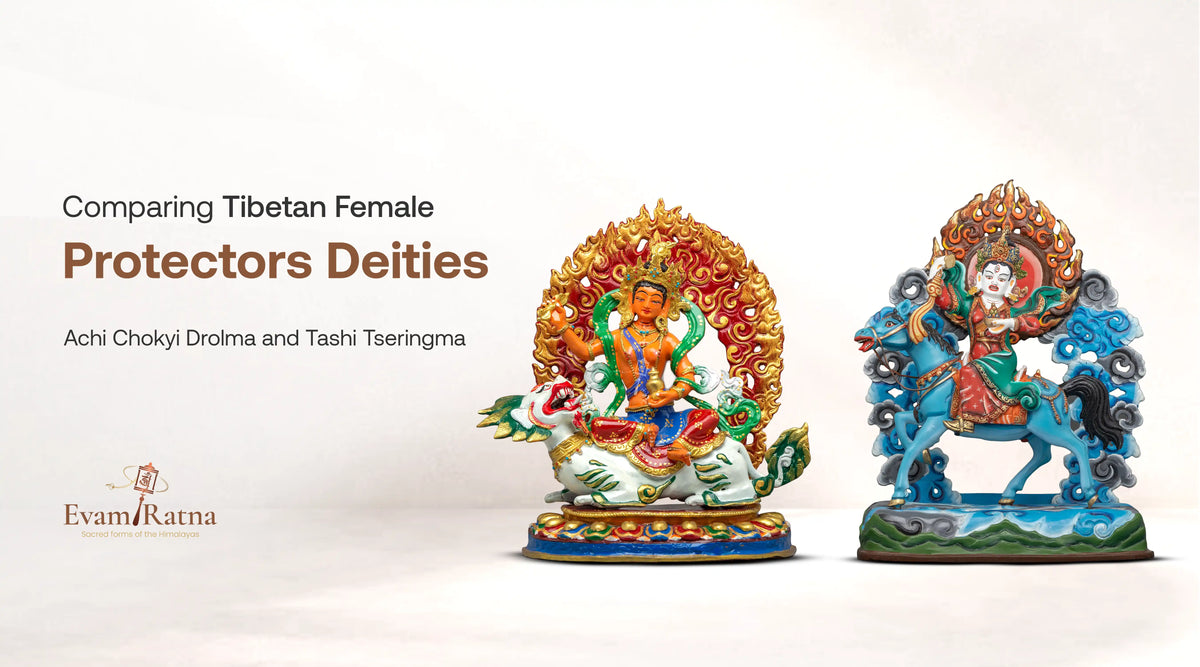
Even if you know nothing else about them, you can tell these two apart by their mounts. The comparison below brings the main visual features together.
|
Feature |
Achi Chokyi Drolma |
Tashi Tseringma |
|
Color and appearance |
White, semi-peaceful, flowing garments and jewels |
White, peaceful, youthful, gold ornaments |
|
Mount |
Blue horse, often flying through clouds |
White snow lion with a green mane |
|
Right hand |
Upraised double-sided drum (damaru) |
Upraised golden vajra |
|
Left hand |
A skullcup with Norbu in the left held to the heart |
Long-life vase held at the heart |
|
Surroundings |
Often four attendants, each on a horse |
Often the four other sisters, each on a different mount |
|
Main symbolism |
Swift protection, impermanence, sacred offering |
Long life, vitality, fearlessness |
- The blue horse: Achi's blue horse recalls the moment she rode into the sky at the end of her life. It stands for speed, readiness and the ability to move beyond the limits of ordinary space and time. Some writing refers to a blue mule instead, but the established thangka descriptions describe a horse.
- The snow lion: Tseringma's white snow lion, with its green mane, is the mythical beast of the Tibetan snow mountains. It expresses fearlessness, vitality and a joyful, unshakeable confidence, fitting for a goddess of long life.
- Hand implements: Achi's damaru, the small drum used in tantric ritual, calls to mind the sound of the teachings and the impermanence of life, while her skull-cup speaks of transforming even the most difficult circumstances into offering. Tseringma's vajra represents indestructible clarity, and her vase holds the nectar of long life.
- The sisters: In many Tseringma paintings she is surrounded by her four sisters, each with a distinct colour, mount and gift: one rides a wild ass and holds a mirror, one rides a tiger and offers food, one rides a blue dragon holding durva grass and a snake lasso, and one rides a hornless stag holding a treasure chest and a wish-fulfilling jewel. Achi's retinue, by contrast, is usually a small circle of attendants on horseback.
- What they share: Both are drawn as graceful women with jewelled ornaments, silk garments and calm, benevolent expressions. Neither is shown in the fierce, flaming form of the great wrathful protectors, which is part of why they feel approachable.
Spiritual Nature: Emanation or Converted Protector?
Here the two protectors diverge most deeply in how practitioners understand them.
In the Drikung view, Achi Chokyi Drolma is a fully enlightened being, an emanation of Vajrayogini who took birth as a woman to protect the teachings and the lineage. Some devotees also know her as Dharma Tara. Her protective activity is therefore understood as enlightened activity, arising from complete wisdom and compassion rather than from a promise made under constraint.
Tashi Tseringma, by contrast, is understood as a worldly deity who was converted. Her power is real and her commitment is sincere, but her story is one of a spirit of the mountains who made binding vows. That does not make her lesser in the eyes of devotees; it makes her story one of transformation. Tibetan Buddhism celebrates the idea that even the most powerful, unruly forces can be turned toward compassion.
Turning to Each Protector in Daily Practice
Both protectors are approached through practices received from a qualified teacher, so anyone wishing to engage with either should seek a lama of the relevant tradition. With that in mind, here is how people often relate to them.
People turn to Achi Chokyi Drolma when they want steadiness on the path. Many find her presence comforting during times of doubt, upheaval or obstacles to practice, and her practices, including offerings and sadhana recitation, are widely done in Drikung communities.
People turn to Tashi Tseringma when they want to support life and wellbeing: during illness or recovery, at milestones such as birthdays. Long-life practices are an important part of Himalayan Buddhist culture, and Tseringma's imagery appears in homes, monasteries and mountain shrines alike.
Practitioners often describe the two as complementary rather than competing. One safeguards the health and vitality that make a practice possible. The other safeguards the teachings that give that practice direction.
Conclusion
Achi Chokyi Drolma and Tashi Tseringma stand side by side in Tibetan Buddhist art, but they are not the same. One began as a woman of Tibet who vowed to guard the teachings and became the beloved protector of a lineage. The other began as a spirit of the high Himalayas who was tamed, taught and transformed into a bestower of long life. Their differences are what make them a meaningful pair. One protects the path; the other protects the life that walks it. Once you can read the blue horse and the white snow lion, every thangka and statue of these two guardians becomes easier to appreciate, and easier to place with intention on your own altar.