Wrapping the Dharma: Why Tibetan Buddhists Cover and Elevate Sacred Texts
Buddhist ritual text holders are the wraps, covers, and stands used to protect, carry, and elevate sacred scriptures. In Tibetan Buddhism, a pecha cover shelters the loose pages of a traditional book from dust and handling, while a book stand lifts the text to a respectful height on an altar or reading space. Together they express one simple conviction: the written Dharma is the Buddha's speech, and it deserves the same care we give to a statue or a stupa.
What is a Pecha?

The word pecha (Tibetan: dpe cha) simply means "book," but it refers in particular to the traditional Tibetan loose-leaf volume. A pecha has long, narrow, horizontal pages. These pages are not stitched or glued together. Instead, the stack of loose leaves is placed between two wooden boards, wrapped in cloth, and secured with a cord or belt.
This format grew out of the Indian pothi, the palm-leaf manuscript that inspired Tibetan religious books. As Buddhist texts traveled north from India, Tibetan scribes kept the long, narrow shape even after paper replaced palm leaf. Kangyur and Tengyur volumes, sadhanas, ritual manuals, and many household prayer books are still produced in this format today. Wrapped tightly between boards, the pages stay in order and are shielded from dust, light, and rough handling. Traditional shrine rooms keep the volumes on red-and-gold painted shelving with a separate compartment for each book. When a pecha is read, it is laid on a flat surface and the unbound pages are lifted and turned away from the reader, one by one.
Why Scriptures Are Honored as the Buddha's Speech?
In Tibetan Buddhism a traditional altar holds representations of the Buddha's enlightened body, speech, and mind:
- Body: a statue or painting
- Speech: a scripture
- Mind: a stupa (chorten)
The scripture stands for the Buddha's speech, the teaching that reveals the path to liberation. As speech carries the Dharma into the world, a scripture is treated as a living presence of the teachings rather than as ordinary reading material. The text does not need to be in Tibetan or Sanskrit; a scripture in any language can fill this role, and many practitioners choose the Heart Sutra or a text connected to their own practice.
On a multi-level altar, the scripture is traditionally placed at the highest point, above the Buddha image. These objects also represent the Three Jewels of Refuge: the stupa as the Buddha, the scripture as the Dharma, and the statue as the Sangha. Placement customs vary between lineages, so a teacher's guidance is always the best final word.
A moving example of this devotion comes from fifteenth-century Tibet. The princess and spiritual leader Chokyi Dronma, the Samding Dorje Phagmo, wrote of scriptures as one would write of respected persons. When she found manuscripts covered in dust, she cleaned them, restored missing parts, and wrapped them in cloth and cord. Later readers have interpreted this gesture as offering the scriptures a robe and a belt. The custom of wrapping texts, and the belief that caring for books well accumulates merit.
Pecha Covers and Scripture Wraps: Protection as Reverence
A pecha cover serves four overlapping purposes.
- Physical protection: The boards and cloth keep the loose leaves aligned and guard them against dust, moisture, abrasion, and the wear of handling. Without them, folios and covering boards are easily misplaced or damaged.
- Ritual honor: Wrapping a text is an act of offering. The cloth clothes the teaching, and unwrapping it before reading is itself part of the ritual. Many practitioners recite a short prayer while wrapping or unwrapping a text, and some lamas are remembered for the way they carefully covered their books after every use.
- Safe transport: Dharma texts are wrapped in cloth whenever they are carried from place to place, whether between a shrine room and a teaching hall or between home and a Dharma center. The wrap keeps the text clean and signals that it is not an ordinary object.
- Visual devotion: Brocade, silk, and painted wood turn protection into an offering of beauty. Museum-held pechas show red wooden covers decorated with gold scrollwork, yellow silk wraps, printed floral cloth, and woven braid ties. Each choice reflects the value the owner places on the teachings.
The same principle applies to the modern book. A paperback sutra translation is not a pecha, but it can be wrapped in a clean cloth or placed in a fitted scriptural cover. The material changes; the intention does not.
Buddhist Book Stands: Why Elevate the Dharma?
Tibetan etiquette places Dharma texts in the highest and cleanest position available. Books are kept off the floor, away from places where people sit or walk, and separate from worldly writing. They are never stepped over, and nothing is placed on top of them.
A book stand puts this principle into practice. It raises the text above the surface of the table or altar, gives it a dedicated place, and keeps it apart from keys, glasses, phones, and other everyday objects. During prayer, chanting, or study, the stand holds the text open at a comfortable angle so that the reader can focus on the words.
It is worth being candid about the history. A traditional pecha is laid flat to be read, and the stand is less an ancient fixed implement than a natural expression of an old principle. Today, stands are widely used to hold bound Dharma books, sutras, prayer books, and sadhana texts, and to display a scripture as the speech support on a home altar. When we choose a stand, we are not reviving a rigid rule. We are choosing a form that makes respect easy to practice every day.
Pecha Cover vs. Scripture Wrap vs. Book Stand: A Quick Comparison
|
Text Holder |
What It Is |
Main Purpose |
Best For |
|
Pecha cover (boards and cloth) |
Wooden or bamboo covering with cloth panels and straps |
Protects loose-leaf pages; keeps them in order |
Traditional pecha volumes, storage, and carrying |
|
Scripture wrap or book cover (silk or brocade) |
Fabric covering that clothes the text |
Honors and protects; used when carrying or storing |
Bound books, sutras, prayer texts, daily use |
|
Book stand |
Painted or carved wooden stand |
Elevates the text for display, reading, and chanting |
Home altars, shrine rooms, study corners |
Many practitioners use all three together: a stand to hold the text open during practice, and a cover or wrap to protect it afterward.
Materials and Craftsmanship: Wood, Bamboo, Silk and Painted Detail
Wood and bamboo form the firm outer boards. Historically, covers have been made of wood, stiffened paper, or similar rigid materials. Painted or carved designs, often in red and gold, turn the boards into a small work of art.
Cloth wraps the pages inside. Cotton and silk are both common. Yellow and maroon are traditional favorites in monastic settings, but patterned and multicolored fabrics are equally at home in lay practice.
Cords, belts, and braids hold everything closed. In a well-made cover, the straps are firm enough to secure the text and soft enough not to mark the cloth.
Painted wooden stands use acrylic or mineral colors on wood. Red grounds, decorative borders, and auspicious patterns are common in Tibetan style.
In Himalayan workshops, much of this work is still done by hand. That is why small variations in color, pattern, and finish are a sign of craftsmanship rather than a flaw.
Featured Text Holders from Evamratna
At Evamratna, we offer three handcrafted pieces that cover the main roles described above. Dimensions and materials are as listed on each product page.
Decorative Book Stand: A Painted Wooden Pecha Holder

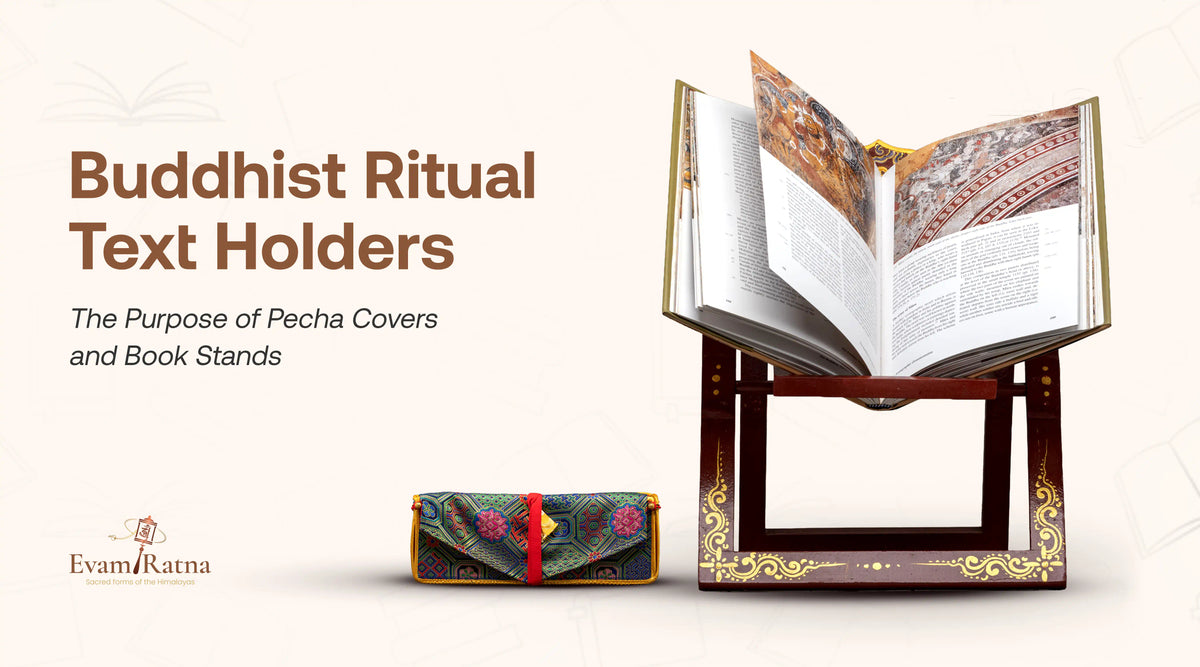
The Decorative Book Stand is a painted wooden scripture holder made for Buddhist altars, meditation rooms, and sacred reading spaces. It measures 41 cm in height, 33.5 cm in length, and 33 cm in width, and weighs 0.83 kg. Made of wood and finished in vibrant acrylic colors, it carries rich red tones and decorative patterning in the Tibetan style.
It is well suited to sutras, prayer books, meditation texts, and pecha scriptures during daily practice. Place it on a home shrine, in a temple room, in a yoga space, or in a quiet reading corner.
Buddhist Scripture Book Cover: A Silk Wrap for Dharma Texts

The Buddhist Scripture Book Cover is made of silk fabric and measures 13 cm by 35 cm, at 0.18 kg. Silk echoes the Tibetan practice of wrapping scriptures to show respect for the Buddha's teachings, and its woven motifs are inspired by Tibetan art and suggest harmony, prosperity, and compassion. It is light enough for everyday carrying and elegant enough for ceremonial use.
Handmade Dharma Text Cover: Bamboo Wood and Colorful Cloth

The Handmade Dharma Text Cover is a protective case for Buddhist scriptures and sacred texts. It measures 35 cm by 11 cm and weighs 0.44 kg. A structured bamboo-wood frame is joined with cloth panels in red, blue, yellow, and green, decorated with repeating floral and ornamental motifs. Red cloth straps wrap around the case to keep it closed when you carry or store the text.
Its elongated form suits the proportions commonly associated with Tibetan scripture volumes, making it a fitting choice for keeping Dharma texts clear of dust and everyday handling. It also works well as part of a shrine, library, or meditation-room collection.
All three pieces are handmade, so slight variations in color and pattern are natural.
How to Use Text Holders on a Home Altar:
A few simple steps help you set up a text holder with care.
- Choose the highest clean place you can. If your altar has more than one level, the scripture belongs on the top level. On a single-level altar, place it beside the Buddha image alongside the stupa.
- Set the stand on a stable, clean surface. Wipe the area before placing a text on it.
- Open the text only when you are ready to read. Unwrap it slowly, hold it with clean hands, and rest it on the stand.
- Wrap or cover it after use. A cloth, silk wrap, or pecha cover keeps the text clean and returns it to its resting state.
- Keep the area clear. Do not place malas, glasses, ritual objects, or everyday items on top of a text.
- Ask your teacher. Lineages differ in details such as which side of the altar the scripture takes. If you have a teacher, follow their advice.
Respectful Care of Dharma Materials
These guidelines apply to every Dharma text, from a hand-copied pecha to a pocket prayer book.
Do
- Keep Dharma texts in a high, clean place, separate from worldly writings.
- Wrap or cover texts when carrying or storing them.
- Spread a clean cloth on the surface when you must set a text down.
- Treat digital devices that hold Dharma texts with the same care.
Avoid
- Placing texts on the floor, on beds, on chairs, on meditation cushions, or anywhere people sit or walk.
- Stepping over texts or placing them under other objects.
- Stacking statues, stupas, malas, or reading glasses on top of a text.
- Licking your fingers to turn the pages.
- Using books as props for wobbly tables or other everyday purposes.
Conclusion
A pecha cover, a silk scripture wrap, and a book stand may look like simple accessories, yet each one carries a centuries-old understanding: the Buddha's speech is precious, and how we hold the written Dharma shapes how we hold its meaning. Wrapping a text, raising it above the table, and keeping it free of clutter are small acts. Practiced daily, they become a quiet training in mindfulness, humility, and gratitude.