The Spiritual Meaning of Fatherhood: Buddha, Shiva & Sacred Gifts
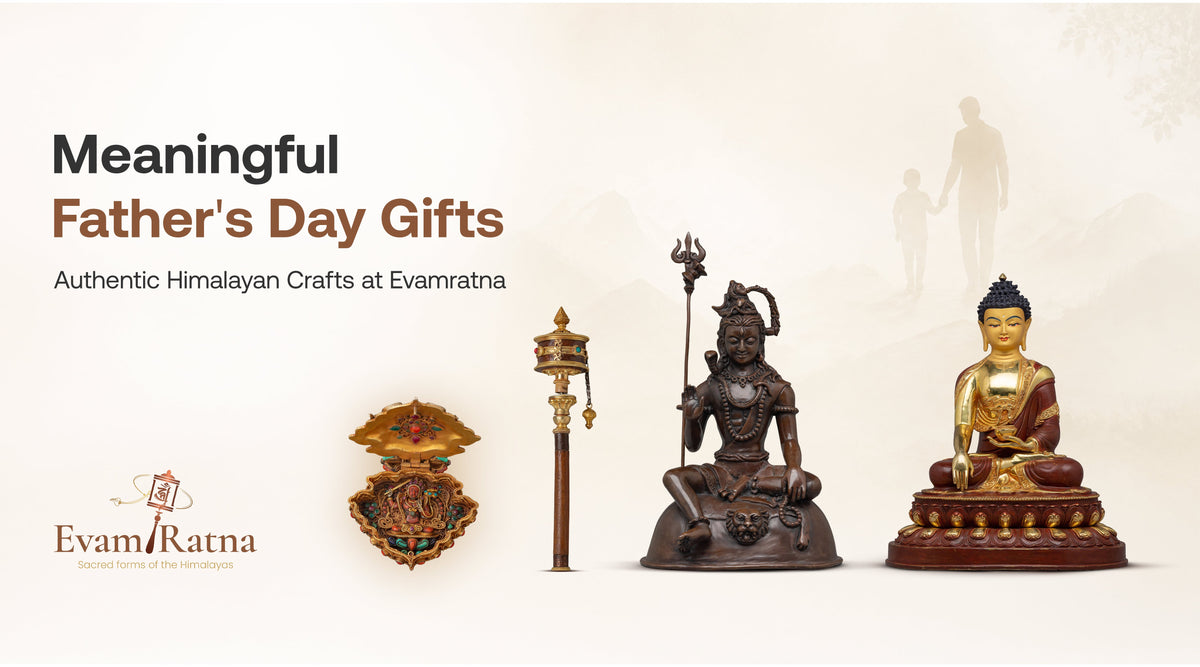
Find a meaningful way to celebrate Father's Day on Bhadra 26, 2083 (September 11, 2026) with a beautiful and sacred gift that reflects the compassion, strength, and guidance of fatherhood. While many gifts are enjoyed only briefly, a meaningful gift can convey a deeper message of gratitude, protection, and spiritual connection. At Evamratna, we believe a father deserves something that reflects the role he actually plays: patient teacher, quiet protector, steady anchor for the whole family. This Father's Day, explore a collection of authentic Himalayan crafts, handcrafted malas, prayer wheels, singing bowls, thangkas, statues, and ghau boxes, each rooted in centuries of Newar and Tibetan sacred art, and each chosen to honor fatherhood as something spiritual and meaningful.
Introduction: Kushe Aunsi (Nepali Father’s Day)

In Nepal, Kushe Aunsi, also known as Gokarna Aunsi (Nepali Father’s Day), is a sacred occasion falling on the new moon day of the month of Bhadra, dedicated to honoring fathers and expressing respect for their guidance and sacrifices. Inspired by Himalayan spiritual traditions, gifts such as Buddhist statues, meditation tools, prayer objects, and handcrafted artworks embody qualities many fathers possess: patience, protection, wisdom, and compassion.
For those whose fathers have passed on, the tradition takes on a different, deeply moving form, a pilgrimage to Gokarneshwar Mahadev Temple on the banks of the Bagmati River, where devotees pay homage to Lord Shiva himself as the eternal father figure of all beings. In this way, Kushe Aunsi bridges the personal and the cosmic: honoring one's own father is also, symbolically, an act of honoring the divine father.
Divine Father Figures
To understand why Himalayan ritual art makes such a resonant Father's Day gift, it helps to look at two of the most enduring spiritual father figures in Buddhist and Hindu tradition: Shakyamuni Buddha and Lord Shiva.
Shakyamuni Buddha: The Father of Compassion and Awakening

In the Lotus Sutra, one of Mahayana Buddhism's most influential texts, Shakyamuni Buddha is described as the father of all sentient beings. This is a deliberate and striking image. He is not a father who rules through command or fear; he is a father who guides through Upaya, skillful means suited to each person's own capacity to understand.
The famous chapter in the Lotus Sutra, Parable of the Burning House, tells of a father who saves his children from danger through wisdom and patience. When children play inside, a house of a kind father burns down. He urges them to escape, but they are too busy playing their games to pay any attention. Desperate, he changes his approach. He knows his children well enough to know what will actually move them, so instead of pleading, he calls out a promise: outside, three magnificent carts are waiting for them, one drawn by a sheep, one by a deer, and one by a mighty ox. At once, the children leave the house, where they find a single cart, drawn by an ox, more wonderful than anything he had described.
The Buddha explains this parable himself: the burning house is samsara, the endless cycle of rebirth and suffering. He is the father, and all sentient beings are his children, so absorbed in the world around them that they fail to notice the danger they're standing in. Rather than force them toward liberation, he meets each being where they are, offering paths and teachings suited to what they can understand and what genuinely calls to them. It is only once they've stepped outside, once they've begun the path toward awakening, that they discover something greater waiting for them than what they were first promised.
Lord Shiva: The Father of Cosmic Protection and Stillness

Where the Buddha represents patient guidance, Lord Shiva, worshipped as Mahadev, the Great God, represents something equally essential to fatherhood: stillness paired with protection. He is a father who protects through stillness and who judges through wisdom rather than force.
A well-known story from Hindu Puranic tradition, often called the Race Around the World, tells of a moment when Shiva was called on to act not as the fierce ascetic of Kailash, but as a father settling a dispute between his two sons. The sage Narada arrived on Kailash bearing a divine fruit, said to grant supreme knowledge, and offered it as a single gift to Shiva and Parvati's family. To decide fairly between their sons, Ganesha and Kartikeya, Shiva and Parvati set a challenge: whoever could circle the entire world three times and return first would receive the fruit. Kartikeya mounted his peacock at once and shot off across the cosmos, determined to win through speed. Ganesha, however, simply turned and walked three quiet circles around his own parents, then asked for the fruit, explaining that his parents were his entire world, so circling them was the same as circling the world itself.
Devotion and wisdom were worthy of him, and this he accepted without question, knowing that these were greater than speed or work. In this, Shiva models something essential to fatherhood: the stillness to sit back and judge fairly rather than react, and the wisdom to honor understanding over showmanship, even when it means one son's insight overturns his own expectations. He is the father who does not need to chase or command to be respected, because his calm, considered presence is authority enough on its own.
Six Sacred Gift Recommendations for Father's Day
At Evamratna, every ritual object is handcrafted by Newar artisans in Patan, one of the Kathmandu Valley's most storied centers of sacred metalwork and religious art. Below are six gifts, each connected to a different aspect of the fatherly archetypes explored above.
1. Handcrafted Mala Beads: The Patience of the Buddha

A mala is, at its core, a tool of repetition and patience, 108 beads moved one at a time through the fingers, mantra after mantra, cycle after cycle. This mirrors precisely how the Buddha is said to guide beings: not in a single decisive act, but across countless patient repetitions. Gifting your father an authentic Bodhi seed or sandalwood mala gives him a tactile anchor for meditation, mantra recitation, or simply a moment of stillness carved out of a demanding day. It is a small object that carries a large idea: that patience, practiced daily, is itself a spiritual discipline.
2. Tibetan Prayer Wheels: Spinning Compassion for the Household

A father's presence in a home often works quietly and continuously, much like a prayer wheel, always turning, always protecting, rarely announcing itself. Each prayer wheel is filled with tightly wound mantras, traditionally the mantra of Avalokiteshvara, and every rotation is believed to release blessings equivalent to reciting the mantra itself. Gifting your father a prayer wheel, you're giving him a way to take part in creating merit and protection for the family, and a moment that helps make it a moment of care for all those you love.
3. Resonant Singing Bowls: The Cosmic Vibrations of Shiva

Few objects capture Shiva's meditative stillness as tangibly as a hand-hammered Himalayan singing bowl. Struck or circled with a wooden mallet, the bowl produces a deep, sustained resonance that has been used for centuries in sound healing and meditation practice. For a father who spends his days managing responsibilities, deadlines, and other people's needs, a singing bowl offers something rare: permission to sit still, breathe, and let a single sound occupy his full attention. It is, in essence, a gift of stillness, Shiva's stillness, made audible.
4. Sacred Thangka Paintings: Bringing the Lineage Home

A thangka is more than decorative art; it is a meditation aid, a teaching tool, and, for many practitioners, a visual embodiment of the deity it depicts. Hanging a finely detailed thangka of Shakyamuni Buddha or Shiva in your father's home altar, office, or meditation corner acts as a continuous, silent blessing. It quietly aligns his daily environment with the very archetypes of patience and protection he already lives by, reminding him and anyone who visits of the lineage his own guardianship belongs to.
5. Buddha and Shiva Statues: A Lasting Presence of Devotion
For a father who has spent decades as the steady center of his family, a statue of Shakyamuni Buddha or Shiva is one of the most enduring gifts available, a permanent, tangible presence rather than something used once and set aside. Cast in bronze or copper using the same repoussé and lost-wax techniques passed down through generations of Newar artisans, each statue is intended to anchor a home altar or personal shrine for a lifetime, and often beyond it. A serene Shakyamuni Buddha statue speaks to a father's patient wisdom; a meditative Shiva statue, seated in deep dhyana, speaks to his role as protector and pillar of calm. Either becomes a daily point of focus, something to light incense before, to sit quietly beside, to pass down eventually to the next generation.
6. Ghau Box: Carrying Protection Wherever He Goes

Traditionally worn by Himalayan travelers, traders, and pilgrims, the ghau is a portable amulet box designed to hold a small sacred image, mantra scroll, or relic close to the body for protection on the move. Intricately embossed with auspicious symbols and often set with turquoise or coral, a ghau box is a strikingly personal gift, protection a father can literally carry with him, whether he's commuting to work, traveling, or simply going about his day. It transforms an ancient tradition of pilgrim's protection into something modern and wearable, a quiet reminder that he is held and honored even when he's away from home.
Why Choose an Evamratna Gift for Father's Day
Every piece in the Evamratna, such as mala, prayer wheel, singing bowl, thangka, statue, and ghau box in our collection, is handcrafted by master artisans in the Kathmandu Valley, using techniques of Newar and Tibetan sacred art that have been carried forward from generation to generation.
This matters because authenticity changes what a gift means. A mass-produced imitation carries no lineage and no intention behind it. A piece handcrafted by an artisan trained in centuries-old sacred proportions and rituals carries both. When you gift from our collection, you aren't just simply giving your father an object, you're giving him a piece of a living spiritual tradition, made by hands that understand exactly what that tradition is meant to hold.
A Gift That Honors Who He Has Always Been
Fatherhood, at its best, looks a great deal like the archetypes explored here: patient like the Buddha, calm and protective like Shiva. This Kushe Aunsi, rather than reaching for something disposable, consider a gift that actually reflects that steadiness, a mala for his patience, a prayer wheel for his quiet blessings over the household, a singing bowl or statue for his role as spiritual anchor, or a ghau box to carry that protection with him wherever he goes.
Every piece in the Evamratna collection carries the same intention behind it: generations of Newar and Tibetan artisan lineage, handcrafted in Patan, made to be kept and passed down rather than used once and forgotten. Give your father something that honors not just what he does for the family, but who he has always been within it.
Frequently Asked Questions
What is a meaningful spiritual gift for Father’s Day?
Meaningful spiritual gifts include Buddhist statues, meditation malas, singing bowls, prayer wheels, and Thangka paintings. These gifts represent qualities such as peace, wisdom, compassion, and protection.
What is a traditional Father’s Day celebration in Nepal?
In Nepal, Father’s Day is celebrated as Kushe Aunsi, a day of respect, offering, and gratitude to fathers.
Which Buddhist statue is suitable as a Father’s Day gift?
A Shakyamuni Buddha statue is a meaningful choice because it symbolizes wisdom, compassion, and guidance. Other choices, such as Chenrezig or Guru Rinpoche, also represent compassion and spiritual protection.
Why are Himalayan crafts meaningful gifts?
Himalayan crafts carry centuries of spiritual values and cultural traditions. They are each handcrafted with meaning, devotion, and artistry, and are a gift that lasts long.