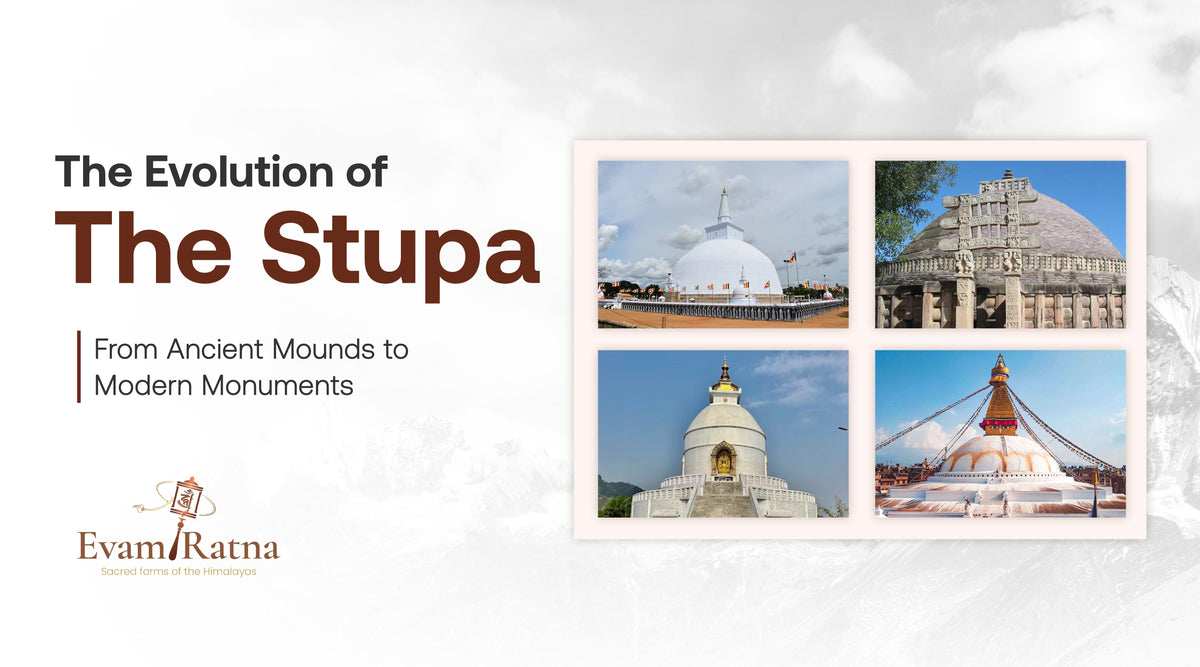
Buddhist Stupa: Evolution, Symbolism, and History
The Evolution of the Stupa reveals the remarkable journey of one of Buddhism’s most sacred architectural forms. The stupa is the oldest surviving architectural form in Buddhist practice. It began as a simple earthen mound over a grave and grew into one of the most sophisticated symbolic structures in world religion, a monument that encodes cosmology, the human body, and the path to enlightenment into a single dome. The humble repository for the cremated was transformed into a profound physical symbol of enlightenment. As Buddhism spread throughout Asia, these monuments adapted to local cultures, from tall to jewel-encrusted pagodas of East Asia to the striking, watchful Himalayan chortens that now define the Buddhist landscape.
Before Buddhism: The Vedic and Funerary Origins of the Stupa
The word "Stupa" has been used for centuries before the Buddha. It derives from the Sanskrit root "to heap" or "to pile up" and is already mentioned in the Vedic texts, namely, the Rigveda, Vajasaneyi Samhita, and the Atharvaveda prior to its association with the Buddhist relics.
Before Buddhism, stupas were just burial mounds in pre-Buddhist India. When a king, a wealthy patron, or another prominent figure died, a mound of earth or brick was raised over the burial site. Often near a tree, as a marker of respect and a place where future generations could remember and honor them. This tradition of honoring the dead through a visible, permanent monument was common in many ancient cultures, but in India it began to take on a new meaning with the rise of Buddhism.
The Buddha's Death and the First Eight Stupas

When the Buddha died and was cremated around the 5th century BCE, his physical relics became objects of intense veneration among his followers. According to Buddhist tradition, it is believed that his ashes were divided into eight portions and distributed among various rulers and clans, each of whom built a stupa to enshrine their share at sites tied to significant events in his life.
This moment marks the true beginning of the Buddhist stupa as distinct from its pre-Buddhist funerary ancestor. It was no longer simply a symbol of death or a burial mound. Instead, it became a sacred reliquary, believed to hold the Buddha’s relics and keep his spiritual presence around the world. The stupa was the primary focus of devotion for early Buddhists, allowing them to commemorate the Buddha and connect with his legacy in the absence of icons or images.
Emperor Ashoka and the Mauryan Expansion
Emperor Ashoka of the Mauryan Empire (c. 268-232 BCE) is largely credited for the transformation of the stupa from a relatively small reliquary to a monumental, empire-spanning structure of religious architecture.
After his conversion to Buddhism, Ashoka is said to have opened the original eight relic stupas, redistributed the Buddha's remains into thousands of smaller portions, and commissioned stupas across his vast empire to propagate the faith. Whether or not the number was literally in the thousands, the historical record is clear that stupa construction accelerated dramatically during his reign, and stupas became tools of both spiritual practice and political authority, visible symbols of a ruler's patronage of the dharma.
The most famous surviving example from this era is the Great Stupa at Sanchi in central India, believed to have been founded by Ashoka in brick and later enlarged in stone. Sanchi's elaborately carved gateways, or toranas, depicting scenes from the Buddha's life and the Jataka tales, made it an architectural prototype that influenced nearly every stupa built afterward.
What is Inside a Buddhist Stupa? The Architecture of an Inner Universe
A common misconception among casual tourists is that stupas are hollow temples you can walk inside. In reality, traditional stupas are almost entirely solid structures. They are spiritual time capsules, built from the inside out through rigorous, highly secretive consecration rituals.
If you have ever wondered what is inside a Buddhist stupa, the answer reads like an inventory of a celestial treasury:
The Tree of Life (Sogshing)
At the geometric center of every authentic stupa runs a vertical wooden pillar called the Sogshing, or the Tree of Life. Usually carved from a sacred cedar or sandalwood tree, this central axis is painstakingly planed into a four-sided tapered pole. Lamas cover the pillar in precious gold leaf, wrap it in thousands of handwritten mantras, and carve sacred syllable grids onto its face. The Tree of Life acts as the central nervous system or the spinal cord (shushumna) of the stupa, channeling cosmic energy from the heavens down through the center of the earth.
Relics (Ringysel)
At the heart of the stupa rest the relics. These can be actual physical remains of enlightened masters, such as fragments of bone or teeth, or tiny, pearl-like crystals called ringysel found in the ashes of cremated saints. To spiritual seekers, these relics are energetic seeds that radiate the high-frequency vibration of pure, realized enlightenment across space and time.
The Sacred Treasury
Surrounding the central pillar, the solid core of the stupa is packed tightly with millions of sacred objects:
- Tsa-Tsas: Thousands of miniature clay stupas molded by practitioners while reciting purification mantras.
- Mantras: Miles of tightly rolled paper printed with millions of prayers for world peace, compassion, and healing.
- Offerings: Precious gemstones, medicinal herbs, pure grains, and five-metal alloys representing the wealth of the natural world.
Because it is packed solid with high-vibrational intent, prayers, and relics, a stupa behaves like a spiritual amplifier. It continuously broadcasts waves of peace, harmony, and protection into the surrounding environment.
Anatomy of a Stupa: Decoding the Symbolism

As stupas spread and multiplied, their form became increasingly codified and deliberately symbolic. Every element of a classical stupa maps onto Buddhist teaching. When you stand before a stupa, you are looking into a mirror of your own highest potential. The architecture is explicitly mapped to the anatomy of an enlightened being:
- The Foundation Platforms (Bedi): This broad, heavy square base represents the crossed, lotus-positioned legs of the Buddha. It provides the literal and spiritual grounding for the entire structure, anchoring celestial energies into the physical earth.
- The Hemispherical Dome (Anda): Anda translates literally to "egg." This massive dome represents the torso of the Buddha. It is the cosmic womb, containing the unmanifest potential of the universe and holding the absolute stillness of primordial wisdom.
- The Square Balcony (Harmika): Sitting atop the dome, this enclosed square symbolizes the eyes and throat of the Buddha. In many Nepalese traditions, the all-seeing eyes of compassion are painted directly onto this section, gazing out into the four cardinal directions to remind seekers of omnipresent awareness.
- The Conical Spire/Thirteen Rings (Chatra): Rising from the harmika, this tapered spire represents the crown of the Buddha’s head, or the ushnisha, the crown chakra where individual consciousness dissolves into the infinite.
- The Crown Jewel (Bindu): At the absolute tip sits a flaming drop or jewel, representing the ultimate realization of enlightenment, passing beyond time, space, and duality.
Cosmic Architecture: How a Stupa Bridges Earth and Ether?
For spiritual seekers, the most transformative aspect of stupa architecture symbolism lies in its mastery of the elements. A stupa is a multidimensional bridge. It harmonizes the microcosm of the human body with the macrocosm of the universe.
Every tier of the structure corresponds directly to one of the five elements and its corresponding chakra system. By meditating in the presence of these perfectly balanced geometric proportions, your personal energetic field aligns with the universal grid.
The Base: Earth Element (Muladhara / Root Chakra)
The square foundation blocks represent the element of Earth. It symbolizes absolute stability, unshakeable equanimity, and the elimination of pride. For the seeker, this is the foundational practice of grounding oneself in ethical living and mindfulness before ascending to higher spiritual states.
The Dome: Water Element (Svadhisthana / Sacral Chakra)
The fluid, curving lines of the hemispherical anda represent the element of Water. It symbolizes the mirror-like wisdom that reflects reality exactly as it is, free from distortion or emotional turbulence. It governs the transmutation of anger into pure clarity.
The Spire: Fire Element (Manipura & Anahata / Solar Plexus & Heart)
The conical, stepped spire represents the element of Fire. Fire is the ultimate agent of transmutation; it burns away ignorance, desire, and karmic impurities. The spire typically consists of 13 progressive discs or umbrellas. In esoteric Buddhism, these represent the thirteen stages of purification and bhumis (levels of consciousness) that a bodhisattva must traverse to achieve complete Buddhahood.
The Crescent Moon: Air Element (Vishuddha & Ajna / Throat & Third Eye)
Near the peak sits a crescent moon, symbolizing the element of Air or Wind. Air represents the breath of life (prana) and the effortless, all-accomplishing wisdom that moves through the universe without attachment. It signifies the clearing of conceptual thoughts and mental chatter.
The Sun and Jewel: Space Element (Sahasrara / Crown Chakra)
At the highest zenith, cradled by the crescent moon, rest the sun and the dissolving point of the jewel (bindu). This represents the element of Space, or Ether. It is the realm of boundless emptiness (shunyata), where the illusion of a separate self completely dissolves into the ocean of primordial cosmic energy.
The Historical Evolution: From Earth Mounds to Spired Pagodas
The physical appearance of the stupa shifted dramatically as Buddhism traveled along the Silk Road and maritime trade routes. Yet, while the exterior aesthetic adapted to local cultures, the core spiritual geometry remained intact.
|
Regional Style |
Architectural Shape |
Primary Spiritual Symbolism |
|
Ancient Indian (Sanchi) |
Hemispherical Dome |
Cosmic Egg / The Universal Womb |
|
Himalayan (Chorten) |
Geometric Vase / Steps |
The Five Elements & Chakras |
|
East Asian (Pagoda) |
Tiered Multi-Story Tower |
Ascension / Realms of Existence |
The Ancient Indian Origins (Sanchi Style)

The evolution of the Buddhist stupa began in India as a simple, pre-Buddhist practice. Before the 5th century BCE, stupas were rudimentary earthen mounds used to inter the ashes of tribal kings, saints, and spiritual masters. They were symbols of respect, earthbound and heavy.
Following the Mahaparinirvana (passing) of Gautama Buddha, his cremated remains were divided into eight portions and buried under eight of these simple earthen mounds. The true evolutionary catalyst arrived in the 3rd century BCE with the Maurya Emperor Ashoka. Overwhelmed by remorse after a bloody war, Ashoka converted to Buddhism. He exhumed the Buddha's relics and redistributed them across thousands of newly constructed stone monuments throughout his empire.
The most famous surviving example of this era is the Great Stupa at Sanchi. Here, the simple earthen heap became a grand stone monument. It featured a massive hemispherical dome surrounded by an ornate stone railing (vedika) and four monumental gateways (toranas) aligned precisely with the cardinal directions. At this stage, the stupa was a physical mandala, a sacred boundary separating the chaotic, profane outer world from the quiet, sacred inner space.
The Himalayan Chorten (Tibetan Style)

As Buddhism climbed into the high-altitude, esoteric realms of Tibet, Bhutan, and Nepal, the Indian dome underwent a dramatic geometric distillation. It evolved into the Tibetan chorten.
Instead of a simple hemisphere, the dome became an inverted, vase-like structure (bumpa). The chorten stepped away from pure organic curves and embraced sharp, mathematically precise geometric angles. Every line was drawn according to strict scriptural measurements found in the sacred arts textbooks.
For the Himalayan meditator, the chorten was no longer just a monument to look at; it was a complex, visual visualization matrix. The structure was divided into eight distinct styles, each commemorating a significant event in the Buddha's life, such as his birth, his enlightenment, his turning of the wheel of Dharma, and his final ascension.
The East Asian Pagoda (Chinese and Japanese Style)

When Buddhist monks carried scriptures and relics over the mountains into China, Korea, and Japan, they encountered deeply rooted architectural traditions based on timber construction and Han Dynasty watchtowers. The result of this cultural synthesis was the birth of the Buddhist pagoda.
In the Buddhist pagoda evolution, the Indian hemispherical dome shrank into a tiny, symbolic ornament placed at the absolute top of the building (known as the sorin or spire). The multi-tiered platforms of the Indian stupa were stretched vertically into soaring, multi-storied wooden towers with sweeping, bracketed roofs.
For seekers in East Asia, each rising floor of the pagoda represented a higher realm of existence or a deeper layer of cosmic consciousness. Walking up a pagoda was the literal, physical equivalent of ascending the planes of meditation toward nirvana.
The Stupa in the Himalayas and Nepal

Nowhere is the stupa more central to daily devotional life than in the Kathmandu Valley, where structures like Boudhanath and Swayambhunath have functioned as living pilgrimage sites for over a thousand years, not museum pieces, but places where kora, butter lamp offerings, and mantra recitation continue every single day.
Nepali stupas follow the same core anatomy described above, but with distinctly regional touches: an emphasized, whitewashed dome; the iconic painted eyes of the Buddha gazing from the harmika in all four directions; and prayer flags strung from the pinnacle to the ground, carrying mantras out into the wind. We've explored the specific history and ritual practice of the Boudhanath kora and the Four Ashoka Stupas of Patan in dedicated posts, since the Valley's stupa culture deserves its own deep dive.
Stupas in Modern Buddhism
Far from being relics of the past, stupas remain active centers of Buddhist life in the modern era, and their story is still being written.
International bodies like UNESCO have played a significant role in preserving major stupa sites. Borobudur was restored with UNESCO's assistance in the 1970s, and both Borobudur and Sanchi are inscribed as World Heritage properties, ensuring their conservation for future generations. At the same time, many of the world's great stupas, such as Shwedagon, remain living religious sites rather than static ruins, continuously enlarged and re-gilded by generations of devoted patrons.
The symbolic power of the stupa form has also inspired entirely new expressions in the contemporary era. In Ladakh, for example, engineer Sonam Wangchuk pioneered "ice stupas", towering cones of frozen meltwater built to store winter runoff for irrigation during the dry spring months. These structures borrow the stupa's conical form and its association with elevating and benefiting a community, adapting an ancient religious shape to a pressing modern environmental need.
Meanwhile, on a devotional level, building even a small votive stupa or commissioning a stupa-shaped ritual object remains a recognized way for practitioners to generate merit, a practice with roots stretching directly back to the earliest centuries of the tradition.
The Seeker’s Ritual: How to Meditate and Practice Circumambulation
Visiting a stupa is not a passive sightseeing activity; it is an active, kinetic meditation. For centuries, practitioners have used specific bodily movements to interface with the unique energetic field of these structures.
The Art of Padakkhina (Circumambulation)
The primary practice at any stupa is Padakkhina, or sacred circumambulation. This involves walking intentionally around the perimeter of the structure.
-
Direction Matters: Always walk around the stupa in a clockwise direction. This mirrors the natural movement of the sun across the sky and aligns your personal energy channels with the clockwise spin of the universe’s creative forces.
-
The Right Shoulder: Historically, seekers walked with their right shoulder facing the stupa. The right side of the body was traditionally viewed as the side of action, purity, and giving. By keeping your right side oriented toward the center, you symbolically place the enlightened mind at the core of your life.
Moving Meditation & Mantras
As you walk the path around a stupa, let your analytical mind rest. Engage in active mindfulness:
-
Spinning Prayer Wheels: Many stupas feature long rows of copper prayer wheels along their base. Spin them gently with your right hand as you pass. Each rotation releases millions of chanted prayers into the wind, multiplying your altruistic intentions.
-
Mantra Recitation: Quietly recite universal mantras of compassion, such as Om Mani Padme Hum. Visualize the light from the stupa’s crown jewel streaming into your heart chakra, clearing away old emotional blocks, anxiety, and past traumas.
Read More About Types of Symbolism in Stupa
Quick Insights for Seekers (FAQs)
Why do you walk clockwise around a stupa?
Walking clockwise (circumambulation) aligns your physical and subtle energy bodies with the cosmic order and the path of the sun. It activates the left hemisphere of the brain for calm observation and opens the energetic nadis (channels) to absorb the spiritual blessings radiating from the relics inside the monument.
Can anyone visit a Buddhist stupa?
Yes. Stupas are universal monuments built for the welfare of all living beings, regardless of their spiritual path, religion, or background. They are designed to bring peace to anyone who crosses their shadow or walks their perimeter with an open, respectful heart.
What happens energetically when a stupa is built?
In esoteric traditions, building a stupa heals the earth. It is believed to balance local geomantic forces, pacify natural disasters, clear negative spirits from the land, and create an auspicious energetic vortex that supports the spiritual practice of everyone living within its radius.
Conclusion:
Trace the stupa from a simple earthen mound over a king's grave to the Sogshing-anchored, relic-packed, element-by-element mirror of enlightenment described above, and one thing becomes clear: the exterior has never stopped changing, but the interior logic never has. Sanchi's dome, the Himalayan chorten's stepped vase, and the East Asian pagoda's soaring tiers all look like different buildings, yet each one still carries the same sequence, earth to water to fire to air to space, the same body of the Buddha, the same path from grounded stillness to the dissolving point at the crown.
That's what makes the stupa unlike almost any other religious monument still standing today. It was never meant to be visited once and understood. It's meant to be circled, clockwise, again and again, mantra by mantra, spin of the prayer wheel by spin of the prayer wheel, so that its geometry has time to work on the person walking it rather than the other way around. A stupa built in the 3rd century BCE and a stupa built as a votive offering last year are doing the same job: holding a concentrated field of intention still enough, and long enough, for someone to walk into it.
That is also why building, commissioning, or simply keeping a stupa-shaped object in one's own practice space remains meaningful, and why it's at the heart of what we do at Evamratna. Our stupa-inspired ritual pieces, handcrafted by Newar artisans in Patan using the same proportions and symbolic logic passed down since Sanchi, are made to bring that same still, radiating center into a home altar, a meditation corner, or a place set aside simply to pause, circle, and breathe.