Beyond the Lights: The Deep Spiritual Meaning Behind Nepal's Tihar Festival
The Tihar festival in Kathmandu is one of the most luminous times to visit Nepal, and in 2026 it falls from 7 to 11 November. Known as the festival of lights, Tihar fills the valley with oil lamps, marigold garlands and the sound of Deusi-Bhailo songs across five days of worship. Each day honors a different being or bond, from crows and dogs to cows, oxen and the sacred night of Laxmi Puja, before closing with Bhai Tika.
Tihar: The Five Days of Yama (Yamapanchak)

Tihar is the second-largest festival in Nepal after Dashain. It is also called Deepawali, and in the Kathmandu Valley it is widely known as Yamapanchak, "the five days of Yama," the lord of death. Among the Newar community it is called Swanti.
Tihar has a character entirely its own. It stretches across five days and gives each day to a different being or relationship: the crow, the dog, the cow and Laxmi, the ox and the brother and sister. At the heart of the festival lies the cherished story of Yama, the God of Death, and his sister Yamuna. Longing to reunite with her brother, Yamuna lovingly persuaded him to set aside his divine duties and spend five days with her. These five sacred days came to be known as Yamapanchak, while Yamuna’s heartfelt expressions of love, devotion, and blessings laid the foundation for Bhai Tika, the festival’s final day celebrating the enduring bond between brothers and sisters.
The Spiritual Meaning Behind Tihar
Behind the marigolds, lamps and music lies a coherent spiritual vision. Tihar is a festival of gratitude, and each day teaches the same lesson in a different way: no being is outside the circle of the sacred.
The crow and the dog, creatures often overlooked or feared, are honored as messengers and guardians. The cow and the ox are acknowledged as the foundation of food and livelihood. Laxmi's arrival reminds the household that prosperity is invited by cleanliness, generosity and an open door. Mha Puja turns the gaze inward, asking each person to honor the life within. Bhai Tika completes the cycle by celebrating sibling love as protection against death itself.
The framing of the festival under Yama adds depth. Tihar celebrates life without turning away from mortality: it lights lamps against the darkness of the lunar fortnight, honors the messengers of death with food and flowers, and then affirms the hope of long life for those we love.
Tihar 2026 Dates at a Glance
In 2026 (Bikram Sambat 2083), Tihar falls in the second week of November. Published Nepali calendars give this schedule:
|
Day |
Observance |
Date (2026) |
|
1 |
Kaag Tihar (crow) |
Saturday, 7 November |
|
2 |
Kukur Tihar (dog) |
Sunday, 8 November |
|
2 / 3 |
Laxmi Puja (main night of lights) |
Sunday, 8 November |
|
3 |
Gai Tihar (cow) |
Monday, 9 November |
|
4 |
Goru Tihar, Govardhan Puja and Mha Puja |
Tuesday, 10 November |
|
5 |
Bhai Tika |
Wednesday, 11 November |
This year the lunar days fall close together, so Kukur Tihar and Laxmi Puja share a date and cow worship moves to the next morning. Public holidays run from Laxmi Puja to the day after Bhai Tika. Exact timings, especially the auspicious hour for Bhai Tika, are announced by Nepal's calendar authorities, so confirm them locally with your hotel or guide.
Yama and Yamuna (the origin of Yamapanchak and the animal days)
Yama, lord of death, was always occupied with his duties, so his sister Yamuna could never meet him. Longing to see him, she sent messengers: first a crow, then a dog, then a cow. This is why Tihar opens by honoring those animals. When no reply came, she waited, and on the fifth day (Kartik Shukla Dwitiya) the siblings met. Tellings differ on who traveled: some say Yamuna went to Yama herself, others say Yama came to her house. She welcomed him with a feast, drew a protective circle of oil around him, applied a coloured tika and placed a makhamali garland on him. Delighted, Yama blessed her: whoever receives tika and garland from a sister on this day will overcome the fear of death.
Day 1: Kaag Tihar, the Day of the Crow

Tihar opens at dawn with the crow, regarded in Hindu belief as a messenger of Yama. Its harsh call is traditionally heard as a sign of sorrow, so on Kaag Tihar families turn that fear into reverence. They place small plates of rice, sweets and grain on rooftops and courtyards and call to the crows, hoping the messenger will carry good news rather than bad.
What you will see: Leaf plates of food on rooftops and balconies, and crows gathering to eat. It is a quiet, observant start to the festival.
Traveler tip: Kaag Tihar is subtle compared with the days that follow. Take a morning walk through the old neighborhoods around Patan Durbar Square or Asan, where household offerings are easiest to spot, and save your energy for the lights.
Day 2: Kukur Tihar, the Day of the Dog

The second day is the one that most delights visitors. Dogs are honored as faithful guardians of the home and, in Hindu tradition, as companions at the gates of Yama's realm. On Kukur Tihar every dog is treated as sacred: pet, guard dog and street dog alike.
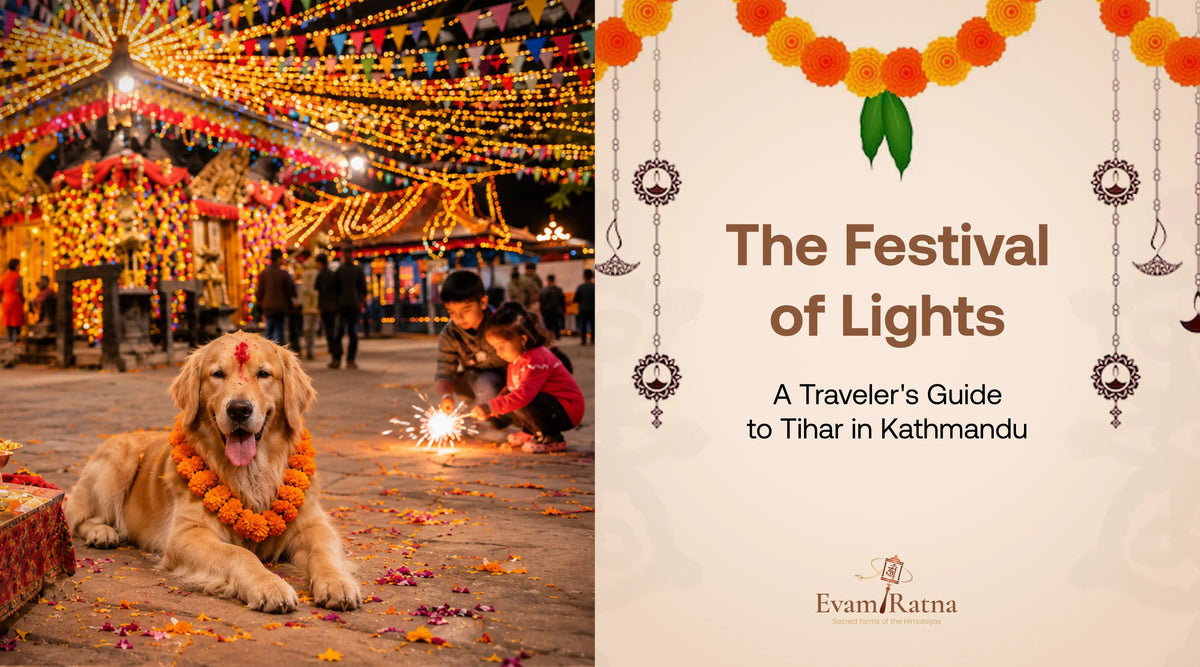
Families and shopkeepers apply a red tika to the dog's forehead, hang a marigold garland around its neck and offer a special meal. Dogs wander the streets in bright garlands, calm and entirely unbothered by the attention.
What you will see: Garlanded street dogs, police dogs receiving tika at their stations, and dogs resting in temple courtyards.
Traveler tip: Offer a biscuit or a flower to a friendly dog, but keep your distance from animals that seem nervous.
Day 3: Gai Tihar and Laxmi Puja, the Night of Lights

The third day is the heart of the festival, with two faces: a morning for the cow and an evening for the goddess of prosperity.
Gai Tihar: Honoring the Cow
The cow is revered as a manifestation of Laxmi herself, giver of milk, farmland and household wealth. Families wash her, mark her forehead with tika, drape her with marigold garlands and offer fresh grass. Cow dung, regarded as purifying, is often used to cleanse thresholds and floors before the evening puja. In some years, as in 2026, the calendar places cow worship on the morning after Laxmi Puja.
Laxmi Puja: Welcoming the Goddess
At dusk, the festival becomes spectacular. Laxmi is believed to visit only homes that are clean, bright and welcoming, so families sweep and scrub every corner beforehand. At sunset they light rows of oil lamps (diyo) and candles along windowsills, doorways and rooftops, and trace small footprints from the front door toward the family altar to guide the goddess inside.
At the threshold of nearly every home you will see rangoli, intricate designs made from coloured powder, rice and flower petals. Inside, the family offers incense, flowers, fruit and sweets. Shopkeepers also honor Laxmi on this night, and doors are traditionally left open so she may enter.
What you will see: Whole neighborhoods glowing in warm gold, temples draped in lights, and the narrow lanes of Thamel, Patan and Bhaktapur shimmering under a thousand small flames.
Traveler tip: Plan an early dinner and then walk. The most magical hour is just after sunset, when the lamps are freshly lit. Many travelers climb to a rooftop terrace, or to Swayambhunath, for a view of the valley sparkling below.
Day 4: Goru Tihar, Govardhan Puja and Mha Puja
The fourth day carries three observances, each rooted in a different part of the valley's cultural world.
Goru Tihar. The ox, quiet partner of the farming household, is bathed, garlanded and fed in gratitude for pulling the plough and carrying the harvest.
Govardhan Puja. This day commemorates Lord Krishna lifting Mount Govardhan to shelter his village from storms. Families shape a small mound of cow dung to represent the mountain and worship it with flowers and offerings.
Mha Puja: Worshipping the Self

For the Newar community, the fourth evening is the most distinctive celebration of Tihar. Mha Puja means "worship of the self" or "worship of the body" in Nepal Bhasa. It is also the first day of the Nepal Sambat new year, which in 2026 begins the year 1147.
Each family member sits in turn on a small mandala drawn on the floor with coloured rice flour, mustard oil and vermilion. A senior woman circles the person with oil, water and flowers and offers lamps, fruit and sweets. The ritual honors the inner soul and life force, a quietly profound idea of self-respect, purification and fresh beginnings. A shared feast follows.
Traveler tip: Mha Puja is a family ritual, usually observed inside homes. If you are invited into one, accept with gratitude, remove your shoes and follow your hosts' lead.
Day 5: Bhai Tika, the Blessing of Siblings

The final day is the most emotional for many Nepalis. On Bhai Tika (Kija Puja among the Newars), sisters pray for the long life and protection of their brothers, while brothers promise their care and offer gifts in return.
The ritual follows: Brothers sit on a prepared seat while their sisters trace a circle of oil and water around them. The sister then applies a multicolored saptarangi tika, a line of seven colours, to the brother's forehead, places a garland of marigold or globe amaranth around his neck, and offers fruit, nuts and sweets. Globe amaranth, locally called makhamali, wilts slowly, a symbol of the lasting wish for longevity.
Bali and Yamuna (the reason for the oil, the tika and the makhamali)
A man named Bali (in one telling, the Kirat king Bali Hang) fell gravely ill. When Yama came to take his soul, his sister Yamuna asked to worship her brother first. She then set her conditions: Yama could not take Bali until the tika on his forehead faded, the makhamali garland wilted, the water on his body dried, and the oil barrier around him evaporated. Yama agreed. Every year he sent messengers to check, but the makhamali never wilted. Moved by the sister’s devotion, Yama granted Bali a long and healthy life. Sisters repeat these acts on Bhai Tika for the same wish.
What you will see: Families in their best clothes, brilliant forehead tikas, and a warm, celebratory mood. Cousins and friends also give tika to one another, and foreign guests welcomed into a home are sometimes included as honorary siblings.
Traveler tip: Bhai Tika is home-centered, so streets are quieter. If you have local friends or a host family, this is the day to ask whether you may join them.
Deusi-Bhailo: The Singing Sound of Tihar Nights
Tihar also has a musical heartbeat. From Laxmi Puja evening onward, groups of children and young people go from house to house singing and dancing in a tradition called Deusi-Bhailo. One person leads the verse and the group answers with the refrain "Deusi re," wishing the household prosperity and health. In return, the family offers money, fruit or sweets.
If a group arrives at your hotel door, smile, listen to the verse and tip generously. They will usually answer with a blessing.
Where to Experience Tihar in Kathmandu Valley
- Pashupatinath Temple: Nepal's holiest Shiva temple is lit with lamps and visited by large crowds. The riverbanks glow in the evening. Remain respectful of the funeral rites that continue throughout.
- Swayambhunath: The hilltop stupa overlooks the valley. At dusk, butter lamps and strings of lights decorate the complex, and the view over the lit city is spectacular.
- Boudhanath Stupa: One of the largest stupas in the world is encircled each evening by pilgrims lighting butter lamps, and during Tihar the kora glows with hundreds of small flames.
- Patan: The cultural home of the Newar artisan tradition, where master metalworkers still cast sacred statues and ritual objects by hand. Its old lanes are among the best places to witness Mha Puja and rangoli.
- Bhaktapur: This medieval city's brick-lined squares are beautifully lit, and its evenings are calmer than Kathmandu's.
- Thamel and Asan: Thamel is lively and decorated, while Asan Bazaar is crowded with shoppers buying lamps, flowers and sweets before Laxmi Puja.
- Rani Pokhari: The temple in the middle of this historic pond opens to the public only once a year, on Bhai Tika.
Etiquette and Practical Tips for Visitors
- Dress modestly: Cover shoulders and knees at temples, and remove shoes before entering homes and sacred spaces.
-
Ask before photographing: Always ask permission before photographing family rituals or people receiving tika, and avoid flash during worship.
- Accept tika graciously: Receive a tika or blessing with a gentle namaste, and never wipe it off in front of the giver.
- Expect closures: Many shops and restaurants close from Laxmi Puja through Bhai Tika. Book hotels and transfers early, and keep small notes for tipping Deusi-Bhailo groups.
- Expect noise and crowds: Evenings can be loud around Laxmi Puja. If you are noise-sensitive, choose quieter parts of Patan or Bhaktapur.
- Pack for November: Days are sunny, evenings are cool, and mountain views are among the clearest of the year. A light jacket and walking shoes are enough.
Carrying the Light of Tihar Beyond November
Tihar in Kathmandu is more than a festival of lamps. Across five days, it asks us to thank the crow at the window, the dog at the gate, the cow and the ox that sustain the household, the goddess who is welcomed into a clean home, and the sister who prays for her brother’s long life. Its deepest message is gratitude: no being is outside the circle of the sacred, and even death is met with love.
If you plan to visit Kathmandu Valley for Tihar 2026, come with an open heart. Ask before you photograph, accept a tika with a gentle namaste, and let the glow of a thousand diyo lamps guide you through Patan, Bhaktapur and the old city lanes.
May the light of Tihar stay with you long after the festival ends. Happy Tihar!