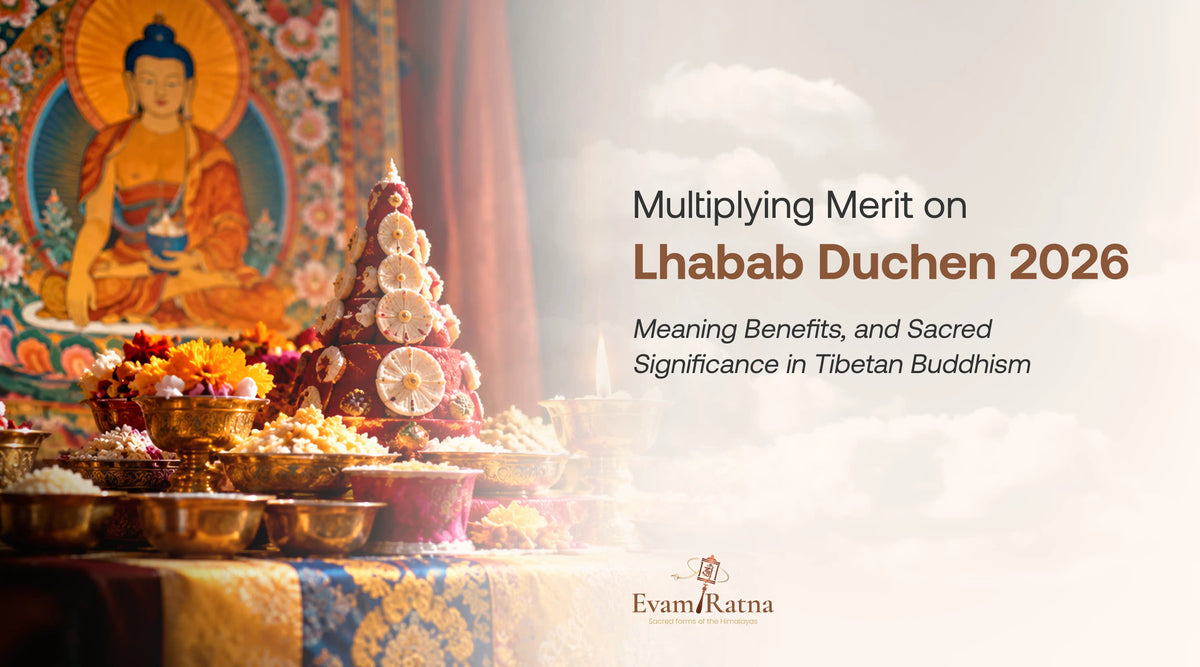
Lhabab Duchen 2026: Honoring the Buddha’s Divine Return with Ritual Chopa
In 2026, Lhabab Duchen observed on Sunday, 1 November, an auspicious festival that honors the Buddha’s return to the human world after three months of teaching the Dharma in the Heaven of the Thirty-Three, where he repaid the kindness of his mother, Mayadevi. For practitioners worldwide, it is both a historical remembrance and a powerful merit-multiplying day, when the karmic effects of every action are said to be magnified one hundred million times. At the heart of this celebration lies the practice of ritual chopa, the Tibetan word for offering. By understanding the history this holy day commemorates, we can see how devotional actions, from a humble bowl of clear water to a communal feast of tsog, express profound gratitude, generosity, and devotion.
What is Lhabab Duchen?

Lhabab Duchen (Tibetan: lha babs dus chen) means "the Great Occasion of the Descent from the Gods." It is one of the four great holy days, or Duchen, of the Tibetan Buddhist calendar. Each of the four marks a major event in the life of Buddha Shakyamuni:
- Chotrul Duchen: The Day of Miracles, recalls the wonders the Buddha displayed at Shravasti during the first lunar month.
- Saga Dawa Duchen: Honors the Buddha's birth, enlightenment, and parinirvana, traditionally held on the full moon of the fourth lunar month.
- Chokhor Duchen: Celebrates the first turning of the wheel of Dharma at Sarnath.
- Lhabab Duchen: Commemorates his return to the human realm after teaching in the heavens.
Together these days form a yearly rhythm of remembrance. Of the four, Lhabab Duchen is especially tender in tone, because it celebrates a teacher's gratitude toward a mother and a mother's devotion to the teaching that liberates.
The Story of the Buddha's Descent
The story of Lhabab Düchen begins with Queen Mayadevi, who passed away seven days after giving birth to the future Buddha and was reborn in the God Realm of the Thirty-Three, the heaven of Trayastrimsa. Years after his enlightenment, the Buddha ascended there to repay her kindness. During the summer rains retreat he spent three months teaching the Dharma to his mother and to the assembled gods, many of whom attained deep realization.
When the retreat ended, humanity longed for their teacher. The tradition tells that the Buddha descended to earth by a ladder of jewels, with the god Indra on his on his left and the god Brahma attending him on his right side. He alighted at Sankasya, in present-day northern India, where a vast crowd of monks, nuns, kings, and lay followers had gathered to receive him. Some popular accounts name Tushita as the heaven he visited, but the classical teaching on this holy day places the Buddha's ministry in the Heaven of the Thirty-Three.
The story carries a simple lesson that practitioners treasure: gratitude is part of the path. The Buddha's journey to teach his mother is understood as an expression of compassion extended first to those closest to us and then to every living being.
Lhabab Duchen 2026: Date and the Meaning of a Merit-Multiplying Day
Lhabab Duchen falls on the twenty-second day of the ninth month of the Tibetan lunar calendar, so its date on the Gregorian calendar shifts every year. In 2026 it was observed on Sunday, 1 November, which is also the closing day of the Buddha days for the year.
Lhabab Duchen is widely known as a merit-multiplying day. In the Tibetan tradition, the results of actions performed on the four Duchen are taught to be multiplied many times over, with one hundred million times being the figure most often cited. The teaching works in both directions. Virtuous actions grow powerfully, which is why practitioners are encouraged to be generous, to recite mantras, to read sutras, and to keep their ethics carefully. Harmful actions also grow, which is why the day is a natural time to slow down, watch the mind, and choose kindness.
For many people, the day is a time for reflection, gratitude, and rejoicing in the countless acts of loving-kindness and Dharma activity taking place around the world. Rejoicing is itself a practice. When we delight in the goodness of others, we share in the merit of their actions without diminishing it.
What Does Chopa Mean in Tibetan Buddhism?

Chopa (Tibetan: mchod pa) is the Tibetan word for offering and worship. A chopa offering is any gift made with reverence to the objects of refuge: the Buddha, the Dharma, and the Sangha. It can be material, such as water, light, flowers, and food. It can also be mental, such as the visualized offering of a limitless universe, or behavioral, such as keeping vows and practicing compassion.
If you wonder Why does an enlightened being need our offerings? The Buddha does not. The benefit flows to us. Offering is a direct antidote to miserliness and clinging, and it gathers merit, the positive potential that supports the growth of wisdom. Tibetan teachers describe the two accumulations of merit and wisdom as the two wings of a bird: both are needed to reach awakening.
A second reason is relational. Offering expresses respect for the sources of the path, in the same way that we thank a teacher who has changed our lives. On Lhabab Duchen, a day that celebrates the Buddha's return to teach, that gesture of thanks feels especially natural.
The Eight Outer Offerings: Water, Flowers, Incense, Light, and More
The most familiar form of chopa is the set of eight outer offerings, drawn from the ancient Indian custom of welcoming an honored guest. Each offering corresponds to a gesture of hospitality and also to one of the senses:
- Drinking water (argham): welcomes the guest and quenches thirst.
- Water for the feet (padyam): refreshes the guest after a journey.
- Flowers (pushpe): delight the eyes and speak of beauty and impermanence.
- Incense (dhupe): perfumes the air and represents pure ethics.
- Light (aloke): dispels darkness and symbolizes wisdom.
- Perfumed water (gandhe): soothes and cools the body.
- Food (naivedya): nourishes the body and mind.
- Music (shabda): pleases the ears and awakens joy.
In many homes and temples, these offerings are arranged as a row of seven water bowls, with the eighth, music, expressed through a bell, a conch, or the sound of mantra. Water is traditionally chosen because it is clean, abundant, and available to everyone. Even a practitioner with very little can offer a bowl of water with the same sincerity as a king offering gold.
The classic teaching holds that what matters is not the value of the gift but the purity of the mind that offers it. A single butter lamp, sincerely lit with a wish for all beings to find freedom from ignorance, carries immense significance.
Inner, Secret, and Suchness Offerings
Tibetan Buddhism describes four levels of offering, moving from the visible to the profound.
Outer offerings are the physical gifts described above: water, flowers, incense, lamps, and food. They are the foundation of most practitioner's daily practice.
Inner offerings transform ordinary experiences into ambrosia. The best-known example is the tsog, or feast offering, in which food and drink are blessed and then offered, shared among the community, and enjoyed with gratitude. Tsog gatherings often accompany holy days and anniversaries, and many Dharma communities hold them on Lhabab Duchen.
Secret offerings belong to the tantric path and involve offering blissful awareness itself. They are practiced under the guidance of a qualified teacher and are explained within the context of initiation.
Suchness offerings are the most subtle: offering with the wisdom that realizes the emptiness of the giver, the gift, and the receiver. At this level, the offering is perfectly pure because it is free of clinging.
A related and beloved practice is the mandala offering, in which a practitioner visualizes the entire universe, arranged in the form of Mount Meru, its continents, and the wealth of gods and humans, and presents it to the Buddhas. Because it requires only rice, a plate, and the imagination, it is one of the most generous offerings anyone can make.
How to Prepare a Chopa Offering at Home?

You do not need a grand shrine to honor Lhabab Duchen. A clean shelf, a quiet corner, and a sincere heart are enough. The following approach reflects widely taught Tibetan custom, and your own teacher may offer slightly different guidance.
- Clean the space: Dust the altar and wipe the bowls. Cleanliness is an expression of respect.
- Set your motivation: Before you begin, wish to offer for the benefit of all beings, not merely for your own happiness.
- Arrange the bowls: Place seven bowls in a straight row, spaced evenly, using bowls without chips or cracks. Many practitioners leave the gap between bowls at about the width of a grain of barley, a detail taught as a reminder of care and precision.
- Pour slowly and mindfully: Fill each bowl with clean water, pouring a thin stream, while reciting OM AH HUM. Fill to a short distance below the rim, never to the brim, so the water remains still and clear.
- Add light and incense: Light a butter lamp or candle and a stick of incense, offering them with the thought that wisdom may dispel the darkness of ignorance in every being.
- Recite and reflect: Say prayers or mantras that you know, or simply sit in silence and contemplate the Buddha's compassion.
- Dedicate: End by sharing the merit with all beings (see Section 9).
- Clear the offerings in the evening: Traditionally the water is poured out and the bowls are wiped dry and turned upside down, so that they are never left empty while upright.
Treat the practice with ease. If you make a small mistake, correct it gently and carry on. The Buddha taught that the heart is the field in which these offerings grow.
Offerings That Reach Beyond the Altar
On Lhabab Duchen, offering extends across the Buddhist world, communities and individuals engage in a rich range of meritorious activities:
- Honoring sacred sites: In Nepal, the great stupas of Boudhanath and Swayambhunath are freshly painted, and new umbrellas are offered to their pinnacles. In Bodhgaya, India, a new set of robes is offered to the main Buddha statue at the Mahabodhi Temple.
- Printing the Dharma: Precious texts such as the Golden Light Sutra, the Arya Sanghata Sutra, the Vajra Cutter Sutra, the Sutra of Great Liberation, and the Amitayus Long Life Sutra are printed and distributed, so that the Buddha's words may reach new readers.
- Making sacred images: Communities sponsor tsa-tsas, small molded images of stupas and deities such as Mitukpa, the Three Long Life Deities, and Kadampa stupas. These are placed in clean, respectful locations as blessings for the surrounding area.
- Saving lives: Animal liberation, in which living beings are rescued and protected, is a direct expression of compassion. In some programs, hundreds of animals are liberated on this single day.
- Supporting the Sangha: Offerings of food, funds, and requisites to ordained monks and nuns help maintain pujas, prayers, and study. Supporting the Sangha creates the conditions for the precious teachings to be preserved, practiced, and passed on to future generations.
- Honoring great teachers: In many communities this year, tsog and other offerings also mark the anniversary of the parinirvana of Zong Rinpoche, a master whose teachings continue to inspire students across many cultures.
In Kathmandu Valley, visitors often feel this atmosphere in the early morning hours, when devotees circle the stupas, light lamps, and recite mantras. If you are fortunate enough to be present, walk quietly, move clockwise, and let the day's generosity wash over you.
Motivation and Dedication: The Heart of Every Offering
Two moments frame every Buddhist offering: the motivation at the beginning and the dedication at the end. Between them, the physical actions are carried by the quality of the mind.
- Motivation: The ideal motivation is bodhicitta, the wish to attain enlightenment in order to free all beings from suffering. An offering made with this attitude is vast in scope even if the gift is small. If bodhicitta feels distant, begin with a simpler aspiration: may this offering bring happiness to others.
- Dedication: Known in Sanskrit as parinamana, dedication directs the merit toward awakening for all beings. Teachers compare it to pouring a drop of water into the ocean: once merged, the drop cannot be lost. A simple dedication might be: "By this merit, may all beings find happiness and its causes, and be free from suffering and its causes."
Practitioners also reflect on the three spheres: the one who offers, the object offered, and the one to whom the offering is made. Seeing these as dependently arisen, like reflections in water, frees the offering from grasping and pride. This is the secret that turns a simple gift into a source of wisdom.
Choosing Sacred Objects for Your Offering Practice
A thoughtfully made bowl, lamp, or incense burner can nevertheless help a practitioner feel the dignity of the ritual and return to it day after day. When selecting items for your altar, a few simple considerations are worth keeping in mind.

- Material and finish: Traditional offering bowls are made of brass, copper, or other sacred metals, and their polished surface reflects light in the way that water and flame do. Choose bowls with a smooth, unchipped rim and a stable base.
- Craftsmanship: In the Kathmandu Valley, many ritual objects are shaped by Newar artisans of Patan, who have inherited metalworking and sculpting skills across generations. Objects made with devotion and technical care carry the lineage of the hands that formed them. At Evamratna, we source our altar essentials from these Patan artisans, so that an offering bowl or butter lamp on your shrine connects you with the living Himalayan tradition.
- Simplicity: A small set of well-chosen objects is better than a crowded altar. A row of seven bowls, a lamp, and an incense holder are all you need to begin.
- Respectful placement: Place offering items on a clean, elevated surface above waist level, and avoid placing anything on the floor. Keep the altar free of clutter and treat each item with care, as you would treat a gift for an honored guest.
Ultimately, the finest offering is a sincere mind. An altar set with simple bowls and clear water, offered with faith, is more precious than a hall of gold offered without care.
Read More About Ten Offerings and Their Blessings: A Practitioner's Guide to the Vajra Sutra
Conclusion
Lhabab Duchen invites us to remember a moment of great tenderness: a teacher returning from the heavens, guided by gratitude and compassion, to share a path of freedom with the world. The ritual of chopa offering turns that remembrance into action. Through a bowl of water, a flame, a stick of incense, a printed sutra, a gift to the Sangha, or a life saved, we practice generosity and prepare the mind for wisdom. Although the great day has passed, the merit of its practice does not need to end. Bowls can be filled each morning, lamps lit each evening, and every offering dedicated for the welfare of all beings. May your offerings be pure, your motivation vast, and your merit shared without limit.