The Meaning and Merit Behind the Ten Buddhist Offerings
In Buddhist practice, making offerings before the Buddha is an invitation to open the heart and deepen one's spiritual intent. Traditionally, practitioners present incense, flowers, lamps, and other items to cultivate sincerity, generosity, and mindfulness as part of their own inner transformation. The Vajra Sutra outlines ten kinds of offerings, from lighting lamps to simply bringing hands together in respectful prayer, showing that even simple offerings can be meaningful. Each type of offering is taught as a way to develop virtue and accumulate merit, reminding us that even humble, sincere gestures have the power to nurture spiritual growth and blessing
What is the Vajra Sutra?
The Vajra Sutra, more widely known by its Sanskrit title, the Vajracchedika Prajnaparamita Sutra, or "Diamond Sutra", is one of the most revered texts within the Prajnaparamita ("Perfection of Wisdom") literature of Mahayana Buddhism. Its central teaching concerns the nature of emptiness, non-attachment, and the dissolving of fixed concepts, including the concept of "offering" itself.
Commentarial traditions built around the sutra, particularly those associated with twentieth-century teachers explaining the text to lay audiences, expanded on a teaching of ten traditional offerings to the Buddha. These ten are not unique to the Vajra Sutra alone; they echo offering categories found across Mahayana and Vajrayana liturgy, but the sutra's framing gives them a particular weight: an offering's value lies not in its material cost, but in the wholeheartedness behind it.
This teaching resonates deeply within Tibetan and Himalayan Buddhist practice, where the seven-limb offering, the torma, the butter lamp, and the mandala offering all draw from the same well of devotional logic.
The Ten Offerings of the Vajra Sutra: Cultivating Sincerity and Devotion
The Ten Offerings form a practical guide for devotional practice that highlights how the merit of giving arises from heartfelt intention rather than material value.
1. Incense

Of all material offerings, incense is given pride of place. Its holy smoke rises and disperses outward, a natural metaphor for merit and good intention spreading without limit. Traditional teaching holds that the offering should be the finest a practitioner can sincerely afford, not the cheapest available; the value is measured by the heart's investment, not the price tag alone.
The legendary "Ox-head Sandalwood" (Gosirsa-candana) incense mentioned in Buddhist scripture is described as so fragrant it could be perceived for miles when burned during the Buddha's teaching assemblies, an image meant to convey not literal radius, but the boundlessness of a sincerely offered gift.
In Himalayan households, this teaching lives on in the daily ritual of lighting Tibetan incense before a shrine, often paired with Tibetan incense burners crafted in repoussé copper or cast bronze. The rising holy smoke is considered an offering pleasing to all buddhas and protective deities alike, and the resulting merit, a body free of affliction, traditionally described as "fragrant", is understood symbolically as freedom from the residue of negative karma.
2. Flowers

Flowers represent impermanence and beauty offered without grasping, cut at their peak, given freely, allowed to wilt without regret. The Vajra Sutra's teaching links flower offerings to the merit of perfect features in future rebirths, but the deeper instruction is about non-attachment: beauty is offered, not hoarded.
In Tibetan ritual practice, fresh or symbolic flowers are placed in offering bowls alongside the seven-bowl water offering (yon chab), and flower motifs recur throughout sacred art, carved into thangka borders, painted onto mandala perimeters, and shaped into the lotus pedestals beneath nearly every Buddhist statue. The lotus itself, rising clean from muddy water, is the master symbol of this offering: purity that does not depend on a pure environment to exist.
3. Butter Lamps

Click Here To View Our Collection of Sacred Offering Butter Lamps
Light offerings hold a singular place in Buddhist devotion because they directly symbolize wisdom dispelling ignorance. The Vajra Sutra's teaching is direct: light a lamp before the Buddha, and in future lives the eyes, both physical and spiritual, will be clear.
This is the origin of the Pañcacakṣu, the Five Eyes spoken of across Mahāyāna literature: the Flesh Eye, the Heavenly Eye, the Wisdom Eye, the Dharma Eye, and the Buddha Eye, a progressive unfolding of perception culminating in the omniscient awareness of full enlightenment.
The Butter lamp, or marme, remains the most iconic embodiment of this offering across the Tibetan plateau and Himalayan world. Rows of lit lamps before a shrine, their small flames steady in still air, are considered one of the most powerful and accessible offerings a practitioner can make, requiring little material cost but carrying profound symbolic weight.
4. Necklaces and Jewels
Precious ornaments, necklaces, gemstones, and fine jewelry are offered as gestures of placing one's most valued possessions before the object of devotion. This is not a transaction; it is a relinquishing. The practitioner sets down what is materially precious to express what is, to them, the truly precious thing: the Dharma itself.
In Vajrayana iconography, this offering is echoed visually in the elaborate jeweled ornamentation worn by deities and bodhisattvas in statues and thangka paintings, crowns, earrings, and necklaces rendered in gold leaf and semi-precious stone inlay, signifying the enlightened qualities adorning a mind free of obscuration.
5. Jeweled Parasols
The ceremonial parasol, or chatra, is among the Eight Auspicious Symbols (Aṣṭamaṅgala) of Tibetan Buddhism, traditionally signifying protection from harm and the shading of all beings from the heat of suffering and affliction. Offering a parasol, whether literal or as part of a temple's adornment, expresses the wish that the Buddha's protection extend over all sentient beings without exception.
Parasols are frequently depicted held above the heads of high lamas and important deities in thangka compositions, marking dignity, spiritual authority, and benevolent shelter.
6. Banners and Canopies
Painted or embroidered banners, along with jeweled canopies hung above a shrine, complete the visual grandeur of a Buddhist hall. The dhvaja, or victory banner, is another of the Eight Auspicious Symbols, representing the Buddha's triumph over the four maras, the forces of death, distraction, pride, and afflictive emotion.
Offering a banner is an offering of victory itself: a dedication of one's own small triumphs over distraction and doubt to the larger path of awakening. Canopies, meanwhile, echo the celestial canopy said to have appeared spontaneously above the Buddha during his enlightenment, sheltering the moment of realization.
7. Clothes
Fine garments, made or purchased with care, may be placed upon the altar before being worn, a gesture acknowledging that even daily necessities can become acts of devotion when offered first. The instruction traditionally specifies upper garments, reflecting the historical Vinaya custom of monastic robes being offered to images of the Buddha before being donned by the practitioner.
The deeper teaching is one of sequencing: placing devotion before personal use, even symbolically, recalibrates the practitioner's relationship to material things, using them, but not being used by them.
8. Fruit and Food
Food offered before a shrine, before being eaten, is a near-universal feature of Buddhist domestic practice. It need not be elaborate, a piece of fruit, a small bowl of rice, a cup of tea, but it must be offered first, with the understanding that nourishment itself is a gift worth acknowledging before consuming.
This practice continues daily in Himalayan households through the offering of the seven water bowls and small food offerings placed before statues of Buddha, Bodhisattvas or taras each morning, refreshed and renewed as part of a living, ongoing relationship with the sacred rather than a one-time ritual act.
9. Music
Sound, too, is an offering. Temple music, the deep resonance of the dhyangro drum, the ringing of hand bells, the low rumble of the damaru, chant and recitation, fills sacred space and is understood to please both buddhas and protective deities while settling the practitioner's own mind into a receptive state.
Monastic instruments carry this dual function in Himalayan ritual: they are practical tools for marking the stages of a ceremony, and simultaneously offerings in their own right, each strike of a gong or note of a horn dedicated outward as merit.
10. Joined Palms
The tenth offering requires no purchase, no preparation, and no wealth at all: the simple joining of the palms in front of the heart, the gesture known as anjali mudrā. It is, in many respects, the offering that completes and underlies all the others, present the moment one bows before a shrine, recites a mantra, or simply pauses with respect.
This final offering is the great equalizer of the list. A practitioner without means for incense, flowers, or fine cloth can still, in any moment, offer this gesture completely and sincerely, and the tradition holds this offering as no lesser than any other.

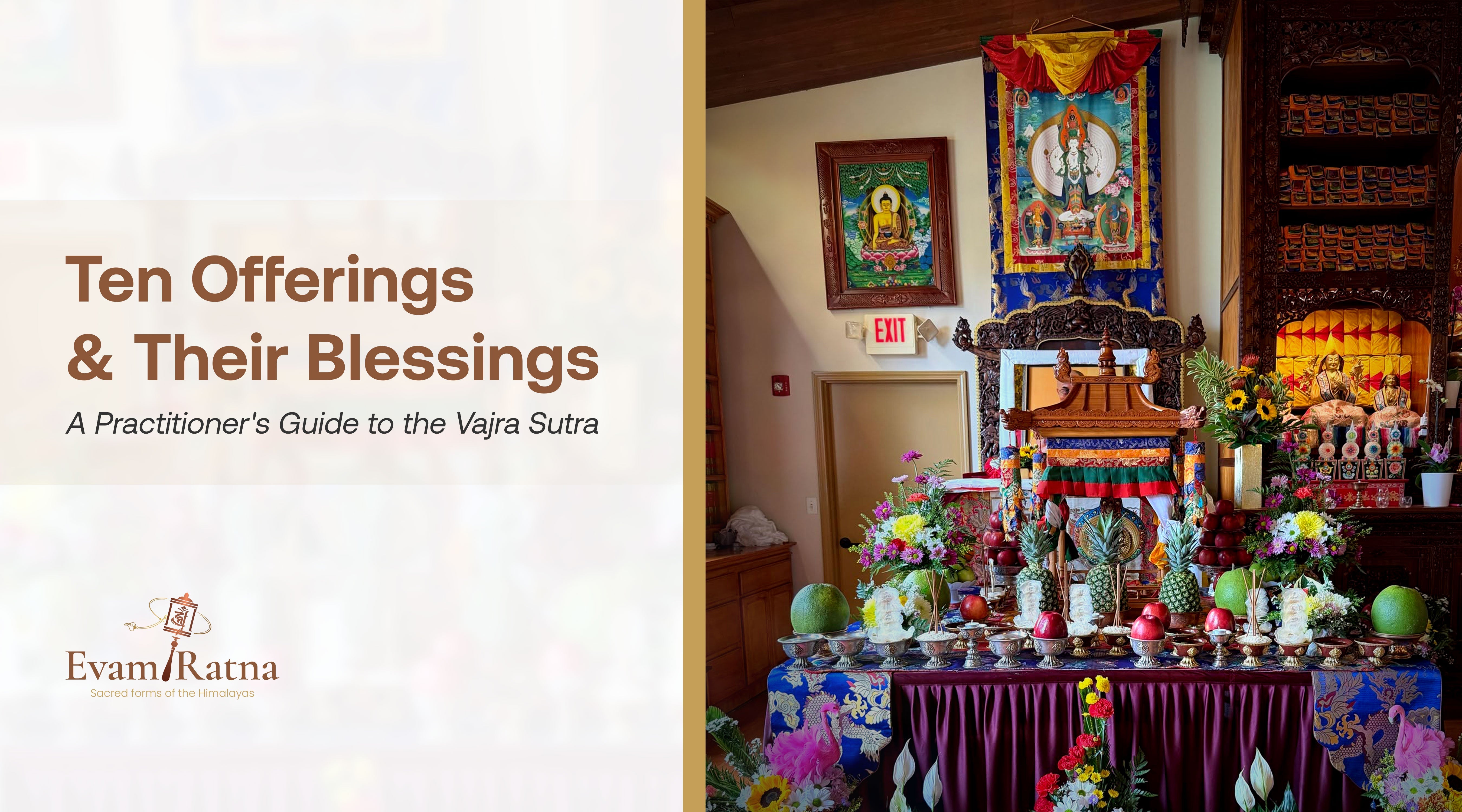
(Image from Drepung Loseling Monastery)
Why Sincerity Matters More Than Wealth?
A consistent thread runs through all ten offerings: it is the quality of intention, not the price of the object, that determines the merit generated. A modest stick of incense given with full sincerity outweighs an expensive offering given carelessly or for show. This is not merely a comforting idea for those of limited means; it is a precise teaching about the mechanics of merit itself, which the Vajra Sutra's broader philosophy of non-attachment supports directly. An offering made while grasping at the idea of merit, or made for outward display, is understood to generate considerably less benefit than one made with simple, unselfconscious devotion.
Bringing the Ten Offerings Into Your Own Practice
These ten categories translate naturally into a home shrine practice. They need not be elaborate; most can be approximated with simple, accessible items, and the tradition has always valued sincerity over expense.
- Incense: Lit a stick each morning or during meditation.
- Flowers: Place fresh or silk flowers near a statue or thangka.
- Lamps: Lit a butter lamp before practice.
- Jewels/ornaments: Adorn a statue with a simple necklace, khata (ceremonial scarf), or small ornament.
- Parasol/canopy: Arrange the shrine carefully to represent a parasol or canopy.
- Banners: Hang prayer flags (lungta) or painted banners near the practice space.
- Clothing: Drape fabric on the altar or offer robes to a statue.
- Food: Offer the seven-bowl water set or a small dish of fruit.
- Music: Ring a bell, play a singing bowl, or use recorded chants during practice.
-
Joined palms: Bring the palms together at the heart (anjali mudra) while bowing, reciting, or pausing before the shrine.
A complete shrine need not include all ten at once. Many practitioners build their offering practice gradually, adding implements over months or years as understanding and resources allow.
Read More About Creating a Peaceful Buddhist Altar: A Simple Beginner’s Guide
Conclusion:
The ten offerings of the Vajra Sutra ask very little and offer, in return, a complete framework for devotional life, one that scales from the simplest gesture of joined palms to the most elaborate temple adornment, without ever privileging wealth over wholeheartedness. Each object placed before a shrine, each lamp lit, each note of a bell, becomes a small act of relinquishing self-concern in favor of reverence. In a tradition that ultimately teaches the emptiness of all fixed forms, including the form of "offering" itself, these ten gestures remain remarkably alive: simple doorways into a state of mind that asks for nothing more than sincerity.