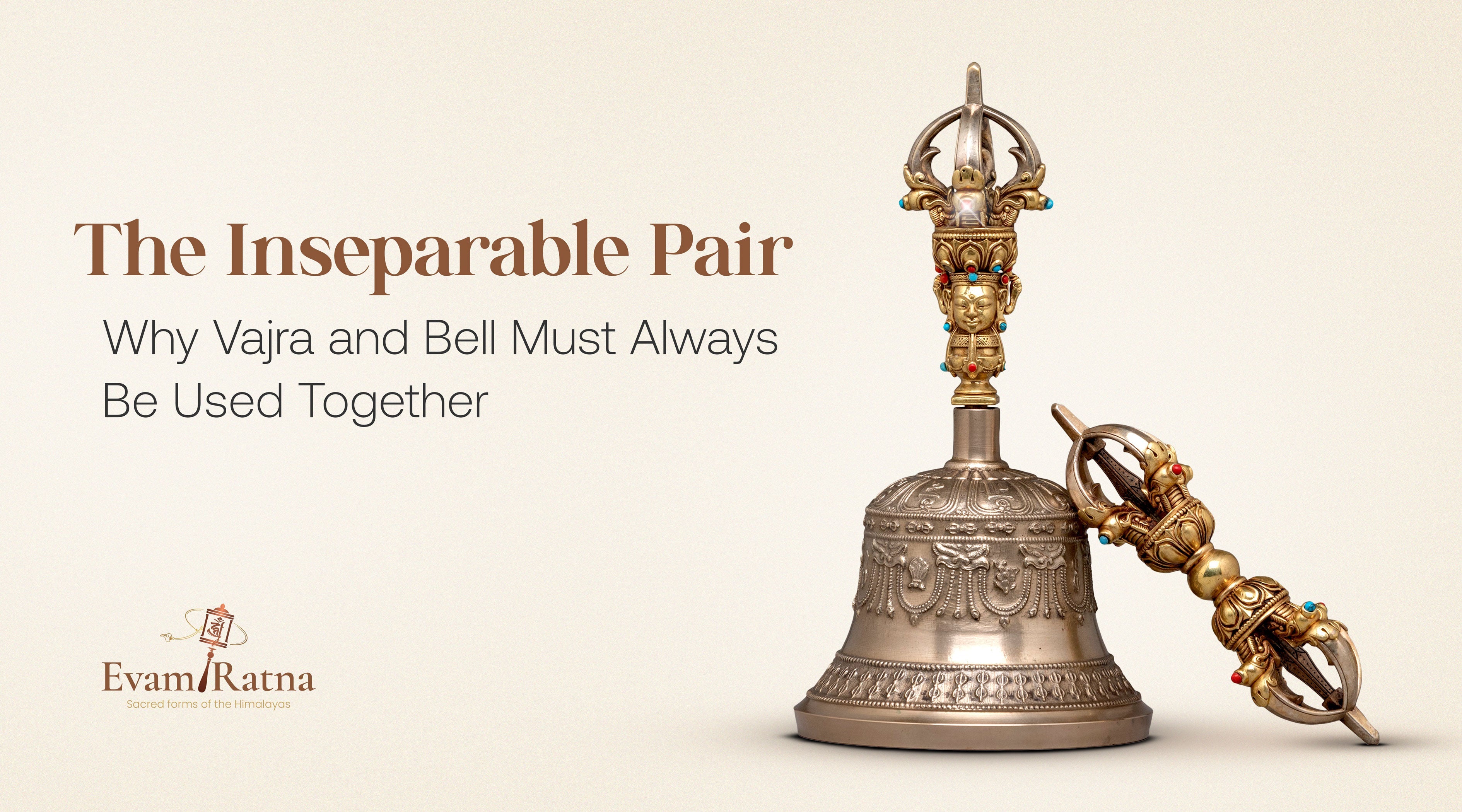
Vajra and Bell: Why These Two Ritual Objects Can Never Be Used Separately?
Walk into any Vajrayana shrine room in a Himalayan monastery, a practitioner's home altar, or a teacher's ritual table, and you will always see vajra and bell together. These two symbols represent the union of wisdom and compassion, essential elements in Vajrayana practice. The Vajra (Dorje) rests to the left of the Bell (Ghanta/Drilbu), ideally touching. They are never placed across the room from each other. They are never stored in separate boxes, nor are they used in isolation during sadhana. In Tibetan Buddhist tradition, the act of separating them is not only incorrect; it is also conceptually incoherent.
The Vajra and Bell are inseparable because they embody a single, indivisible truth at the heart of Vajrayana Buddhism: that wisdom (prajna) and compassionate method (upaya) are not two things that happen to cooperate. They are two faces of the same awakened reality. You cannot hold one without the other, in ritual or in life.
Vajra (Dorje): Meaning and Symbolism

The Sanskrit word "vajra" has two meanings: diamond and thunderbolt. This duality is intentional. A diamond is perfectly pure, indestructible, and transmits light without altering it. A thunderbolt strikes with immense force, removing obstacles with a single, precise blow. Together, these concepts illustrate the essence of awakened compassion, infinitely powerful and entirely purified.
In its earliest Indian context, the vajra was the weapon of Indra, king of the Vedic devas, crafted from the bones of the sage Dadhichi to destroy the demon Vrtra. When Vajrayana Buddhism absorbed and transformed this mythology, the vajra ceased to be a weapon against external enemies. It became the precise instrument of liberation from inner ones: ignorance, attachment, and aversion.
Physically, a traditional five-pronged Vajra (the most common form) is structured with deep intentionality:
- The central sphere (bindu) represents the underlying nature of all phenomena, Sunyata, emptiness, sealed by the seed syllable Hum.
- Three rings on each side symbolise the threefold bliss of Buddha-nature.
- Two lotus bases represent Saṃsara and Nirvaṇa, the entire arc of existence
- The Makara mouths from which the prongs emerge represent the five poisons being transformed into the five wisdoms
- The five prongs correspond to the Five Dhyāni Buddhas, the five aggregates, and the five wisdoms
- Closed prongs signify the perfection of upaya, skillful means brought to full completion
In Vajrayana practice, the Dorje is held in the right hand, which in classical Indic symbolism is associated with the masculine principle, not male gender, but the active, outward-moving energy of compassionate action in the world. It represents method: how awakening moves through form.
Bell (Ghanta/Drilbu): Meaning and Symbolism

The Bell, called Ghanta in Sanskrit or Drilbu in Tibetan, is among the most sacred instruments in Tantric Buddhist ritual. Its sound is considered auspicious, said to drive away negative forces and announce the presence of the sacred. But its role is far more than ceremonial. It represents prajna, wisdom, specifically the Perfection of Wisdom (Prajnaparamita) that directly perceives the emptiness of all phenomena. The open hollow of the bell represents Sunyata, the void from which sound arises and into which it dissolves. The clapper, or tongue, represents form arising within that emptiness. Every ring of the bell is thus a live enactment of the Heart Sutra's central proclamation: form is empty, emptiness is form.
The Bell is held in the left hand, associated with the feminine principle in Indic symbolism. This is not to be taken as passivity, but as the capacity of wisdom to realise inward, directly apprehending ultimate truth. Where the Vajra moves outward as compassion in action, the Bell turns inward as the still knowing that makes all action possible. The Bell's sound is described in traditional sources as the sound of emptiness; it arises from nowhere, permeates everywhere, and silence returns. This is not poetry; it is a precise phenomenological description of how prajñā functions. Wisdom is not a fixed object. It arises, illuminates, and dissolves without leaving a trace, never grasping, never distorting.
Together, the Vajra and Bell represent what Tibetan teachers call yab-yum in its most distilled form: the union of method and wisdom as the complete path to Buddhahood.
The Philosophy Behind the Vajra and Bell: Upaya and Prajna

In Mahayana and Vajrayana Buddhism, the path to full awakening rests on two inseparable wings:
- Upaya (Skillful Means/Method): The compassionate capacity to act in the world, to teach, to guide, to respond to beings exactly as they need to be met. Upaya is creative, responsive, and dynamic. Without it, wisdom remains unrealised in conduct.
- Prajna (Wisdom): The direct, non-conceptual recognition of how things actually are, empty of inherent existence, interdependent, without a fixed self. Without it, compassion is sentimental, easily misguided, and ultimately unable to cut through the root of suffering.
These two are described in the classical literature as the two wings of a bird. You cannot fly with one wing. A bird with only compassion and no wisdom may exhaust itself performing acts of apparent kindness that ultimately cause harm, like feeding attachment or reinforcing delusion. A bird with only wisdom and no compassion remains immobile, a light that illuminates nothing for anyone.
The Vajra, held in the right hand, is upāya made tangible. The Bell, held in the left, is prajna made audible. Their union in the practitioner's hands during ritual is not a symbol of this teaching. It is the teaching, enacted through the body, in real time. This is why Vajrayāna is sometimes called the swift path: rather than merely thinking about the union of wisdom and compassion, the practitioner becomes it through each mudra, each mantra, each ritual gesture. The implements are not props. They are transformative tools that enact the very reality they represent.
Form is Empty, Emptiness is Form: The Deeper Doctrine
At its deepest level, the inseparability of Vajra and Bell points directly to the non-dual nature of reality as articulated in the Prajnaparamita scriptures.
The Heart Sutra's famous teaching, rupam sunyata, sunyata rupam (form is emptiness, emptiness is form), is precisely what the pair enacts:
- The Vajra is rupa: form, substance, the manifest world of compassionate activity
- The Bell is sunyata: the emptiness that is the ultimate nature of all form
They are not opposites. Emptiness is not the absence of form; it is the very way form exists, without fixed, inherent, independent existence. And form is not a trap or an illusion to be escaped; it is the natural expression of emptiness in the field of experience.
The Encyclopedia of Buddhism describes this precisely: the Vajra represents the primordial state's manifestation as form, and the Bell represents the energy or essence of that which is manifest, inseparable from each other, just as the handle of the bell itself takes the form of a vajra, encoding the male principle within the body of the female.
To use one without the other would be to teach half of the Heart Sutra. It would be to say either that form is all there is, or that emptiness is all there is, both of which are the classic errors of eternalism and nihilism that the Buddha's Middle Way was designed to transcend.
How the Bell's Anatomy Encodes the Union

One of the most elegant expressions of this inseparability is the bell's own physical construction. The handle of every traditional Ghanta is itself a half-vajra; the upper portion of the handle ends in a crown of vajra prongs. The bell thus contains the vajra within its very form.
Working upward from the bell's bowl, the traditional anatomy includes:
- The open mouth of the bell: Sunyata, the resonating void.
- The vase of plenty (purnaghata): abundance, the inexhaustible energy of dharma.
- The face of Prajnaparamita: the mother of all Buddhas, wearing the crown of the Five Wisdom Buddhas, her hair bound to represent the binding of all diverse views into non-dual awareness.
- Six rings above and below the face: representing the six perfections (paramitas).
- The eight-petal lotus: the lotus-throne of the mandala's central deity.
- The vajra crown at the very top: the Five Wisdom Buddhas (Aksobhya, Amitabha, Amoghasiddhi, Vairocana, Ratnasambhava) embodied in the implement itself.
During specific ceremonies, the practitioner may insert the vajra into the opening of the bell, a deliberate act of non-dual unification, signifying the complete interpenetration of method and wisdom, male and female principle, form and emptiness. Its entire architecture is a map of the Prajnaparamita teaching, from base to crown.
Hand Placement and Ritual Protocol
In standard Vajrayana ritual practice, the correct hand placement is well established across all Tibetan Buddhist schools:
- Right hand holds the Vajra (Dorje): upaya, method, compassion, the masculine principle.
- Left hand holds the Bell (Ghanta/Drilbu): prajna, wisdom, emptiness, the feminine principle.
During sadhana, both implements are typically held at heart height, with the forearms lifted so that the union of wisdom and method is enacted at the level of the heart, the seat of bodhicitta. This posture mirrors the iconography of deities like Vajradhara and Chakrasamvara, who hold the crossed vajra and bell at their chests, representing the coincident perfection of compassion and wisdom.
Note: For practitioners actively visualising themselves as the Yidam deity, the vajra's position may theoretically vary according to the specific sadhana being practiced. However, in most traditions, the vajra is conventionally held in the right hand throughout.
Deities Who Hold Vajra and Bell:

The inseparability of Vajra and Bell is not a practitioner's convention; it is embedded in the iconography of the most important figures in the Vajrayāna pantheon:
Vajrasattva: The Adamantine Being, primary deity of purification, is depicted in his most common form holding the Vajra at his heart in his right hand and the Bell (Ghanta) resting on his left hip or in his left hand. His very name, Vajra-sattva, the Diamond Being, encodes the primacy of this union. Vajrasattva's iconography communicates that the attainment of the adamantine state (Sunyata fully realised) requires both instruments simultaneously.
Vajradhara: The Primordial Buddha of many Sarma (New Translation) lineages holds the Vajra and Bell with his arms crossed at the heart in Vajrahumkara mudra, the ultimate gesture of the indivisible union of wisdom and compassion. Vajradhara is the source-state, the dharmakāya expression of Buddhahood itself, and his posture declares that at the ground of awakening, method and wisdom are not two.
Chakrasamvara: This wrathful yidam also holds Vajra and Bell at the chest in crossed-arm mudra, symbolising the same coincident perfection of wisdom and compassionate activity in the context of highest yoga tantra practice.
Padmasambhava: The Lotus-Born Guru is frequently depicted holding the Vajra above his right knee, with the Khatvanga staff in the crook of his left arm, the Bell's function absorbed symbolically into the feminine wisdom energies he embodies through his consort practices.
Vajrapani: The Wrathful Protector, whose name literally means Vajra in the Hand, brandishes the Vajra above his head as the thunder of enlightened wrath that destroys ignorance. Even in his most explicitly single-instrument form, his symbolic function is always understood in relation to wisdom; he acts from prajna.
In every case, the iconographic message is identical: the wisdom-body of enlightenment cannot be represented by the Vajra alone, nor by the Bell alone. Their union is the teaching.
What Happens If You Use Vajra and Bell Separately?
This question is worth addressing directly, because many people encounter Vajra or Bell as individual items, in shops, in galleries, on altars where only one is present.
From a purely aesthetic or decorative standpoint, there is nothing harmful about displaying either object individually. Both carry their own beauty and symbolic resonance. A Bell used as a mindfulness instrument, rung to mark moments of attention, serves a valid purpose in secular or loosely spiritual contexts.
However, within the context of Vajrayana ritual practice, using the Vajra alone or the Bell alone is understood as incomplete, not dangerous, but doctrinally incoherent. It would be like practicing only compassion or only wisdom, hoping that half the path leads to full awakening. The traditional literature is clear: the two implements are used in many recitation rituals by Vajrayāna practitioners who have received permission, and that permission always involves both objects together.
There is also a practical ritual dimension: the Bell's sound punctuates and organises the ritual structure, while the Vajra's mudras direct the ritual energy. Each depends on the other for its full function. Remove one, and the ritual framework loses a structural support.
For practitioners who have received Vajrayāna empowerments (wang), using them together is not optional; it is the practice as it was transmitted. For those newer to the tradition, the pairing is an invitation to encounter the teaching of non-duality in the most direct, embodied way possible: held in your own two hands.
Read More About Unlocking the Secrets of the Vajra and Bell: A Guide to Ritual Practice
Conclusion:
The Vajra and Bell are never used separately because the path they represent cannot be divided. Wisdom without compassionate method remains beautiful but inert, like a lamp burning in an empty room. Method without the grounding of wisdom becomes busy and well-intentioned but ultimately lost; compassion without discernment is susceptible to every distortion the deluded mind can produce.
What the Vajra and Bell hold between them, in the practitioner's two hands, at heart height, during every recitation and every mudra, is the complete teaching of Vajrayana in concentrated, embodied form. Form and emptiness. Sound and silence. Compassion and wisdom. Method and realisation. The masculine principle reaching out, the feminine principle recognising. Together, and only together, they constitute the path.
The Heart Sutra says it plainly: form is empty, emptiness is form. The Vajra says it with its prongs. The Bell says it with its ring. And when the practitioner holds them both, unhurried, present, at heart height, the teaching is not being studied. It is being lived.