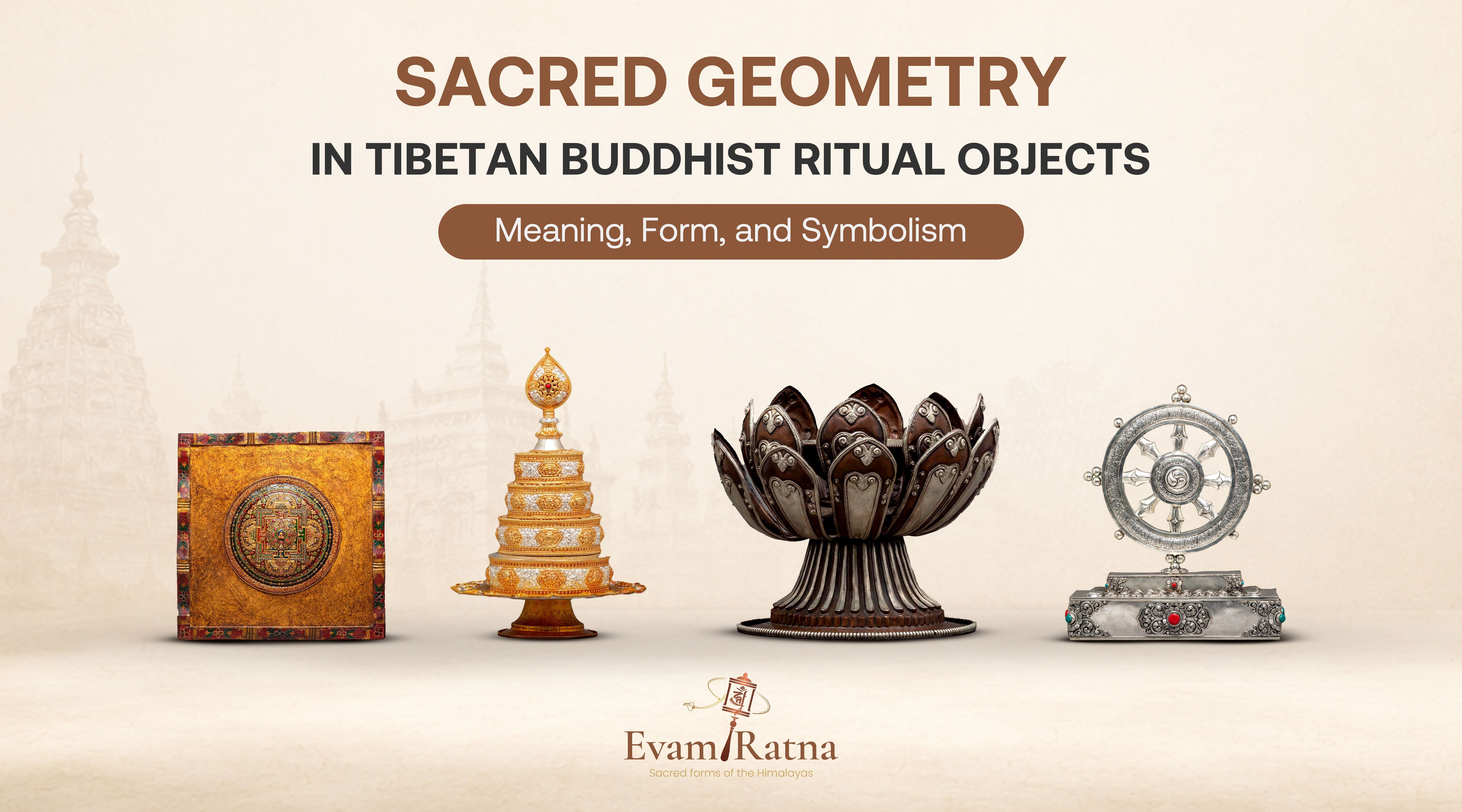
The Meaning Behind Every Shape in a Tibetan Ritual Object
In Tibetan and Himalayan Buddhist traditions, every ritual object is made with sacred geometry that has a meaningful purpose. The shape of a bell, the structure of a stupa, or the design of a dharma wheel each is a deliberate act of sacred communication. Before the practitioner lifts an object, recites a mantra, or sets a single item on the altar, geometry has already spoken. These shapes are carefully created to guide the mind, support meditation, and reflect deeper spiritual truths.
What is Sacred Geometry? A Buddhist Definition
Sacred geometry is the study of geometric forms understood to carry intrinsic spiritual meaning and a living map of consciousness, cosmos, and causality. In Tibetan Buddhism, sacred geometry is not a separate philosophical discipline. It is simply the visual language through which the Dharma is expressed in form.
The philosophical basis lies in the Vajrayana understanding that the phenomenal world is not separate from enlightened reality. The five elements, i.e earth, water, fire, wind, and space, each has geometric correspondences. Earth is the square. Water is the circle. Fire is the triangle. Wind is the half-circle. Space is the point, or bindu. These are not metaphors. In Vajrayana cosmology, these correspondences are considered as real as the elements themselves.
The Circle: Wholeness, Continuity, and the Dharmachakra
The circle is perhaps the most fundamental shape in Buddhist sacred geometry. It has no beginning and no end, no corners and no interruptions, making it the natural geometric expression of continuity, completeness, and the endless cycle of interdependent origination (pratītyasamutpāda).

The Dharma Wheel (Dharmachakra)
The eight-spoked wheel is among the most recognised symbols in all of Buddhism, and its geometry is deliberate at every level. The rim represents the mindfulness that holds practice together. The hub is the ethical discipline at the centre of the path. The Dharma Wheel represents the Noble Eightfold Path: right view, right intention, right speech, right action, right livelihood, right effort, right mindfulness, and right concentration.
When cast in bronze or carved into a stupa gateway, the dharmachakra is a geometric summary of the entire teaching of the Buddha. Its circular form further signals that the Dharma has no hierarchical beginning or end point; all eight aspects of the path support one another equally.
The Offering Bowl (Torma Base)
Even the circular base of an offering bowl participates in this geometry. Round bases denote receptivity, completeness, and the womb-like quality of compassion (karuna), the vessel that holds and nourishes, neither spilling nor withholding.
The Mala (Prayer Beads)
The mala, typically strung with 108 beads, forms a circle when complete. The practitioner moves through it bead by bead, mantra by mantra, enacting the circular path of repetition that gradually wears away habitual mental patterns. The circle of the mala is the geometry of perseverance and return.
The Triangle: Fire, Ascent, and Transformation
If the circle represents continuity, the triangle represents directionality, specifically, the movement upward, toward transformation. In Tibetan elemental cosmology, the triangle corresponds to the fire element (tej), and fire's function is transformation: the burning away of ignorance, attachment, and aversion.

Fire Offering Mandalas (Homa Pits)
Ritual fire offering pits used in homa ceremonies are frequently triangular or built around a central triangular form. The geometry is not arbitrary; the three angles correspond to the Three Jewels (Buddha, Dharma, Sangha), and the upward-pointing triangle directs the energy of offering toward the divine. In wrathful fire practices, the downward-pointing triangle can also appear, representing receptivity of the lower realm and the drawing of obstacles downward.
Deity Iconometry
Triangular relationships between the crown, shoulders, and base of a deity sculpture are prescribed by Tibetan iconometric texts. These geometric ratios ensure that the proportional harmony of the figure reflects cosmic harmony; an improperly proportioned deity image is considered ritually deficient regardless of its artistry.
The Trikona in Yantra
Within yantra diagrams (geometric meditation supports used in Vajrayana practice), the upward-pointing triangle represents Shiva or masculine awareness, while the downward-pointing triangle represents Shakti or feminine wisdom. The Sri Yantra, though more associated with Hindu tantrism, influenced Tibetan tantric visual culture through the shared Indo-Himalayan heritage. Interlocking triangles appear in many Tibetan geometric ritual diagrams as symbols of non-dual union.
The Square: The Four Directions and Grounded Reality

Where the circle curves and the triangle ascends, the square anchors. In Tibetan cosmology, the square corresponds to the earth element, stable, fixed, and providing the ground upon which all spiritual practice can be built. The square's four sides correspond to the four cardinal directions, the four immeasurables (loving-kindness, compassion, empathetic joy, and equanimity), and the four activities of enlightened beings (pacifying, enriching, magnetising, and wrathful activity).
The Palace of the Mandala
Every Tibetan mandala features a square palace (vimāna) at its centre, surrounded by circular rings of protection. This square-within-circle composition is one of the most fundamental geometric pairings in Vajrayana iconography. The square palace has four gates, one at each cardinal direction, each guarded by a gate deity and approached from its respective realm. The square represents the structured, grounded domain of practice, the world as it must be ordered before the mind can be freed.
Altar Platform Construction
Traditional Himalayan Buddhist altars are arranged on square or rectangular platforms. Even the placement of objects follows directional geometry: the centre for the central deity, east for water offerings, south for incense, west for lamps, north for food. The square geometry of the altar grounds ritual activity in all four directions simultaneously, invoking the completion and totality suggested by the four-sided form.
The Stupa's Square Base
The lowest tier of a stupa is invariably square, the earth element that supports all that rises above it. This is not architectural convention but cosmological statement: enlightenment rests on the ground of ethical conduct and physical reality.
The Lotus and the Point: The Bindu and the Origin of Form

Before any shape, there is the point, the bindu. In Vajrayana cosmology, the bindu is the dimensionless origin from which all form emerges, the geometric equivalent of śūnyatā (emptiness) that is simultaneously the ground of appearance. It appears in ritual objects as the central jewel of a vajra, the centrepiece of a mandala, the navel of a deity figure, and the seed syllable (bīja mantra) written at the heart of a thangka.
The Lotus Geometry
The lotus (padma) is the flowering of the bindu into manifest form. Its geometry radiates outward in equal petals, four, eight, sixteen, or thirty-two, from a central point, making it the sacred geometric image of an enlightened mind opening from a point of origin. The number of petals is never casual: eight-petalled lotuses correspond to the eight directions; sixteen to the sixteen bodhisattvas of the inner mandala; thirty-two to the thirty-two marks of an enlightened being.
Lotus forms appear as the base of nearly every Tibetan Buddhist sacred sculpture, the pedestal on which Buddhas and bodhisattvas are seated. This is a geometric teaching in itself: enlightenment rises from the mud of samsara (the lotus grows in muddy water) and opens into perfect symmetry above.
The Lotus on the Altar
Cast-metal altar lotuses, offered as decorative objects in their own right, replicate this geometry in three dimensions. Each petal is shaped to precise curvature, and the whole composition radiates from the central stamen point, the bindu made visible in metal.
Why Sacred Geometry Still Matters: Ritual Objects as Living Teachings
In a contemporary context, where Himalayan ritual objects are increasingly encountered outside their original ritual settings, in homes, meditation spaces, and across international markets, the question of what makes an object genuinely sacred becomes pressing.
The answer, within the Tibetan Buddhist framework, lies at least partly in geometry. An object whose proportions, forms, and geometric relationships faithfully replicate those prescribed by tradition carries the full weight of that tradition's teaching. The vajra's five prongs are not merely elegant; they enumerate the five wisdom families. The bell's resonant geometry is not merely pleasing; it produces the sound of śūnyatā. The stupa's five tiers are not merely architectural; they trace the path through the five elements to liberation.
When a practitioner places a properly proportioned vajra on their altar, lights butter lamps in a lotus-shaped holder, or circumambulates a geometrically correct stupa, they are not performing superstition. They are engaging in a conversation with a geometric language refined over centuries to communicate what words alone cannot: the shape of an awakened mind, the structure of a liberated reality, and the path from confusion to clarity.
Sacred geometry in Tibetan Buddhist ritual objects is, ultimately, the visual Dharma, teaching in form for those who know how to look.
Conclusion
Sacred geometry in Tibetan Buddhist ritual objects is the architecture of the Dharma made visible, a precise geometric language developed over centuries of practice, scholarship, and meditation to carry teachings that words alone cannot hold. Every circle on a mala encodes continuity. Every triangle in a fire offering encodes transformation. Every square in a mandala encodes the four directions of complete reality. Every convergence of prongs on a vajra encodes the integration of multiplicity into wisdom. Every tier of a stupa encodes the path through the five elements to liberation.
When you hold a vajra, ring a bell, gaze at a mandala, or circumambulate a stupa, you are participating in a geometric teaching that has been transmitting the Dharma, in form, for eyes that know how to look, for over a thousand years.