From Metals to Offerings: The Spiritual Significance of Metal in Himalayan Buddhist Craft
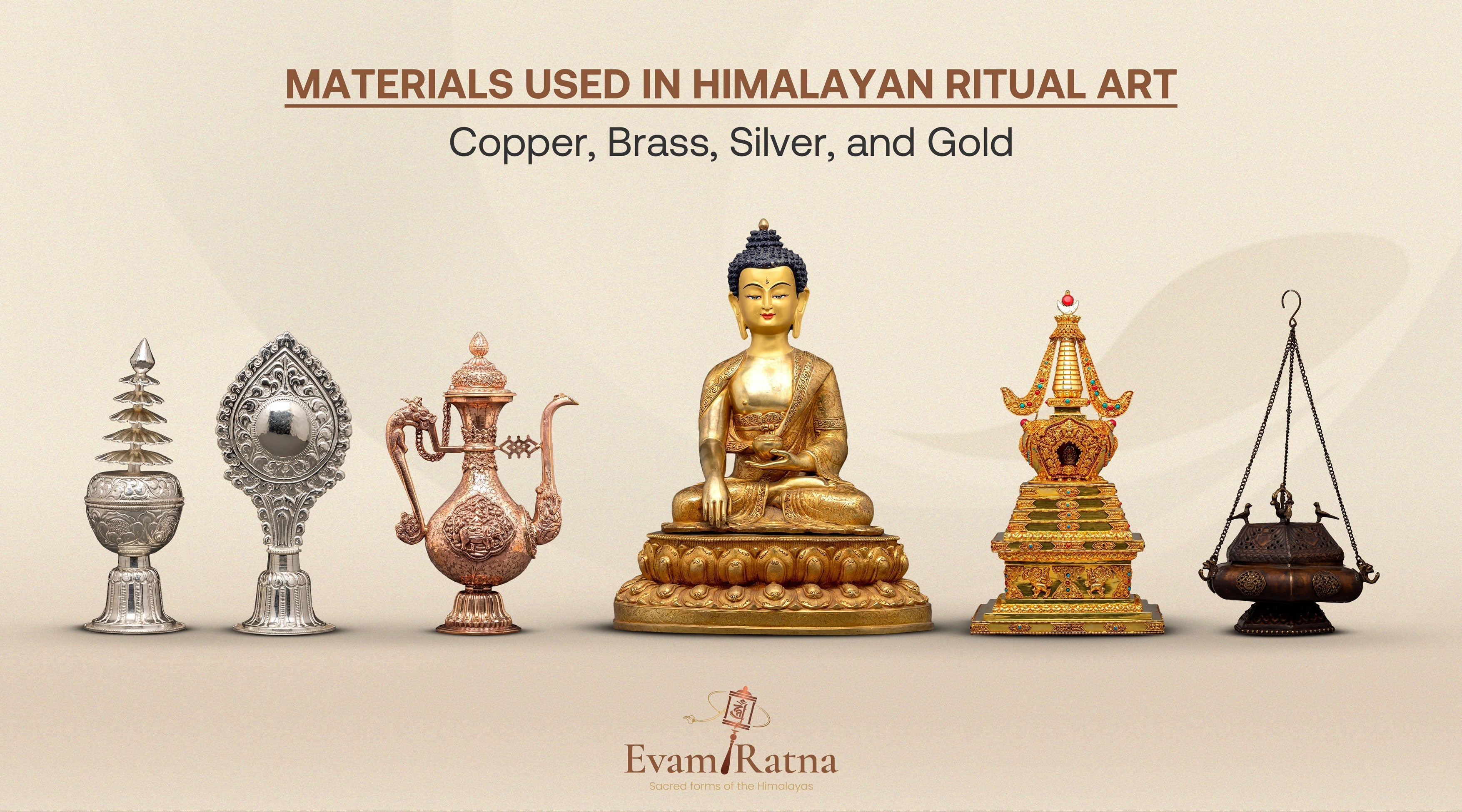
In the Buddhist art of the Himalayas, the materials that are used in any craftsmanship have a rich significance and symbolic value. Copper, brass, silver, and gold have unique energetic properties that are thought to facilitate meditation, ritual, and the making of sacred objects. Each is a symbolic expression of a different aspect of the awakened mind, and many are objects of ritual use and spiritual power, made from ordinary materials.
The Philosophy of Material in Vajrayana Buddhist Art
In Vajrayana Buddhism, the physical world is not separate from the sacred. The doctrine of pure vision (suddha drsti) holds that phenomena, when perceived with an awakened mind, reveal their inherent luminous nature. Sacred art is a technology for cultivating this perception. The statue is not merely a representation of a deity; properly consecrated through the rab gnas ceremony, it becomes a support for the actual presence of awakened mind. This means the materials that form a ritual object carry genuine spiritual consequence.
Himalayan texts and oral traditions associate metals with the five elements, specific deities, planetary correspondences inherited from both Indian and Tibetan astrological systems, and levels of merit and purity. This is why the great workshops of Patan, the home of the Newar metalworking lineages that have supplied Buddhist monasteries across the Himalayas for more than a thousand years, preserve not only technical skill but also knowledge of which metal is appropriate for which deity, ritual function, and level of sponsorship.
Copper: The Metal of Purity, Vitality, and Life Force

Click Here To View Our Collection of Traditional Tibetan Ritual Vases Bhumba Set
Copper is the foundational metal of Himalayan ritual art. Sanskrit texts refer to it as tamra; in Tibetan it is zangs. Of all the metals used in sacred objects, copper has the longest documented history in Nepal and Tibet, and it remains the most common material for ritual objects at every price point.
Copper is associated with the fire element and, in some Vajrayana systems, with Amitabha Buddha, the Buddha of Infinite Light who presides over the western buddha field of Sukhāvatī. Its warm, reddish-orange hue echoes the color of the setting sun and of the padma family of deities, who govern the transformation of desire into discriminating wisdom. Wrathful deities such as Vajrakilaya and certain forms of Mahakala are frequently cast in copper, as the metal's earthiness and conductivity are considered appropriate for fierce protective practice. More broadly, copper is regarded as a purifying metal, one that clears negative energies from the environment, which is why copper offering bowls, butter lamps, and water vessels have been placed on Buddhist altars for centuries.
In Ayurvedic and Tibetan medical traditions, copper is considered to balance the three humors and to be beneficial when used to store water for drinking. This intersection of medicinal and spiritual properties reflects how deeply intertwined the material and sacred dimensions are in the Himalayan worldview.
Repoussé and Lost-Wax Casting: Copper Craftsmanship in Nepal
Two primary techniques are used to work copper in the Himalayan tradition.
Repoussé (ti ka) is the art of hammering sheet copper from the reverse to create raised relief designs. The smith works the metal cold, annealing it repeatedly to maintain ductility. The finest repoussé panels, found on monastery gates, shrine rooms, and large votive plaques, represent an astonishing synthesis of iconographic precision and physical labor, sometimes taking teams of artisans months to complete.
Lost-wax casting (cire perdue) is used for three-dimensional statues. A wax model is built up by the sculptor, often over a clay core, then encased in clay and fired. The wax melts out, and molten copper is poured into the resulting mold. After cooling, the clay is broken away, and the artisan begins the long process of chasing, polishing, and, if the statue is to be gilded, applying gold.
Both techniques are alive in Patan today, passed down within traditional Newar artisan families, many of whom have been practicing these crafts for twenty or thirty generations.
Read More About How Authentic Nepalese Statues are Made in Nepal: The Lost-Wax Metal Casting Process
Brass: The Metal of Versatility and Devotion

The term "brass" in everyday usage refers to an alloy of copper and zinc. In the Himalayan ritual context, however, the picture is more complex and more spiritually layered. Himalayan artisans have historically worked with two important alloy traditions that encompass far more than simple copper-zinc brass:
Pancadhatu, literally "five metals", typically refers to an alloy combining copper, zinc, tin, lead, and iron. The precise ratios vary by workshop, tradition, and intended ritual function. The five metals correspond to the five elements and, in some systems, to the five families of Dhyani Buddhas.
Astadhatu, "eight metals", adds gold and silver (and sometimes mercury or other metals) to produce a sacred alloy considered particularly auspicious and spiritually potent. Objects cast in aṣṭadhātu are often reserved for the most important icons and the finest ritual implements. The inclusion of gold and silver means these objects carry the complete spectrum of sacred metal symbolism.
In contemporary Nepali and Tibetan craft terminology, the word sometimes translated as "brass" often refers to this broader family of copper-based alloys, and many of what are sold as "brass" ritual objects are in fact working within the pancadhatu tradition.
Silver (Dngul): Purity, the Moon, and Feminine Divine Energy

Click Here To View Our Pure Silver Jwala-Nhyaka & Sinamu Set
Silver occupies a distinct and elevated position in the Himalayan sacred material hierarchy. In Tibetan, silver is dngul, a word that appears in compound with other terms to convey wealth, purity, and spiritual clarity. The metal's visual coolness, its reflective brightness, and its association with the moon make it a natural symbol for the feminine principle, for emptiness (sunyata), and for the clarity of the dharmakāya, the truth body of awakened mind.
In Hindu-Buddhist tantric cosmology, silver is associated with the moon and with the goddess Candra. In Tibetan astrological systems inherited from both Indian and Chinese sources, silver corresponds to the lunar element. Many of the great offering vessels associated with goddesses, particularly forms of Tara and Vajravarahi, are made from silver or silver-plated copper, reflecting the metal's alignment with feminine awakened energy.
Silver's antimicrobial properties were understood empirically by Himalayan cultures long before germ theory: silver vessels were used to store sacred water, consecrated liquids, and medicinal preparations. This practical knowledge reinforced the material's sacred status, as purity in the physical sense and purity in the spiritual sense were understood to be continuous.
Read More About Silver Craftsmanship: Where Art Meets Spirituality
Gold (Gser): The Supreme Sacred Metal of Enlightenment

Gold stands at the apex of the Himalayan sacred material hierarchy. Its Tibetan name, gser, appears in compound with terms of the highest spiritual value: the serkyem offering, the golden throne of the Buddha, the gilded rooftops of the great monasteries that catch the morning light above the Kathmandu Valley. Gold is the color of the Buddha's skin in thangka painting, the color of the sun, the color of the wisdom that transcends all conceptual boundaries.
In Vajrayana iconography, gold corresponds to the Ratnasambhava Buddha family, the jewel family, presiding over the south, associated with the transformation of pride into equanimity, with the element earth, and with the quality of richness and inexhaustible generosity. The mandala offering, in which one imagines offering the entire universe to the buddhas, is said to consist of gold.
Gold is also associated with permanence. Unlike copper, which oxidizes, or silver, which tarnishes, gold maintains its luminous surface indefinitely. This quality made it the material of choice for the most sacred icons: objects intended to serve practitioners across generations, to be passed down within lineages, to outlast their donors. The great gilt-copper statues of the Kathmandu Valley temples, some of which have stood for more than a thousand years, embody this principle of sacred permanence.
Gold Gilding (Fire Gilding/Mercury Gilding) in Statue Making

The most important technique for applying gold to Himalayan ritual art is fire gilding, also known as mercury gilding or the amalgam process. This ancient method, practiced by Newar artisans in the Kathmandu Valley for at least twelve centuries, creates an extraordinarily durable gold surface that bonds chemically with the base metal beneath.
The process begins with gold beaten into extremely thin leaf or dissolved in mercury to form an amalgam. This amalgam is applied to the surface of the finished copper statue. The statue is then carefully heated over a controlled fire until the mercury vaporizes, leaving a pure gold layer fused to the copper surface. The process is typically repeated multiple times to achieve sufficient thickness and depth of color. Skilled artisans distinguish between a single-application gilding and the deeper, more lustrous gold of a piece that has been gilded three or five times.
The health risks of mercury gilding are severe; traditionally, master gilders in Patan had shortened life expectancies from mercury exposure, and many workshops today use electroplating as a safer alternative. However, traditionally fire-gilded statues remain among the most sought after by practitioners and collectors, as the quality and durability of the gold surface is genuinely superior.
Beyond full gilding, gold is applied to Himalayan sacred art in several other ways: gold paint made from powdered gold (gser tshon) is used in thangka painting for halos, ornaments, and the Buddha's golden body; gold leaf is applied to specific parts of statues (particularly faces) by practitioners making offerings; and gold thread is woven into the finest textile backings for thangkas and the ceremonial robes of lamas.
How Nepalese Artisans Combine Metals: Multi-Metal Ritual Objects
Some of the most sophisticated Himalayan ritual objects deliberately combine multiple metals within a single piece. This practice draws on several principles:
- Iconographic precision: Different parts of a deity's body or implements may correspond to different buddha families or elements. A multi-metal statue ensures that each dimension of the iconographic program is materially expressed.
- The astadhatu principle extended: Even when working within a single base material, artisans add inlays, surface applications, or secondary casts in other metals to achieve the full spectrum of sacred material correspondence.
- Functional differentiation: In objects like the ritual phurba, different sections serve different functions. The blade may be iron (for cutting through delusion), the central section copper (for fire, transformation), and the handle may include brass or silver elements for the qualities of clarity and protection.
The great workshops of Patan, where families like the Shakya, Maharjan, and Tamrakar have maintained unbroken craft lineages, continue to produce multi-metal objects using traditional alloy formulations and surface treatments that would be recognized by craftsmen from the eighth century.
Conclusion: The Living Tradition of Sacred Metal in the Himalayas
The metals used in Himalayan ritual art are not merely aesthetic choices or practical considerations. They are a theological vocabulary, a way of encoding, in durable and radiant form, the understanding that matter and spirit are not separate, that the physical world, when seen clearly, reflects the luminous nature of mind.
Copper carries the fire of transformation and the warmth of the wrathful compassion that burns through ignorance. Brass, in its many alloy forms, provides the accessible, grounded foundation for daily practice. Silver holds the cool clarity of the moon, of emptiness, of the feminine wisdom that sees without grasping. Gold embodies the sun-like radiance of enlightened mind, permanent, self-luminous, capable of illuminating whatever it touches.
The artisans of Patan who work these metals today are the inheritors of a tradition more than a thousand years old. Each piece they create carries not only their personal skill but the accumulated knowledge of generations of craftsmen who understood that to make a sacred object is itself a form of practice, an act of generosity toward all beings who will encounter the finished work on altars, in monasteries, and in homes across the world.