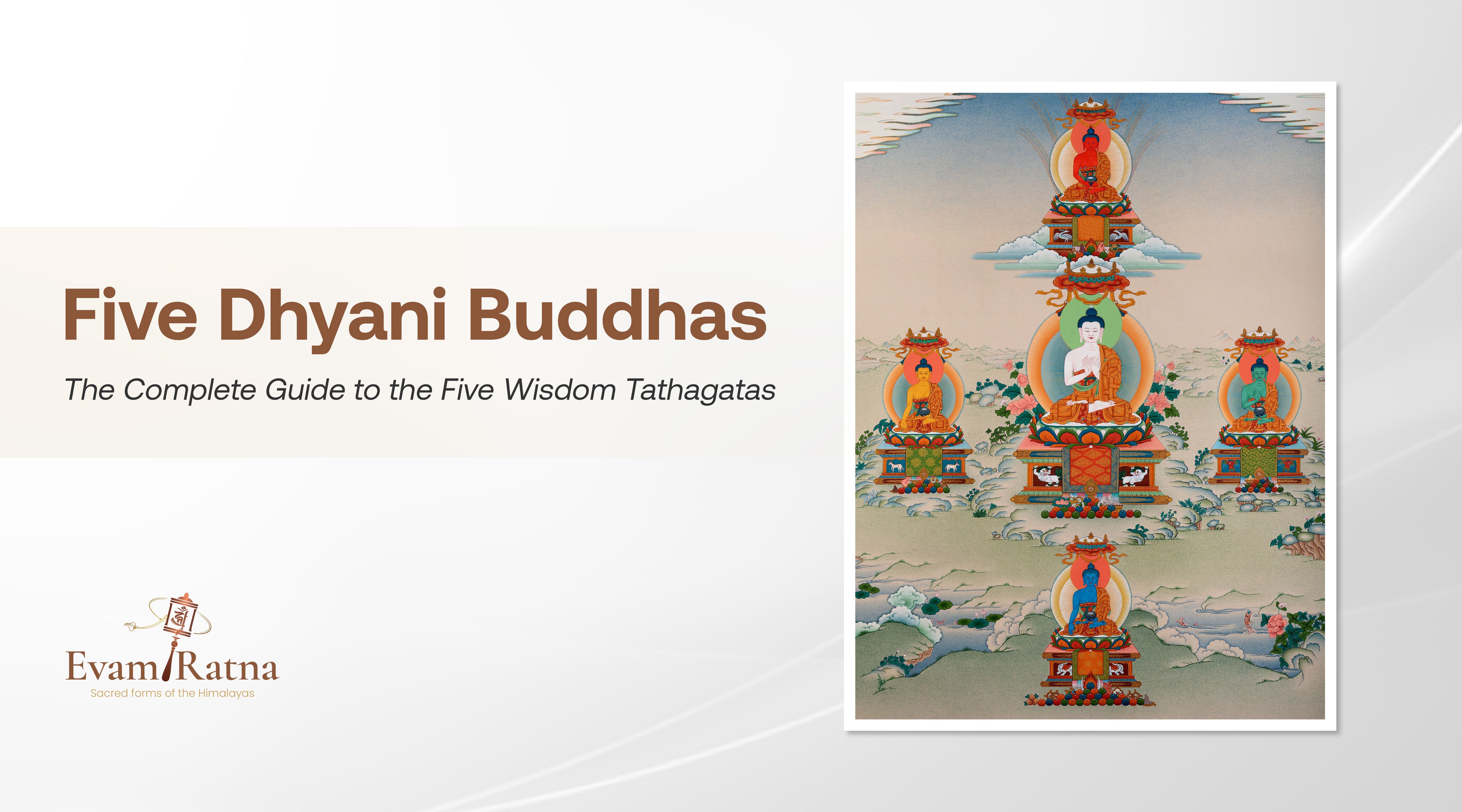
Five Direction Buddhas: Vairocana, Akshobhya, Ratnasambhava, Amitabha & Amoghasiddhi
The Five Dhyani Buddhas, also known as the Five Wisdom Tathagatas, are central figures in Vajrayana Buddhism who represent the five qualities of the enlightened mind. They are Vairocana, Akshobhya, Ratnasambhava, Amitabha, and Amoghasiddhi, each symbolizing a unique form of wisdom that transforms human emotions into spiritual awareness. They are the principle of the Five Enlightened Buddha Families.
These Five Jinas (Conquerors) hold a central place in Vajrayana Buddhism. Emerging from the primordial source of Adi-Buddha, the original Buddha nature, they symbolize the unfolding of enlightenment in its complete and universal form. Each of the Five Dhyani Buddhas presides over a direction of space, embodies a specific color, holds a characteristic hand gesture (mudra), and radiates a particular form of wisdom that corresponds to a poison of the ordinary mind. Together, the five form a complete map of consciousness, a mandala of enlightenment that has guided Tibetan, Newar, and all Vajrayāna practitioners for over a millennium.
Origins of the Five Wisdom Buddhas

The Five Dhyani Buddhas as a complete system emerged most fully within Vajrayana Buddhism, the tantric vehicle that developed in India and reached extraordinary flowering in Tibet, Nepal, and the Himalayan region from roughly the 7th century CE onward.
Their earliest canonical appearances trace to Mahayana texts. The Golden Light Sutra (Suvarnaprabhasottama Sutra) references multiple cosmic Buddhas who eventually coalesced into this grouping. Later tantric literature, particularly the Mahāvairocana Tantra and the Vajrasekhara Tantra, systematized them into the iconic fivefold mandala that practitioners recognize today.
In Newar Buddhist tradition (the indigenous Buddhism of Nepal's Kathmandu Valley), the Five Dhyani Buddhas, called Pancha Tathagata, hold a foundational place. Each of the valley's great stupas, including Swayambhunath and Boudhanath, has niches on its four cardinal sides enshrining these Buddhas. The very architecture of the stupa is a three-dimensional five-Buddha mandala: the dome represents the cosmos, and the five Buddhas anchor its directional gates.
The Five Dhyani Buddhas at a Glance: Quick Reference Table
|
Five Dhyani Buddhas |
Direction |
Color |
Mudra |
Poison Transformed |
Pure Land |
|
Vairocana |
Center |
White |
Dharmachakra (Teaching) |
Ignorance into the wisdom of Dharmadhatu (Intrinsic Nature of All Things) |
Akanishtha |
|
Akshobhya |
East |
Blue |
Bhumisparsha (Earth-touching) |
Anger/Hatred into the wisdom of Mirror-like Awareness |
Abhirati |
|
Ratnasambhava |
South |
Yellow/Gold |
Varada (Giving) |
Pride/Jealousy into the wisdom of Equality |
Srimat |
|
Amitabha |
West |
Red |
Dhyana (Meditation) |
Desire/Attachment into the wisdom of Discriminating Awareness |
Sukhavati |
|
Amoghasiddhi |
North |
Green |
Abhaya (Fearlessness) |
Envy/Fear into the wisdom of All-Accomplishing Action |
Prakuta |
Vairocana: The Buddha of Illumination

Vairocana sits at the very center of the mandala, the luminous axis around which the other four Buddhas revolve. His name means "The Illuminator" or "The Sun-like One," and he radiates the pure white light of primordial awareness in all directions simultaneously. Representing the center direction, element of Space, and the color white, he symbolizes completeness and awareness beyond conceptual overlays. His wisdom reflects the true nature of reality, contrasting ordinary ignorance. His hand gesture, the Dharmachakra Mudra, signifies the cosmic turning of the Wheel of Dharma, while he rides a lion, symbolizing fearlessness. Vairocana's seed syllable, OṂ, represents the primordial vibration of the cosmos, foundational in Vajrayana practices, cultivating the luminous awareness that nourishes all wisdoms.
Akshobhya (Mitrupa): The Buddha of Mirror-Like Wisdom

Akshobhya, presiding over the East, symbolizes unshakeable stability and enlightenment. His name means "The Immovable," embodying resilience against emotional turmoil, represented in deep blue, akin to a still lake. He gestures with the Bhūmisparsha Mudra, denoting groundedness and the purification of anger through earth's stabilizing force. The vajra symbolizes indestructible awareness, while his consort, Locanā, and pure land, Abhirati, signify joy. Akshobhya's wisdom, Mirror-like Wisdom, involves observing emotions like a mirror reflecting without distortion, aiding practitioners in transforming negative feelings into clarity, particularly in Vajrayāna practices.
Ratnasambhava: The Buddha of Equanimity

Ratnasambhava, meaning "Born from the Jewel," symbolizes spiritual richness and generosity. He presides over the South, associated with abundance and warmth, characterized by a golden yellow hue like ripe harvests. His element, Earth, nourishes life indiscriminately. His hand gesture, the Varada Mudra, represents unconditional giving without expectation, reflecting his nature. Riding a horse, he embodies swift action, while his consort, Māmakī, symbolizes ownership of all. Ratnasambhava's wisdom, the Wisdom of Equality, counters pride and hierarchy, promoting the view that all beings are equally precious. His teachings help practitioners overcome attachment and self-centeredness, emphasizing that awakened nature exists in everyone without exception.
Amitabha: The Buddha of Infinite Light

Amitābha, a key figure in both Vajrayāna and Mahāyāna Buddhism, is revered in Pure Land Buddhism as the embodiment of "Infinite Light." He oversees the blissful realm of Sukhāvatī, described in the Sukhāvatīvyūha Sūtra, where devoted practitioners can achieve Buddhahood. Symbolizing compassion, Amitābha is depicted with a warm red hue and associated with the Fire element, riding a peacock, a symbol of transformation. His meditative posture reflects deep insight, while his consort, Pāṇḍaravāsinī, signifies purity. Amitābha's wisdom, known as Discriminating Wisdom, enables a clear perspective on phenomena without attachment. In Tibetan Buddhism, he is central to the Lotus Family and plays a crucial role in phowa, guiding consciousness at death for rebirth in Sukhāvatī.
Amoghasiddhi: The Buddha of Fearless Action

Amoghasiddhi, embodying "Unfailing Success," represents fearless awakened activity. Associated with the North, he symbolizes strength and overcoming challenges. His vital green color and the element Air express active growth and unobstructed movement. The Abhaya Mudra gesture signifies protection and reassurance. His vāhana, Garuḍa, represents unstoppable compassionate action, while his consort, Samayatārā, embodies swift liberation. With the wisdom of All-accomplishing Wisdom, Amoghasiddhi addresses envy and fear, promoting clarity and absence of self-interest in actions. His teachings guide practitioners through obstacles, empowering them with purposeful energy. His green light from the North facilitates clear, fearless action.
The Five Dhyani Buddhas Symbolism: Transforming Poison into Enlightenment
The Five Dhyani Buddhas teach the doctrine of transmutation, emphasizing that the five root poisons of the ordinary mind: ignorance, anger, pride, desire, and envy, are not to be suppressed but refined into wisdom. Each Buddha embodies a transformation: Vairocana turning ignorance into Dharmadhātu Wisdom; Akshobhya converting anger into Mirror-like Wisdom; Ratnasambhava changing pride into the Wisdom of Equality; Amitābha transmuting desire into Discriminating Wisdom; and Amoghasiddhi evolving envy into All-accomplishing Wisdom. This approach contrasts with methods that view negative emotions as adversaries. Instead, Vajrayāna acknowledges these emotions as powerful energies that, when approached with awareness, reveal their intrinsic wisdom. For instance, a clear perception of anger offers mirror-like precision, purified desire grants a discerning view of beauty, released pride fosters equality among beings, transformed envy drives altruistic accomplishment, and dissolved ignorance fosters comprehensive awareness. Thus, the Five Dhyani Buddha mandala serves as a practical map of the human mind, illustrating both the entrapment by the five poisons and the potential for transformative awareness through appropriate practices.
Five Dhyani Buddhas in Sacred Art: Statues, Thangkas & Mandalas
The Five Dhyani Buddhas have inspired some of the most magnificent sacred art in human history, and Nepal's Kathmandu Valley remains, to this day, the living heart of that tradition.
Thangkas
In Tibetan and Newar thangka painting, the Five Dhyani Buddhas appear in several formats. Single-Buddha thangkas depict each Buddha individually in full iconographic precision, surrounded by attendant figures, pure land imagery, and identifying Tibetan inscriptions. These are ideal for practitioners working closely with a specific Buddha's energy. Five-Buddha mandala thangkas arrange all five in the classic directional configuration, Vairocana at the center, the four cardinal Buddhas at the compass points, in a composition of exact geometric symmetry, and these are among the most complete and auspicious thangka formats available. A third format, sometimes called Shakyamuni with the Five Dhyani Buddhas, places the historical Buddha at the center surrounded by the five cosmic Buddhas, connecting the historical and transcendent dimensions of Buddhahood in a single image.
The finest Newar thangka painters of Kathmandu preserve these iconographic traditions using traditional mineral pigments, lapis lazuli for Akshobhya's blue, cinnabar for Amitābha's red, orpiment for Ratnasambhava's gold, ground by hand and applied with techniques that maintain their luminosity across centuries. Outlines traced in 24-karat gold add both visual beauty and sacred significance.
Statues

Copper-gilt statues of the Five Dhyani Buddhas are among the most treasured objects on Himalayan home altars. Traditional Newar craftsmen of Patan, the ancient city of metalworkers in the Kathmandu Valley, produce these statues using the lost-wax (cire-perdue) casting method, a technique passed down through hereditary artisan guilds, the silpakār families, for over a thousand years.
A complete Five Dhyani Buddhas set, all five statues in matching style, size, and finish, is considered one of the most auspicious altar arrangements in Himalayan Buddhist tradition. Placed together on a shrine, they recreate the cosmic mandala in miniature, transforming the altar space into a sacred geography of enlightened awareness.
Mandalas

The Five Dhyani Buddha mandala is the template from which virtually all Buddhist mandalas derive. Its most elaborate physical expressions include sand mandalas (kilkhor), created over days by monk artists using colored sand and then ritually dissolved as a teaching on impermanence; the Five Dhyani Buddha mandala thangka, an elaborately detailed painted composition depicting the five Buddhas within nested geometric and lotus arrangements; and architectural mandalas, where stupas and certain temple complexes are themselves three-dimensional mandalas, the stupa body as Vairocana, the four niches as the four directional Buddhas.
The Five Dhyani Buddhas Tibetan Crown

Among the most distinctive and sacred objects in all of Tibetan Buddhist ritual art, the Five Dhyani Buddhas Crown, known in Tibetan as Rig nga'i cod pan, stands in a category of its own. It is not merely a decorative object. It is a wearable mandala, a consecrated embodiment of the five wisdom families that transforms the person who wears it into a living representation of the complete enlightened mind. The crown takes the form of a wide, lotus-petal tiara, typically five rising panels arranged in a semicircle, each panel enshrining one of the Five Dhyani Buddhas in his characteristic color, mudra, and iconographic form.
The Five Dhyani Buddhas Stupa

The stupa (chorten in Tibetan, caitya in Sanskrit) is one of the oldest and most universal forms in all of Buddhist architecture and sacred art, and the Five Dhyani Buddhas Stupa is its most complete and cosmologically rich expression. Every element of a stupa's structure, from the square base to the tapering spire, encodes meaning. In the Five Dhyani Buddhas Stupa, that meaning is made fully explicit: the entire form becomes a three-dimensional mandala of the five wisdom families. Looking at the stupa, the multi-tiered structure follows the classical Newar astamahapratiharya form, the eight great miraculous events stupa, rendered in gilded copper with extraordinary richness of detail.
Conclusion
The Five Dhyani Buddhas serve as a map of our inherent nature, illustrating how the five poisons, such as ignorance, anger, pride, desire, and envy, contain the seeds of corresponding wisdom. Each Buddha represents a facet of enlightened mind: Vairocana embodies all-pervading awareness, Akshobhya's clarity reflects mirror-like insight, Ratnasambhava symbolizes boundless equanimity, Amitābha offers discerning warmth, and Amoghasiddhi signifies fearless action. These qualities are not external traits but intrinsic to awareness, free from confusion. The teachings of the Five Wisdom Tathagatas emphasize that enlightenment is not a distant goal but already present within us. The mandala of enlightenment is complete in our minds, bodies, and environments. Ritual objects like statues, thangkas, and mantras act as reminders of this completeness rather than additions to something lacking. Through various encounters with the Dhyani Buddhas, whether through art, practice, or emotional recognition, they offer the same timeless invitation across all five directions: awaken to what you already are.