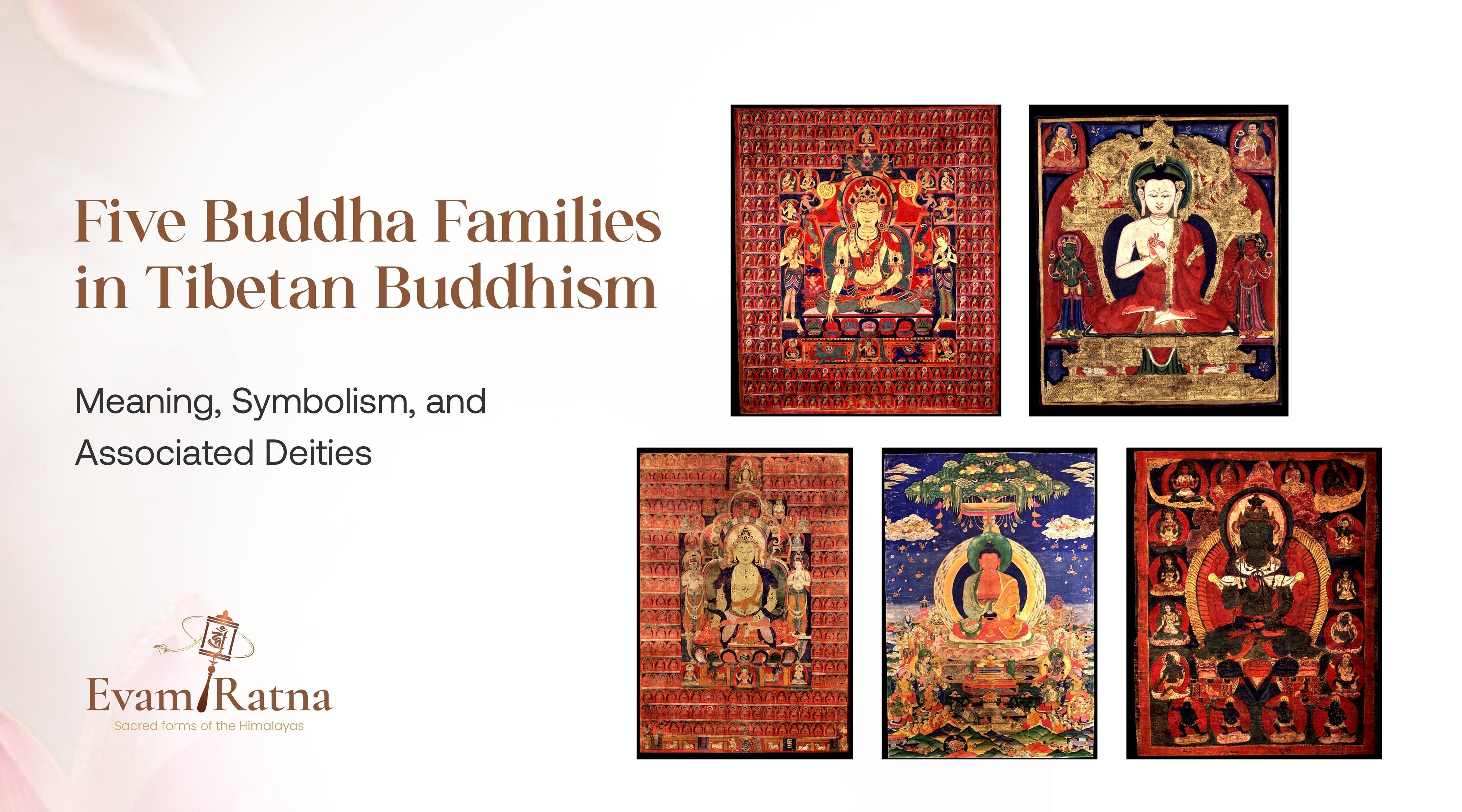
The Five Buddha Families of Vajrayana Buddhism: A Journey Through Five Wisdom Energies
The Five Buddha Families are a core concept in Vajrayana (Tantric) Buddhism that map human experience, emotions, and aspects of the awakened mind into five distinct patterns. Through meditation, each family allows practitioners to transform a confused emotional state (poison) into an enlightened, clear awareness (wisdom). Five categories of enlightened energy describe different aspects of Buddhahood. These five Buddhas are commonly arranged within the sacred structure of a mandala, with each occupying a specific direction and representing a particular quality of enlightened awareness.
The purpose of the Five Buddha Families is that they reveal different expressions of one awakened reality. Just as sunlight can appear in different colors through a prism, enlightened consciousness manifests through five wisdom aspects.
The Five Buddha Families in Vajrayana Buddhism

Click Here To View Our Five Dhyani Buddha Thangka
In Vajrayana Buddhism, the Five Buddha Families (Sanskrit: Panca Tathagata Kula) represent five fundamental dimensions of enlightened consciousness. Each family is a lineage, or “clan,” of awakened beings connected to a specific wisdom quality, direction, color, element, and method for transforming an ordinary human emotion into enlightened awareness.
The Sanskrit word kula means “family,” “clan,” or “lineage.” They describe different expressions of Buddha-nature and the ways enlightened wisdom manifests through various Buddhas, Bodhisattvas, tantric deities, and protectors. According to Vajrayana teachings, every human being possesses all five Buddha qualities within their mind. The five negative emotions that create suffering: ignorance, anger, pride, desire, and jealousy, are not destroyed but transformed into five forms of wisdom. Each Buddha family represents one of these transformations.
The five Buddha families are:
- Buddha Family (Tathagata Family): Transformation of Ignorance
- Vajra Family: Transformation of Anger
- Ratna Family (Jewel Family): Transformation of Pride
- Lotus Family: Transformation of Desire and Attachment
- Karma Family (Action Family): Transformation of Jealousy
Buddha Family (Tathagata Family)

The Buddha Family, also known as the Tathagata Family, represents the fundamental nature of awakened consciousness. It is considered the central family among the Five Buddha Families because it represents the wisdom that recognizes the true nature of reality. The Buddha Family reminds practitioners that beneath confusion and ignorance lies naturally pure awareness.
The main Buddha of this family is Vairochana Buddha, whose name means “The Illuminating One” or “The Radiant One.” He represents the vast, limitless awareness that exists beyond ordinary conceptual thinking. Vairochana is often depicted seated in meditation posture, holding the Dharma Wheel (Dharmachakra), symbolizing the teachings of the Buddha and the universal nature of truth.
Ignorance is considered the root cause of confusion because it prevents beings from recognizing the true nature of themselves and reality. Through the wisdom of the Buddha Family, ignorance is transformed into the Wisdom of Dharmadhatu, the direct realization that all phenomena arise within the vast space of enlightened awareness.
Vajra Family

(Photo From Himalayan Art Resources)
The Vajra Family represents the indestructible and unchanging nature of the enlightened mind. The Sanskrit word vajra means “diamond” or “thunderbolt,” symbolizing something that cannot be destroyed or broken. The Vajra Family teaches practitioners that even intense emotions like anger contain the potential for awakened wisdom.
This family is connected with the transformation of anger, hatred, and aggression. When anger is purified, it becomes Mirror-Like Wisdom, a state of awareness that sees reality clearly without distortion, judgment, or emotional disturbance.
The central Buddha of this family is Akshobhya Buddha, whose name means “The Unshakable One.” He represents complete stability and freedom from emotional disturbance. Akshobhya is traditionally depicted with a blue-colored body and holding a vajra. His calm expression represents a mind that remains peaceful even when facing challenges.
Ratna Family (Jewel Family)

The Ratna Family, also called the Jewel Family, represents abundance, generosity, dignity, and the precious qualities of enlightenment. The Sanskrit word ratna means “jewel,” symbolizing the priceless nature of Buddha wisdom. This family transforms pride, arrogance, and attachment to self-importance into Equalizing Wisdom, which recognizes the equal value and potential of all beings.
The central Buddha of this family is Ratnasambhava, whose name means “Source of Jewels” or “Jewel-Born One.” He is usually depicted with a yellow or golden-colored body and performing the Varada Mudra, the gesture of generosity and blessing. Ratnasambhava represents the understanding that true wealth does not come from possession but from compassion, generosity, and spiritual richness.
Lotus Family
(Photo From Himalayan Art Resources)
The Lotus Family is one of the most widely recognized Buddha families in Tibetan Buddhism. It represents compassion, love, communication, and the ability to perceive the unique qualities of all beings. The lotus flower symbolizes purity because it grows from muddy water yet blossoms beautifully above the surface. Similarly, enlightened compassion arises from the challenges of ordinary existence.
This family is connected with the transformation of desire, attachment, and emotional grasping into Discriminating Wisdom, the ability to understand the nature of things clearly without becoming attached. The central Buddha of this family is Amitabha Buddha, the Buddha of Infinite Light. Amitabha represents limitless compassion and is especially important in Pure Land traditions.
The Lotus Family is also traditionally associated with human beings because human emotions, relationships, and compassion practices provide a direct path toward awakening.
Karma Family (Action Family)

(Photo From Himalayan Art Resources)
The Karma Family, also known as the Action Family, represents enlightened activity, accomplishment, and the ability to benefit all beings. The Sanskrit word karma means “action,” referring here not to ordinary action but to the spontaneous activity of enlightened beings.
This family transforms jealousy, envy, and competitiveness into All-Accomplishing Wisdom, the ability to perform beneficial actions effortlessly and skillfully. The central Buddha of this family is Amoghasiddhi Buddha, whose name means “Successful Accomplishment” or “Unfailing Achievement.” He is usually depicted with a green body and performing the Abhaya Mudra, the gesture of fearlessness.
The Five Buddha Families in Sacred Mandalas
Five Buddha Mandala
The Five Buddha Mandala is one of the clearest visual representations of the Five Buddha Families. It places Vairocana at the center, surrounded by four other Buddhas representing the four directions.
The arrangement symbolizes the complete transformation of consciousness:
- Center- Vairocana: Purification of ignorance
- East- Akshobhya: Transformation of anger
- South- Ratnasambhava: Transformation of pride
- West- Amitabha: Transformation of attachment
- North-Amoghasiddhi: Transformation of jealousy
The mandala represents the universe of awakened awareness, where every direction and every aspect of existence becomes an expression of enlightened wisdom.
Guhyasamaja Tradition
The Guhyasamaja Tantra, one of the most influential texts of Vajrayana Buddhism, presents an advanced system of tantric meditation involving the Five Buddha Families. Within this tradition, the Five Buddhas represent purified aspects of body, speech, and mind. Through visualization and tantric practice, practitioners recognize that ordinary consciousness itself possesses the potential for enlightenment. The Guhyasamaja system greatly influenced later Tibetan Buddhist traditions, particularly the development of complex mandala structures and deity yoga practices.
Vajradhatu Mandala
The Vajradhatu Mandala (Diamond Realm Mandala) is another important representation of the Five Buddha Families, especially within the Shingon Buddhist tradition of Japan and broader tantric Buddhist systems. It portrays the enlightened universe as a perfectly ordered realm of wisdom. At its center is Vairocana Buddha, representing the ultimate reality from which all enlightened qualities emerge. The Vajradhatu Mandala emphasizes that all phenomena are interconnected expressions of awakened consciousness.
The Role of the Five Buddha Families in Meditation Practice
In Vajrayana meditation, the Five Buddha Families serve as methods for transforming the practitioner's own mind. Through visualization practices, practitioners imagine themselves surrounded by or becoming one with the enlightened qualities represented by each Buddha.
- Meditating on Akshobhya helps transform anger into clear awareness.
- Meditating on Amitabha develops compassion and discriminating wisdom.
- Meditating on Ratnasambhava cultivates generosity and equality.
- Meditating on Amoghasiddhi strengthens fearless compassionate action.
- Meditating on Vairocana reveals the spacious nature of awareness.
The ultimate purpose is to recognize that these enlightened qualities are not external possessions but innate potentials within one's own mind.
Vairocana: The Buddha of Illumination

Click Here To View Our Collection of Vairochana Buddha Thangkas
Vairocana Buddha represents the center of the Five Buddha Families and the wisdom of the Dharmadhatu, the all-encompassing nature of reality. His name means “The Illuminator” or “The Radiant One,” symbolizing the light of primordial awareness that illuminates all phenomena. Unlike ordinary light that shines in one direction, Vairocana’s wisdom is described as illuminating all directions simultaneously.
He is associated with:
- Direction: Center
- Color: White
- Element: Space
- Wisdom: Wisdom of the Dharmadhatu
- Affliction Transformed: Ignorance
- Mudra: Dharmachakra Mudra
Vairocana is often depicted seated in meditation with his hands forming the Dharmachakra Mudra, symbolizing the turning of the Dharma wheel and the revelation of ultimate truth. In many mandalas, he occupies the central position because he represents the foundation from which all other enlightened qualities arise. His symbol is the wheel, representing universal Dharma, and his wisdom reminds practitioners to move beyond limited conceptual understanding toward direct realization of reality.
Akshobhya: The Buddha of Mirror-Like Wisdom

Click Here To View Our Collection of Mitrupa (Akshobhya Buddha) Thangkas
Akshobhya Buddha, also known as Mitrupa in Tibetan traditions, represents unwavering stability and the transformation of anger into clear awareness. His name means “The Immovable One,” expressing the qualities of stillness and freedom from emotional disturbance.
He is associated with:
- Direction: East
- Color: Blue
- Element: Water
- Wisdom: Mirror-like Wisdom
- Affliction Transformed: Anger
- Mudra: Bhūmisparsha Mudra
Akshobhya’s blue color resembles a calm, clear lake that reflects reality without distortion. His wisdom allows practitioners to observe experiences without being overwhelmed by emotional reactions. His pure land, Abhirati, represents a realm of unwavering joy and clarity. The vajra associated with Akshobhya symbolizes indestructible awareness and the unchanging nature of the awakened mind.
Ratnasambhava: The Buddha of Equality and Generosity

Click Here To View Our Buddha Ratnasambhava Giclee Print
Ratnasambhava Buddha represents spiritual richness, generosity, and the wisdom of equality. His name means “Born from the Jewel,” symbolizing the precious qualities of enlightened consciousness.
He is associated with:
- Direction: South
- Color: Yellow/Gold
- Element: Earth
- Wisdom: Wisdom of Equality
- Affliction Transformed: Pride
- Mudra: Varada Mudra
Ratnasambhava’s open hand gesture represents generosity, compassion, and the offering of spiritual wealth without discrimination. His wisdom transforms pride and feelings of superiority into recognition that all beings possess equal potential for awakening. The earth element represents stability, nourishment, and abundance, reflecting his role as the source of generosity and compassion.
Amitabha: The Buddha of Infinite Light

Amitabha Buddha is one of the most widely revered Buddhas in Mahayana and Vajrayana Buddhism. His name means “Infinite Light,” representing limitless compassion and wisdom. He is the Buddha of the western direction and the lord of the Lotus Family.
He is associated with:
- Direction: West
- Color: Red
- Element: Fire
- Wisdom: Discriminating Wisdom
- Affliction Transformed: Attachment
- Mudra: Meditation Mudra
Amitabha presides over Sukhavati, the Pure Land of Ultimate Bliss, where practitioners aspire to be reborn to continue their journey toward enlightenment. His wisdom allows practitioners to perceive the uniqueness of all phenomena without becoming attached to them. In Tibetan Buddhism, Amitabha is especially connected with phowa practice, where practitioners cultivate awareness of consciousness at the moment of death.
Amoghasiddhi: The Buddha of Fearless Enlightened Action

Click Here To View Our Collection of Amoghasiddhi Buddha Thangkas
Amoghasiddhi Buddha represents enlightened activity, confidence, and the ability to overcome obstacles. His name means “Unfailing Achievement,” symbolizing successful compassionate action.
He is associated with:
- Direction: North
- Color: Green
- Element: Air
- Wisdom: All-Accomplishing Wisdom
- Affliction Transformed: Jealousy
- Mudra: Abhaya Mudra
His green color represents active compassion and dynamic energy. The Abhaya Mudra, the gesture of fearlessness, expresses protection and reassurance. Amoghasiddhi transforms jealousy and insecurity into confidence, purposeful action, and the ability to accomplish beneficial activities for others. His association with the mythical Garuda symbolizes freedom, power, and the ability to rise above obstacles.
Conclusion
The Five Buddha Families of Vajrayana Buddhism represent one of the most profound teachings on the transformation of human consciousness. Rather than viewing negative emotions such as ignorance, anger, pride, attachment, and jealousy as obstacles to be simply rejected, this sacred system reveals that they contain the potential to become five forms of enlightened wisdom. Through the teachings of Vairocana, Akshobhya, Ratnasambhava, Amitabha, and Amoghasiddhi, practitioners are guided to recognize different dimensions of awakened awareness within their own minds. The Five Buddha Families demonstrate that enlightenment is not something separate from ordinary experience; instead, it is the realization and purification of the wisdom already present within.
From the central illumination of Vairocana’s Dharmadhatu Wisdom to the fearless compassionate activity of Amoghasiddhi’s All-Accomplishing Wisdom, each Buddha Family represents a unique path toward understanding the true nature of reality. Their presence in sacred mandalas such as the Five Buddha Mandala, Guhyasamaja traditions, and Vajradhatu Mandala provides practitioners with a visual and meditative map for transforming confusion into clarity.