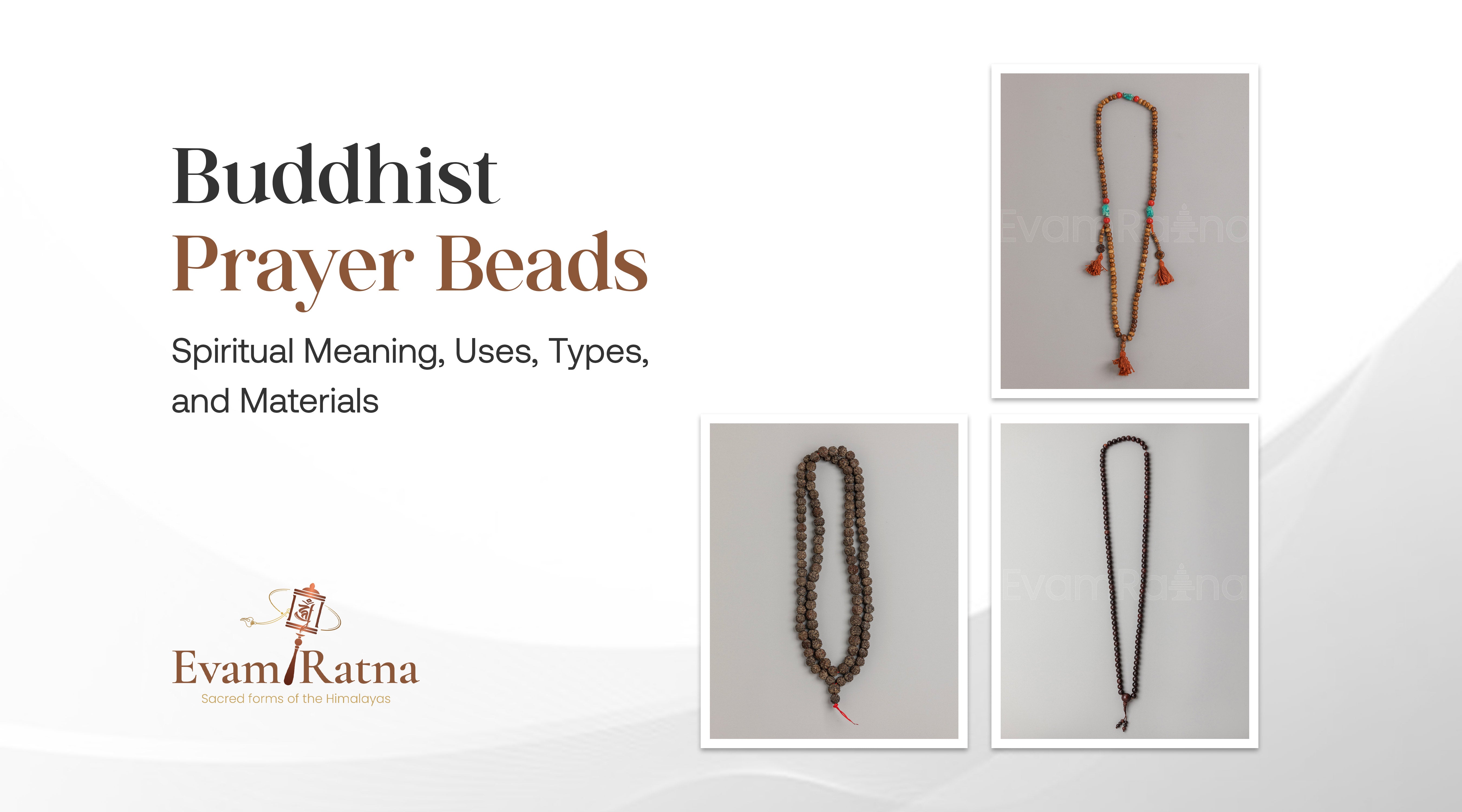
How to Choose and Use Buddhist Mala Beads for Meditation
Buddhist prayer beads or mala are traditional strings of 108 prayer beads used in Hinduism, Buddhism, and Sikhism to keep count during mantra repetition, meditation, and mindful breathing. It is a sacred companion that has accompanied generations of meditators, monks, and devotees as a tool for cultivating awareness, devotion, compassion, and wisdom. It can be seen in the hands of countless practitioners around the world as it carries a profound spiritual purpose.
What Are Buddhist Prayer Beads?

Buddhist prayer beads, commonly revered as mala, are a string of 108 beads used for counting mantra recitations, prayers, and meditation practices. The Sanskrit word mala means “garland” or “string,” which refers to the arrangement of beads connected together in a circular form. In Tibetan Buddhism, mala is known as threngwa, meaning a garland or rosary. The English word “bead” itself comes from the Old English word “bede,” meaning prayer, showing the historical connection between beads and spiritual devotion. These beads are traditionally used as a meditation tool. Each bead becomes a reminder of mindful practice; each movement of the hand supports concentration, and every repeated mantra becomes an opportunity to transform the mind. A mala acts as a companion during meditation, helping practitioners maintain focus while reciting sacred syllables and prayers. The circular arrangement represents continuity, completeness, and the ongoing nature of spiritual practice.
The History of Buddhist Prayer Beads (Malas)
Historians and scholars widely accept that the japa mala (prayer beads) originated in ancient India, with roots tracing back to around the 8th century BCE during the late Vedic period. While physical beads were likely used earlier by ascetics and sages, the earliest explicit written record of prayer beads used for counting mantras appears later in texts such as the Chinese Mu Huanzi Jing (Soapberry Bead Scripture), which translated Indian Buddhist traditions into China in the 4th - 5th century CE. From India, the use of the mala spread alongside Hinduism and Buddhism into Tibet, China, and across Asia, eventually influencing prayer bead traditions globally. As Buddhism adopted and developed this practice, it integrated prayer beads into various forms of meditation.
As Buddhism spread across different regions through trade routes, cultural exchanges, and pilgrimage journeys, the use and meaning of these objects evolved with local traditions. In Tibet, they became closely connected with meditation and spiritual practices, while in China and Japan, they were adapted into local forms of prayer and devotion. In Southeast Asia, malas were often made from fragrant woods such as sandalwood, adding a sensory element to meditation through their natural aroma and touch. Today, Buddhist prayer beads are used by practitioners across the world, from Himalayan monasteries in Nepal, Tibet, Bhutan, and India to meditation communities throughout Asia, Europe, and North America. They remain one of the most recognizable symbols of Buddhist practice, representing patience, discipline, mindfulness, and the continuous journey toward awakening.
What does a Buddhist Mala Consist of?

- 108 counting beads
- One larger guru bead (also called the meru or sumeru bead)
- A tassel or decorative ending
- Sometimes additional counters, vajra ornaments, or protective charms
1. 108 Prayer Beads
The number 108 is one of the most recognizable features of a traditional long mala, and it appears throughout Buddhist, Hindu, and Jain traditions with several particular spiritual significances. In Buddhist tradition, the 108 beads are often connected to the 108 human desires and mental afflictions that keep beings trapped in suffering. Each bead represents one of these obstacles, and reciting prayers or mantras with the mala symbolizes the process of purification and inner transformation. According to Mokugenji, or soapberry seed, sutra, the historical Buddha advised using a string of beads while reciting the Three Jewels of Buddhism: the Buddha (the fully awakened teacher), the Dharma (his teachings), and the Sangha (the community that practices those teachings), establishing the devotional use of counted beads within the tradition itself. Another interpretation connects the number 108 with the Kangyur, the traditional collection of the Buddha’s teachings in Tibetan Buddhism, which is often arranged into 108 volumes. From this perspective, each mala bead represents a volume of sacred wisdom, reminding practitioners of the teachings they follow on the path to awakening.
2. Guru Bead
At the top of a traditional long mala sits a distinct, often larger bead known as the guru bead, sometimes also called the sumeru bead, a reference to Mount Sumeru, the cosmic mountain at the center of traditional Buddhist cosmology. Structurally, the guru bead is usually different from the rest of the strand; it often has a different shape and contains three holes, serving as the point where the mala’s tassel is attached.
The guru bead is not counted as one of the 108 recitation beads. Instead, it marks the beginning and end of a full cycle. Practitioners begin counting from the bead immediately next to the guru bead and move around the mala until they arrive back at it, completing what is understood as one full "round" of recitation. Symbolically, the guru bead represents the connection between a practitioner and their spiritual teacher or guru, from whom teachings and practices are received. For this reason, many traditions avoid crossing over the guru bead while counting. When reaching it, practitioners turn the mala around and continue in the opposite direction, expressing respect for the lineage of teachers and the wisdom passed down through generations.
3. The Role of the Tassel
Most malas end in a tassel attached directly below the guru bead. While it can be easy to think of the tassel as purely decorative, it carries symbolic meaning in several Buddhist and Himalayan traditions, where it is associated with the lotus flower. It is a widely used symbol of enlightenment blooming out of difficult, muddy conditions. The tassel, in this sense, functions as a quiet visual reminder of the mala's ultimate purpose: supporting the practitioner's movement toward awakening.
4. Additional counters, vajra ornaments, or protective charms
Additional elements found on a mala, such as counters, vajra ornaments, and protective charms, carry their own symbolic meanings and are used to support spiritual practice. Mala counters are small attachments used to keep track of the number of mantra recitations, especially during long periods of practice. They help practitioners maintain discipline, focus, and commitment while accumulating prayers, mantras, or spiritual merit.
Vajra ornaments symbolize the indestructible nature of wisdom and compassion in Vajrayana Buddhism. The vajra represents spiritual strength, clarity, and the unchanging truth of awakening. Protective charms or amulets are often added as reminders of blessings, protection, and connection with enlightened beings or specific practices. Together, these additions transform the mala from a simple counting tool into a sacred object that supports mindfulness, devotion, and the practitioner’s journey toward inner transformation.
Types of Malas: Long Malas vs Wrist Malas
Two main formats are widely available and used today:
Long malas are the traditional style, usually made with 108 beads plus a guru bead. They are designed to be held in the hand or worn around the neck during meditation and mantra recitation. This format remains the most closely connected with formal Buddhist prayer and spiritual practice.

Wrist malas are a smaller and more convenient version, often made with fewer beads and strung on elastic so they can be worn comfortably throughout the day. While they may not always be used for extended mantra counting like traditional long malas, they serve as a meaningful reminder of mindfulness, intention, and personal spiritual practice. They are especially popular among those who want to carry a connection to meditation and Buddhist traditions in everyday life.
Mala Materials and Their Traditional Meanings
In Buddhist traditions, different materials are believed to carry specific symbolic qualities and spiritual purposes, so it's not just about the appearance of a mala. In this way, malas are made from a wide range of natural materials; these materials are chosen for their connection with nature, spiritual qualities, and the intentions behind meditation practices. For centuries, practitioners have used beads made from wood, seeds, gemstones, and bone as tools for mantra recitation, mindfulness, and spiritual reflection.
Understanding the symbolism behind different materials allows practitioners to choose a mala that reflects their personal goals and supports their journey of meditation and self-awareness. A mala is a tool for counting mantras but also a meaningful companion that represents dedication, compassion, and the continuous pursuit of inner awakening.
The most commonly used mala materials include:
- Wood
- Seeds
- Gemstones
- Bone
1. Wooden Malas

Wooden malas are made from sacred trees and are valued for their natural connection with the earth. Different woods carry unique symbolism and are used to support meditation and spiritual practice.
- Sandalwood Mala: Known for its calming fragrance, sandalwood malas are used to promote peace, focus, and relaxation during meditation.
- Rosewood Mala: Rosewood beads are associated with protection, compassion, and spiritual growth.
- Bodhi Tree Mala: Made from the sacred Bodhi tree, these malas symbolize Buddha’s enlightenment, wisdom, and the path toward awakening.
2. Seed Malas

Seed malas are made from natural seeds and represent growth, renewal, and spiritual connection. They are commonly used for mantra recitation and meditation.
- Rudraksha Mala: Traditionally valued for meditation, Rudraksha beads are associated with protection, focus, and inner balance.
- Bodhichitta Mala: These seeds symbolize compassion, wisdom, and the aspiration to achieve enlightenment for the benefit of all beings.
- Tulsi Mala: Sacred in Hindu traditions, Tulsi malas represent devotion, purification, and spiritual growth.
- Lotus Seed Mala: Lotus seeds symbolize purity, transformation, and the journey toward enlightenment.
3. Gemstone Malas

Gemstone malas are chosen for their symbolic qualities and connection with different meditation intentions. Each stone is believed to support specific spiritual qualities.
- Amethyst: Associated with calmness, clarity, and peaceful meditation.
- Rose Quartz: Symbolizes love, compassion, and emotional balance.
- Clear Quartz: Represents clarity, awareness, and spiritual growth.
- Citrine: Linked with abundance, confidence, and positive energy.
- Lapis Lazuli: Associated with wisdom, insight, and self-awareness.
- Turquoise: Represents protection, healing, and emotional balance.
- Onyx: Symbolizes strength, grounding, and protection.
- Moonstone: Connected with intuition and emotional harmony.
- Black Tourmaline: Used for grounding and energetic protection.
- Jade: Represents harmony, good fortune, and emotional healing.
4. Bone Malas

Bone malas are traditionally used in Vajrayana Buddhism as reminders of impermanence and transformation. They symbolize acceptance of change, inner strength, and spiritual awareness. Traditionally, bone malas are made from ethically sourced animal bone and serve as powerful reminders of the temporary nature of physical existence.
Symbolism and Meaning of Bone Malas
- Impermanence: Bone beads remind practitioners that all physical forms are temporary. They encourage reflection on the changing nature of life and the importance of spiritual development.
- Transformation: The process of turning bone into a meaningful spiritual object represents transformation, the ability to turn ordinary experiences into opportunities for wisdom and awakening.
- Strength and Resilience: Bones symbolize endurance and the ability to overcome difficulties, reminding practitioners to develop inner strength on the spiritual path.
- Protection: In some traditions, bone malas are associated with protective practices and are used alongside rituals connected with powerful meditation practices.
How to Use a Mala: Step-by-Step
Using a mala is a simple yet meaningful practice that helps develop mindfulness, concentration, and devotion. Traditionally, it is used for counting mantra recitations, prayers, or meditation cycles. The practice is less about the beads themselves and more about cultivating awareness and intention.
- Find a Quiet Space and Set Your Intention: Begin by sitting comfortably in a calm place. Take a few moments to settle your mind and set a clear intention for your practice, such as cultivating compassion, wisdom, peace, or healing.
- Hold the Mala Correctly: Traditionally, the mala is held in the right hand in many Buddhist traditions, though practices may vary by lineage. Hold the mala between the thumb and middle finger, while avoiding the index finger, which is sometimes associated with ego or self-grasping.
- Begin at the bead next to the guru bead. This is your starting point for each new round of recitation.
- Recite the mantra once per bead. Using your thumb, draw each bead over your index finger as you complete one recitation. For example, a well-known mantra such as Om Mani Padme Hum, associated with the bodhisattva of compassion.
- Move in a clockwise direction. Continue drawing beads across your index finger with your thumb, one bead per repetition, moving steadily around the strand.
- Turn the Mala Around at the Guru Bead: When you reach the guru bead, do not cross over it. Instead, turn the mala around and continue in the opposite direction if you wish to begin another round. This gesture symbolizes respect for the spiritual teacher and the lineage of teachings.
- Complete the Practice with Dedication: After finishing your recitation, take a moment of gratitude and dedicate the positive energy or merit of the practice toward the benefit of all beings. This reflects the Buddhist principle of using personal practice for the well-being of others.
- Handle the mala with care throughout: As malas are considered sacred, spiritually charged objects, the physical way they are handled, i.e gently, attentively, without carelessness, is treated as part of the practice itself.
How to Care for Your Buddhist Prayer Beads?

A mala is a sacred object, believed by many practitioners to carry the accumulated energy of the deity or practice it's connected to; traditional guidance recommends treating it with a level of reverence similar to that given to religious texts or other ritual implements.
A few widely observed guidelines include:
- Handle Your Mala with Respect: Treat your mala mindfully, especially if it has been used for prayers or mantra practice. Avoid placing it on the floor or in places where it may be damaged or treated carelessly. Many practitioners keep their mala in a special pouch or clean cloth when not in use. If a mala does accidentally fall, one common practice is to touch it briefly to the crown of the head while reciting a short purifying mantra, such as Om Ah Hum, three times.
- Keep your mala dry. Malas are typically not worn while bathing or exposed to water, since moisture can weaken the cord over time and cause the strand to break.
- Protect It from Extreme Conditions: Keep your mala away from direct sunlight, excessive heat, and humidity, which can fade, crack, or weaken the beads and cord. Store it in a cool, dry place when not being worn or used.
- Remove your mala before sleep. Wearing a mala overnight increases the risk of stress on the cord, which can lead to premature breakage.
- Maintain Its Spiritual Connection: Some practitioners refresh their mala through meditation, prayer, incense, or placing it near sacred objects. While the practice varies between traditions, the intention is to honor the connection between the practitioner, the teachings, and the path of mindfulness.
- Store it properly. A dedicated mala bag or pouch is a traditional and practical way to protect the beads from dust, tangling, and everyday wear.
How to Choose a Mala for Your Practice?
Choosing a mala doesn't require being a formally initiated Buddhist practitioner. Malas are widely used by people simply seeking a physical anchor for a calmer, more intentional mind, regardless of their specific religious background. That said, a few practical considerations can help guide the choice:
- Consider Your Intention: Begin by reflecting on the purpose of your practice. Are you using the mala for meditation, mantra recitation, compassion practice, healing, protection, or personal mindfulness? Your intention can guide you toward a material and style that feels meaningful for your journey.
- Consider Your Personal Connection: If a particular quality calm, clarity, protection resonates with your current life circumstances, choosing a material traditionally associated with that quality can add a layer of personal significance, even outside strict ritual use.
- Consider durability and comfort: Beads that are comfortable in the hand and strung on a sturdy cord will hold up better to daily handling, particularly for a mala intended for regular recitation practice.
- Consider provenance: Malas made and blessed within an established monastic or nunnery community carry particular significance for many practitioners, both because of the craftsmanship involved and because purchasing them often directly supports the community that made them.
How to Recognize an Authentic Buddhist Mala?

When choosing a Buddhist mala, authenticity is not only about appearance. A genuine mala reflects traditional design, meaningful materials, careful workmanship, and respect for the spiritual practices behind it. Here are some important factors to consider before buying a mala.
1. Quality of the Beads
Authentic malas are usually made with carefully selected natural materials such as sandalwood, Bodhi seeds, gemstones, rudraksha seeds, or bone. The beads should feel consistent in shape, size, and texture, while natural materials may show slight variations that reflect their organic origin. Genuine beads often have unique markings, grain patterns, or natural color differences rather than a perfectly uniform appearance.
2. Natural vs Synthetic Materials
Traditional Buddhist malas are commonly made from natural materials connected with spiritual symbolism, including wood, seeds, stones, and gemstones. While synthetic beads can imitate the appearance of traditional materials, they usually lack the natural texture and characteristics of genuine materials. When purchasing a mala, it is important to ask whether the beads are made from authentic wood, natural seeds, or real gemstones.
3. Proper 108-Bead Structure
A traditional Buddhist mala generally contains 108 counting beads, a number that holds deep spiritual significance in many Buddhist traditions. These beads are used to count mantra recitations during meditation practice. Some malas may have smaller counts such as 54 or 27 beads, but these are usually based on divisions of the traditional 108-bead structure.
4. Presence of the Guru Bead
A traditional mala includes a special guru bead (also called the Buddha bead or mother bead) that marks the beginning and end of a complete cycle of 108 repetitions. Unlike the other beads, the guru bead is not counted during mantra recitation. It often has a larger size or a different design, symbolizing the guidance of the teacher and the wisdom of the Buddhist path.
5. Handmade Craftsmanship
Many authentic malas are handmade by skilled artisans who carefully string, knot, and arrange each bead. Hand-knotting between beads is a traditional technique that helps keep the beads separated and allows smoother movement during meditation. Small variations in handmade malas are often signs of individual craftsmanship rather than imperfections.
6. Importance of Ethical Sourcing
A meaningful mala should also come from responsible and respectful sources. Ethical sourcing ensures that natural materials are collected responsibly and that artisans involved in making the mala are fairly supported. Choosing ethically made malas helps preserve traditional craftsmanship while respecting the cultural and spiritual importance of Buddhist objects.
How Are Buddhist Prayer Beads Used in Different Practices?

Buddhist prayer beads help to support mindfulness, mantra recitation, and spiritual discipline. It also helps practitioners maintain focus, count repetitions, and develop qualities such as compassion, wisdom, and awareness. The traditional use of malas is especially prominent in Tibetan Buddhism, where mantra practice and meditation are important parts of the Vajrayana path.
1. Mantra Meditation
The most common use of a Buddhist mala is for mantra meditation. Practitioners move through each bead while repeating a sacred mantra, using the mala as a physical counting tool that helps keep the mind focused and present.
In Tibetan Buddhist traditions, practitioners may repeat a mantra hundreds, thousands, or even millions of times as part of their spiritual practice. Completing one full round of a 108-bead mala is often considered one cycle of mantra recitation. The repetitive movement of the beads, combined with sound and concentration, supports a deeper meditative state.
2. Deity Yoga Practice
In Vajrayana Buddhism, malas are often used during deity yoga practices, where practitioners meditate on enlightened figures known as yidams or meditation deities. The purpose of these practices is the cultivation and realization of awakened qualities within oneself. These practices are designed to cultivate the enlightened qualities represented by these figures.
Common deity practices using mantra recitation include:
- Chenrezig: cultivating compassion and kindness
- Green Tara: developing protection, compassion, and swift assistance
- Vajrasattva: purification of negative karma and mental obscurations
- Manjushri: developing wisdom and insight
- Padmasambhava: connection with the teachings of Vajrayana Buddhism
- Medicine Buddha: cultivating healing and compassion
3. Compassion Practice
Malas are also widely used during compassion meditation practices. Through repeated recitation of compassionate mantras, practitioners train the mind to develop qualities such as kindness, patience, generosity, and empathy.
A well-known example is the mantra of Chenrezig: Om Mani Padme Hum
Repeated with a focused mind, this practice is traditionally associated with developing bodhichitta, the wish to attain awakening for the benefit of all sentient beings. The mala serves as a reminder that Buddhist practice is not only focused on personal peace but also on reducing suffering and cultivating compassion toward others.
4. Purification Practices
Certain malas are used during purification practices, especially within Vajrayana Buddhism. One of the most widely practiced purification meditations is connected with Vajrasattva. During Vajrasattva practice, practitioners recite the Vajrasattva mantra while reflecting on the purification of harmful actions, negative emotions, and mental obstacles. Moving through each bead represents the gradual process of transforming confusion and negativity into wisdom and awareness. Malas used for purification practices may be made from specific materials traditionally associated with these practices, depending on the lineage and instructions of a teacher.
5. Retreat and Advanced Practice
In Tibetan Buddhist monasteries and meditation retreats, malas are important tools for completing large numbers of mantra recitations. During intensive practices, practitioners may count:
- Thousands of mantra repetitions
- Hundreds of thousands of recitations
- Millions of accumulated mantras
The mala allows practitioners to maintain accurate counting while keeping their attention connected with the meditation itself. For advanced practitioners, mantra accumulation is often part of long-term spiritual commitments known as ngöndro (preliminary practices) or other Vajrayana training methods. In these contexts, the mala becomes a companion in disciplined practice, helping practitioners develop concentration, devotion, and perseverance.
The Deeper Meaning of Using a Mala
Beyond its practical purpose as a counting tool, a Buddhist mala carries deep spiritual symbolism. A traditional mala usually contains 108 beads, a number that represents completeness and the totality of existence in many Buddhist traditions. The 108 beads are often associated with the 108 worldly desires or mental afflictions that bind beings to suffering and prevent the realization of true awareness.
As practitioners move through each bead while reciting a mantra, each repetition becomes a symbolic step toward purification. The act of counting each bead represents gradually transforming and letting go of these attachments, negative emotions, and obstacles of the mind. Through continuous practice, practitioners cultivate wisdom, compassion, and awareness, moving closer to the goal of liberation and enlightenment.
Frequently Asked Questions (FAQs)
1. What is the significance of 108 beads in a Buddhist mala?
A traditional Buddhist mala contains 108 beads, which represent completeness and the totality of spiritual practice. In Buddhist traditions, the 108 beads are often associated with the 108 worldly desires and mental afflictions that cause suffering. Reciting mantras while moving through each bead symbolizes purification and transformation of these obstacles.
2. What is the purpose of the guru bead on a mala?
The guru bead marks the beginning and end of one complete cycle of 108 mantra recitations. It is not counted as one of the 108 beads and symbolizes the connection between the practitioner and the spiritual teacher or lineage of teachings.
3. Can anyone use a Buddhist mala for meditation?
Yes. While malas have deep roots in Buddhist traditions, they can be used by anyone seeking mindfulness, meditation, and a more focused practice. A mala serves as a physical reminder to develop awareness, intention, and inner calm.
4. What materials are Buddhist malas made from?
Buddhist malas are made from various natural materials, including wood, seeds, gemstones, and bone. Different materials carry traditional meanings and are chosen based on their symbolism and connection with specific meditation practices.
5. How is a mala used during meditation?
A mala is commonly used by holding each bead while reciting a mantra, prayer, or meditation phrase. Practitioners move from one bead to another with each repetition and turn the mala around when reaching the guru bead instead of crossing over it.
Conclusion
Buddhist prayer beads, or malas, are much more than simple strings of beads. They are sacred meditation tools that support mindfulness, mantra recitation, and spiritual discipline. From the traditional 108-bead structure and symbolic guru bead to the different materials chosen for their meanings, every element of a mala carries a deeper connection with Buddhist practice. Whether used for mantra meditation, compassion practice, purification, or personal mindfulness, a mala helps practitioners remain focused and connected with their spiritual intentions. Each movement through the beads represents a step toward transforming the mind, cultivating wisdom, and moving closer to awakening.