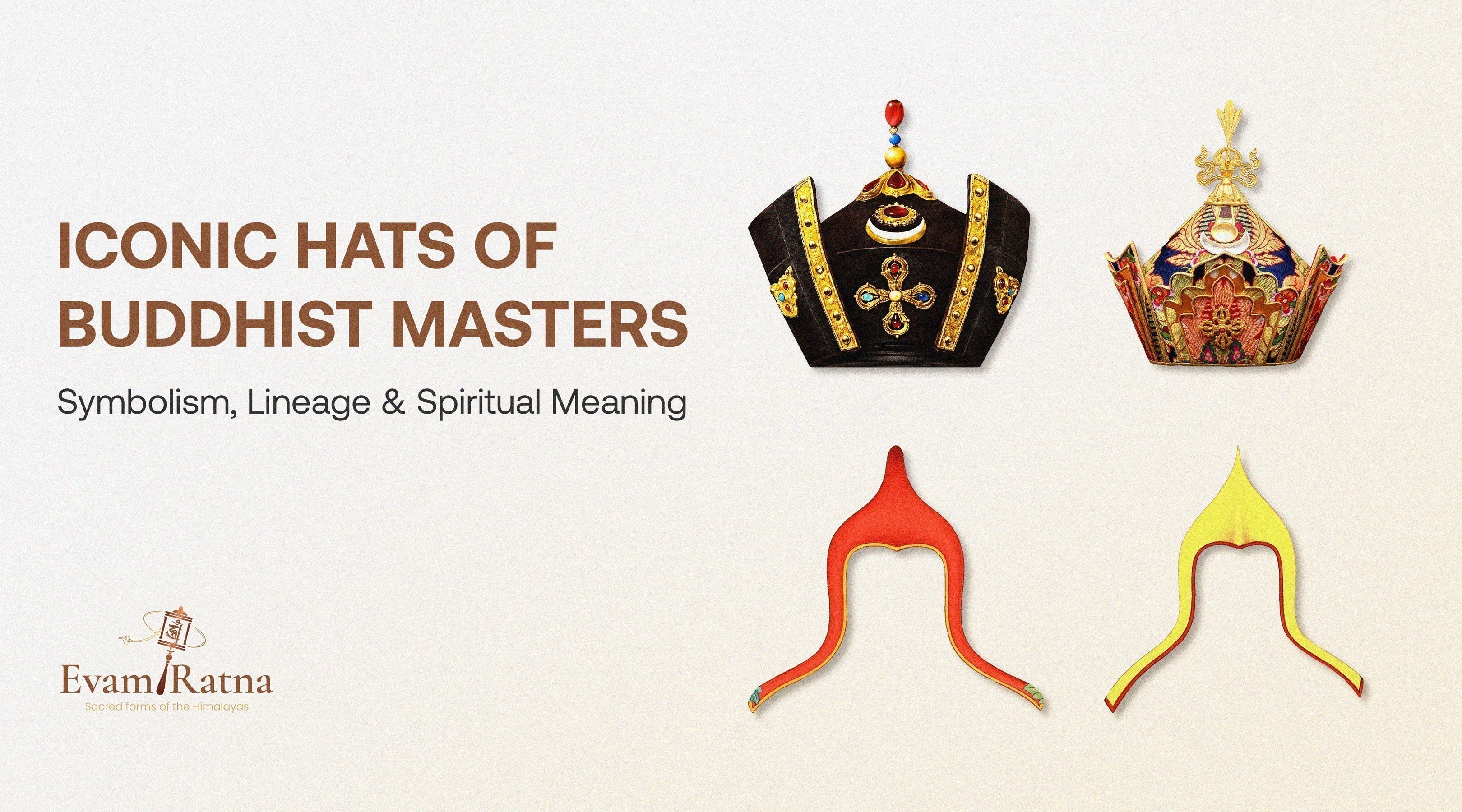
Guru Rinpoche, Tsongkhapa & Karmapa Hats: Sacred Symbolism Explained
We have all seen Iconic Hats of Buddhist Masters in the visual language of Tibetan Buddhism, each representing a unique aspect of their spirituality and teachings. Long before a viewer reads any text beneath a thangka or examines the mudra of a statue's hands, the shape and color of a master's headwear have already conveyed a message about their identity and status within the religious hierarchy. Each detail, from the fabric's texture to the intricate patterns, tells a story of tradition, spirituality, and the cultural significance embedded in the art.
Each hat carries a transmission of lineage, of authority earned through study or realization, and in some cases, of a blessing said to have descended from the deity world itself. This piece walks through five of the most recognizable hats in Himalayan Buddhism, worn by Guru Rinpoche, Je Tsongkhapa, Longchenpa, the Karmapas, and Guru Shabdrung, and what each one is actually telling us.
Why Buddhist Masters Wear Sacred Hats?
A ceremonial hat in Tibetan Buddhism is important as it identifies which of the four schools, Nyingma, Sakya, Kagyu, or Gelug, a teacher belongs to, since each developed its own signature color and shape over the centuries. It functions as a working ritual object in empowerments, initiations, and sacred cham dances, where its form is believed to help focus particular energies and blessings. It marks spiritual authority, since certain hats are reserved only for recognized lineage holders and senior teachers. And it ties the wearer to an unbroken chain of transmission stretching back to the founding masters of their tradition; putting on the hat is, in a real sense, stepping into a lineage rather than simply dressing for a ceremony.
The Hat Families of Tibetan Buddhism
Before looking at individual masters, it helps to see the wider map. Tibetan ceremonial hats generally sort into a few recognizable families, and color is the fastest way to read them:
The Pandita Hat (Yellow Gelug Hat)

Origin: The pandita hat traces back to the scholar's cap worn at the great Indian Buddhist monastic universities, Nalanda and Vikramashila chief among them. It entered Tibet alongside the Indian panditas and translators who carried sutra and tantra across the Himalayas during the early spread of the Dharma, and Tibetan scholars adopted the same silhouette as a mark of textual lineage.
Purpose: The hat identifies its wearer as a trained scholar and philosopher rather than purely a ritual specialist. It is worn during teachings, formal debate, and the conferral of tantric empowerments that require deep textual grounding; the pointed crown and long lappets framing the face are read as a sign of disciplined study reaching toward realization. The Pandita hat in the Gelug tradition of Tibetan Buddhism is a distinct, high-pointed yellow hat that symbolizes supreme scholarship, philosophical mastery, and strict monastic discipline.
Tradition: The pandita hat is not confined to one school. It appears in red across Nyingma, Sakya, and other older lineages, and was given a yellow form by the Gelug school, where it became the order's defining emblem.
Masters who wear it: Sakya Pandita, Je Tsongkhapa and the Dalai Lamas in its yellow form, Longchenpa in a Nyingma red hybrid, and the eleventh-century translator-scholar Atisha, often depicted in a similar pointed scholar's cap.
The Lotus Hat (Pema Zhwa)

Origin: The lotus hat is tied directly to Guru Padmasambhava. Tradition holds it was offered to him by King Vihardhara (also known as King Indrabodhi) of Zahor as recognition of his tantric mastery, and that he wore it while subduing Tibet's local spirits and binding them as protectors of the Dharma during the eighth century.
Purpose: Where the pandita hat marks scholarship, the lotus hat marks tantric realization and ritual authority. It is worn during empowerments and high ceremonies as a vessel for transmitting Guru Rinpoche's blessing directly to those present; practitioners describe the wearer as channeling that original blessing each time the hat is donned.
Tradition: This is the signature hat of the Nyingma school, sometimes called the "Red Hat" tradition for this reason. Individual Nyingma seats Mindrolling, Dzogchen Monastery, Shechen- developed their own variations in ornament and proportion, all recognizably descended from the same original form.
Masters who wear it: Guru Rinpoche himself, Longchenpa in his hybrid pandita-lotus form, Dilgo Khyentse Rinpoche, and Guru Shabdrung, who carried the same lotus-hat tradition into Bhutan.
Karmapa's Black Crown (Zhwa Nag)

Origin: The Kagyu schools trace their lineage through Tilopa, Naropa, Marpa, and Milarepa, figures associated with renunciation and simplicity rather than elaborate regalia, which is reflected in the plain, close-fitting cap that became Kagyu's everyday monastic headwear. The Karmapa's Black Crown has a separate and more dramatic origin: it is said to have been woven by the dakinis of the Buddha-realms from their own hair, offered to the first Karmapa, Dusum Khyenpa, as recognition of his complete realization. A physical replica was later commissioned by the Yongle Emperor of China after witnessing what he understood to be the crown's presence during a visit from the fifth Karmapa, Deshin Shekpa.
Purpose: The everyday cap simply identifies a Kagyu monk or lama. The Black Crown serves a far more specific ritual function: in the Black Crown Ceremony, the Karmapa wears it briefly while reciting a mantra, an act understood to make the compassion of Avalokiteshvara directly perceptible to those witnessing it.
Tradition: Karma Kagyu is the lineage most associated with this hat family, with the Shamarpa's red crown standing as a parallel emblem representing a wisdom-aspect counterpart to the Karmapa's enlightened activity.
Masters who wear it: The successive Karmapas, most recently the seventeenth, Ogyen Trinley Dorje, along with Shamar Rinpoche and senior Kagyu tulkus in the plain red or black cap form.
The Sakya Red-and-Black Hat

Origin: This hat traces to Khön Konchok Gyalpo, founder of Sakya Monastery in the eleventh century, who established the wearing of a distinct hat as a marker of lineage authority within the newly founded school.
Purpose: The hat's combination of red base and black flaps is read as a sign of mastery over both tantric practice and scholastic philosophy at once, Sakya's particular synthesis. It is worn at high ceremonies and was historically used to signal diplomatic as well as spiritual authority, most famously when Sakya Pandita wore it at the Mongol court in the thirteenth century.
Tradition: This hat belongs solely to the Sakya school and is not shared with the other three major orders, making it one of the more immediately identifiable hats in Tibetan Buddhism.
Masters who wear it: Sakya Pandita, the current Sakya Trizin (Gyana Vajra Rinpoche), and the Jetsunmas, the female lineage holders of the Sakya tradition.
Bon Ritual Hats

Origin: Bon is Tibet's pre-Buddhist indigenous spiritual tradition, and its ceremonial hats predate the arrival of Buddhism itself. Bon's mythic founder, Tonpa Shenrab Miwoche, is traditionally depicted wearing elaborate cosmic-authority headwear, establishing hats as central to Bon ritual identity from its earliest layer.
Purpose: Bon hats are working ritual tools rather than purely identity markers; feathered hats in particular are used in protective rites and exorcisms, where the hat is believed to help the wearer connect with sky spirits and cosmic forces during the ritual.
Tradition: Bon hat styles include feathered hats, wide-brimmed hats, and conical ritual hats, each tied to a different ritual function and worn at monasteries such as Menri and Triten Norbutse.
Masters who wear it: Tonpa Shenrab Miwoche in Bon iconography, the contemporary teacher Lopön Tenzin Namdak Rinpoche, and the Menri Trizin, the tradition's current head.
With that map in place, here is what five of the tradition's most iconic hats actually mean for the individual masters who made them famous.
The Lotus Hat of Guru Rinpoche:

Guru Padmasambhava, the "Precious Teacher" who carried tantric Buddhism into Tibet in the eighth century, is associated with what is generally considered the original lotus hat, known in Tibetan as the Pema Zhwa. Tradition holds that the hat was offered to him by King Vihardhara (also known as King Indrabodhi) of Zahor as a mark of his realization, and that he wore it as he subdued the local spirits of the Himalayas and bound them to protect the Dharma.
The lotus hat's design is built almost entirely out of symbolism. It typically has two layers, representing the development and completion stages of tantric practice. Its peak rises to three points, for the three bodies (kayas) of buddhahood. A vulture feather and a half-vajra often crown the top, and a sun-and-moon motif marks the union of skillful means and wisdom, the central pairing that gives Vajrayana practice its name. The hat's flared sides and open front distinguish it visually from the narrower pandita hat, even though the two share a common ancestry.
Because the lotus hat is reserved for senior Nyingma lamas, every Nyingma monastery developed its own variation, some modest, some extravagant, with long lappets or distinctive coloring specific to a single seat of practice. When a Nyingma teacher today is enthroned wearing a lotus hat, the gesture is understood as a direct continuation of Guru Rinpoche's blessing, passed unbroken from teacher to student across more than a millennium.
Read More About Guru Padmasambhava Lotus Hat: Meaning in Tibetan Buddhism & Vajrayana Practice
The Pandita Hat of Je Tsongkhapa: Birth of the Yellow Hat
Je Tsongkhapa (1357 - 1419) founded the Gelug school as a reform movement built on rigorous monastic discipline and exacting scholarship, and he marked that reform visually. The pandita hat he adopted traces back to the headwear of the great Indian monastic universities like Nalanda; in its original red form, it had already been worn by scholars across several Tibetan schools for centuries. Tsongkhapa's innovation was the color: he turned the hat bright yellow, a shift said to emphasize discipline and the strict keeping of monastic vows.
That single change gave an entire tradition its popular name. The Gelug school became known across the Himalayas, and eventually across the world, as the "Yellow Hat" school, with the hat itself becoming shorthand for the lineage's emphasis on philosophical training, debate, and the gradual path through sutra and tantra. The hat's tall, crested shape and long lappets are now instantly recognizable in thangkas of Tsongkhapa, and his two principal disciples, and the same yellow pandita hat is worn today by Gelug monks at the great prayer festivals Tsongkhapa himself established.
Pandita Hat of Longchenpa: The Dzogchen Master's Hybrid Crown
Longchen Rabjam or Longchenpa (1308 - 1364) stands as the great systematizer of Dzogchen, the "Great Perfection" teachings at the heart of Nyingma practice. Where Tsongkhapa's hat marked a reform, Longchenpa's hat marks a synthesis. He is generally shown wearing what iconographic sources describe as a treasure lotus hat that blends features of both the pandita hat and the lotus hat, pointed and scholarly in silhouette, but carrying the layered, ornamented character of the Nyingma crown. In keeping with Nyingma convention, his hat is rendered in red rather than the Gelug yellow.
The hybrid form fits the man. Longchenpa was both a formally trained scholar and a realized tertön-level master of the highest tantric teachings, and his writings, above all the Seven Treasuries, are revered precisely for holding scholastic precision and direct meditative experience in one hand. His hat, sitting at the intersection of two hat families, is a quiet visual argument for the same thing his texts argue at length: that deep study and direct realization are not in tension, but complete each other.
The Black Hat of the Karmapas: Crown Woven by Dakinis

No hat in Tibetan Buddhism carries a more dramatic origin story than the Karmapa's black crown. According to Karma Kagyu tradition, the dakinis of the Buddha-realms wove a crown from their own hair as an offering to the first Karmapa, Dusum Khyenpa, in recognition of his complete realization. This original crown was said to be visible only to those with sufficiently pure perception, invisible to the eyes of ordinary beings, hovering just above the Karmapa's head rather than resting on it.
Centuries later, the Yongle Emperor of China, having witnessed what he took to be visible evidence of this crown during a visit from the fifth Karmapa, Deshin Shekpa, commissioned a physical replica in gold and black silk so that ordinary practitioners could also receive its blessing. This physical crown became the basis for the Black Crown Ceremony, in which the Karmapa dons the hat briefly while reciting a mantra, an act understood to make the compassion of Avalokiteshvara, of whom the Karmapas are considered an emanation, directly perceptible to those present. The cap-style hat itself, modest and unadorned in its everyday monastic form, belongs to the broader Karma Kagyu tradition of simple caps rather than the more elaborate lotus or pandita styles, which is part of what makes the ceremonial black crown's history feel so distinct from its plain appearance.
The Lotus Hat of Guru Shabdrung: Bhutan's Sacred Inheritance

Zhabdrung Ngawang Namgyal (1594 - 1651), Guru Shabdrung, occupies a singular place in Himalayan history as both a Drukpa Kagyu lineage holder and the unifier of Bhutan as a single nation-state. Fleeing political conflict in Tibet, he established a new seat of authority in the Bhutanese valleys, founding the dual system of religious and civil governance that still shapes Bhutan today, and he is honored alongside the Buddha and Guru Rinpoche as one of the three central figures of Bhutanese sacred art.
In thangkas and statuary, Guru Shabdrung is most often shown in monastic robes with his distinctive pointed beard, wearing ceremonial headwear in the lotus-hat tradition associated with great realized masters, a visual link that, fittingly, places him in the same family of crowned teachers as Guru Rinpoche himself, whose Dharma he carried into a new land. For Bhutanese practitioners, the hat is inseparable from the man: a sign that the figure who built a nation did so as a recognized master of the Dharma, not merely as a political founder.
Why Do These Hats Still Matter Today?
For practitioners, these hats are not historical curiosities; they remain active tools of recognition and devotion. A glance at the right hat tells a viewer which lineage a teacher belongs to, what kind of training stands behind them, and which blessing-stream they are understood to carry forward. For collectors and devotees who bring a statue or thangka of one of these masters into a home or shrine room, the hat is often the detail that confirms the identity and lineage of the figure being honored, a small piece of iconography doing the work of an entire biography.
Conclusion:
Looked at side by side, these five hats sketch a kind of map of Himalayan Buddhism itself, its oldest tantric roots in Guru Rinpoche's lotus crown, its reforming scholasticism in Tsongkhapa's yellow peak, its synthesis of study and realization in Longchenpa's hybrid form, its most mysterious lineage-transmission in the Karmapa's black crown, and its extension into a new nation through Guru Shabdrung's. Worn, carved, painted, or simply remembered, each hat keeps doing exactly what it was designed to do: carrying a teaching forward without needing a single word.