A Tale of Guru Padmasambhava, Mandarava and King Vihardhara of Zahor
Guru Padmasambhava, revered as Guru Rinpoche, the Precious Master, stands as one of the most luminous and enigmatic figures in the entire Vajrayana tradition. Born miraculously upon a lotus in a lake in the kingdom of Oddiyana, he is considered the Second Buddha, the one who brought the indestructible teachings of the Vajrayana into Tibet and sealed them within the very mountains and minds of its people.
Unlike the historical Buddha Sakyamuni, Padmasambhava does not move through a single, tidy biography. His life is a series of manifestations, trials, miracles, and transmissions, each episode a teaching in itself. Among the most dramatic and symbolically rich of these episodes are the fires of Mandi and Oddiyana, the sacred union with the dakini princess Mandarava, and the offering of the royal lotus hat that would become his eternal iconographic crown.
The Princess Mandarava and the Kingdom of Zahor

The story of the Lotus Hat begins in the kingdom of Zahor (identified with the Mandi region of present-day Himachal Pradesh, India). Mandarava was a princess of Zahor, with exceptional beauty and spiritual inclination. Despite her father, King Vihardhara, seeking numerous royal suitors for her, Mandarava had already resolved to renounce the worldly life in favor of the Dharma.
When Guru Padmasambhava arrived, drawn to Mandarava as his destined teacher and Vajrayana co-practitioner, she recognized him immediately as her true teacher and the union of their practices as the path to liberation. She left the palace and joined him.
Back in Mandi, the people recognized their princess in the streets, dressed in simple clothing, walking in the market like any ordinary person. To the court and the kingdom, this was an unbearable insult. A great princess, heir to Zahor, was wandering as if she were a common woman. Rage spread from the streets to the ministers, and from the ministers to King Vihardhara himself.
Burned Alive in Mandi, The First Trial by Fire
The ministers gathered sandalwood because it burns hotter than any other wood, and they would give this interloper no advantage. Great quantities of sesame oil were added. The pyre was built to ensure no memory of the pair would remain.
Both Guru Padmasambhava and Mandarava were burned alive upon it. The king and ministers returned to see what was going on. But they did not find ash. They found something that shook the foundations of their worldview: under the fire there was water, and upon the water, there was a giant lotus flower. On the lotus flower, both Guru Padmasambhava and Mandarava were seated, comfortably, peacefully, unharmed.
That is when they realized they had made a great mistake. Strong regret and great shame arose, and they requested the two to come out of the fire.
The Lotus in the Lake, Miracle and Recognition

The image of the two figures seated on a vast lotus was a precise dharmic statement. The lotus in Buddhist and Hindu iconography grows from muddy, dark waters yet blooms immaculate and untouched above the surface. It is the very emblem of liberation within samsara, of purity not achieved by avoiding defilement but by being beyond the reach of defilement entirely.
By transforming the oil of destruction into a medium for a lotus throne, Padmasambhava revealed the true nature of phenomena. He demonstrated that for an individual who has realized the nature of mind, no external element, whether it is fire or water, carries inherent power. The only true power is the power of awareness itself.
The king descended from his elephant and walked towards them on the ground, like an ordinary person, and offered his elephant to Guru Padmasambhava and Mandarava. They climbed onto the elephant and were led back to the palace.
The King's Offering: The Sacred Lotus Hat

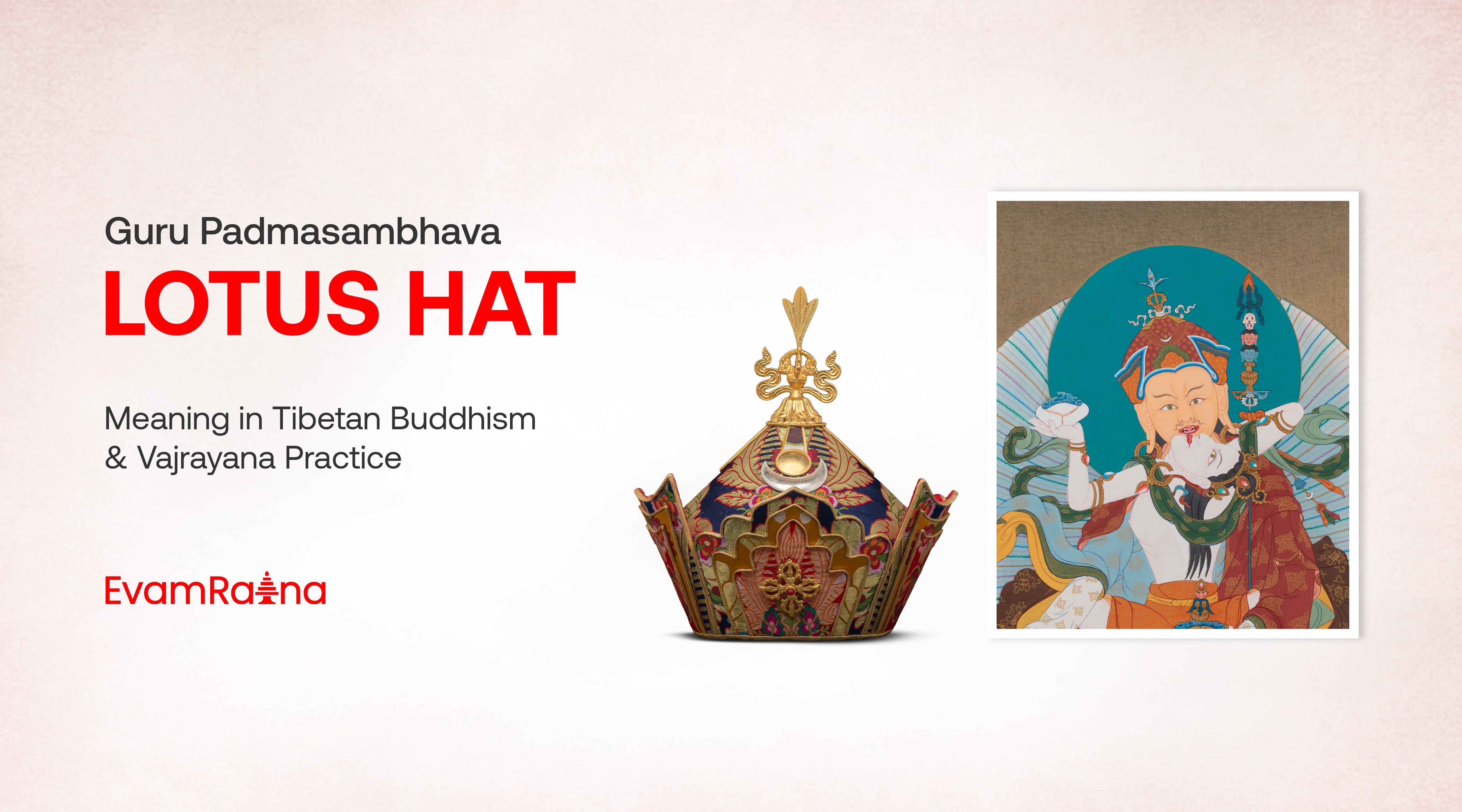
A great ceremony followed. The king and his ministers offered the whole kingdom to Guru Padmasambhava and Mandarava. Most significantly, the king offered his royal raiment: his jewelry, his finest clothing, and his royal hat. Guru Rinpoche then taught the king and all the subjects of Zahor, and many attained realization. As Padmasambhava donned these items, they were transformed from symbols of worldly authority into sacred iconographic ornaments. This is why, unlike many other masters depicted in simple robes, Guru Rinpoche is almost always shown adorned with fine jewelry and his distinctive crown.
Sacred Names of the Lotus Hat:
The hat that was offered became known across the Vajrayana world by several sacred names:
- The Lotus Which Liberates on Sight: Liberation arises through mere visual contact with the awakened form
- The Petalled Hat of the Five Families: Each petal embodies one of the five buddha families (pancakula)
- The Crown of the Three Kayas: Its three points represent dharmakaya, sambhogakaya, nirmanakaya
Symbolism of the Lotus Hat: The Five-Petalled Crown
The Lotus Hat of Guru Padmasambhava is one of the most layered symbolic objects in all of Vajrayana iconography. Every element, such as the layers, the points, the colors, the ornaments, encodes a specific teaching:

Inner & outer layers
These symbolize the unity of the generation phase (kyerim) and completion phase (dzogrim). This represents the inseparability of form and emptiness within spiritual practice.
Three points
The points represent the three kayas: the dharmakaya (truth body), sambhogakaya (enjoyment body), and nirmanakaya (emanation body).
Five Colours
These represent the five buddha families (pancakula) and their respective wisdoms. They also signify the five kayas working in all directions for the benefit of sentient beings.
Sun & Moon
Adorning the hat, these symbols represent the union of skilful means (upaya) and wisdom (prajna), which are the masculine and feminine principles united on the bodhisattva path.
Blue Border
This represents unlimited samaya, signifying the unbreakable and sacred commitment between the practitioner and the guru-dakini lineage.
Vajra Top
The vajra at the summit symbolizes unshakeable concentration and the indestructible, realized nature of awareness that remains unmoved by any condition.
Vulture’s Feather:
This signifies the realization of the highest view, specifically Dzogchen. It is likened to a vulture soaring at heights no other bird can reach, representing the culmination and summit of all spiritual vehicles.
Overall Form
The hat functions as a maṇḍala of awakened qualities. It is believed to plant a seed of liberation in the mind-stream of anyone who truly sees it, which is why it is called the "Petalled Hat of the Five Families" or the "Lotus Which Liberates on Sight."
The Second Fire: The Return to Oddiyana and the Garland of Skulls
After teaching the people of Zahor, many of whom attained realization, Padmasambhava and Mandarava returned to his birthplace, Oddiyana. History repeated itself as they were again recognized and subjected to a sandalwood pyre. As before, they burned Guru Padmasambhava and Mandarava alive.
In Oddiyana, such a fire normally dies down in seven days. But this fire was still burning after twenty-one days. As before, the people were dismayed. When they went to check on the fire, they saw Guru Padmasambhava and Mandāravā in the flames, both unharmed, even looking better than ever, and wearing garlands of kapāla skulls.
Following this miracle, Padmasambhava was known as Pema Totreng Tsal, "The Powerful Lotus-born, with a Garland of Skulls".
The Legacy of Pema Gyalpo: Liberation on Sight
The Guru and Mandarava remained in Oddiyana for thirteen years, eventually leading the king, queen, and many subjects to attain the rainbow body, the ultimate sign of Dzogchen realization. During this period, he became known as Padma Raja or Pema Gyalpo, the "Lotus-born King".
The Lotus Hat remains the defining feature of this "King" manifestation. Because it encodes the entirety of the path, from the commitment of samaya to the heights of Dzogchen, it is known as "The Lotus Which Liberates on Sight". It is believed that even a brief moment of visual contact with this form can awaken the latent seed of enlightenment within a person's mind.
Conclusion: The Enduring Power of Vajrayana Symbols
Every time a practitioner sees a thangka or statue of Guru Padmasambhava, eyes blazing with awareness, draped in the royal silks of Zahor, wearing the three-pointed lotus crown with its vulture feather reaching toward the sky, they are seeing a compressed map of all of this. The story of the Lotus Hat is more than a legend of ancient fires and royal gifts. It is a testament to the transformative power of the Vajrayana. Through the symbols of the hat, Guru Padmasambhava provides a visual map of the enlightened mind. Each layer, color, and feather serves as a reminder that the world we perceive as solid and threatening can be transformed, through awareness and wisdom, into a lake of lotuses. In the presence of the Lotus-born, the fires of worldly anger are cooled into the waters of realization, and the ordinary crown of a king becomes the vehicle for the liberation of all beings.