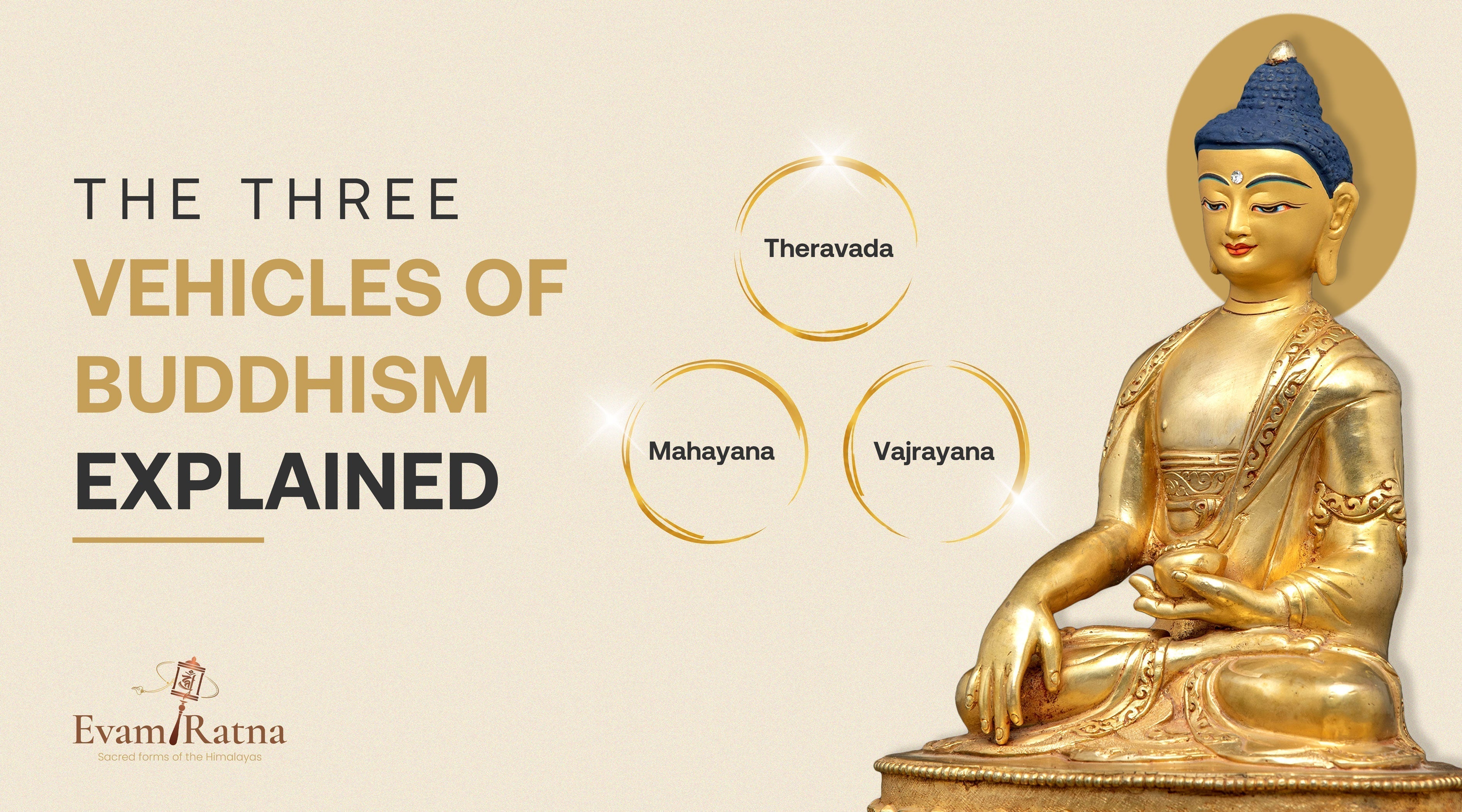
The Three Yanas: A Beginner's Guide to Buddhist Paths
Buddhism is one of the world's oldest living spiritual traditions, dating back more than 2,600 years to the historical Buddha, Shakyamuni. Yet to speak of "Buddhism" as a single, unified religion is to miss much of its richness. Over millennia, the Buddha's teachings evolved into three distinct paths, known as the three vehicles or three yanas, each designed for different kinds of practitioners, different levels of aspiration, and different approaches to the same ultimate destination: liberation from suffering.
Whether you are new to Buddhist practice or deepening a study you have carried for years, understanding the three vehicles Theravada, Mahayana, and Vajrayana exploring their origins, core teachings, distinctive practices, and what makes each path unique is one of the most illuminating frameworks the tradition offers.
What Are the Three Vehicles of Buddhism?
The Sanskrit word yana simply means "vehicle", something that carries a traveller from one place to another. In Buddhist philosophy, each yana is a vehicle that carries the practitioner from the suffering of ordinary existence (samsara) toward liberation or full enlightenment (nirvana or Buddhahood). Just as different vehicles suit different journeys and terrains, the three yanas are suited to practitioners with different levels of motivation, capacity, and commitment.
How did the three vehicles emerge from the Buddha's teachings?
Buddhist scholars refer to the development of the three vehicles as three “turnings of the wheel of dharma.” The framework claims that the historical Buddha did not teach one singular, uniform doctrine to all of his followers. Instead, he taught at different levels according to the readiness of his audience.
- The first turning took place at Deer Park in Sarnath, where the Buddha taught the Five Good Followers the foundational doctrine of the Four Noble Truths and the Eightfold Path. These became the basis of Theravada.
- The second turning comprised the Prajnaparamita (Perfection of Wisdom) teachings on emptiness (sunyata), the philosophical foundation of Mahayana.
- The third turning bridged sutra and tantra by revealing that all sentient beings carry Buddha-nature within them, the seed of awakening, forming the basis of Vajrayana.
Are the three yanas separate religions or one unified path?
The three vehicles are not separate religions. They are better understood as progressive depths of the same tradition, each building on the last. Mahayana accepts the validity of all Theravada teachings, and Vajrayana accepts and extends both. As the 17th Karmapa's office describes it, the root of all dharma is realization, understanding the true nature of phenomena, and all three vehicles are pathways toward that same realization.
Theravada Buddhism (Sravakayana)

Origins and historical spread of Theravada
Theravada, meaning "Teaching of the Elders" in Pali, represents the oldest surviving school of Buddhism. It traces its lineage directly to the monastic community established after the Buddha's parinirvana and is grounded in the Pali Canon, the most complete collection of early Buddhist scriptures. From India, Theravada spread southward and eastward, becoming the dominant tradition in Sri Lanka, Thailand, Myanmar, Cambodia, and Laos.
In some classical texts, this vehicle is also called Sravakayana, meaning "the vehicle of the hearers", referring to those who heard the Buddha's teachings directly and sought their own liberation.
Core teachings: the Four Noble Truths and Eightfold Path
The cornerstone of Theravada is the Four Noble Truths:
- Dukkha: suffering is inherent in conditioned existence
- Samudaya: the cause of suffering is craving and afflictive emotions (kleshas)
- Nirodha: cessation of suffering is possible (nirvana)
- Magga: the path to cessation is the Noble Eightfold Path
The Eightfold Path covers right view, intention, speech, action, livelihood, effort, mindfulness, and concentration, a comprehensive guide to ethical living, mental discipline, and wisdom.
Read More About The Path to Enlightenment: Four Noble Truths and Eightfold Path
The arhat ideal: personal liberation from suffering
The motivational north star of Theravada is the arhat, an individual who has completely extinguished the fires of craving, aversion, and ignorance and attained nirvana. The focus is fundamentally personal: the practitioner works primarily toward their own liberation from the cycle of rebirth. This is sometimes called the "lesser aspiration," though not in a derogatory sense, it reflects a particular scope of intention, not lesser sincerity or effort.
Theravada practices: Vipassana, Samatha meditation, and the Vinaya
Theravada practice centers on meditation, particularly Vipassana (insight meditation), which cultivates direct investigation into the impermanent and selfless nature of experience, and Samatha (calm-abiding), which develops concentration and mental stability. Monastics follow the Vinaya, a detailed code of ethical conduct. Lay practitioners observe the Five Precepts and support the monastic community through offerings and dana (generosity).
Countries and regions where Theravada is practiced today
Theravada remains the dominant Buddhist tradition across Southeast Asia: Thailand, Myanmar, Sri Lanka, Cambodia, and Laos. It has also gained significant global reach, particularly through the mindfulness movement, which draws heavily on Theravada insight meditation methods.
Mahayana Buddhism (The Great Vehicle)

Origins of Mahayana and the second turning of the wheel
Mahayana, literally "the Great Vehicle", emerged in India around the 1st century BCE, though its full flowering came over several subsequent centuries. It expanded on the Theravada foundation by incorporating new sutras, most notably the Prajnaparamita (Heart Sutra, Diamond Sutra) and the Lotus Sutra. From India, Mahayana spread north: to China, Korea, Japan, Vietnam, Nepal, and Tibet.
The "great" in Great Vehicle refers to the scope of its aspiration: rather than seeking liberation for oneself alone, the Mahayana practitioner vows to attain Buddhahood for the benefit of all sentient beings without exception.
Bodhicitta: the mind of enlightenment for all beings
The defining motivational force of Mahayana is bodhicitta, often translated as "mind of enlightenment" or "awakening mind." Bodhicitta is the heartfelt wish to attain full Buddhahood not for one's own comfort but to guide all beings out of suffering. As the Namchak Community describes it, no matter what practices a Mahayana practitioner engages in, if they do so with the motivation of bodhicitta, they are practicing a Mahayana path.
The bodhisattva path and the Six Perfections
Rather than aiming to become an arhat, the Mahayana practitioner aspires to become a bodhisattva, a being who deliberately delays full nirvana to remain active in the world and serve others. The bodhisattva cultivates the Six Perfections (paramitas):
- Generosity (dana)
- Ethical conduct (sila)
- Patience (kshanti)
- Enthusiastic effort (virya)
- Meditative concentration (dhyana)
- Wisdom (prajna)
These six qualities form the practical backbone of the bodhisattva's training over countless lifetimes.
Sunyata (emptiness) and Prajnaparamita teachings
Philosophically, Mahayana deepens Theravada's teaching on no-self (anatta) into the broader doctrine of sunyata, emptiness. All phenomena, not just the personal self, are empty of inherent, independent existence. This realization, when fully integrated through both study and meditation, cuts through the subtlest layers of delusion and opens the door to non-dual awareness.
Mahayana traditions: Zen, Pure Land, and Tibetan Buddhism
Mahayana gave rise to a rich diversity of schools. Zen (Chan) emphasizes direct experience of emptiness through meditation and koan practice. Pure Land focuses on devotion to Amitabha Buddha and the aspiration to be reborn in a realm conducive to awakening. Tibetan Buddhism, while often classified separately as Vajrayana, is built on a Mahayana foundation. Together these traditions have shaped much of the Buddhist world from East Asia to the Himalayas.
Read More About The Eight Great Bodhisattvas of Mahayana Buddhism Explained
Vajrayana Buddhism (The Diamond Vehicle)

What is Vajrayana? Origins and the third turning
Vajrayana, the "Diamond Vehicle" or "Thunderbolt Vehicle", is the third and most esoteric of the Buddhist paths. It is grounded in the third turning of the wheel, in which the Buddha taught the doctrine of Buddha-nature: the recognition that all sentient beings inherently possess the seed of full awakening. Vajrayana emerged as a distinct stream in India, roughly from the 3rd to 7th centuries CE, before migrating northward into Tibet, Nepal, Bhutan, and Mongolia, where it became the dominant form of Buddhism.
Tantra, mantra, and deity yoga: the core practices
What distinguishes Vajrayana is its use of the tantras, esoteric texts containing detailed instructions for rapid transformation. Where Theravada and Mahayana work primarily through gradual purification, Vajrayana uses the energy of experience, including difficult emotions, as fuel for awakening rather than obstacles to it.
Central practices include:
- Mantra recitation: the repetition of sacred syllables that embody the qualities of enlightened mind
- Visualization and deity yoga: identifying with the purified form of a Buddha or bodhisattva as a method of transforming perception
- Mudra: sacred gesture and physical posture
- Mandala offerings: symbolic representations of the universe offered to accumulate merit and wisdom
Buddha-nature (tathagatagarbha) as the basis of Vajrayana
The philosophical bedrock of Vajrayana is tathagatagarbha, Buddha-nature, the recognition that enlightened awareness is not something to be created but revealed. The practitioner is not building something new but uncovering what has always been present. This understanding transforms practice from an effort of striving into one of recognition.
Why Vajrayana is called the fastest path to enlightenment
Traditional accounts describe Vajrayana as capable of producing enlightenment within a single lifetime, compared to the countless lifetimes required on the other vehicles. This is because Vajrayana works with the full energetic spectrum of human experience, including the body, emotions, and subtle energy systems, rather than gradually transcending them. It is not, however, easier: its power requires careful guidance from a qualified teacher and a strong Mahayana foundation.
Vajrayana in Tibet, Nepal, Bhutan, and Mongolia
Today, Vajrayana is primarily associated with Tibetan Buddhism and its four main schools, Nyingma, Kagyu, Sakya, and Gelug, as well as Mongolian and Bhutanese traditions. It is also found in Japanese Shingon and certain Tendai schools, though these developed independently from the Indian tantric transmission.
Theravada vs Mahayana vs Vajrayana: Key Differences Compared

Motivation and goal: arhat, bodhisattva, or vajra master?
Each vehicle is defined by its motivational aspiration:
- Theravada: Attain personal liberation (nirvana) as an arhat
- Mahayana: Attain full Buddhahood to liberate all beings as a bodhisattva
- Vajrayana: Attain full Buddhahood in this very lifetime through direct recognition of Buddha-nature
Comparison table: practices, texts, regions, and emphasis
| Three Vehicles |
Theravada |
Mahayana |
Vajrayana |
|
Also called |
Sravakayana, Hinayana |
Great Vehicle |
Diamond Vehicle, Tantrayana |
|
Scriptural basis |
Pali Canon |
Sanskrit sutras (Prajnaparamita, Lotus Sutra) |
Tantras + sutras |
|
Ideal practitioner |
Arhat |
Bodhisattva |
Vajra master / siddha |
|
Key motivation |
Personal liberation |
Liberation of all beings |
Recognition of Buddha-nature |
|
Core practices |
Vipassana, Vinaya, sila |
Six Perfections, bodhicitta, sunyata |
Six Perfections, bodhicitta, sunyata |
|
Primary regions |
South East Asia (Thailand, Myanmar, Sri Lanka) |
East Asia (China, Japan, Korea, Vietnam) |
Tibet, Nepal, Bhutan, Mongolia |
|
Philosophical emphasis |
Four Noble Truths, anatta |
Emptiness (sunyata), interdependence |
Buddha-nature, non-dual awareness |
Which Vehicle of Buddhism Is Right for You?
There is no universal answer to this question, and the tradition itself warns against forcing a choice. Many practitioners begin with a Theravada-style foundation, building ethical discipline and basic meditation, before encountering the Mahayana teachings on compassion, and perhaps eventually exploring Vajrayana under the guidance of a qualified teacher.
It may help to reflect on the following:
- If you are drawn to simplicity, direct practice, and personal accountability, the Theravada path offers a clear, well-tested framework.
- If you feel motivated by a wish to help others and are drawn to a philosophy that encompasses all of reality, Mahayana may resonate deeply.
- If you feel called to intensive, transformative practice and have access to a qualified teacher, Vajrayana offers extraordinary depth, but requires proper preparation and guidance.
Importantly, the vehicles are not mutually exclusive. A practitioner of Tibetan Buddhism, for instance, takes refuge and Vinaya precepts (Theravada), generates bodhicitta (Mahayana), and engages in tantric deity yoga (Vajrayana), all within a single integrated practice.
Frequently Asked Questions About the Three Yanas
Is Hinayana the same as Theravada?
The term Hinayana ("Lesser Vehicle") was used historically by Mahayana scholars to describe early Buddhist schools focused on personal liberation. Today it is considered pejorative and is avoided in respectful discourse. Theravada is the appropriate and accurate term for the surviving early school.
Can you practice all three vehicles?
Yes, in fact, within the Tibetan Buddhist tradition, practitioners typically engage all three in an integrated system. The Mahayana vehicle contains and extends Theravada; the Vajrayana vehicle contains and extends Mahayana. Most traditional teachers describe them as layers of a single path rather than competing alternatives.
Which vehicle is the oldest form of Buddhism?
Theravada is the oldest surviving school and most closely preserves the early canonical teachings. However, all three vehicles claim to transmit the authentic teachings of the Buddha, the difference lies in which teachings are emphasized and for which practitioners they were originally intended.
Where should a complete beginner start?
Most contemporary teachers recommend starting with the Theravada foundation regardless of which tradition you ultimately feel drawn to. Learn to meditate. Study the Four Noble Truths and the Eightfold Path. Establish a simple ethical practice. From that foundation, every other doorway in Buddhism becomes far more accessible.
Final Thoughts: One Destination, Three Roads
The three yanas of Buddhism: Theravada, Mahayana, and Vajrayana are three roads heading toward the same destination: freedom from suffering, the awakening of wisdom, and the full expression of compassion. Each road is suited to different terrain, different travellers, and different stages of the journey.
You do not need to map out the whole path before you take the first step. The most important thing, as the tradition has always said, is simply to begin.