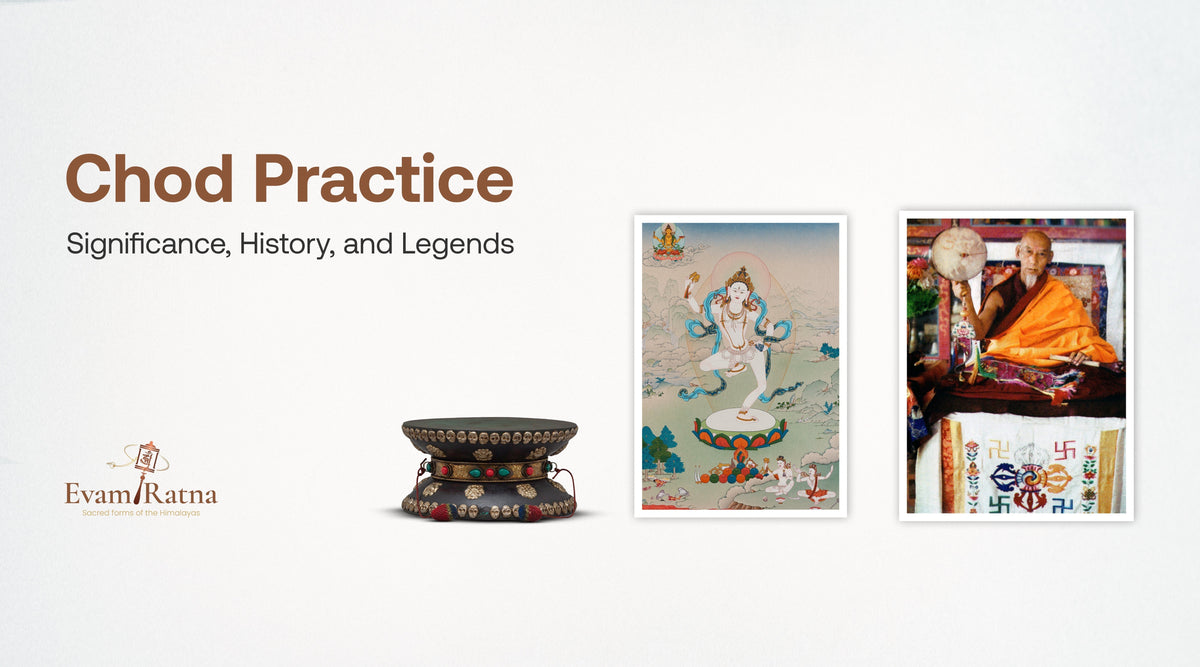
Vajrayana Chöd Practice: Instruments, Visualization, and Rituals Explained
In Tibetan Buddhism, Chöd practice is considered a continuous daily mindset and a lifelong path of behavior. In this practice, practitioners visualize offering their own body as a feast to spirits, deities, and demons, all in service of a single goal: cutting through the self-grasping mind that binds us to suffering. Chöd is regarded across every school of Tibetan Buddhism as one of the most direct methods for realizing emptiness and awakening bodhicitta, the compassionate wish to liberate all beings. It is an unique method for confronting fear, overcoming attachment, and cutting through the illusion of a separate self.
What Does "Chöd" Mean?

The Tibetan word Chöd (Wylie: gcod) translates literally as "to cut off" or "to sever." As the Foundation for the Preservation of the Mahayana Tradition (FPMT) explains, the practice cuts off self-cherishing and grasping at a truly existent "I," creating the conditions for both conventional bodhicitta, holding others as more dear than oneself, and ultimate bodhicitta, which sees reality as it truly is.
In its formal ritual expression, the practitioner visualizes their own body being transformed into an offering of food, blood, and flesh, generously given to hungry ghosts, spirits, and wrathful deities. The act of giving is not about the body itself; it is a rehearsal for releasing the deepest attachment most beings hold, attachment to the sense of "I."
What is Chöd Practice?
Chöd is a deep inner practice that transforms the mind by directly confronting the roots of fear and attachment. It is a combination of meditation, visualization, ritual implements, chanting and offerings, and is based on the teachings of wisdom in Prajnaparamita (Perfection of Wisdom) and Vajrayana Buddhism. In this practice, practitioners develop compassion, generosity and the understanding of emptiness: the lack of an independent and permanent nature of all phenomena.
The central purpose of Chöd is not to destroy the physical body or reject oneself. Instead, it symbolically “cuts” the attachment to the concept of an independent self. The practitioner learns to let go of the strong attachment to “I,” “mine,” and personal identity, creating space for greater compassion and wisdom.
The Roots of Chöd Before Machig Labdron
While Chöd as a formal system was established in eleventh-century Tibet, its underlying spirit is described as far older. According to the Jataka tales recounting Buddha Shakyamuni's previous lives, the same impulse of total self-sacrifice appears again and again: in one life, he offered his own body to a starving tigress so she could feed her cubs; in another, as the "Bodhisattva Monkey," he sacrificed himself to protect his troop from harm. These stories are cited as the spiritual precedent for what Chöd would later formalize into a complete meditative system.
Machig Labdron: The Founder of Chöd

Chöd is a Vajrayana Buddhist practice traditionally associated with the great Tibetan yogini Machig Labdrön (1055–1149), who established and developed the Chöd lineage in Tibet during the 11th century. Her teachings combined profound wisdom, compassion, and methods for overcoming ego-clinging. Over time, Chöd spread throughout the major schools of Tibetan Buddhism, including Nyingma, Kagyu, and Gelug traditions. Sarah Harding, the translator of Machig's Complete Explanation, describes her as revered within the tradition as the embodiment of timeless wisdom, "the birth mother of all past, present, and future buddhas."
By tradition, Machig Labdron showed extraordinary spiritual gifts from childhood, reciting the Prajnaparamita Sutra by age eight, and had renounced worldly comforts by twenty. A formative episode in her life is said to have occurred while she was absorbed in deep meditative concentration and a fierce naga king moved to attack her. Rather than resist, she offered her own body to the nagas as food; moved by her fearless compassion, they became her protectors instead of her assailants. This encounter is considered the seed from which the entire Chöd lineage grew, and Machig Labdron developed a systematic approach sometimes called Mahamudra Chöd, that takes the demons and negative mind-states we fear and transforms them into objects of compassion rather than aversion.
Machig Labdron's teacher lineage also includes the Indian Mahasiddha Padampa Sangye, sometimes called "the father of Chöd," who is credited with carrying the practice's roots to Tibet and is also associated with the related Zhije (pacification) teachings. The lineage of Chöd became especially connected with wandering yogis and practitioners who practiced in isolated places such as mountains, caves, and charnel grounds. These environments provided a powerful setting for confronting fear and recognizing the nature of the mind,
Chöd Across the Four Schools of Tibetan Buddhism
After Machig Labdron established the lineage, Chöd spread across all four schools of Tibetan Buddhism, becoming especially prominent within the Nyingma and Kagyu traditions so much so that its presence within the Gelug school is sometimes overlooked. In fact, the practice passed from Lama Tsongkhapa through a distinguished line of Gelug masters, including Gyalwa Ensapa and His Holiness Kyabje Pabongka Rinpoche, down to His Holiness Kyabje Zong Rinpoche, widely regarded as a foremost contemporary holder of the Chöd lineage within Gelug. Jamgön Kongtrul's monumental Treasury of Precious Instructions likewise preserves Chöd teachings alongside the related Zhije tradition, underscoring how thoroughly Chöd became woven into the broader fabric of Tibetan Vajrayana practice and the Bön tradition maintains its own parallel Chöd lineage as well.
The Philosophy: Cutting Self-Grasping, Cultivating Bodhicitta
At its core, Chöd is a Prajnaparamita (Perfection of Wisdom) practice wearing tantric clothing. The ego in Buddhist teachings refers to the mistaken belief that the self exists as something permanent, separate, and independent. According to Chöd teachings, this attachment becomes the foundation of fear, anger, desire, and suffering. Shambhala Publications describes it as a method that lets practitioners cut through anger, jealousy, arrogance, fear, and attachment, along with the fundamental dualism of experiencing the self as separate from everything else, transforming difficult circumstances into opportunities for awakening.
Offering the body, the object most beings cling to above all else, becomes a rehearsal for releasing self-cherishing itself. As Kyabje Zong Rinpoche taught, the purpose of practicing Chöd in frightening surroundings such as charnel grounds is not fear for its own sake but the chance to genuinely investigate the "I" that becomes afraid: when the mind mixes with space and searches honestly for that fixed self, it discovers there is no truly existent "I" to defend at all, this, he said, is how the practitioner arrives at a direct realization of emptiness.
The "Real" Chöd: A Teaching for Everyday Life
Not every encounter with Chöd requires a drum, a trumpet, or a charnel ground. In a widely cited FPMT teaching titled "The Real Chöd Practice," Lama Zopa Rinpoche reframes Chöd as something available in ordinary life. He explains that when someone says something that genuinely hurts us, that sting is itself an opportunity: it shows us, like a mirror, that an ego is present, because if there were truly no self to defend, the words could not hurt at all. Rinpoche's teaching reframes painful criticism as a chance to see the falsely imagined "I" clearly enough to recognize, through reasoning, that it is a merely imputed, dependent phenomenon rather than something solid and truly existing. In this sense, everyday irritations and insults become a lay practitioner's version of the charnel-ground encounter, an invitation to meet the ego rather than defend it.
The Sacred Instruments of Chöd Practice

Formal Chöd practice is performed with a distinct set of ritual instruments, each carrying both a practical and symbolic role:
- The Damaru: A small, double-headed hand-drum, held in the practitioner's right ("method") hand and played with a rotating wrist motion that produces a rapid, rhythmic pulse. Its two faces represent the union of wisdom and skillful means, and its sound is traditionally understood to summon the beings invited to the offering.
- The Kangling: A trumpet traditionally fashioned from a human thighbone, held in the left ("wisdom") hand. Its wild, resonant sound is played as a gesture of fearlessness, summoning hungry spirits and demons so the practitioner may satisfy their hunger and relieve their suffering, a sound the Tibetan Buddhist Encyclopedia describes as taking on an orderly yet tumultuous, hypnotic quality within group practice.
- The Bell (Drilbu): Paired with the damaru, the bell represents wisdom and is rung in combination with the drum's method aspect; practitioners are taught that the two should never be separated, since each represents one half of the same realization.
- Kartika (Curved Ritual Knife): The curved knife, known as a kartika, symbolizes cutting through ignorance, attachment, and conceptual limitations. It represents the wisdom that separates confusion from awakened awareness.
Together, these instruments give Chöd what practitioners describe as a "sonic architecture" every bit as precise as its visualized imagery, the rhythms, chants, and the eerie call of the kangling are function as an integral part of the meditation itself.
The Visualization and the Charnel Ground Setting
Traditionally, Chöd practitioners sought out cemeteries and charnel grounds to perform their rituals places that, in the Tibetan and Indian context, were left exposed to the elements as a final act of merit-making for the deceased, rather than concealed as in Western burial customs. These were understood to be places of genuinely unsettling energy, where spirits summoned by the ritual might be perceived by those with heightened sensitivity.
Within this setting, the practitioner visualizes their own consciousness separating from the body, which is then transformed through the power of meditation into an inexhaustible offering: blood becomes an ocean for spirits to drink, and flesh becomes food to satisfy every hungry being present. According to Kyabje Zong Rinpoche's own teaching on the practice, once the body has genuinely been offered in this way, there is no longer any reason to protect it, and "exchanging self for others" in a fearsome setting becomes an unusually direct method for dissolving attachment and generating bodhicitta.
Chöd and the Practice of Compassion
Although Chöd appears to focus on cutting the ego, its deeper purpose is the cultivation of compassion. By offering the body symbolically to all beings, practitioners develop the attitude of putting others before themselves.
This connects Chöd with the Mahayana Buddhist ideal of bodhicitta, the wish to attain enlightenment for the benefit of all sentient beings. The visualized offering of the body is the vehicle for both: giving away the thing you're most attached to is a direct rehearsal of "others before self," while watching that attachment dissolve is how you glimpse emptiness. Through cutting self-centered attachment, the practitioner creates the foundation for greater kindness, generosity, and wisdom.
Machig Labdron's Four Demons
This is probably the clearest window into why Chöd counts as a compassion practice rather than an exorcism. Machig taught that what we call "demons" aren't external spirits attacking us, they're categories of ego-fixation:
- The Tangible Demon: attachment to physical form and material objects
- The Intangible Demon: attachment to our own thoughts, emotions, and mental patterns
- The Demon of Elation (sometimes called the "Demon of Pleasure"): attachment to spiritual progress itself, getting proud or clingy about good meditation experiences
- The Demon of Ego: the root demon, the basic sense of "self" versus "other" that generates all suffering for oneself and others
An Inner Traditions summary of Namkhai Norbu Rinpoche's oral commentary puts it this way: all four demons are thought-patterns that block clear, unattached awareness, rooted in ego-fixation and a failure to understand emptiness.
The compassionate move is that Machig taught practitioners to feed these demons rather than fight them to fully relate to difficult emotions and invite them into conscious awareness, instead of suppressing or acting them out. That's a strikingly different posture than most spiritual traditions take toward "temptation" or "obstacles": you don't banish the demon, you host it as a guest and offer it what it wants.
Read More About Machig Labdron: The Tibetan Yogini Who Founded the Chöd Lineage
Compassion in Everyday Life
This loops back to Lama Zopa Rinpoche's "real Chöd" teaching: when someone's words hurt you, that sting is the demon of ego showing itself. The compassionate response toward yourself and toward the person who hurt you is the same one Machig taught: don't suppress it, don't retaliate, just look directly at the "I" that got hurt and ask whether it's really as solid as it feels.
The Importance of Chöd in Vajrayana Buddhism

Chöd represents one of the most profound examples of Vajrayana methods that combine philosophy, meditation, ritual, and symbolism. It transforms ordinary experiences, fear, attachment, and suffering into opportunities for awakening. While the external appearance of Chöd may involve powerful rituals and unusual instruments, its essential message is simple: liberation comes through understanding the true nature of the self and developing limitless compassion toward all beings.
Shambhala's reader's guide frames Chöd as fundamentally a Prajnaparamita practice in tantric form, it's valued in Vajrayana precisely because it fuses the view (emptiness, from the Perfection of Wisdom teachings) with a method intense enough to produce fast, visceral realization, rather than slow intellectual understanding. That's why it sits alongside deity yoga and guru devotion as one of the tradition's "swift paths" and per the earlier post, it's the rare practice that both Gelug lineage holders (through Tsongkhapa to Kyabje Zong Rinpoche) and Nyingma/Kagyu/Bön traditions all claim as central, rather than being one school's specialty.
Chod Practice in Nepal
Nepal, especially the Kathmandu Valley, is one of the most active living centers of Chöd practice outside Tibet itself. Many monasteries and nunneries around Boudhanath and the surrounding hills have kept Chöd traditions alive in an unbroken, practicing form, not just as historical teaching. Nagi Nunnery (also called Nagi Gompa), sitting high up on a mountainside in Shivapuri Nagarjuna National Park on the outskirts of Kathmandu, is one of the best-known examples of this.
Chöd at Nagi Nunnery on September 12, 2026
Nagi Nunnery is home to over 100 nuns and sits under the spiritual guidance of Chokyi Nyima Rinpoche, who also oversees Ka-Nying Shedrub Ling Monastery in Boudhanath. Its Chöd lineage traces back over a century to Kharsha Rinpoche, the hermit-founder of the gompa, who traveled to the remote Nubri valley in north-central Nepal to learn the practice from a disciple of the great Nyingma Dzogchen master Togden Shakya Shri. The specific Chöd cycle practiced at Nagi comes from the Longchen Nyingthig terma tradition revealed by Tertön Jigme Lingpa, and Nagi Gompa itself sits at a rare convergence of Nyingma and Kagyu transmission through its connection to the Chokling Tersar lineage.
What makes Nagi Nunnery particularly notable is its Chöd Cham, a ritual dance version of the practice. Historically, most Vajrayana ritual dances (cham) were performed exclusively by monks, so nuns performing a full cham is still fairly uncommon, and Nagi's version has become one of the most documented examples of nuns carrying this tradition. Every nun at Nagi is required to learn it, starting around age 14-15 after completing five years of basic religious study, they train an hour a day for a month to master it. The dance itself involves the nuns forming a mandala circle while drumming the two-sided Chöd damaru and carrying the kangling (thighbone trumpet), moving through sequences that visualize the five wisdom dakinis transforming the five poisons (anger, pride, desire, envy, ignorance) into their corresponding wisdoms, followed by dances representing vajras, a protective ring of fire, and finally a closing "twisting black snakes" sequence tied to Machig Labdron's own legend of taming the nagas. The nuns perform it barefoot, in monastic robes with a sash symbolizing the body's three subtle energy channels.
The Chöd Puja and Dance After Yarney
The Chöd Puja and Dance After Yarney is an annual observance held the day after Yarney (the end of the Monastic Rainy Season Retreat), this year scheduled for September 12, 2026. On this day, the nuns of Nagi Nunnery perform the Chöd Pūjā, known as Khandro Gegyang, together with the Chöd Dance.
According to the announcement, the dance is understood to purify the defilements of everyone involved, the dancers themselves, those who witness it, and even those who have simply requested to be included by offering, with particular emphasis on cleansing negative actions of body, as well as negative karma created through speech and mind. The dance centers on visualizations of Tröma Nakmo (the Black Wrathful Mother), described as a feminine embodiment of wisdom whose ferocity represents fearless compassion cutting through ego and ignorance, a fitting deity for a practice built entirely around confronting fear with compassion rather than avoidance.
The announcement also reiterates Chöd's core aim in plain terms: because everything we do tends to center on "my happiness, my well-being," clinging to the concept of "I" becomes the root of negative emotion and suffering, and Chöd is offered as a method for detaching from that grasping and moving toward selflessness. Attending and listening to the chants, mantras, and dance is considered highly beneficial in itself for cultivating both relative bodhicitta (holding others as more precious than oneself) and ultimate bodhicitta (realizing the emptiness of all phenomena), even for those who are only observers rather than initiated practitioners.
A Note on Initiation and Practice
It's worth being direct about something the tradition itself insists on: Chöd's visualizations, sadhanas, and ritual texts are not intended for casual reading or self-directed practice. Teachers who have shared source texts publicly, such as Tsem Rinpoche in presenting Carol Diane Savvas's academic study of the practice, have been explicit that the introductory, historical material may be read by anyone, but the liturgical sections are reserved strictly for those who have received the appropriate initiation from a qualified lineage holder. This guide is offered in that same spirit as an introduction to Chöd's history, meaning, and symbolism, not as a substitute for authentic transmission.
Frequently Asked Questions
Is Chöd practice dangerous?
Traditional sources describe Chöd as psychologically intense, since it deliberately invokes fear in order to examine it. For this reason, it is taught as a practice to be undertaken only under the guidance of a qualified teacher, after receiving the proper initiation.
Is Chöd a practice of sacrificing the body?
No. Chöd does not involve a physical sacrifice of the body. During the practice, practitioners symbolically visualize offering their own body as a feast to beings, spirits, and enlightened forces. This visualization represents the highest form of generosity and trains the mind to release attachment to the self and physical identity.
Do you need to be a monk or nun to practice Chöd?
No. Chöd has been practiced by ordained sangha and lay yogis and yoginis alike since Machig Labdron's own time; she herself was a mother rather than a nun.
What is the difference between Chöd and other Vajrayana practices?
Chöd is distinctive for using the visualized offering of one's own body as its central method, and for its traditional association with a charnel-ground or cemetery setting rather than a temple or shrine room, though the underlying goal realizing emptiness and generating bodhicitta is shared with the wider Vajrayana path.
Can Chöd be practiced without the damaru, kangling, and bell?
The formal ritual sadhana traditionally considers the damaru, kangling, and bell as an essential instruments as they support the ritual structure, chanting, visualization, and meditation process. Each instrument carries a deep symbolic meaning: the damaru represents skillful means and the rhythm of awakening, the bell represents wisdom, and the kangling expresses fearlessness while calling beings to the offering. Together, they combine to form the strong ritual atmosphere that nurtures the practitioner's transformation.
What is the main purpose of Chöd practice?
The main purpose of Chöd is to overcome ego-clinging, develop compassion, and realize emptiness, The primary aim of Chöd is to liberate from the attachment of the self, cultivate compassion, and to attain the understanding of emptiness. Practitioners learn to see through the illusion of 'self' and develop the wisdom and compassion for all beings by facing fear and attachment directly.
Conclusion
Chöd practice is, at its heart, a way of making friends with fear instead of running from it. It might look intense from the outside the drum, the bone trumpet, the idea of offering your own body but the real point is much simpler: to loosen the grip of the ego, the constant "me, mine, I" that causes so much of our stress and suffering. When Machig Labdron taught that demons are really just our own fears, attachments, and pride wearing scary masks, she was pointing to something every reader can relate to, even without any ritual training. Whatever frightens us or hurts our pride is simply showing us where our ego still needs to soften.
That's why Chöd practice remains so valued in Tibetan Buddhism today, and why its lessons don't stay locked inside a monastery. You don't need a charnel ground to practice it, the next time criticism stings or fear creeps in, that moment is your invitation to look closer instead of pushing it away. In the end, Chöd is less about a dramatic ritual and more about a gentle, honest way of meeting life: with less self-protection, more compassion, and a little more freedom from the "self" we cling to so tightly.