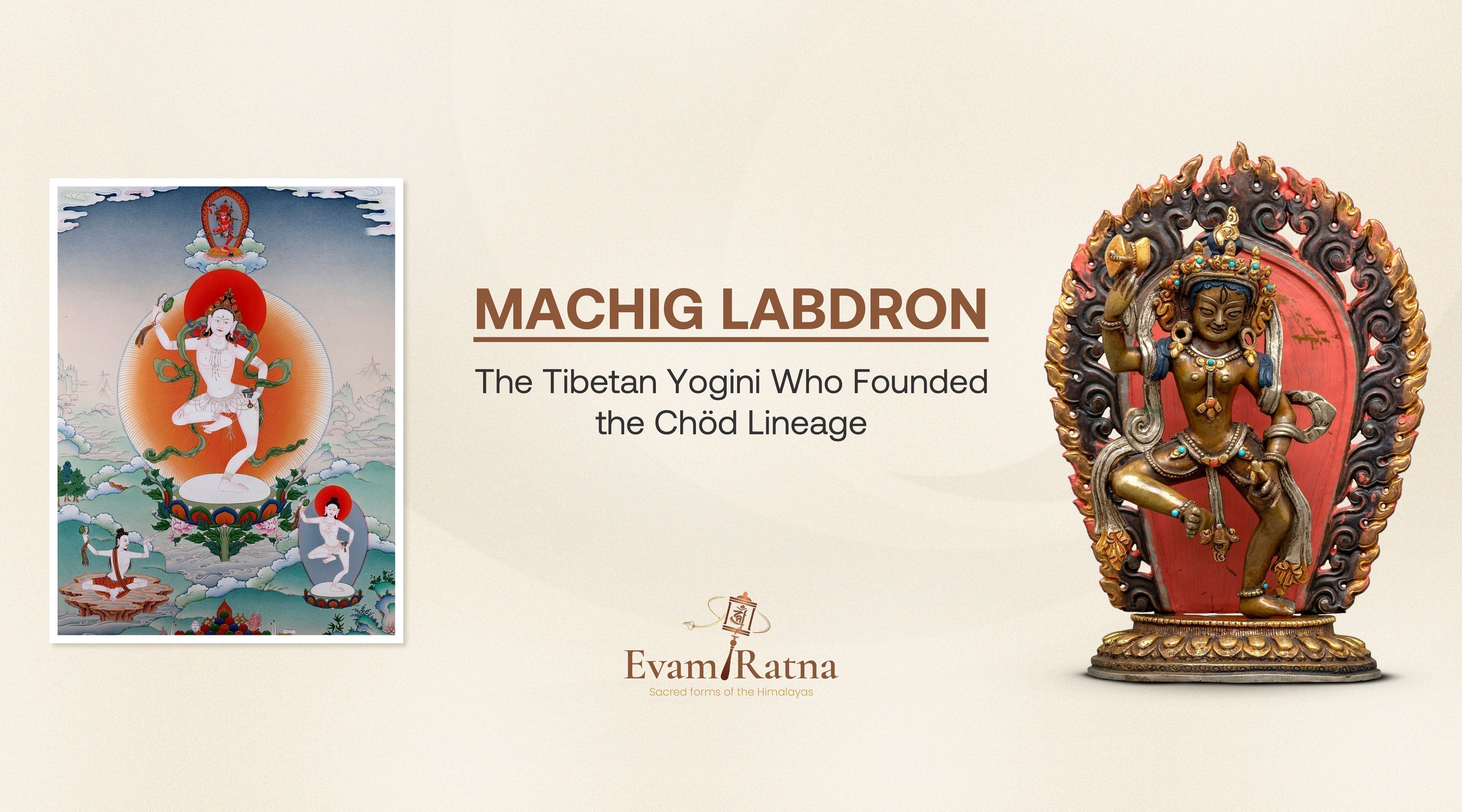
Machig Labdron: Life, Teachings, and the Origins of the Chöd Tradition
Machig Labdron is one of the brightest figures in Tibetan Buddhism. A native of Tibet, born in 1055 CE, she was a mother, a wanderer, a scholar of the Perfection of Wisdom, and most remarkably, the founder of a completely new lineage, the Chöd lineage, which is a practice to overcome the sense of self by offering it. Her contributions and teachings are accepted by all Tibetan schools and Indian scholars, emphasizing the reversal of the traditional dharma flows from Tibet to India. Her life story includes miraculous beginnings, teachings from Padampa Sangye, and the evolution of Chöd rituals that all challenge practitioners to face their fears with acceptance.
Machig Labdron Name Meaning: The Sole Mother of Tibetan Buddhism

Her name is itself a teaching. Ma is 'mother' in Tibetan, Chig is 'unique' or 'singular,' Lab is the area where she was born, in central Tibet, and Drön is 'lamp' or 'torch. Together, Machig Labdron translates as 'the Singular Mother lamp from Lab', a name that carries the weight of her entire legacy. She was the one mother, the solitary lamp, illuminating a path that no other Tibetan, male or female, had walked before her.
She is sometimes referred to by the alternative name Ahdrön Chödron, referencing the syllable AH that appeared on her forehead at birth, a mark widely recognized in Tibetan culture as the sign of a dakini, a wisdom-woman who moves through the sky of awareness.
The Meaning of Chöd: Cutting Through Ego, Fear, and the Illusion of Self
The Tibetan word Chöd (gcod) means 'to cut' or 'to sever.' But Chöd is not a cutting away of anything external. It aims to cut through the grasping ego and the illusion of a separate, fixed self. Machig Labdrön’s Chöd is unique because it is one of the few lineages that originated in Tibet and then spread back to India, eventually influencing all major schools of Tibetan Buddhism, including the Nyingma, Kagyu, Sakya, and Gelug traditions.
The philosophical heart of Chöd is based on the Prajnaparamita tradition and the Mahamudra understanding of the mind. The teachings focus on sunyata (emptiness), which states that nothing exists on its own or independently, even the self. By recognizing that the ego is a construction fueled by fear, the practitioner uses Chöd to face that fear directly rather than suppressing or avoiding it. What is severed is the grasping at a self, the deeply habituated belief in a separate, solid, independently existing 'I' around which fear, aversion, craving, and suffering all organize themselves.
Her Iconography: The Dancing Dakini with Damaru, Bell, and Skull Crown

In thangka paintings and traditional sculpture, Machig Labdron is depicted as a wisdom dakini, white in color, youthful and beautiful, with one face, three eyes, and two hands. She wears a tiara of five skulls, symbolizing the transformation of the five kleshas into the five wisdoms, and is adorned with gold earrings, a necklace, bracelets, and a flowing blue silk scarf.
In her right hand, raised upward, she holds a damaru, the small double-sided hand drum whose rhythmic beat summons beings to the Chöd feast and stabilizes the practitioner's mind in awareness. In her left hand, held at the hip, she holds an upturned ghanta bell, symbol of the wisdom of emptiness. She is typically shown in a dancing posture, her body in dynamic motion, suggesting the inseparability of compassionate activity and the recognition of emptiness.
Her Previous Life: The Indian Monk Who Became a Tibetan Dakini
The hagiographic traditions surrounding Machig Labdron begin before her birth in Tibet. In her most celebrated biography, she is said to have been, in a previous life, an Indian prince-monk named Monlam Drup, a scholar of great spiritual attainment who had reached an advanced stage of realization. Repeatedly receiving visions urging him to travel to Tibet to benefit sentient beings, Monlam Drup entered a cave, left his physical body, and merged his consciousness with a fierce blue-black dakini. That stream of consciousness then entered the womb of Lady Bumcham, Machig's mother, in the Lab region of central Tibet.
It establishes Machig not simply as a gifted Tibetan woman but as the continuation of an Indian Buddhist lineage, a bridge between the two great civilizations of Buddhist dharma. Her body was Tibetan; her dharma lineage, in the deepest sense, was borderless.
Birth, Early Signs, and the Syllable AH
Machig's birth was attended by auspicious signs. The most significant was the appearance of the syllable AH on the baby's forehead at the location of the third eye. Her mother, Lady Bumcham, initially concealed the child out of fear, but her father Chökyi Dawa recognized the mark immediately as the sign of a dakini and ensured the child was raised and supported in developing her spiritual gifts.
By the age of eight, Machig could recite the Prajnaparamita in Eight Thousand Lines, one of the most demanding and extensive of the Buddha's discourses on the Perfection of Wisdom, with remarkable speed and comprehension. At thirteen, her mother died, and she began traveling with her sister, seeking teachers throughout central Tibet.
How She First Encountered the Perfection of Wisdom (Prajnaparamita)?
Before she was a founder of lineages, Machig Labdron was a professional reader of sacred texts. She traveled between monasteries and lay households reciting the Prajnaparamita sutras, the vast literature of the Perfection of Wisdom, with the clarity and speed that astonished her audiences. It was not mere performance; as she read these texts, her understanding deepened into direct realization of the teachings on emptiness, or śūnyatā.
The Prajnaparamita sutras are the teachings that all phenomena, including the self, do not have an independent and inherent existence. They arise interdependently, change ceaselessly, and cannot be grasped. For Machig Labdron, years of immersion in this literature became the philosophical bedrock upon which the entire structure of Chöd would later be built. Chöd without Prajnaparamita is not Chöd, a fact she would state repeatedly in her own teachings.
Her Teacher Padampa Sangye and the Zhije Transmission

The encounter that catalyzed Machig Labdron's realization into a transmittable lineage was her meeting with the South Indian master Padampa Sangye, a wandering mahāsiddha who arrived in Tibet carrying the Zhije, the 'Pacification of Suffering', teachings rooted in the Indic traditions of Āryadeva the Brahmin, Nāropa, and their lineages.
Padampa Sangye is described as unconventional, provocative, and utterly direct. His teaching style challenged and destabilized the habitual patterns of his students' minds, creating the precise inner conditions that Machig needed to break through into full realization. Under his guidance, she received the transmissions that she would synthesize into Chöd, a radical act of creative dharma that Indian pandits would later officially recognize as a valid teaching.
The relationship between Machig Labdron and Padampa Sangye is a profound example of the guru-disciple bond at its most transformative. She did not simply copy his Zhije teachings. She received them, digested them through the lens of her own Prajnaparamita realization, and gave birth to something entirely her own.
Machig Labdron as Mother, Scholar, and Sky-Wanderer
One of the most humanizing and spiritually instructive aspects of Machig Labdron's biography is that she was also a mother. She married, bore children, and lived through the full range of ordinary human experience: love, loss, domestic responsibility, even as she moved through visionary states of samādhi and wandered remote landscapes practicing Chöd in charnel grounds and desolate places.
Her life refuses the conventional dichotomy between worldly life and spiritual renunciation. She was, as one biography puts it, 'a committed practitioner, an at-times beggar woman, a brilliant teacher, a mother, and a lineage founder', all at once, without contradiction. In this, her life functions as its own Chöd teaching: carrying the full load of appearing conditions without fleeing from any of it.
The Damaru: Machig Labdron's Drum and Its Role in Chöd

Of all the instruments associated with Machig Labdron and the Chöd tradition, none is more iconic than the damaru, the small, double-headed drum held in the right hand and played by rotating the wrist so that two small pendants strike the drumheads alternately. In iconographic depictions of Machig Labdron, the damaru is always present, raised in her right hand, its rapid rhythmic sound filling the charnel ground or meditation space.
In the Chöd ritual, the damaru serves several interrelated functions. Its beat helps the practitioner enter and maintain states of focused awareness; the rhythm acts as an anchor for the mind, preventing it from drifting while simultaneously creating the sonic environment in which the feast offering visualization unfolds. Traditionally, the damaru is understood to summon all beings, enlightened and unenlightened, benevolent and hostile, to the feast, inviting them to receive the offering of the practitioner's body. The two drumheads symbolize the union of appearance and emptiness, method and wisdom, the male and female principles of awakening.
Damaru drums used in Chöd practice are traditionally made from the tops of two human skulls joined together, a material choice that is itself a teaching on impermanence and the transformation of death into liberation. More commonly today, they are constructed from wood, but the resonance of the traditional form, skull upon skull, mortality in the practitioner's hand, reflects the fearless orientation at the heart of Machig Labdron's teaching.
The Kangling: The Thighbone Trumpet That Cuts Through Samsara

Click Here To View Our Collection of Tibetan Kangling for Chöd Practices
The kangling is a trumpet traditionally fashioned from a human thighbone, its haunting, penetrating sound unlike any other instrument in the Tibetan ritual world. In Chöd practice, the kangling is blown at key moments in the ritual to summon beings, to mark transitions between stages of the visualization, and to pierce the ordinary perceptual world with a sound that carries the vibration of impermanence and fearlessness.
The use of human bone in the construction of the kangling is deliberately transgressive. It confronts the practitioner with the reality of physical death, the ultimate form that fear of loss takes, and transforms that reality into a vehicle of liberation. The thighbone that once carried a living person now calls all beings to a feast of awakening. This is Chöd's characteristic move: taking what the ego most fears and making it the instrument of liberation.
The Ghanta Bell: Wisdom as the Sound of Emptiness

The ghanta, or bell, held in the left hand, is one of the most universal ritual instruments across all Vajrayana traditions. In Chöd, it carries its traditional significance as the symbol of wisdom, specifically, the wisdom of emptiness. The bell and damaru together, held in left and right hands, enact the fundamental Vajrayana teaching on the union of wisdom (emptiness) and method (compassionate action). Every time the Chöd practitioner plays the bell, they are, at the level of symbolic enactment, touching the nature of mind itself.
Machig Labdron's Three Practice Verses: Wisdom for Daily Life
Among the teachings ascribed directly to Machig Labdron, three short practice verses stand out for their distilled power and practical applicability. Collected and reflected on by teachers in the living Chöd tradition, these verses function similarly to the famous Lojong mind-training slogans, brief formulations designed to be carried through daily life, re-encountered in the midst of ordinary experience, and deepened through practice over time.
"The Supreme Severance Is No View"
The first verse addresses the nature of view itself:
'Without asserting any notion of view about the unimpeded arising of anything, unbiased experience dawns as basic space. The supreme severance is no view.'
This is one of the most radical teachings in all of Machig Labdron's corpus. View, what we believe about the fundamental nature of reality, ourselves, and others, provides security and orientation. It is also, Machig warns, one of the ego's most tenacious strongholds. Even the most sophisticated Buddhist view, if grasped and defended, becomes a prison. The supreme severance is to let go even of the view that emptiness is the correct view, to release all handles, all grounds, and rest in what she calls 'basic space,' the open, unbiased expanse of awareness that precedes any conceptual framework.
"Carry the Load of Appearing Conditions"
The second verse calls the practitioner back to the world:
'Carry the load of appearing conditions. If you don't carry the load of all phenomena, the remedy of peace and happiness can't liberate you.'
This teaching is Machig Labdron's antidote to spiritual bypassing. The peace that Chöd offers is not found by retreating from samsara but by remaining fully present within it, to grief, to injustice, to the broken and the beautiful alike. The Great Mother, Prajnaparamita, is compared to space itself: she can hold everything precisely because she is no-thing. To carry the load of appearing conditions is to realize one's own nature as that space, vast, open, capable of holding the full catastrophe of human experience without being crushed by it.
"Don't Search, Don't Practice; Rest in Your Nature"
The third verse is the most paradoxical:
'Don't search, don't practice; rest in your nature.'
As the Chöd teacher Lopön Charlotte Z. Rotterdam has observed, this verse is not an instruction to abandon the path. It is an instruction to stop grasping the path as a means to get somewhere else. Buddhanature, the ground of awakening, is not a future attainment. It is already present, always available, the very nature from which all searching and all practice arise. When we stop for a moment, release the tight grip of spiritual ambition, and simply rest, in the midst of washing dishes, in the moment between thoughts, what remains is exactly what Machig Labdron spent her life pointing toward.
Conclusion:
Machig Labdrön remains a beacon of wisdom, compassion, and spiritual power in the Tibetan tradition. Her Chöd lineage offers a path that is both fierce and tender, fierce in its confrontation of ego and fear, and tender in its radical inclusivity of the most difficult parts of our experience. At its heart, her message is one of primordial worthiness. She reminds us that we do not need to prove ourselves worthy of our lives; rather, we can rest in our nature as the ground of being and manifest our world from that space of total freedom. Through the rhythmic beat of the damaru and the wisdom of "no view," Machig Labdrön continues to light the way for those seeking to transform the "charnel grounds" of their own lives into a portal for awakening.