The Six Signs of Longevity (Tshe Ring Drug Skor): A Guide to Tibetan and Chinese Symbolism
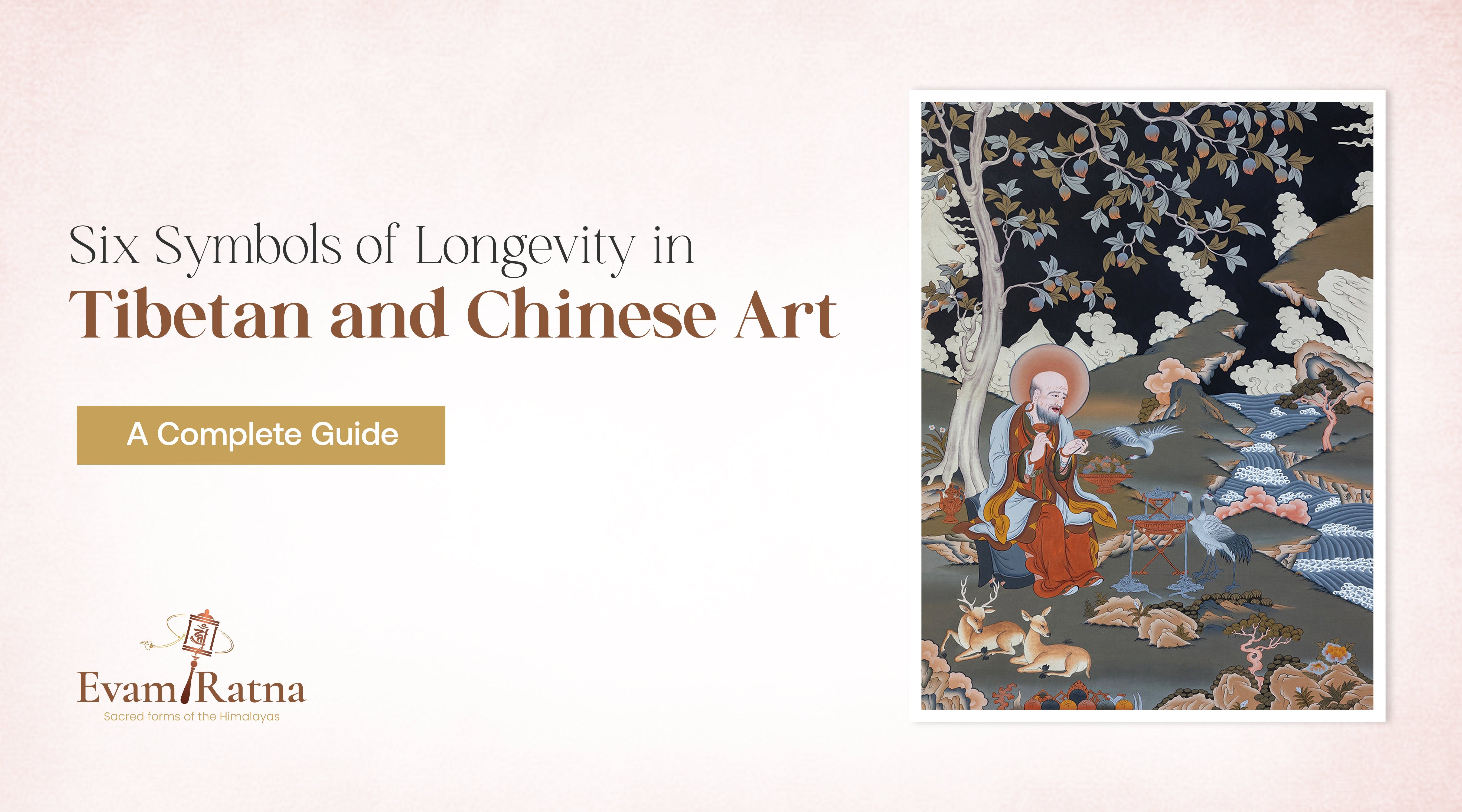
The six symbols of longevity are one of the most familiar patterns of decorative art in the Tibetan, Chinese, and Himalayan world, found on carved wooden furniture, painted wall panels, and porcelain wares. They are known in Tibetan as "tshe ring drug skor" (the six signs), and they are thousands of years old and have many layers of meaning, from Taoist cosmology to Buddhist contemplative ideals, and from the universal human desire for a long and long, peaceful, and abundant life.
The Six Longevity Symbols were not explicitly Buddhist in origin like the Eight Auspicious Symbols, but they were images of Chinese origin that were gradually adopted into Tibetan art and culture, from the eighteenth century onward. However, because they are in tune with the Buddhist principles of impermanence, vitality and liberation, they have a subtle spiritual quality beyond their decorative uses.
Introduction: What Are the Six Symbols of Longevity?

(Image from Mandala Palace Online)
The six symbols of longevity are a set of pictorial elements representing the ideal conditions for a harmonious, long, and spiritually fulfilling life. The six are:
- The Old Man of Long Life: the sage Shou-lao
- The Tree of Longevity: typically the divine peach tree
- The Rock of Longevity: an auspiciously shaped, geomantically empowered formation
- The Water of Longevity: pure spring water bearing the eight qualities of nectar
- The Cranes of Longevity: sacred birds associated with immortality and faithful union
- The Deer of Longevity: the vehicle of Shou-lao and finder of the plant of immortality
All of these six elements create a unified symbolic landscape: the spring water sustains the tree; the tree sustains the man; the deer and the cranes live in this world; and the auspicious rock holds the entire scene together with geomantic power.
Origins: Chinese Roots and Tibetan Adaptation
The six longevity symbols originated in Chinese cosmological and Taoist traditions before being adopted into Tibetan artistic vocabulary. In Chinese decorative art, they appear across a wide range of media such as silk embroidery, lacquerwork, ceramic glazing, and architectural ornamentation, which carry associations with springtime, renewal, abundance, and natural harmony.
Their absorption into Tibetan art accelerated significantly during the eighteenth century, a period of intense cultural exchange between Tibet and China under Qing dynasty patronage. Tibetan artists adapted the imagery to their own visual idiom while preserving the symbolic content largely intact. In a Buddhist interpretive frame, the scene of the old man resting peacefully beneath his peach tree, surrounded by deer, cranes, and living water, evokes the contemplative ideal: a long life of undisturbed practice, lived in harmony with the natural world and free from the anxieties of worldly entanglement.
The Old Man of Long Life: Shou-lao

(Image from meisterdrucke)
At the center of the longevity tableau is Shou-lao (also commonly spelled Shou Xing or Shoulao), the Chinese god of longevity, the most admired and recognized figure in this group of icons. He is also known as Shouxing (Shou Hsing or Nanji Laoren), one of the three stellar gods called Fulushou. His distinctive physical characteristics include a big, protuberant, domed forehead, a cascade of white hair, long, drooping eyebrows, a long flowing white beard, and a joyful, smiling demeanor. He carries a curved, dragon-headed wooden staff, a naturally formed simulacrum of a divine creature, from whose neck hangs a double gourd, the alchemist's flask of Taoist tradition.
He is also associated with the double gourd, which is rich with layered symbolism. In Taoist alchemy, it symbolizes the union of opposite energies into one awakened state. Its two chambers represent warm solar energy and cool lunar energy, which are brought together and purified to create the “elixir of immortality.” In simple terms, it shows that when body, mind, wisdom, and energy become balanced, a person moves toward spiritual clarity, inner transformation, and enlightenment.
Shou-lao originated as a star deity associated with Canopus, the brightest star in the southern constellation Argo (the ship of Jason and the Argonauts in Greek mythology). Because Canopus is most prominent on the horizon during March and April, Shou-lao became a symbol of springtime, renewal, peace, and longevity. He is often accompanied by two companion star gods: Fu-hsing, the god of happiness, and Tsai-chen, the god of wealth, a triad symbolized by the three sacred fruits of peach, pomegranate, and citron. In a Buddhist interpretive register, the old man represents a contemplative sage who embodies the qualities of Amitayus, the red deity of infinite life, one of the primary long-life deities of Vajrayana practice.
The Tree of Longevity

Shou-lao is most famously shown sitting beneath the heavy, fruit-laden branches of the divine peach tree. The divine peach is a powerful Chinese symbol of immortality, health, and long life. In Chinese mythology, the peach tree of the gods yields the fruit of eternal life. It is said to have blossomed and ripened over an immense cosmic period, imbued with eight medicinal qualities. Its transient spring blossoms heralded the onset of the marriage season; its ripe fruit symbolized fidelity and the fullness of life well-lived. The kernel of the peach was often carved into protective talismans for children. Also in Chinese medicine, it is valued for its healing qualities, and peach kernels were sometimes carved as protective talismans for children.
Shou-lao himself is said to have been born from a peach, and in Chinese decorative art the trunk of the peach tree is sometimes twisted to form the calligraphic character shou, meaning longevity, making the tree itself a living ideogram. Alongside the peach tree, the pine frequently appears as a longevity symbol, one of the celebrated "three friends of winter" alongside bamboo and the winter plum. The evergreen pine, unchanging through the cold season, naturally evokes endurance, constancy, and long life, and is commonly depicted alongside deer and cranes as a triple emblem of immortality.
The Rock of Longevity

Behind or beside the old man rises the auspicious rock, a naturally formed stone whose shape and geomantic properties are believed to channel beneficial energies toward the living beings in its vicinity.
The ideal longevity rock takes the form of a vajra- or conch-shaped formation, whose fissures and striations turn clockwise, a powerful auspicious sign in both Tibetan and Chinese symbolic systems. A site near such a rock is considered highly favorable for the placement of monasteries, temples, stupas, retreat caves, and human dwellings.
The rock is understood as a living geomantic anchor, the ground from which the spring of long life flows, supporting the tree, nourishing the deer and cranes, and sheltering the old man who sits in its shadow.
The Water of Longevity
From the base of the auspicious rock cascades the water of longevity, pure spring water possessing the eight qualities of sacred water, understood in the Buddhist tradition as a direct manifestation of the nectar of immortality held in the flask of Amitayus.
Water in this symbolic system is understood as the source of all organic life: it descends from the heavens, springs from the empowered earth, and flows through the landscape giving vitality to every living being. Morning dewdrops, believed to have fallen immaculately from the sky, were thought to carry the concentrated essence of flowers and plants, and thus to confer a measure of immortality on those who consumed them.
Water emerging from jade formations or empowered rock was particularly prized as a fountain of perpetual youth. In the composition, the cascading spring is the dynamic center of the longevity scene, the source that makes every other symbol possible.
The Cranes of Longevity

(Image from Buddhist Art Gallery)
Among the most beloved and widely reproduced of the six symbols, the crane has been a potent emblem of immortality in Chinese art since antiquity.
Cranes were described as "twice-born", once as an egg, and again at hatching, giving them a mythological association with cycles of life, death, and renewal. They were believed to survive to extraordinary ages; the black crane in particular was said to subsist on water alone, as if sustained by the very essence of the longevity spring.
A pair of cranes symbolizes happiness, fidelity, and long life, the ideal of a devoted partnership that endures across decades. Like the stork in Western folklore (which ferries newborn souls into the world), cranes in Chinese tradition were believed to carry the souls of the dead to the western heavens, completing the arc of life with grace and spiritual dignity.
In composition, cranes are most commonly depicted with pine trees as a paired emblem of immortality. A solitary crane, by contrast, represents the timeless contentment of the hermit-recluse, serene, unattached, sustained by the simple harmony of the natural world.
The Deer of Longevity

(Image from Buddhist Art Gallery)
The deer holds a unique place in this iconographic grouping as the personal vehicle of Shou-lao, who is typically depicted riding a mature stag with full five-tined antlers.
Deer were believed to live to an exceptionally great age, and more remarkably, were credited with being the only creatures capable of locating the ling-chih, the sacred "plant of immortality." This divine plant, a cultivated fungus growing on the roots and lower trunks of certain trees, was consumed as a longevity tonic of the highest potency. The deer is frequently depicted with a sprig of ling-chih held in its mouth, an image that combines the animal's mythological wisdom with the plant's medicinal power.
Chinese legends describe the Islands of the Immortals, located somewhere in the eastern ocean, where divine beings consumed ling-chih and drank from the eternal jade fountain. The deer, as the finder of this sacred food, is their guide and companion in the wilderness of immortality.
Associated Symbols and Motifs

The six primary longevity symbols are often accompanied by a rich constellation of supporting motifs that enrich the overall composition:
The Bat of Longevity: The bat (fu in Chinese, a homophone for "blessing") frequently appears flying above Shou-lao's head. The "five bats" of Chinese symbolism together confer five blessings: longevity, health, honesty, wealth, and a natural death in old age.
The Peach Bowl: A bowl of ripe peaches, the fruits of immortality, is traditionally placed before the old man. In some Tibetan renditions, medicinal pills or precious longevity pills (tshe ril) are depicted in its place.
The Three Sacred Fruits: The peach, pomegranate, and citron together symbolize the companion triad of Shou-lao, Fu-hsing, and Tsai-chen, longevity, happiness, and wealth.
The Four Friends (thuenpa pungzhi): In some compositions, a narrow panel depicts the elephant, monkey, hare, and partridge cooperating to reach the fruit of the tree of life. This popular Tibetan moral tale of mutual respect and cooperation sometimes appears alongside the longevity grouping.
The Six Longevity Symbols in Tibetan Art and Decor

In Tibetan artistic tradition, the six longevity symbols appear across a wide range of secular and semi-sacred contexts. They are commonly found:
- Carved on wooden furniture and architectural panels in monasteries and noble households
- Painted as wall murals in reception rooms and antechambers
- Printed on textiles, brocade borders, silk offering scarves, and ceremonial cloth
- Applied as decorative motifs on porcelain and metalwork brought from or inspired by Chinese craft traditions
Two distinct artistic styles are recognized: the Chinese style, in which Shou-lao is drawn with an enlarged domed head, long beard, and dragon-headed staff in a more painterly, naturalistic idiom; and the Tibetan style, typified by artists such as Tsering Wangchub of Tashijong, who render the old man with a rosary in hand, feeding the plant of immortality to the stag at his feet in a flatter, more iconic compositional mode.
Both traditions share the same essential symbolic landscape: the rock, water, tree, cranes, deer, and sage arranged as a vision of natural abundance, meditative peace, and a life lived in auspicious harmony with the world.
Conclusion:
The six symbols of longevity, Shou-lao, the peach tree, the auspicious rock, the sacred spring, the cranes, and the deer, are far more than decorative motifs. Together they form a complete philosophical vision: a landscape where the conditions for long, abundant, and spiritually awakened life converge in perfect natural harmony. Rooted in thousands of years of Chinese Taoist cosmology and absorbed into Tibetan Buddhist artistic tradition from the eighteenth century onward, these symbols continue to appear on monastery walls, carved furniture, ceremonial textiles, and sacred objects across the Himalayan world.
Whether you encounter them as a devotional image, a piece of decorative art, or a meditation on impermanence and vitality, the tshe ring drug skor invite the same reflection: that a truly long life is not merely a matter of years, but of peace, wisdom, natural abundance, and harmony with the living world around us. Understanding these symbols opens a window into Tibetan and Chinese artistic heritage, sharing human longing across cultures and centuries, for a life well and fully lived.
If you are drawn to explore the broader world of Tibetan sacred symbolism, read more about the Eight Auspicious Symbols (ashtamangala)