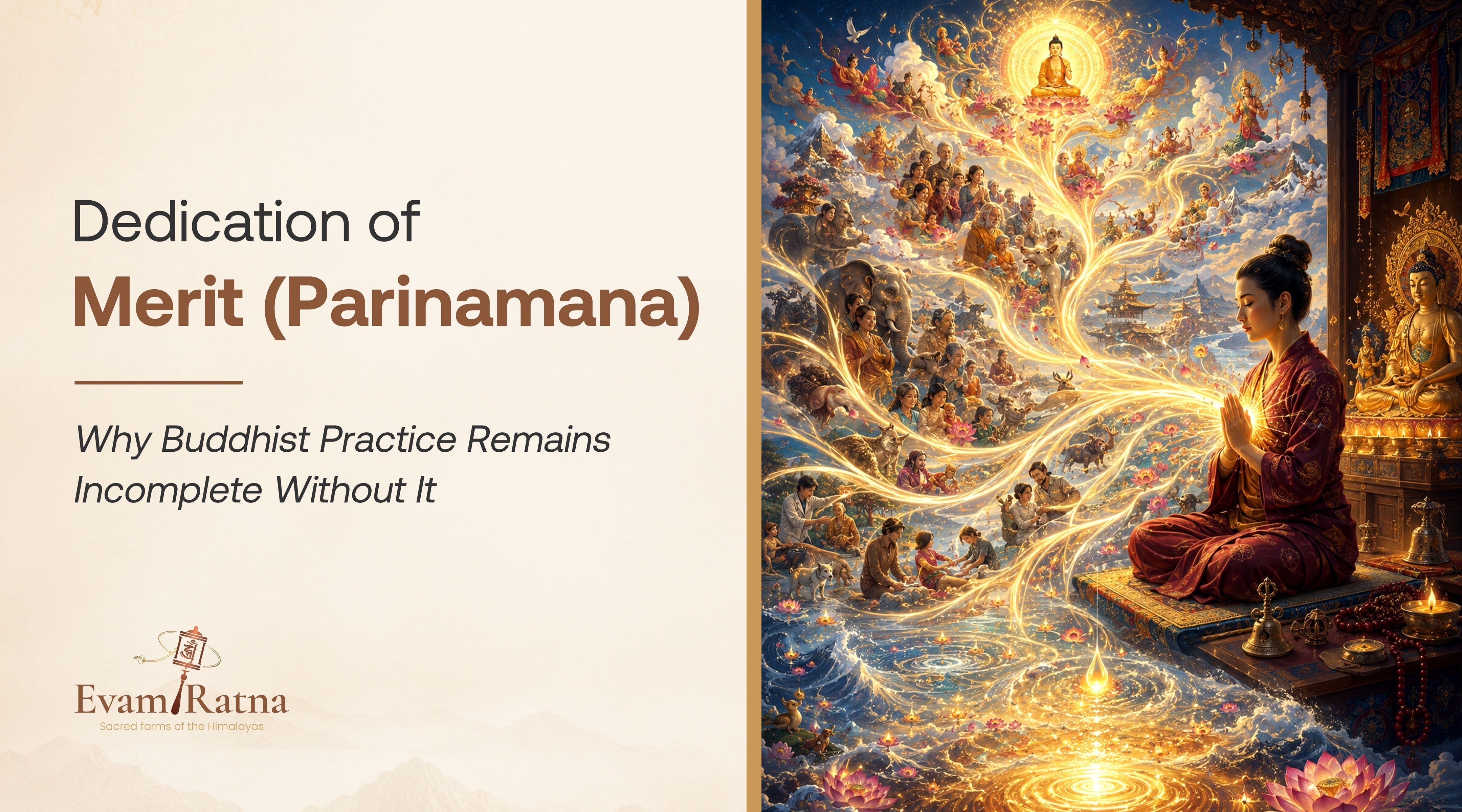
What Is Parinamana? The Buddhist Practice of Dedicating Merit for The Purity of Transformation
You might sit for hours in meditation, recite thousands of mantras, and still find that your practice is incomplete. Not because the effort was insufficient, but because you forgot one of the most important steps: parinamana, the dedication of merit.
In the Vajrayana and broader Mahayana traditions, every formal practice ends with this step. It is not just a small prayer at the end or something added for tradition. It is seen as a very important part of the practice because it gives meaning and direction to everything done before it. This step shows how Buddhism understands good actions, pure intention, and spiritual progress. It teaches that practice is not only for personal benefit, but also for the welfare and awakening of all beings.
What is Parinamana? Defining the Dedication of Merit

Parinamana is a Sanskrit word that literally means "turning over," "transformation," or "ripening toward." In Tibetan, it is called ngowa (bsngo ba), carrying the same sense of the dedication of merit. The term describes the practice of consciously offering the merit (punya) generated by a virtuous act, meditation, recitation, generosity, study, or ritual offering for the benefit of all sentient beings, rather than retaining it for oneself alone.
It typically takes the form of a short verse spoken or recited at the close of a practice session, a ritual, or even an ordinary act of kindness. The most widely recited dedication in the Mahayana world, drawn from Shantideva's Bodhicharyavatara, begins with the aspiration that whatever goodness has been accumulated becomes a cause for the alleviation of suffering everywhere, not confined to the individual who generated it.
Punya: Understanding Merit Before It Can Be Dedicated
To understand why dedication matters, one must first understand what is being dedicated. Punya, often translated as "merit" or "virtue," refers to the positive karmic potential generated through actions rooted in generosity, ethical conduct, patience, meditative discipline, and wisdom.
In the classical Buddhist worldview, punya is understood as a real force shaping future experience, ripening as favorable circumstances, states of mind, or conditions conducive to further practice. Because it is powerful, how it is directed matters enormously. But merit is not seen as something to collect only for oneself. In Mahayana and Vajrayana Buddhism, keeping merit for personal gain is considered limited. The purpose of practice is much wider than individual happiness or success. It is meant to support the awakening of all beings.
This is why practitioners dedicate the merit at the end of a practice. They mentally offer any goodness created through meditation, prayer, mantra, offerings, or study for the benefit of others. Instead of thinking, “May this bring only me good results,” we should think, “May this help all beings find peace, freedom, and enlightenment.”
The Three Noble Principles:

Tibetan Buddhist pedagogy frequently structures practice around what are called the Three Noble Principles (Tib. dam pa sum):
- The Beginning: generating bodhicitta, the altruistic intention to attain awakening for the sake of all beings, before the practice begins.
- The main practice: the meditation, recitation, ritual, or virtuous action itself, ideally performed without grasping at the outcome.
- The conclusion: the dedication of whatever merit has arisen to the welfare and awakening of all sentient beings.
Why Merit Without Dedication is Incomplete?
Buddhist ethical psychology holds that virtuous karma, however substantial, remains vulnerable until it is dedicated. Several classical sources describe how a single moment of intense anger or hatred can destroy merit accumulated over a very long period.
When a practitioner fails to close a session with the Noble Conclusion, the spiritual energy generated faces specific spiritual risks. Such as:
- Vulnerability to Negative Emotions: Undedicated merit remains unstable in a practitioner's mindstream. The sudden bursts of anger, pride, or jealousy can completely destroy or burn away accumulated good karma before it can fully ripen. Dedication securely "seals" and protects that spiritual wealth.
- Lack of Direction: Merit acts as spiritual fuel. Without a conscious dedication to steer it toward enlightenment, it will naturally ripen as temporary samsaric comfort, such as wealth or temporary heavenly rebirth. Dedication acts like a steering wheel, consciously directing that positive energy toward the liberation of all sentient beings.
- Missing the "Ocean" Effect: Tibetan masters frequently compare undedicated merit to a single drop of water on the ground, which quickly evaporates and disappears. Dedicating virtue to all living beings is like dropping that water into the ocean. By merging personal merit with the collective well-being of all sentient beings, the positive karma multiplies and lasts until full Buddhahood is achieved.
- Entrapment in Self-Cherishing: Practicing virtue without giving it away can subtly reinforce ego, self-importance, and spiritual attachment ("look at the merit I made today"). Actively dedicating merit to others is a radical act of generosity that actively diminishes self-grasping and purifies karma.
The most enduring image used to explain parinamana is that of a single drop of water merged with the ocean. A drop of water left exposed on a rock will eventually evaporate, however pure it may be. The same drop, once merged into the ocean, endures for as long as the ocean itself exists. Dedication works like a protective seal for the merit created through practice. When a practitioner offers the merit for the awakening and benefit of all beings, it is no longer held only for personal gain. Because it has already been offered with a pure intention, later emotions like anger, pride, or selfishness cannot easily damage it. In simple terms, once the merit is dedicated, it is like giving a gift away. Since it is no longer kept for oneself, there is nothing for the ego or negative emotions to hold on to or spoil.
Shantideva and the Bodhicharyavatara on Dedication
The eighth-century Indian master Shantideva devotes the final chapter of his Bodhicharyavatara (A Guide to the Bodhisattva's Way of Life) entirely to dedication. Having spent the preceding chapters detailing generosity, ethical discipline, patience, joyous effort, meditative concentration, and wisdom, Shantideva closes the text not with a summary of doctrine but with an extended aspiration, dedicating the merit of having composed and taught the text itself toward the relief of suffering beings everywhere: the sick, the frightened, the imprisoned, those lost in the wilderness, and ultimately all beings without exception.
This structural choice is itself instructive. Shantideva does not treat dedication as separate from the six perfections (paramitas) he has just described; he treats it as their natural completion. Wisdom without dedication, in his framework, is unfinished business.
Three Levels of Dedication: Mundane, Supramundane, and Ultimate
Buddhist scholastic traditions distinguish between different qualities of dedication, generally organized into three tiers:
- Mundane dedication: merit dedicated toward worldly benefit: long life, health, prosperity, or favorable rebirth for oneself or others. This is virtuous but limited, since it remains oriented toward conditioned, samsaric outcomes.
- Supramundane dedication: merit dedicated toward liberation (nirvana) or awakening (bodhi) for oneself and others. This exceeds worldly concern but may still involve a subtle reference point: a "self" dedicating merit "for" a goal.
- Ultimate or non-referential dedication (Skt. anupalambha parinamana): dedication performed with the recognition that the one dedicating, the merit being dedicated, and the beings to whom it is dedicated are all empty of inherent existence. This is considered the highest form, free of the subtle grasping that even well-intentioned dedication can carry.
Most practitioners begin with the first two levels and grow into an understanding of the third as their study of emptiness (shunyata) deepens.
Parinamana and the Bodhisattva Vow

Dedication of merit is inseparable from the bodhisattva vow, the commitment to work for the awakening of all sentient beings rather than for personal liberation alone. Every act of dedication is, in effect, a renewal of this vow in miniature. It restates, at the close of each practice session, the scope of the practitioner's intention: not confined to individual benefit, but extended without limit.
This is why dedication verses so often invoke language of totality, "all sentient beings," "as vast as space," "until samsara is emptied." The scale of the aspiration is deliberate. It trains the mind, session after session, to habituate itself to a bodhisattva's scope of concern rather than an ordinary, self-referential one.
How Is Dedication Practiced in Tibetan Buddhist Ritual?
In practical terms, parinamana appears at the conclusion of nearly every formal Tibetan Buddhist activity: a sadhana session, a puja, a teaching, a pilgrimage, the consecration of a statue or thangka, the construction of a stupa, or even a simple offering at a home shrine. Practitioners typically fold their hands, recall the virtue just generated, and recite a dedication verse, sometimes brief, sometimes an extended aspiration prayer such as the Bhadracharya (the King of Aspiration Prayers of Samantabhadra), which is among the most widely recited dedication texts in the Tibetan canon.
Ritual objects used in practice such as a vajra and bell, mala, damaru, and offering bowls are set down, and the session closes not with the ringing of a bell or the final mantra repetition, but with this verbal act of dedication. In many lineages, teachers instruct that dedication should follow immediately after the main practice, before the mind has a chance to become distracted or to lapse into self-congratulation over the virtue performed.
Common Dedication Verses and Their Meaning
Among the most frequently recited dedication verses is this widely known aspiration, adapted from Shantideva:
By this merit, may all beings complete the accumulations of merit and wisdom, and may they attain the two resultant bodies (rupakaya and dharmakaya) that arise from merit and wisdom.
Its structure reflects a common pattern: an acknowledgment of the merit just created, followed by an aspiration that this merit function as a direct cause for the awakening of all beings, not simply their temporary happiness, but full Buddhahood, understood as the union of form and wisdom bodies.
Shorter dedications are also common in daily practice, often as simple as offering the virtue of the moment "for the benefit and awakening of all mother sentient beings," reflecting the same underlying logic in condensed form.
Why This Matters for Practitioners Today
For a contemporary practitioner, the significance of parinamana extends beyond ritual correctness. It addresses a real psychological tendency: the subtle self-congratulation or quiet possessiveness that can attach itself to spiritual effort. Meditation, study, and ritual offering can, without this closing gesture, quietly reinforce a sense of personal spiritual achievement, the very self-concern the practice is meant to loosen.
Dedication interrupts that tendency at its root. It reorients the practitioner, at the close of every session, away from accumulation and toward offering. Over time, this repeated redirection is understood to shape not just isolated karmic outcomes but the practitioner's underlying disposition, cultivating a mind that habitually inclines toward the welfare of others rather than the safekeeping of personal gain.
Conclusion: Completing the Circle of Practice
Parinamana, the Buddhist practice of dedicating merit, is one of the most meaningful steps in Mahayana and Vajrayana practice. It reminds practitioners that meditation, mantra recitation, offerings, study, and every virtuous action should not end with personal gain alone. Instead, the merit created through these practices is consciously offered for the peace, liberation, and awakening of all sentient beings.
This is closely connected to the Three Noble Principles, beginning with pure motivation, performing the main practice with awareness, and ending with dedication. These three stages make the practice complete. The right motivation gives the practice a compassionate purpose, the main practice creates merit, and dedication seals that merit for the benefit of all beings.
By dedicating merit, the practitioner protects the virtue from being weakened by pride, anger, or self-centered attachment. Like a drop of water placed into the ocean, dedicated merit becomes vast, lasting, and connected to the Bodhisattva path. Parinamana transforms ordinary goodness into a powerful cause for universal benefit, making it not just a closing prayer, but the sacred seal that completes the entire practice.