The Meaning of Bone Apron and Jewelry in Tibetan Ritual Practice
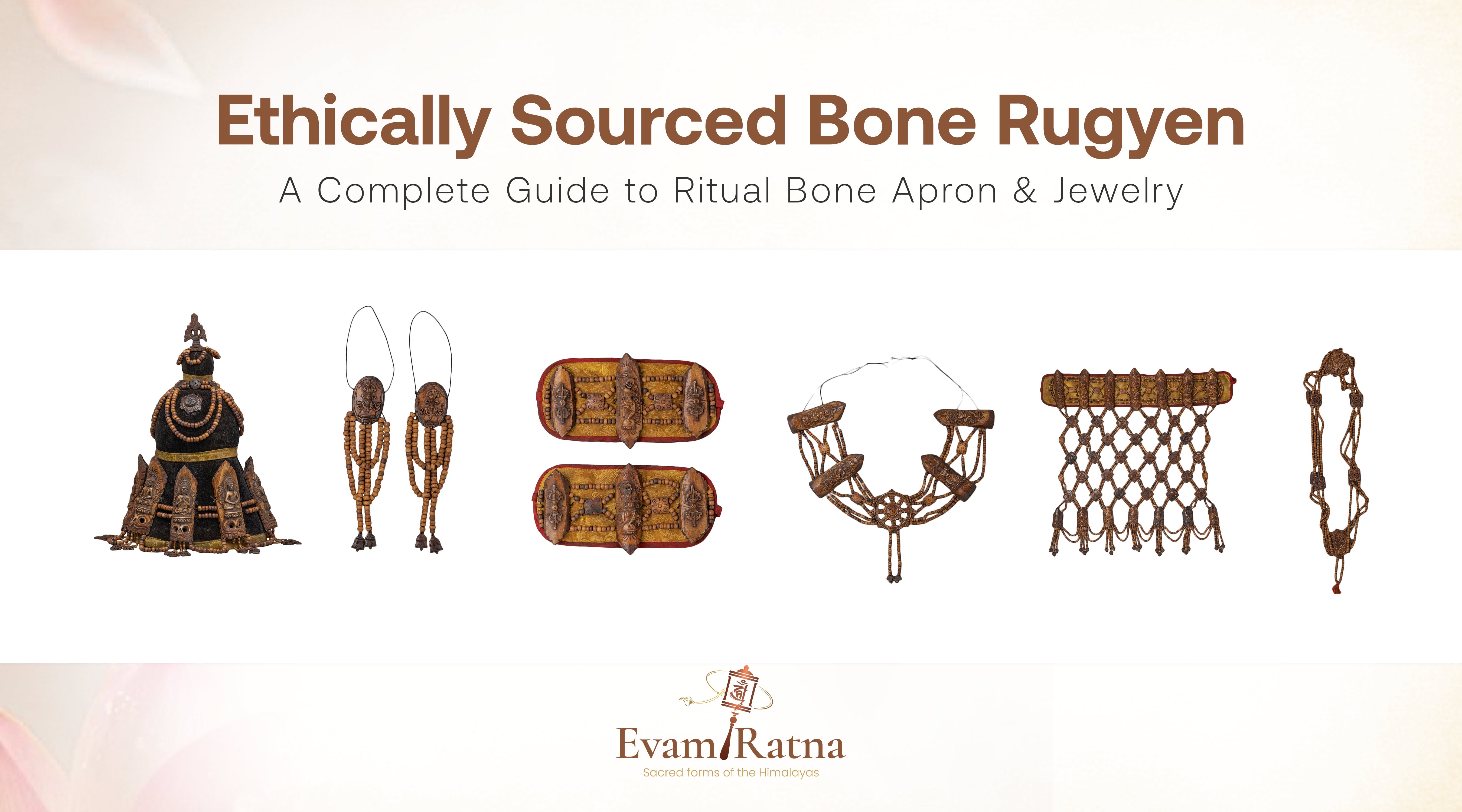
Ethically sourced Bone Rugyen is sacred Tibetan Buddhist ritual jewelry in the form of carved bone aprons, crowns, necklaces, bracelets, and other ceremonial ornaments used in Vajrayana practice. Known in Tibetan as rus rgyan, meaning “bone ornament,” it carries deep symbolic meaning connected to impermanence, wisdom, and the transformation of ordinary identity into an enlightened form. Traditionally worn by practitioners, ritual dancers, and figures representing Heruka deities, bone aprons and jewelry sets remain an important part of Himalayan tantric culture.
What Is Rugyen (Bone Apron & Jewelry)?

Rugyen (Tibetan: rus rgyan, "bone ornament") is a set of carved bone pieces worn by wrathful and semi-wrathful deities in Tantric Buddhism, and by spiritual practitioners and ceremonial dancers who embody those deities in ritual. A complete traditional set includes a crown or hairnet, earrings, a short necklace, a long necklace, a girdle or apron, bracelets and anklets.
Each ornament in a set is tied to a specific wisdom or quality, meaning the ornaments function as a wearable teaching, a way of literally putting on the qualities of an enlightened form during deity yoga. These aprons are worn by tantric masters for the purpose of initiation at certain stages of the ritual, to represent non-dual wisdom.
The Origins of Bone Ornaments in Tantric Buddhism
The use of bone ornaments in Vajrayana Buddhism developed from the charnel-ground symbolism of Indian tantra, tied especially to the Chakrasamvara and Vajravarahi cycles of yogini tantra that spread into Tibet after the eleventh century. The six-pointed mandala of Vajravarahi is found in the form of carved plaques on surviving aprons in museum collections, as pointed out by a scholarly essay: a fragment in the Sven Hedin Collection at the Museum of Ethnography in Stockholm, arranged in the building of the Museum's ethnographic collection; a related example of the 13th century of the Kagyu tradition. This form of design lattice evolved into the longer, more elaborate apron form known today in the late 15th century.
Most of the surviving historical sets were said to be carved in the Kathmandu Valley and then exported into Tibet and neighboring Himalayan regions wherever Tantric Buddhism took root. That same source notes bone ornaments have also been worn by Vajracharya priests of Kathmandu, both historically and in the present day, typically alongside an elaborate metal Vajracharya crown bearing additional Tantric symbols.
The Complete Set of Bone Rugyen: Traditional Components

As the bone-ornament sets belonged to different lineages and deity forms, the exact count of pieces varies. The clearest breakdowns, which separate the ornament sets by the type of deity they belong to, are:
Six bone ornaments of a wrathful male deity:
- A hairnet of bone pendants hanging from the crown protrusion (ushnisha)
- Bone earrings
- A short bone necklace
- A long bone necklace
- A bone girdle
- Bone bracelets and anklets
Six bone ornaments of a wrathful female deity (associated with Vajravarahī and related yogini forms):
- Bone jewels on the right and left shoulders
- Bone lotuses on the breast
- Bone vajras on the back
- Bone chakras on the shoulder blades
- A bone eternal knot at the waist
- A bone double vajra at the navel
Five bone ornaments of a peaceful female deity, each tied to a specific wisdom:
- A bone ring at the crown, symbolizing the wisdom of basic space
- A bone necklace, symbolizing the wisdom of equality
- Bone earrings, symbolizing discerning wisdom
- Bone bracelets, symbolizing mirror-like wisdom
- A bone belt, symbolizing all-accomplishing wisdom
Physical sets sold and displayed today are usually built around the simplified wrathful-deity model: crown, necklace, apron/girdle, and bracelets, since these four pieces carry the strongest visual identity and are the most practical for wear.
What Rugyen Is Actually Made From?
A common misconception is that Rugyen ornaments are carved from human bone. However, buffalo bone is the most common material used to carve these ornament sets. Also, it is actually ethically sourced buffalo bone.
Some ritual objects, such as certain rosaries, hand drums, and trumpets, are indeed made from human bone under specific traditional criteria, often connected to a holy individual or the ritual significance of their death. Bone aprons, however, are consistently catalogued as animal bone.
This matters for anyone sourcing or selling Rugyen today: an ethically produced set should be traceable to animal bone (most commonly buffalo, sometimes supplemented with yak, wood, resin, or metal), carved from material that was a byproduct of another use, never harvested for the ornament alone.
Symbolism: Bone as a Teaching on Impermanence
Across wrathful Himalayan iconography, bone and skull motifs consistently point to one idea: impermanence. The Bone ornaments, skull garlands, and charnel-ground settings are reminders of mortality, not glorifications of death. Wrathful imagery is meant to confront the viewer with a truth about the fragility of life rather than offer comforting illusions.
This same source notes that many wrathful deities wear a crown of five skulls representing the transformation of the five poisons: anger, grasping, ignorance, pride, and envy, into the five wisdoms. The bone apron and jewelry extend this same logic across the whole body: every plaque and strand is a physical reminder that what looks solid and permanent is, in fact, subject to dissolution, and that this dissolution is itself the ground for awakened qualities to arise.
Rugyen in Practice: Chöd, Cham Dance, and Deity Yoga

Bone ornaments appear across several living contexts in the Himalayan world:
- Chöd practice: In the lineage traced to the yogini Machig Labdrön, practitioners visualize offering the body as a feast to all beings while playing the damaru drum and kangling trumpet. Bone ornaments reinforce this meditation on non-attachment to the body.
- Cham dance: Monastic ritual dances performed at monasteries and public festivals often include dancers dressed as wrathful protector deities, complete with bone ornament sets, to bring blessing to the community.
- Vajracharya ritual dress: As noted above, Newar Vajracharya priests of the Kathmandu Valley have worn bone ornaments alongside metal crowns during tantric ceremonies, a tradition that continues among some practitioners today.
- Siddha appearance: A realized practitioner is shown in full ornamentation, from a simple "yogi appearance," where dress is limited to a plain robe with few or no ornaments. Historical siddhas including Virupa, Tilopa, and Naropa are depicted in bone ornaments, and the fifteenth-century Tibetan master Tsang Nyön Heruka was particularly known for adopting this dress as an outward sign of his realization.
Why Ethical Sourcing Matters Today?
As interest in Himalayan ritual art has widened beyond traditional practitioner communities into museums, private collections, and the wider spiritual-goods market, questions about material origin have become more visible and more important to answer clearly. An ethically sourced Rugyen set, and its significance should rely on several specific principles:
- Strict Animal Welfare: Ethical bone ornament creators ensure that no animals are harmed, poached, or hunted specifically for their bones or ivory.
-
Waste Reduction & Upcycling: Reputable makers utilize natural byproducts from the sustainable food industry (such as cattle, sheep, or camel bones). This honors the entire animal and keeps discarded remains out of landfills.
-
Endangered Species Protection: Purchasing from verified ethical platforms helps prevent the illegal black-market trade of threatened or endangered species.
-
Fair Trade & Artisan Empowerment: Many bone ornaments are handcrafted. Ethical sourcing ensures that the workers crafting these items are provided with safe working conditions and fair, living wages.
-
Supply Chain Transparency: Conscious buyers demand to know exactly how a piece was sourced, allowing them to verify that the item's creation respects both people and the environment
This is also a matter of continuity. The Kathmandu Valley carving tradition that is documented has supplied bone ornament sets to Tibet and the wider Himalayan region for centuries. Sourcing ethically, transparently, and from artisans working within that lineage keeps the craft alive on its own terms, rather than displacing it with unrelated or misrepresented reproductions.
How to Choose an Ethically Sourced Bone Apron & Jewelry Set?

When evaluating a Rugyen set for purchase, whether for ritual use or respectful display, consider:
- Material transparency: The seller should be able to state plainly what the bone source is (typically buffalo).
- Carving origin: Kathmandu Valley workshops carry the strongest documented craft lineage for this object.
- Iconographic accuracy: Look for correctly rendered deity or mandala imagery (such as Chakrasamvara-cycle figures, which Himalayan Art Resources notes are the most common subject on surviving sets) rather than vague ornamental carving.
- Intended use: A set meant for ritual practice or Cham performance differs in weight, completeness, and finish from a set meant purely for display.
- Craftsmanship over price: Genuine hand-carving takes considerably longer than machine finishing, and this is reflected in cost.
Caring for Your Rugyen
Bone is porous and reactive to the environment. Keep pieces away from prolonged direct sunlight and high humidity, both of which can cause cracking, warping, or discoloration over time. Store flat or hung rather than compressed, avoid harsh chemical cleaners, and wipe periodically with a soft, dry cloth. If a piece is strung on cord or thread, inspect the stringing regularly; it will wear out well before the bone itself does, and a small repair early on can prevent losing plaques later.
Conclusion
Ethically Sourced Bone Rugyen is more than a traditional bone apron and jewelry set; it is a sacred expression of Vajrayana Buddhist wisdom, ritual identity, and Himalayan craftsmanship. From its carved crown and necklaces to its symbolic apron and ornaments, each piece reflects teachings on impermanence, transformation, and enlightened awareness. Rugyen, the bone apron and jewelry of Tantric Buddhism, carries centuries of documented symbolic and material history, from the yogini tantra imagery carved into surviving museum aprons to the living practice of Vajracharya priests in Kathmandu today. Choosing an ethically sourced set means honoring two things at once: the craftsmanship of the Newar artisans who have carried this carving tradition forward, and the integrity of a symbolism that has always used bone as a teaching on impermanence, never as a display of harm.