Why Buddha-Nature Matters: The Foundation of Hope in Tibetan Buddhism
Buddha-nature is one of the most inspiring and hopeful teachings in Tibetan Buddhism. Known in Sanskrit as Tathagatagarbha, it points to the awakened potential already present within every sentient being. This does not mean that every person is already fully enlightened in an obvious way. Rather, it means that beneath confusion, fear, anger, attachment, and ignorance, there is a deeper purity of mind that can be revealed through the Buddhist path.
In Tibetan Buddhism, Buddha-nature is the very reason spiritual practice is possible. If the mind were permanently stained by suffering, enlightenment would be impossible. But because the true nature of mind is pure, luminous, and open, transformation is always possible. This is why Buddha-nature becomes the foundation of hope: no matter how confused or broken a person may feel, awakening is not something foreign to them. It is something already hidden within, waiting to be recognized.
What Is Buddha-Nature?

Buddha-nature is one of the innate potentials for all beings to achieve enlightenment. In Sanskrit, buddha-nature is called tathagatagarbha, literally, the "womb" or "embryo" of the Buddha. It's also referred to as buddha-dhatu (the Buddha element) or buddha-gotra (the Buddha's spiritual lineage or "gene"). All three terms point to the same idea: every sentient being carries, at the core of their mind, the same purity and potential that a fully awakened Buddha has already realized. In simple terms, it means that every being carries the seed or inner possibility of Buddhahood.
This teaching is especially important in Mahayana and Vajrayana Buddhism. It explains that enlightenment is not created from nothing. Instead, spiritual practice removes the layers that conceal our awakened nature. The Mahayana view is deeply hopeful because negativity is not the permanent truth of who we are; it is a temporary obscuration covering our awakened nature. A traditional image often used to explain this is the sun behind clouds. The Nyingma and Kagyu traditions offer a simple image for this: The clouds may hide the sun, but they do not destroy it. In the same way, ignorance, anger, jealousy, pride, and attachment may cover the mind’s natural clarity, but they do not remove its awakened potential.
Where Did the Idea Come From?
The roots of this teaching reach back further than most people expect. In the Pali canon, the Buddha is recorded saying that the mind is naturally luminous, and only defiled by things that arrive from outside it, a passage scholars consider one of the earliest hints of what would later become the buddha-nature doctrine.
Centuries later, in India, an entire body of Mahayana scripture, the tathagatagarbha sutras, developed this idea in depth. Texts like the Mahaparinirvana Sutra described this indwelling Buddha-essence as eternal and blissful, in deliberate contrast to how early Buddhism described nirvana as simply the extinguishing of suffering. In Tibet, this material was later distilled into the Uttaratantra Shastra (the Ultimate Continuum), attributed to Maitreya and transmitted through Asanga, still the central textbook on buddha-nature in Tibetan monastic education today. When Vajrayana Buddhism emerged, buddha-nature stopped being just a topic for study and became something to be worked with directly, through mandalas, deity practice, mantra, and ritual implements.
Why Buddha-Nature Is the Foundation of Hope?
Buddha-nature matters because it gives spiritual life a reason to continue. In times of suffering, people often feel trapped by their mistakes, trauma, anger, or emotional patterns. The teaching of Tathagatagarbha reminds us that these experiences are not the final truth.
In Tibetan Buddhism, hope is not based on wishful thinking. It is based on the nature of reality. Since the mind is not permanently stained, purification is possible. Since confusion is temporary, wisdom can arise. Since compassion is part of awakened nature, kindness can be cultivated.
This is why Buddha-nature is so powerful: it tells us that enlightenment is not reserved for special beings. The path may be long, but the seed of awakening is already present. Every act of meditation, generosity, patience, prayer, mantra recitation, and mindful awareness helps uncover what has always been there.
Why Buddha-Nature Matters: Five Reasons
Buddhist tradition offers a memorable answer to an obvious question: if everything is ultimately empty, why teach a doctrine that sounds so much like "the Buddha inside you"? Maitreya's Uttaratantra gives five reasons, each one a corrective to a specific human failing.
- It counters discouragement. The path to awakening can look impossibly long. Believing you already carry the capacity for enlightenment keeps you from giving up before you start.
- It counters contempt for others. If buddha-nature is universal, no being, regardless of status, behavior, or apparent spiritual progress, is beneath basic respect.
- It counters attachment to illusion. Recognizing an unconditioned, luminous nature within yourself makes the endless pursuit of material and social validation look exactly as unstable as it is.
- It counters denial of deeper truth. Without some sense that a higher reality exists, people settle for surface-level spiritual practice, going through motions without transformation.
- It counters excessive self-focus. Paradoxically, recognizing your own buddha-nature dissolves self-obsession rather than inflating it, because that same nature is recognized as shared, not exclusive.
Buddha-Nature and the Three Poisons

The three poisons: ignorance, attachment, and aversion, are the main causes of suffering in Buddhist teachings. They shape the way beings misunderstand themselves and the world. Ignorance makes us cling to a false sense of self. Attachment makes us chase happiness outside ourselves. Aversion makes us reject what we dislike.
From the perspective of Buddha-nature, these poisons are not permanent. They are like dust on a mirror. The mirror’s reflective quality remains unchanged, but dust prevents it from showing clearly. Practice does not create the mirror; it cleans it.
This is why Tibetan Buddhism places strong emphasis on purification practices, meditation, mantra, visualization, and the cultivation of bodhicitta. These methods help remove obscurations and reveal the mind’s natural wisdom. When ignorance is purified, wisdom shines. When attachment is transformed, compassion deepens. When anger is understood, clarity appears.
Buddha-Nature and Emptiness
Buddha-nature and emptiness are closely connected. At first, they may seem opposite. Emptiness teaches that all things lack fixed, independent existence. Buddha-nature sounds like something present within us. But in Tibetan Buddhist philosophy, these teachings can support each other.
Buddha-nature is not a solid object inside the body. It is not a hidden soul. It is the mind’s ultimate nature, free from fixed identity and open to awakening. Because the mind is empty of permanent limitation, transformation is possible. Because emotions are empty, they can change. Because identity is empty, we are not trapped by who we think we are.
This is where Buddha-nature becomes a bridge between wisdom and compassion. Emptiness frees us from clinging, while Buddha-nature gives confidence that awakening is possible. Together, they form a powerful foundation for Tibetan Buddhist practice.
Buddha-Nature in Ritual and Practice: A Practical Reflection
This is where the doctrine stops being theory and becomes the reason Himalayan Buddhist ritual art exists at all.

A melong, or ritual mirror, used in Bön and Tibetan Buddhist contexts, reflects this idea with striking simplicity. A mirror does not create the images that appear on its surface, nor does it hold onto them. It reflects clearly when it is unobscured. In the same way, the mind’s true nature is often described as clear, open, and reflective. Thoughts, emotions, fears, and attachments appear within awareness, but they do not permanently stain awareness itself. The mirror therefore becomes a powerful symbol of the mind’s natural purity: it can reflect everything, yet remain untouched by what it reflects.
A mandala offering expresses the same truth through a larger cosmic gesture. In Tibetan Buddhism, the practitioner symbolically offers the entire universe: Mount Meru, the four continents, the sun, moon, precious substances, goddesses, jewels, and all beautiful things. This is not merely an act of giving external objects. It is a profound training in releasing attachment to the entire world as “mine.” Traditional explanations describe mandala offering as a practice for accumulating merit and purifying attachment, miserliness, and grasping.
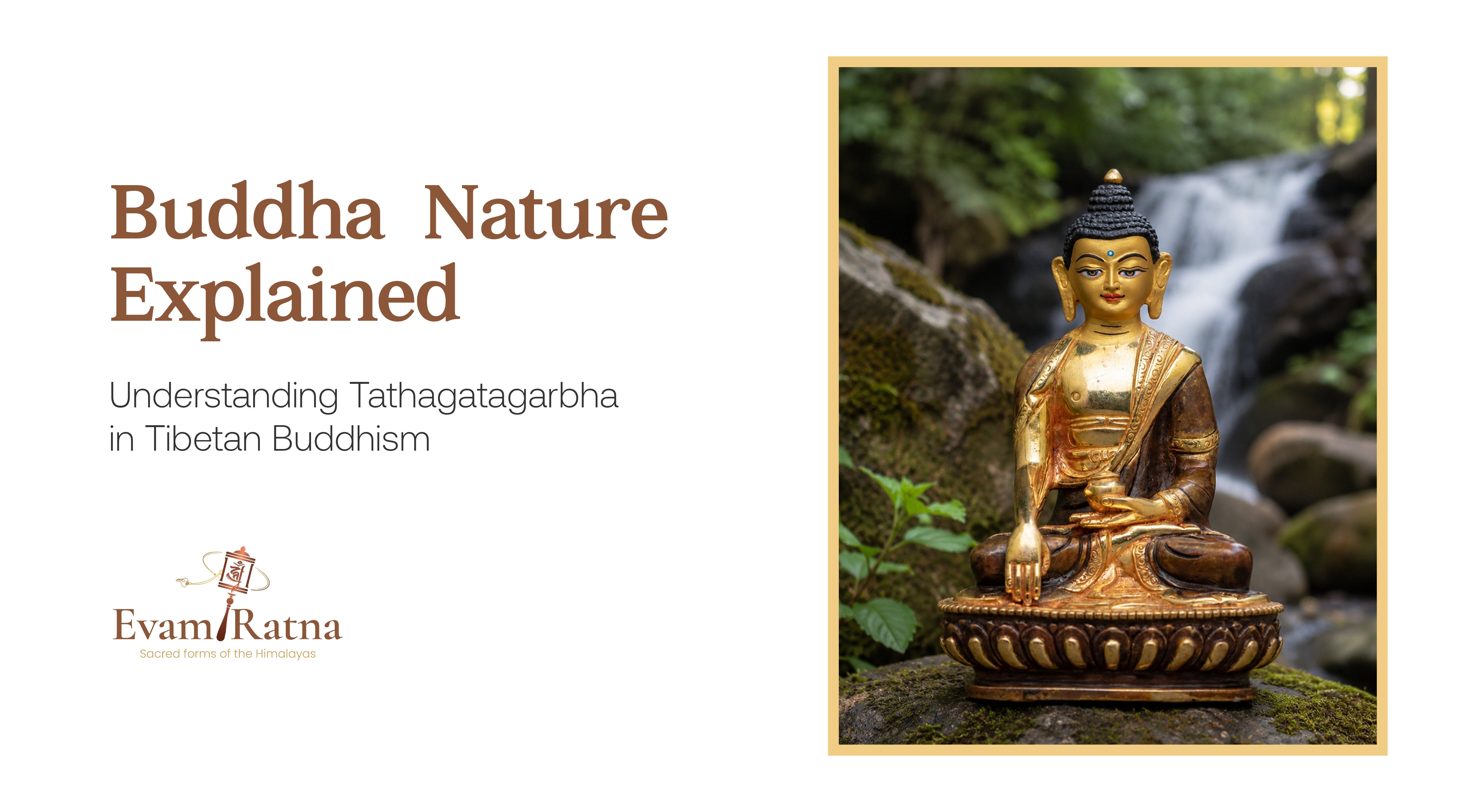
This is also why Buddha images and thangka paintings are central to Himalayan Buddhist practice. A statue of Shakyamuni Buddha, a thangka of Green Tara, or a mandala of Kalachakra does not function as an external idol separate from the practitioner. These sacred forms reveal enlightened qualities in visible language. Compassion becomes Chenrezig. Wisdom becomes Manjushri. Purification becomes Vajrasattva. Healing becomes Medicine Buddha. Swift enlightened activity becomes Tara.
Conclusion
Buddha-nature, or Tathagatagarbha, is one of the most powerful teachings in Tibetan Buddhism because it reminds us that enlightenment is the awakened potential already present within every sentient being. Beneath ignorance, attachment, anger, fear, and confusion, there remains a deeper purity of mind that can be revealed through practice, wisdom, compassion, and ritual. This is why Buddha-nature matters so deeply. It gives practitioners a foundation of hope. It teaches that suffering is real, but it is not permanent. Emotional obscurations may cover the mind, but they do not destroy its luminous nature. Like clouds hiding the sun or dust covering a mirror, our confusion can be cleared away. Through meditation, mantra, mandala offerings, prostration, thangka contemplation, and devotion to sacred Buddhist forms, practitioners are gradually reminded of the awakened nature within themselves.