A Complete Guide to the Top 10 Shared Deities in Hinduism and Buddhism
For over two thousand years, Hinduism has evolved alongside Buddhism in the spiritual geography of South Asia and the Himalayas. While they are philosophically different in their teachings and practices, as well as in their interpretations of enlightenment, they share a very rich cultural environment in which stories, symbols, artistic traditions, and holy figures have interacted continuously.
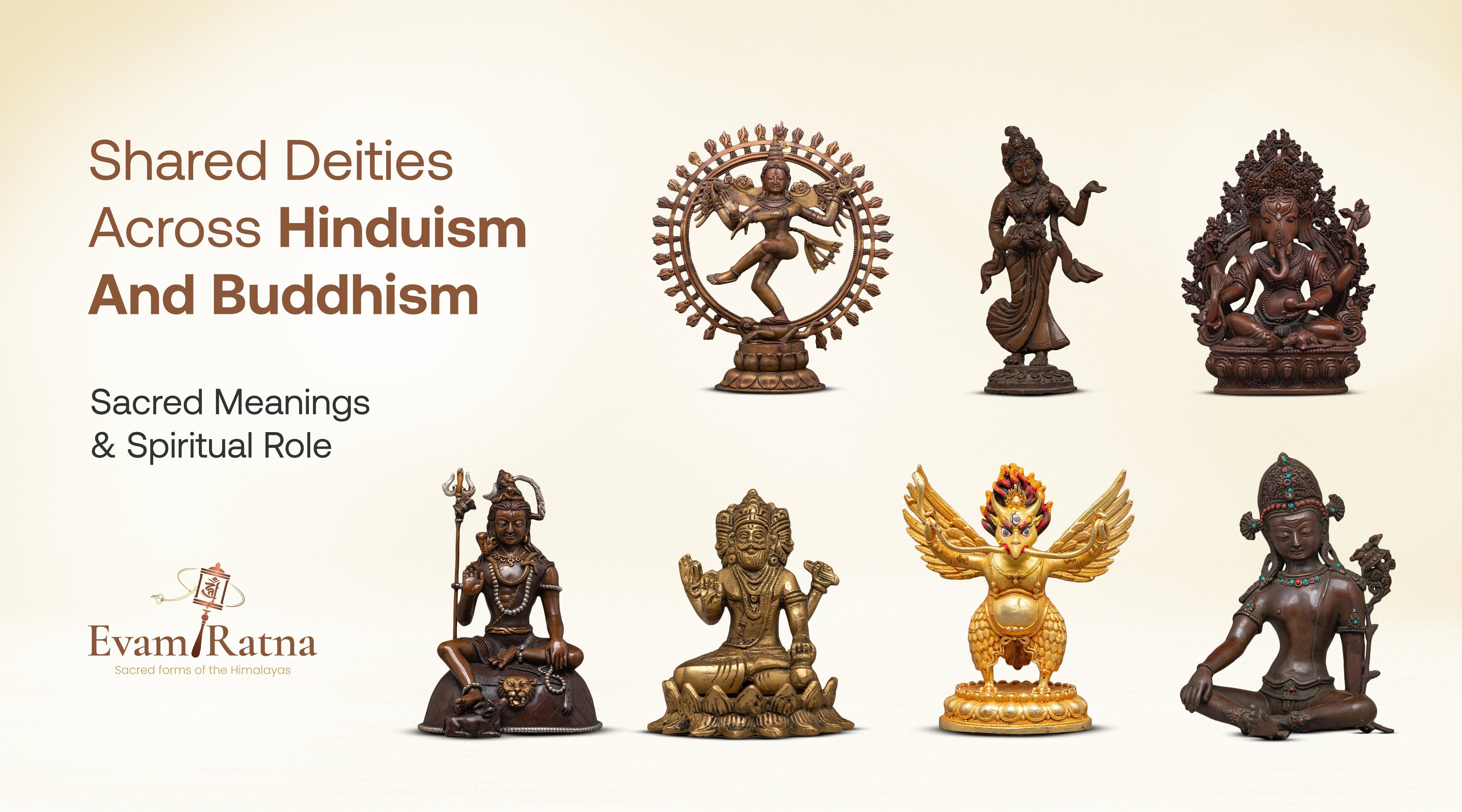
One of the most fascinating examples of this connection is the presence of shared deities across Hinduism and Buddhism. Figures such as Shiva, Ganesh, Durga, Garuda, Indra, Mahakala, Lakshmi, Parvati, and Nataraja appear within the artistic and religious traditions of both communities. However, their meanings and roles are not always identical. A deity who plays a pivotal role in Hindu belief can be represented in Buddhism as a protector, guardian, an enlightened being, or a symbolic form that serves as a representation of a particular spiritual attribute.
Why Do Hindu Deities Appear in Buddhism?
Hindu deities came into the Buddhist traditions with historical and cultural context. Buddhism began in ancient India in the 5th century BCE in a religious climate that was influenced by Vedic beliefs, local religious practices, and new philosophy. When Buddhism spread to India, Nepal, Tibet, Bhutan, China, and the Far East, it encountered different cultures that already had their own worship systems and symbols that had to be understood. Buddhism did not ignore local traditions, but rather incorporated local culture into its own framework. In Buddhist literature and art, numerous Hindu deities are depicted as:
- Dharma protectors (Dharmapalas)
- Guardians of Buddhist teachings
- Celestial beings within Buddhist cosmology
- Symbolic representations of spiritual qualities
- Figures who acknowledge the superiority of awakened wisdom
One of the main differences is that Buddhism does not consider such beings as eternal creators or as supreme gods. In Buddhist philosophy, even powerful celestial beings are still part of the cycle of existence (samsara) and are still affected by the law of cause and effect (karma) and impermanence.
Therefore, a deity’s role changes according to the religious framework in which they appear.
Shiva: The Auspicious Lord and Cosmic Principle

Lord Shiva is one of the principal deities of Hinduism along with Brahma and Vishnu, in the Trimurti. He is a symbol of change, destruction of ignorance, and re-birth. But Shiva's role is not to destroy in the negative sense, but to break down and dissolve to create again and grow spiritually.
Shiva is known through many forms:
- Mahadeva (The Great God)
- Yogeshwara (Lord of Yoga)
- Nataraja (Lord of Dance)
- Bhairava (Wrathful Protector)
Early texts, such as the Pali Canon, view Shiva (often called Maheshvara or Ishana) as a mighty deity within the god realm. However, he is bound by karma and remains subject to the same cycle of suffering as all other sentient beings. Also, Shiva is respected as a protective figure associated with safeguarding the Dharma and supporting spiritual practitioners. This interpretation differs from his Hindu role as a powerful deity of transformation, where destruction is understood as a necessary force that leads to renewal and regeneration.
In Buddhism, Shiva-related symbolism is often understood through concepts of wisdom, transformation, protection, and liberation. His imagery reminds practitioners that spiritual growth requires overcoming ignorance, embracing change, and realizing the deeper nature of existence. The presence of Shiva in Buddhist art and traditions stands as a testament to the shared cultural heritage of India, Nepal, and Tibet, where spiritual ideas have crossed boundaries for centuries, creating a rich tapestry of Himalayan wisdom.
Nataraja: The Cosmic Dance Echoed in Vajrayana Art

Nataraja, Shiva as Lord of the Dance, is one of Hinduism's most philosophically dense images: a four-armed figure dancing within a circle of flame, one foot crushing the demon of ignorance, hands holding a drum for creation and fire for destruction. The dance represents five simultaneous cosmic acts: creation, preservation, destruction, concealment, and grace, compressed into a single, endlessly repeating gesture.
While Nataraja crushes the dwarf Apasmara in Hinduism, Tantric Buddhism uses similar imagery. Buddhist deities are often depicted stepping upon Hindu gods (like Shiva and his consort Parvati) to symbolize the transcendence of worldly attachments and the triumph of the Buddhist path to enlightenment. The symbolism of the cosmic dance resonates strongly through Vajrayana iconography. Wrathful deities such as Chakrasamvara and Vajrayogini are frequently depicted mid-dance, one leg bent and one extended in the ardhaparyanka posture, trampling figures that represent ego and ignorance underfoot, much as Nataraja tramples the demon Apasmara. Ritual cham dances performed by monks during Himalayan festivals draw on this same idea, that dance itself can be a vehicle for transformation, dissolving illusion through disciplined, symbolic movement rather than static contemplation alone.
Parvati: Shakti's Echo in Buddhist Wisdom-Consorts

Parvati is Shiva's consort and the gentler face of Devi, the great goddess, embodying Shakti, the active, dynamic energy that complements Shiva's stillness. Parvati is one of the principal goddesses in Hindu traditions and represents love, fertility, devotion, motherhood, and divine feminine energy. As a mountain goddess with deep roots in the Himalayan landscape itself, her mythology is intimately tied to the very geography in which Vajrayana Buddhism later flourished. She is regarded as the gentle and compassionate aspect of Shakti, the dynamic creative power of the universe. Parvati appears in many forms, including:
- Uma
- Gauri
- Durga
- Kali
Parvati’s symbolic role in Buddhism is as the expression of feminine energy united with a masculine principle finds a meaningful parallel in the yab-yum imagery of Vajrayana Buddhism. In these sacred representations, wisdom deities such as Vajrayogini are shown in embrace with their consorts, symbolizing the inseparable union of wisdom and compassionate action.
Similarly, Tara carries a compassionate and nurturing quality that can be compared to aspects of Parvati’s character, especially in her Green and White forms, which represent protection, healing, and long life. These similarities do not mean that one tradition directly borrowed from the other; rather, they reflect a shared Himalayan understanding of the divine feminine as a powerful source of compassion, wisdom, and spiritual transformation.
The similarities between Hindu Shakti traditions and Buddhist female wisdom traditions reflect a shared cultural environment where concepts of feminine spiritual power developed in different philosophical directions.
Ganesha: Remover of Obstacles in Tantric Buddhism

Ganesha, the elephant-headed son of Shiva and Parvati, is perhaps Hinduism's most universally beloved deity, invoked at the start of the beginning of anything, as the remover of obstacles and lord of beginnings. His adoption into Tantric Buddhism has occurred across Nepal, Tibet, and Japan, where he appears under many names and in several distinct forms, some benevolent and some deliberately wrathful.
He is worshipped in Japan as Kangiten (Deva of Bliss), a tantric symbol of two elephant-headed figures, which is not usually displayed in public. In Tibetan Buddhism, Ganesha also serves as a minor protector, who is tamed under the feet of the wrathful deities, and in some representations such as Gaṇapati, he is a deity who is directly invoked for the elimination of obstacles to practice. His image is particularly prominent in Newar Buddhism, and small shrines dedicated to Ganesha are found at the entrance of many temples and courtyards in Kathmandu and Patan, where they are invoked before any journey, ceremony, or business begins.
The dual role of Ganesha, one in which he is subdued underfoot, and the other in which he is directly called, displays a general subtlety of the Vajrayana Buddhism of assimilation, which does not always take the form of simple subordination. There are a few worldly gods shown literally squashed under the feet of wrathful Buddhist protectors, a visual shorthand to the taming of the ego, obstacle, and worldly attachment. In some other manifestations, such as the more benevolent form of Ganesha, they have a significant degree of devotional independence and can be worshipped directly for various worldly purposes.
Brahma: The Creator Who Bows to the Buddha

In the Hindu trimurti, Brahma is the creator god, the first cause who brings the universe into being alongside Vishnu, the preserver, and Shiva, the destroyer. In Buddhism, his role is shifted from creator to guardian. Known in Buddhist texts as Mahabrahma, he presides over the Brahma-loka, a heavenly realm of deep meditative absorption, and he is consistently depicted as a protective, deferential figure rather than a supreme creator.
One of the most repeated scenes in Buddhist art and scripture shows Mahabrahma, alongside Sakra, descending from the heavens to pay homage to the newly awakened Buddha, often shown offering a wheel of the Dharma or an alms bowl as a gesture of entreaty. This single image carries enormous doctrinal weight: it visually subordinates the Vedic creator god to the Buddha's realization, reinforcing the idea that even the highest gods remain within the cycle of samsara and stand to benefit from the Buddha's teaching. In thangka and mural traditions, Mahabrahma is typically shown as a serene, four-headed white figure, hands folded in añjali mudra, flanking the Buddha in scenes of the First Sermon or the Buddha's descent from Trāyastriṃśa heaven.
The Pali canon goes further still, crediting Mahabrahma with a decisive role in the founding of the Buddhist mission itself. According to the well-known account, immediately after his awakening the Buddha hesitated to teach, doubting that a truth so subtle could be understood by a world consumed by desire and aversion. It is Mahabrahma who intervenes, descending to formally implore the Buddha to teach for the benefit of those with little dust in their eyes. Buddhism's entire teaching lineage is therefore framed, symbolically, as a direct response to a Vedic god's request, a narrative choice that neatly resolves any tension between the old religious order and the new: the creator god himself recognizes and requests the Dharma, rather than resisting it.
Indra: From Storm-King to Sakra, Defender of the Dharma

Indra is the Vedic king of the gods, wielder of the thunderbolt (vajra), and lord of storms, thunder, war, and rain. He is arguably the most powerful deity in the Rig Veda, commanding armies of gods against demonic forces. In Buddhism, he is renamed Sakra, or Sakka in Pali, and is recast as the ruler of Trayastrimsa, the Heaven of the Thirty-Three, one of the six heavens of the desire realm.
As Sakra, Indra is transformed from a war-god into a devout, almost anxious protector of the Dharma, frequently appearing in Jataka tales to test the Buddha's past lives or to intervene at moments when the teaching is threatened. His signature weapon, the vajra, takes on an entirely new meaning in Vajrayana Buddhism, becoming the symbol of an indestructible awakened mind rather than a literal thunderbolt. This is one of the clearest examples of how Himalayan Buddhism did not simply borrow a deity's name, but repurposed his very iconography, so that the vajra held in a tantric deity's hand today still carries an echo of Indra's ancient thunderbolt.
Sakra's heaven, Trayastrimsa, also becomes an important setting in Buddhist cosmology and narrative art, most famously as the location the Buddha visited to teach the Abhidharma to his mother, Queen Māyā, who had passed away shortly after his birth. The image of the Buddha descending a jeweled staircase from Trāyastriṃśa back to the human realm, flanked by Śakra on one side and Mahabrahma on the other, is a recurring subject in Himalayan Buddhist painting and sculpture, and it neatly bundles together several of these assimilated deities in a single, instantly recognizable scene. For Newar and Tibetan artisans, this composition offers a way to depict, in one frame, the entire relationship between the old gods and the new teaching: reverence without rivalry.
Saraswati: Goddess of Wisdom and Creativity

Saraswati holds a singular place in Hindu religious life as the goddess of knowledge, music, art, and speech, consort to Brahma and patroness of students, scholars, and musicians. Her iconography, seated on a lotus or swan with a veena in hand, has traveled remarkably intact across Asia. In Japan she is worshipped as Benzaiten, a goddess of eloquence, water, and the arts absorbed into the Buddhist pantheon through esoteric traditions; in Tibetan Buddhism she appears as Yang Chenma.
Within the Buddhist framework, Saraswati is closely associated with Manjusri, the Bodhisattva of transcendent wisdom, and the two are sometimes invoked together by students and writers seeking clarity of mind and eloquence of speech. This pairing reflects a broader pattern in Himalayan Buddhism, where feminine wisdom deities and their Bodhisattva counterparts are understood as complementary expressions of prajña, or discriminating wisdom. For anyone setting up a personal altar for study or creative work, a Saraswati or Mañjuśrī image is traditionally placed to invite mental clarity rather than material blessing.
In Vajrayana practice, Saraswati also appears under a specific tantric form as Vajra Saraswati, invoked in rituals meant to sharpen memory, eloquence, and debate skill, faculties historically prized in monastic education. Tibetan monks preparing for public philosophical debate, one of the central pedagogical institutions of Tibetan Buddhism, have traditionally recited praises to her alongside Mañjuśrī before entering the courtyard for examination. This monastic use underscores an important point about how absorbed deities function within Buddhist practice: Saraswati was not retained as a decorative holdover from Hinduism, but was given an active, ongoing ritual role tailored to specifically Buddhist institutional needs.
Lakshmi: Fortune, Wealth, and Kishijoten

Lakshmi is one of Hinduism's most widely worshipped goddesses, embodying prosperity, beauty, and good fortune, and consort to Vishnu. The image of her standing or sitting on a lotus with gold coins coming out of her palms is seen in Hindu homes and businesses, especially during Diwali. During her trip to Buddhism, she got transported to Japan, where she became the goddess of fortune, beauty, and happiness, known as Kishijoten, and later became part of the Seven Lucky Gods of Japanese folk religion.
In earlier Buddhist textual traditions, she also appears as Mahasri or is associated with Vasudhara, the Buddhist goddess of abundance particularly beloved in Newar Buddhism here in the Kathmandu Valley. Vasudhara, often shown pouring a stream of jewels from a vase, is the clearest Himalayan Buddhist parallel to Lakshmi's role, and her image remains a common choice for households and shops to ensure continued and ethical prosperity.
A ritual calendar exists for the worship of Vasudhārā in the Kathmandu Valley; most significant is the annual Vaiśudhārā Vrata of the Newar Buddhist households, during which families recite her sutra and make offerings for the well-being and prosperity of the household for the following year. This practice runs in parallel to Hindu Lakshmi Puja observed during Tihar, reflecting the deep syncretism and shared pursuit of abundance that defines the region's religious landscape.
Garuda: Protector and Symbol of Enlightened Power

Garuda is a strong and powerful mythical bird-like figure worshipped in both Hinduism and Buddhism, and it symbolizes strength, protection, wisdom, and spiritual freedom. Garuda is the divine mount (Vahana) of Lord Vishnu in Hindu mythology; it is also the symbol of courage, devotion, and protection of cosmic order. His flight through the sky represents his freedom from the constraints of the world and the triumph of the positive over the negative.
In Buddhism, especially within Mahayana and Vajrayana traditions, Garuda appears as a protector of the Dharma and a powerful celestial being. Known as Khyung in Tibetan Buddhism, Garuda is associated with the ability to overcome obstacles, remove negative influences, and turn negative energies to good through awakened wisdom. His fierce look symbolizes how strong he is to defeat ignorance and safeguard spiritual practice.
The common presence of Garuda in both Hinduism and Buddhism demonstrates a significant cultural and spiritual interchange between Indian and Himalayan traditions. In every faith, his role is unique, but Garuda is always associated with fearlessness, transformation, and the victory of wisdom over negativity.
Conclusion:
The common deities in Hinduism and Buddhism highlight the cultural, historical, and spiritual ties between the two ancient religions. The figures of Shiva, Ganesha, Saraswati, Garuda, Indra, Lakshmi, and other sacred figures illustrate the development of religions over several centuries of interaction between India, Nepal, and the Himalayan region. While each religion may have different interpretations of these deities and their significance, they are frequently linked to shared spiritual principles of wisdom, compassion, protection, transformation and overcoming obstacles. Hindus might view them as manifestations of the divine and cosmic functions, whereas Buddhists might consider them to be protectors, symbols of enlightened attributes, or as figures from Buddhist cosmology. These common deities offer insights into the spiritual heritage of the Himalayan region, highlighting how various traditions have shaped and interacted with each other. They do not denote separation but rather illustrate the inter-woven nature of religious history, art and philosophy, with an ability to share common symbols, yet be distinct in teaching.