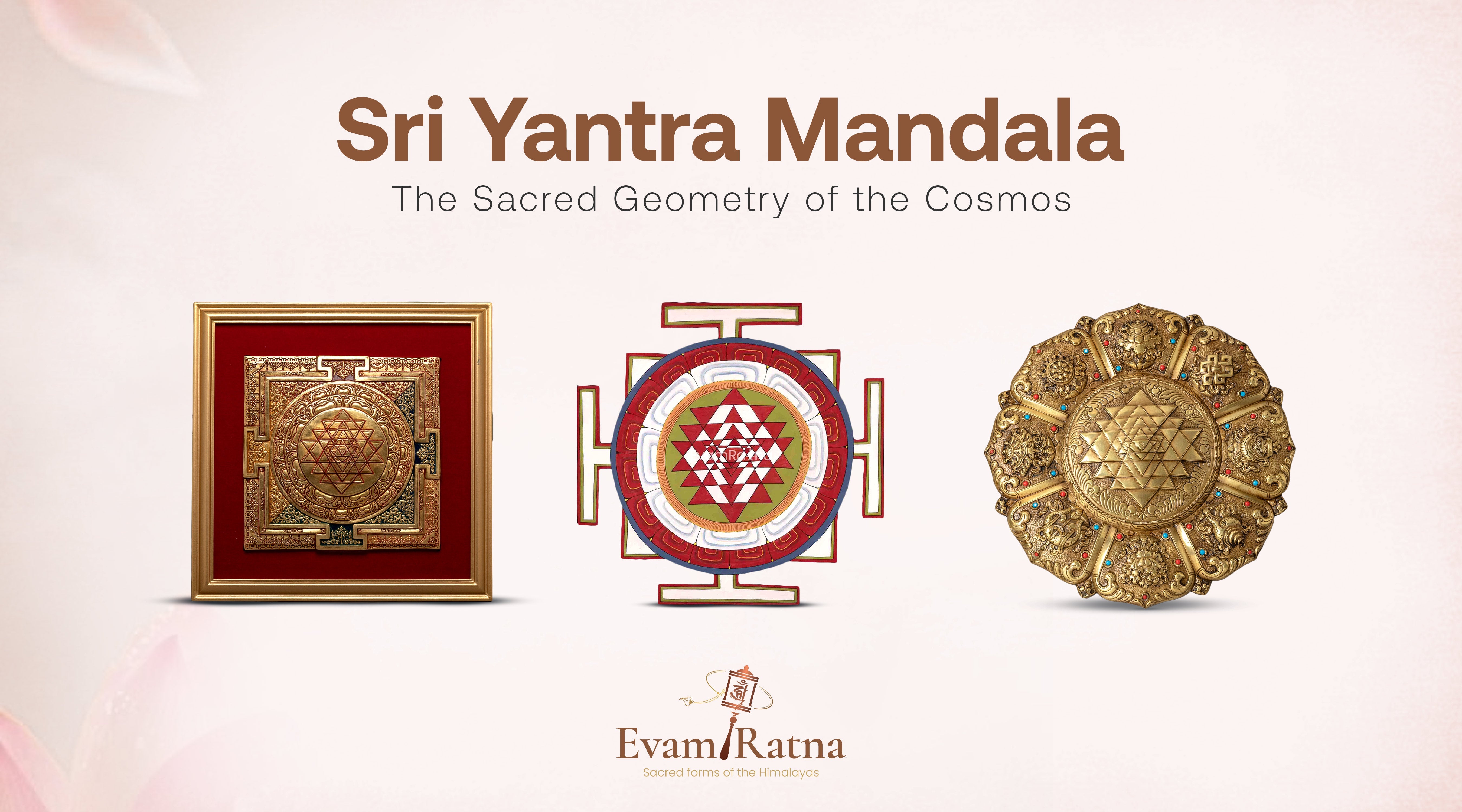
Mother of all Yantras: Nine Interlocking Triangles and the Path to the Divine Feminine
The Sri Yantra is the most revered of all sacred diagrams produced by the Tantric traditions of the Indian subcontinent and the Himalayas. The Sri Yantra Mandala, known as the “mother of all yantras,” is a geometric map of creation and a devotional object that has been guiding meditators, temple priests, tantric and Newar artisans for well over a thousand years. It’s formed of nine interlocking triangles radiating from a single point.
What is a Sri Yantra?

The name itself carries the meaning: Sri is an honorific denoting glory, auspiciousness, beauty, and abundance, and shares the same root as the Goddess Lakshmi and other divine feminine forms. Yantra, derived from the Sanskrit root yam ("to control" or "to support"), refers to a geometric instrument or diagram used to focus and channel spiritual energy. Sri Yantra or Shree Yantra translates roughly to "the sacred or glorious instrument", a tool symbolic and functional, designed to draw the mind of the practitioner toward a specific state of consciousness through contemplation of its form. Known as the "King of Yantras," it is widely used in meditation and Tantric traditions to focus the mind, channel cosmic energy, and manifest abundance.
Origins and Historical Roots
The Sri Yantra's precise origin is difficult to pin to a single date or text, which is itself telling of how deeply it is woven into the shared fabric of Tantric practice across Hindu and, later, Himalayan Buddhist traditions. Its geometric principles appear in the Shri Vidya school of Tantra, a tradition centered on the worship of the Goddess in her form as Tripura Sundari, "the beauty of the three worlds." But sacred geometry rarely respects sectarian boundaries cleanly, especially in a region like the Kathmandu Valley, where Hindu and Buddhist Tantric traditions developed in proximity and mutual influence for centuries.
References to yantra-based worship appear in Tantric texts composed roughly between the sixth and tenth centuries CE. However, oral and ritual traditions describing the Sri Yantra's construction likely predate their first written codification. As Tantric Buddhism absorbed and adapted elements of Hindu Tantra during its spread through Nepal and Tibet, the underlying geometric grammar of the yantra, a point expanding into interlocking triangles, squares, and lotus petals, found parallel expression in Buddhist mandalas, even as the deities and philosophical framings diverged.
A Diagram Shared Across Traditions
As Vajrayana Buddhism absorbed Tantric methods and vocabulary during its development in India and its flowering in Nepal and Tibet, certain geometric principles the use of interlocking triangles, radiating patterns from a central point, layered enclosures representing stages of realization- became part of a shared visual language. The Sri Yantra's structure, in this sense, did not need to be "converted" into a Buddhist symbol to be meaningful within Buddhist practice; its underlying grammar was already legible to a Buddhist eye trained in mandala visualization.
The Sacred Geometry of the Sri Yantra

At the heart of the Sri Yantra's power lies its geometry: nine interlocking triangles, arranged so that four point upward and five point downward, overlapping to create forty-three smaller triangles in total.
The upward-pointing triangles are traditionally associated with Shiva, consciousness, the unmanifest, the witnessing principle. The downward-pointing triangles represent Shakti, energy, manifestation, the dynamic force that gives form to the formless. Their interlocking is a diagram of cosmology, showing how consciousness and energy are never separate but always interpenetrating, each requiring the other to exist. This is what distinguishes the Sri Yantra from ordinary ornamental geometry. Every line has a philosophical referent. The precision required to draw it correctly, historically, was itself considered a spiritual discipline.
Buddhist cosmology and practice have their own deep tradition of sacred geometry, most visibly expressed through the mandala, a circular, symmetrical diagram representing the architecture of the enlightened mind, often centered on a specific deity such as Kalachakra or Chakrasamvara. Like the Sri Yantra, Buddhist mandalas are built from a precise, mathematically governed structure: concentric rings, cardinal gates, a central deity or point representing the fully realized state toward which the practitioner moves.
The Bindu at the Center
At the exact center of the nine triangles sits a single point: the bindu. In Tantric cosmology, the bindu represents the point before creation, the unmanifest totality from which the entire universe of form eventually unfolds. It is simultaneously nothing (dimensionless) and everything (the seed of all triangles, all layers, all manifestation radiating outward from it).
Meditatively, the bindu serves as the focal point of contemplation. A practitioner's gaze, and by extension the mind, is drawn inward through the expanding rings of geometry toward this single point, a visual technique for withdrawing attention from external multiplicity and resting in unified awareness.
The Four Gates and Outer Lotus Petals
Surrounding the triangular core, the complete Sri Yantra is typically enclosed within a series of additional structures: a ring of eight petals, a ring of sixteen petals, and an outer square structure with four gates opening to the cardinal directions.
The lotus petals represent expansion and blossoming, the unfolding of consciousness into the manifest world, layer by layer, much as a lotus opens petal by petal from its center. The four gates of the outer square mark the threshold between the ordinary world and the sacred diagram within. In ritual use, a practitioner symbolically "enters" through these gates, passing from the external world into progressively subtler layers of the yantra until reaching the bindu at its heart.
Shiva and Shakti in the Sri Yantra
It bears repeating, because it is the crux of the diagram's meaning: the Sri Yantra is fundamentally a visual theology of divine union. Shiva and Shakti are not depicted as two separate figures, as they might be in sculpture or painting, but as two categories of triangle, locked in permanent interpenetration.
This is a subtler and, in some respects, a more complete expression of non-duality than an anthropomorphic image can offer. There is no Shiva triangle without a Shakti triangle nearby; the geometry will not resolve without both. In this way, the Sri Yantra teaches through structure rather than narrative, a lesson written in proportion and angle rather than story.
The Sri Yantra in Shri Vidya Tantra
Within Shri Vidya Tantra specifically, the Sri Yantra is the primary object of worship for devotees of Tripura Sundari, one of the ten Mahavidyas, or great wisdom goddesses. Her worship through the yantra, rather than, or alongside, an anthropomorphic murti, reflects a particular theological stance: that the Goddess's truest form may be geometric and abstract rather than figurative.
Ritual worship in this tradition often involves puja performed directly to a physical Sri Yantra, along with the recitation of her thousand names (the Lalita Sahasranama) and structured meditative visualization moving through each layer of the diagram in sequence, from the outer square to the central bindu.
Sri Yantra as a Meditation and Devotional Tool

Beyond formal Shri Vidya ritual, the Sri Yantra has found a much broader devotional and meditative life. Many practitioners today use it as a drishti, a visual point of focus for concentration meditation, placing a Sri Yantra at eye level and allowing the gaze to move gently inward through its layers toward the bindu.
Others keep the Sri Yantra as a home or altar object without formal ritual practice at all, understanding its presence as a quiet reminder of cosmic order, balance, and the underlying unity of opposites. Both approaches honor the diagram's essential purpose: to still and focus the mind through contemplation of sacred form.
Sri Yantra in Newar Buddhist and Hindu Ritual Art
In the Kathmandu Valley, where Hindu and Vajrayana Buddhist traditions have coexisted and cross-pollinated for centuries, the Sri Yantra is crafted with the same reverence and technical mastery Newar artisans bring to statues, thangkas, and ritual vessels. Patan in particular remains a living center of this craftsmanship, where families of metalworkers have passed down the technical knowledge of yantra-making across generations.
This regional continuity matters. A Sri Yantra produced in the Kathmandu Valley is the product of a craftsman trained in a specific lineage of proportion, measurement, geometry, and ritual correctness, often accompanied by consecration practices before the piece leaves the workshop.
How is the Sri Yantra Made?
Traditional Sri Yantras are most commonly rendered in metal, copper, brass, and occasionally silver or gold-plated finishes, chosen both for durability and for the metal's own symbolic and energetic associations within Himalayan ritual art. Copper, for instance, is prized for its associations with purity and its long history in Vedic ritual implements.
The process typically begins with precise mathematical layout: the nine triangles must be constructed according to specific proportional rules, not freehand approximation, since a distorted Sri Yantra is considered incomplete or even inert as a ritual object. Skilled artisans etch or emboss the design into the metal plate, working outward from the central bindu through each triangular layer, the lotus petals, and finally the outer gates and border.
Placement and Use in the Home or Altar

Those incorporating a Sri Yantra into home practice often place it facing east, allowing the practitioner to sit facing the diagram during morning meditation, though placement conventions vary across lineages and personal practice. Many prefer an elevated placement, an altar, shelf, or dedicated niche, rather than a low or cluttered surface, in keeping with the general principle across Himalayan ritual art that sacred objects merit a place of visual and physical prominence.
Some devotional households will pair the Sri Yantra with other ritual implements such as a bell and vajra, mala beads, or a small oil lamp, building a modest altar space centered on daily contemplative practice rather than elaborate ceremony.
Conclusion
The Sri Yantra Mandala remains one of the most powerful sacred geometry symbols in Tantric, Hindu, and Himalayan spiritual traditions. With its nine interlocking triangles, central bindu, lotus petals, and four sacred gates, it represents the union of Shiva and Shakti, consciousness and energy, stillness and creation. More than a decorative object, the Sri Yantra is a spiritual tool for meditation, focus, abundance, and inner awareness. The Sri Yantra Mandala endures because it accomplishes something rare: it expresses a complete cosmology, the union of consciousness and energy, the unfolding of the manifest world from a single unmanifest point, entirely through geometric form, without a single figure or narrative.
For practitioners, collectors, and devotees, a handcrafted Shree Yantra wall hanging brings sacred presence into the home, shrine, or meditation space. Created through precise geometry and traditional Newar metal artistry, it serves as a visual path toward balance, devotion, and the divine feminine. Whether used for daily contemplation, altar placement, or spiritual décor, the Sri Yantra Mandala continues to guide the mind back to the center.