A Complete Guide to Vajra in Detail: Deities Holding Vajra
The vajra is used as a core ritual implement in Vajrayana Buddhism. A vajra fits in the palm, yet it names an entire vehicle of practice, Vajrayana, the Diamond Vehicle. To hold one is to hold a condensed statement of the path itself: reality is indestructible, awakening is sudden and total, and the tools of practice must mirror the nature of the goal they point toward.
Introduction: What is a Vajra?

In Sanskrit, vajra means both "diamond" (indestructibility) and "thunderbolt" (irresistible force). In Tibetan, the vajra is dorje, "lord of stones." In Vajrayana Buddhism, it is a core symbol and sacred ritual tool that represents the adamantine, unchanging, and indestructible nature of enlightenment, often referred to as the "vajra mind."
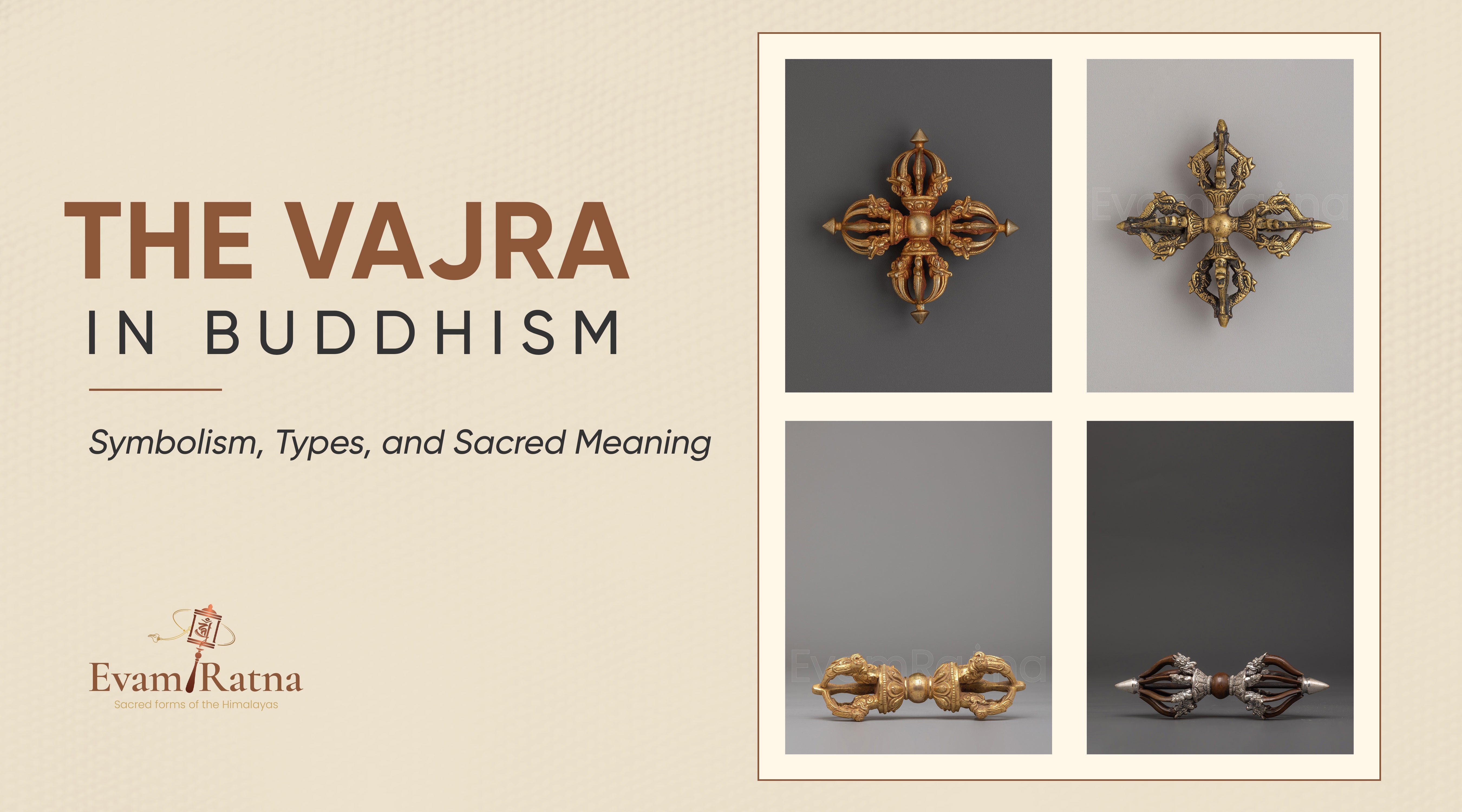
The tool itself is a metallic scepter featuring a central sphere flanked by symmetrically shaped prongs on either side. The number of prongs often varies depending on the specific practice, usually featuring five or nine prongs. Practitioners use it as a powerful visual and physical aid during meditation and consecration ceremonies to invoke the unshakeable power of the Buddhas.
Origins: From Indra's Thunderbolt to Buddha's Diamond
In Vedic mythology, it was the weapon of Indra, king of the gods; it was forged from the indestructible bones of the sage Dadhichi. Dadhichi sacrificed his life for the greater good, willingly offering his spine so the gods could build a weapon powerful enough to defeat the serpent demon Vritra, who had swallowed the cosmic waters and caused a great drought. Armed with this weapon, Indra was able to split the serpent's stomach, release the waters, and restore balance to the heavens.
Buddhist tradition holds that Shakyamuni Buddha took this wrathful weapon and, through compassion, closed its outer prongs inward, transforming a tool of destruction into upaya, skillful means.
Anatomy of the Vajra:

The anatomy of the Vajra in Buddhism reflects deep spiritual symbolism, where every part of its design represents wisdom, protection, purity, and enlightened power. It is a sacred symbol of indestructible awareness and the union of wisdom and compassion.
- Central Axis: The central axis of the Vajra represents the unchanging truth of enlightened wisdom. It runs through the entire form, showing stability, balance, and the direct path toward awakening. Spiritually, it symbolizes the firm center of the awakened mind that cannot be disturbed by ignorance or confusion.
- Central Round Hub: The round hub at the center of the Vajra symbolizes the heart of enlightened reality. It is the meeting point of both sides of the Vajra, representing unity, balance, and the non-dual nature of wisdom and compassion. In ritual meaning, this center reminds practitioners that all enlightened qualities arise from the awakened mind.
- Three Rings: The three rings around the central hub can symbolize the Three Jewels: Buddha, Dharma, and Sangha. They may also represent the purification of body, speech, and mind. These rings show that the Vajra is connected to the complete Buddhist path, guiding practitioners toward protection, discipline, and spiritual realization.
- Eight-Petalled Lotus: The eight-petalled lotus represents purity, spiritual awakening, and the unfolding of enlightened qualities. Just as a lotus rises clean from muddy water, the Vajra reminds practitioners that wisdom can arise from ordinary life and transform confusion into clarity. The eight petals may also connect with the Noble Eightfold Path.
- Makara Head: The Makara head is a mythical protective creature often seen in Himalayan Buddhist art. In the Vajra, it symbolizes protection, strength, and the power to overcome negative forces. The prongs of the Vajra often emerge from the Makara’s mouth, showing enlightened energy being released to destroy ignorance and obstacles.
- Prongs of the Vajra: The curved prongs of the Vajra represent enlightened power returning to unity. In a five-pronged Vajra, the prongs are often connected with the Five Wisdoms and the Five Dhyani Buddhas. They show how negative emotions can be transformed into awakened wisdom through Vajrayana practice.
- Symmetrical Design: The Vajra is usually designed with two identical ends, showing balance and harmony. This symmetry represents the union of opposites: wisdom and compassion, emptiness and form, method and insight. It also reflects the complete and perfect nature of enlightenment.
- Overall Sacred Meaning: The full structure of the Vajra represents the indestructible nature of the awakened mind. Its design teaches that wisdom is stable like a diamond, powerful like a thunderbolt, and compassionate like enlightened action. This is why the Vajra remains one of the most important ritual symbols in Tibetan Buddhism, Vajrayana practice, Buddhist altar rituals, and sacred Himalayan art.
Because the two ends of a vajra are mirror images of one another, a "five-pronged vajra" has five prongs at each pole, ten prongs total, unified around the shared central axis. The symmetry itself is meaningful: the vajra folds outward from a single point in two identical directions, echoing the doctrine that method and wisdom, form and emptiness, are two expressions of one undivided nature rather than opposites in tension.
Sacred Symbolism of the Vajra in Buddhism
- Indestructible Wisdom: The Vajra represents wisdom that cannot be broken by ignorance, illusion, or negative emotions. Like a diamond, it symbolizes purity, strength, and unchanging truth. In Buddhism, ignorance is one of the main causes of suffering, and the Vajra shows the power of awakened wisdom to cut through confusion and reveal the true nature of reality.
- Thunderbolt Power: The Vajra is also understood as a thunderbolt, symbolizing sudden and powerful spiritual energy. Just as lightning cuts through darkness, the Vajra represents the force of enlightenment that removes obstacles, destroys delusion, and awakens clarity in the mind of the practitioner.
- Compassion and Skillful Means: In Vajrayana Buddhism, the Vajra is often linked with method, compassion, and skillful means. It represents enlightened action, the ability to help sentient beings in the right way according to their needs. This shows that true compassion is not passive; it is active, wise, and powerful.
- Union of Wisdom and Compassion: The Vajra is traditionally used together with the bell in Buddhist rituals. The Vajra represents method and compassion, while the bell represents wisdom and emptiness. Together, they symbolize the complete path of enlightenment, where wisdom and compassion are inseparable.
- Enlightened Power and Protection: The Vajra is a symbol of spiritual strength and protection. It is often held by wrathful deities to show their power to remove obstacles, protect the Dharma, and defeat ignorance. This power is not ordinary anger, but enlightened compassion in a fierce and protective form.
- Transformation of Negative Emotions: The Vajra reminds practitioners that negative emotions such as anger, attachment, pride, and ignorance can be transformed into wisdom. In Vajrayana practice, obstacles are not always rejected; they are purified and transformed into the path of awakening.
- Unshakable Nature of Enlightenment: The Vajra also represents the unshakable nature of the awakened mind. It shows stability, fearlessness, and inner strength. For practitioners, it becomes a reminder to remain steady in spiritual practice, even during confusion, suffering, or difficult life situations.
Read More About Vajra vs Double Vajra: Meaning & Divine Bearers
Five-Pronged, Nine-Pronged, and Viswa Vajra
For the full iconographic breakdown, see the dedicated post on open- versus closed-pronged vajras. In short:
Five-Pronged Vajra

The five-pronged vajra is the form most widespread in Tibetan, Newar, and broader Himalayan ritual practice, and the one most collectors and new practitioners encounter first. Each of its five prongs corresponds to one of the Five Dhyani Buddhas, Vairochana, Akshobhya, Ratnasambhava, Amitabha, and Amoghasiddhi, and to the wisdom each one embodies. The central prong, typically the most prominent, is usually read as dharmadhatu wisdom itself, the unifying ground from which the other four differentiate. Because it so directly encodes the mandala of the Five Buddha Families, it is the default implement across most general ritual work.
Nine-Pronged Vajra

The nine-pronged vajra is rarer and belongs to more specific ritual and lineage contexts. Its additional prongs are read, in the Nyingma tradition, as corresponding to the nine yanas, the nine vehicles of the path, culminating in Atiyoga, the Great Perfection, giving the form a connotation of totality, the entire path condensed into a single implement. Because of this association, and because of its established link to Guru Padmasambhava's subjugation of Tibet's obstructing spirits, the nine-pronged form carries a more forceful, wrathful presence and appears more often in higher tantric ritual than in general lay practice.
Viswa Vajra

The Viswa Vajra, or crossed vajra, departs from the bilateral, two-pole structure of the standard vajra entirely. Formed by two vajras crossed at their center points, it produces a four-pronged emblem oriented to the four cardinal directions, expressing totality across space rather than a single vertical axis. It appears as a foundation motif beneath thrones, mandala platforms, and stupa bases, the ground upon which a deity, or the entire mandala, is said to rest, much as Mount Meru is said to rest on a crossed-vajra foundation in traditional cosmological diagrams.
What neither existing post covers in depth is who actually holds these forms, and that's the gap this guide fills.
Read More About Understanding the Two Types of Vajra: Open Prongs and Closed Prongs Vajra
Deities Who Hold the Vajra
The vajra is not the exclusive attribute of one deity. It recurs across the pantheon because it names the vehicle itself. What follows groups the major vajra-bearers by function: peaceful, wrathful, yidam, and dakini, since that grouping tells you more about why each one holds it than a simple alphabetical list would.
Peaceful Vajra-Holders

Click Here To View Our Collection of Sacred Ritual Bell and Vajra Set
Vajrasattva: Purification and the Vajra of Awakened Mind
The purification deity, and the clearest embodiment of the vajra's peaceful register. He holds a five-pronged closed vajra at the heart with the right hand and a bell at the hip with the left, the canonical posture for method-wisdom union. His hundred-syllable mantra makes him the deity most associated with the vajra's cleansing rather than forceful function.
Vajradhara: Primordial Buddha of Vajrayana
The primordial Buddha of the Kagyu and Gelug lineages, shown holding vajra and bell in both hands, crossed at the heart. Where Vajrasattva's vajra points toward purification, Vajradhara's crossed implements point toward totality, the union of method and wisdom as the ground state of buddhahood itself, before any specific activity.
Akshobhya (Mitrugpa): Vajra Family and Mirror-Like Wisdom
One of the Five Dhyani Buddhas and lord of the vajra family specifically, holds the vajra in his left hand while his right touches the earth in bhumisparsha mudra. His wisdom is mirror-like wisdom, the capacity to reflect phenomena exactly as they are, without distortion, and his vajra marks the transformation of anger at its very root into this clarity.
Wrathful Vajra-Holders

Vajrapani: The Supreme Vajra Holder
"Holder of the Vajra," one of the eight great bodhisattvas and the wrathful protector of the Buddha's teachings. Where the peaceful holders cradle the vajra in stillness, Vajrapani wields it aloft, blue-black, flame-wreathed, raw protective force directed against obstruction and delusion rather than turned toward purification.
Guru Rinpoche (Padmasambhava) and Dorje Drollo:
Guru Rinpoche is closely tied to the nine-pronged open vajra, which he used, according to tradition, to subdue the demonic forces obstructing Buddhism's establishment in Tibet. Dorje Drollo, his wrathful emanation, carries this same vajra-power in an even fiercer register, embodying the same subjugating activity in a more explicitly protective form.
Vajrakilaya:
The wrathful deity of the phurba, the three-sided ritual dagger. His entire practice cycle is built around the vajra-dagger as the implement that pins and liberates obstructing forces. The phurba is often crowned with a vajra hilt, fusing vajra and blade into a single implement.
Hayagriva:
The horse-headed wrathful emanation of Amitabha, whose ferocity is often expressed through vajra-related implements in his multiple hands, used to subdue negative forces that resist gentler methods.
Mahakala Forms:
Across the many forms of Mahakala, Four-Armed, Six-Armed, Bernagchen, Sakya, White, and others, the vajra frequently appears among the implements held in their multiple arms, reinforcing their role as protectors whose wrath is itself a form of compassionate activity.
Yidams and Union Deities Holding Vajra and Bell
Chakrasamvara:
A central yidam of the Anuttarayoga tantra class, shown in yab-yum union with his consort Vajravarahi, holding vajra and bell crossed behind her back, the implements doubled across two figures to intensify the method-wisdom union a single deity already expresses alone.
Hevajra:
Another highest yoga tantra yidam, iconographically dense with implements including the vajra, often shown with multiple faces and arms holding kapalas alongside it, the vajra here marking his tantric potency within a wider field of symbolic tools.
Why So Many Deities Share One Implement?
As Vajra symbolizes the perfect balance of wisdom (the ability to cut through ignorance) and compassion (irresistible, unstoppable power), peaceful deities hold the vajra close, at the heart, paired with a bell, expressing purification and stillness. Wrathful deities raise it, brandish it, or fuse it with a blade, expressing forceful, transformative activity. Yidams in union double the implement across two embracing figures to intensify the same method-wisdom statement. And dakinis, even where they don't hold a vajra directly, are named and defined by vajra-nature all the same.
This is the vajra's real function in Vajrayana iconography: not a badge belonging to one deity, but a grammatical marker, like a verb conjugation, that tells you what kind of activity a given deity is engaged in, peaceful or wrathful, individual or in union, the moment you see it in their hand.
The Vajra and Bell: An Inseparable Pair

In Vajrayana Buddhism, the vajra (or dorje) and the bell (or ghanta) form an inseparable ritual pair. They are never used or stored separately, as they conceptually and physically represent the ultimate union needed for enlightenment. The bell (Sanskrit: ghanta; Tibetan: drilbu) is never used alone in formal ritual, and the vajra, likewise, is rarely depicted or handled without it nearby. Their doctrinal pairing method and wisdom, form and emptiness, sound and object, is enacted physically every time a practitioner crosses the vajra over the bell at the heart during a ritual gesture. This is not a symbolic afterthought, but the structural center of tantric ritual grammar: the vajra by itself is only half a statement, which is why nearly every peaceful deity in the roster above is described holding both.
The Vajra in Ritual and Meditation Practice
Beyond deity iconography, the vajra functions as an active ritual tool. In empowerment ceremonies (wang), the officiating lama typically touches the vajra to the crown of the recipient's head as part of transmitting authorization to practice a given deity's sadhana. In daily practice, crossing the vajra and bell at the heart during mantra recitation enacts the method-wisdom union described above, translating doctrine into embodied gesture.
Conclusion:
The vajra is a powerful symbol of indestructible wisdom, spiritual protection, and enlightened activity. From its diamond-like meaning to its thunderbolt power, the Vajra represents the awakened mind that cuts through ignorance and transforms negative emotions into wisdom. Its sacred anatomy, including the central axis, lotus petals, makara heads, and prongs, reflects the deep Vajrayana teaching of balance, purity, strength, and the union of wisdom and compassion.
Peaceful deities hold it as a symbol of purification and an awakened mind, while wrathful deities wield it as a force of protection and obstacle removal. Whether used with the bell in ritual practice, placed on a Buddhist altar, or studied through sacred iconography, the Vajra remains one of the most important symbols in Tibetan Buddhism, Vajrayana practice, and Himalayan Buddhist art.
Frequently Asked Questions
Is a vajra the same as a dorje?
Yes, vajra is the Sanskrit term; dorje is its Tibetan equivalent for the same implement.
Why do some vajras have open prongs and others closed?
The posture signals ritual register: closed, inward-curving prongs mark peaceful practice; open, outward-flaring prongs mark wrathful, subjugating activity.
Does every vajra-holding deity use the same type of vajra?
No. Peaceful deities like Vajrasattva are consistently shown with the five-pronged closed form, while wrathful figures linked to subjugation, such as Guru Rinpoche, are associated with the nine-pronged open form, the deity's function and the implement's form correspond.
What is the difference between a five-pronged and nine-pronged vajra?
The five-pronged (closed) vajra has prongs curving inward and is used in peaceful practice, tied to the Five Dhyani Buddhas. The nine-pronged (open) vajra has prongs flaring outward and is associated with wrathful, subjugating activity and the Nyingma system of nine vehicles.
What is a Viswa Vajra (double vajra)?
It's two vajras crossed at the center, forming a four-pronged emblem oriented to the four directions. It symbolizes structural stability and appears as a foundation motif beneath thrones, mandalas, and stupas.