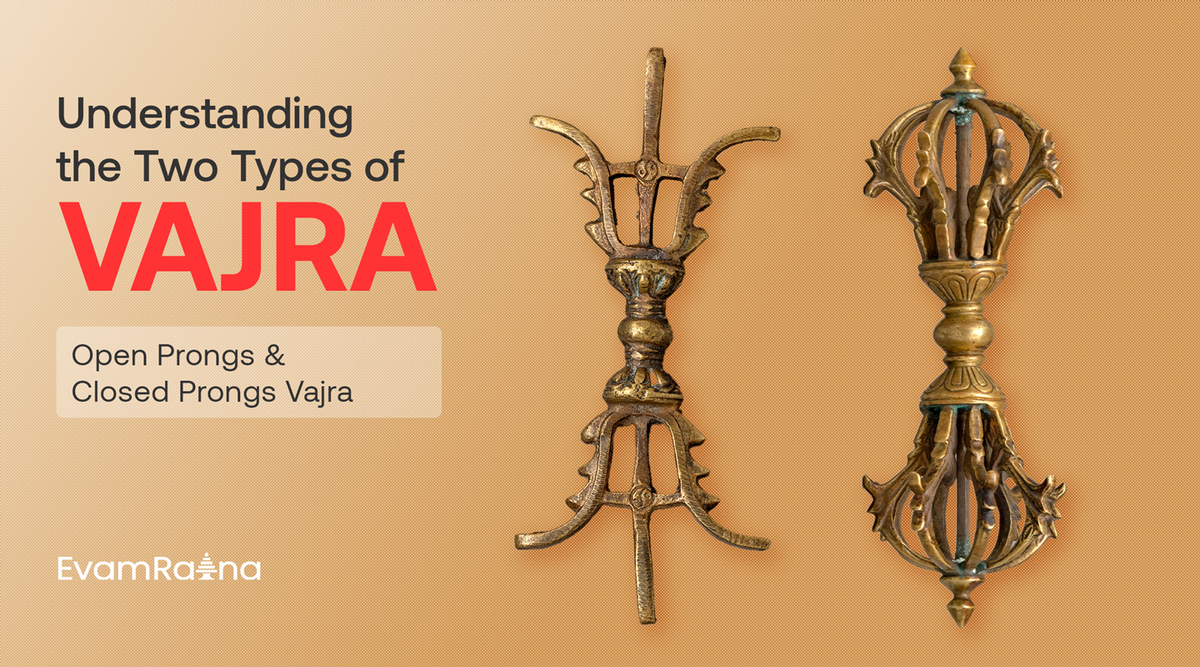
Open Prongs and Closed Prongs Vajra: Meaning, Symbolism, and Differences
The Vajra, known in Tibetan as the Dorje, is an important symbol in Vajrayana Buddhism. It is a sacred key tool used in sermons and ceremonies, as it is one of the main spiritual concepts in the tradition. The term is often translated as "thunderbolt" or "diamond," reflecting both the invincible power of a thunderbolt and the unbreakable quality of a diamond. Vajra, as a ritual implement, symbolizes a mind that is impenetrable, indivisible, and indestructible. It is the representation of the state of light which may reach even the densest layers of ignorance and illusion.
The Vajra comes in various forms, but the difference between open prongs and closed prongs is key to its ritual use and symbolic meaning. These two variations reflect distinct stages on the spiritual path, embodying different energies, peaceful and wrathful, and representing various levels of tantric practice.
The Historical and Mythological Roots of the Vajra

The origins of the Vajra trace back to ancient Vedic traditions, where it was the primary weapon of Indra, the king of the gods. In this early context, it was a terrifying weapon of divine authority used to destroy enemies and maintain cosmic order.
However, Buddhist tradition offers a transformative legend regarding its shape. According to Buddhist lore, Shakyamuni Buddha took the wrathful, open-pronged vajra from Indra and, through the power of his compassion, united the prongs. This act transformed a weapon of destruction into a peaceful Buddhist scepter, which is an embodiment of the transformation of aggression into wisdom and the use of power for the good of all creatures.
In the Buddhist context, the Vajra is never separated from the Bell (Ghanta). When used together in ritual, the Vajra (in the right hand) is used in combination with the Bell (in the left hand) to symbolize the use of skillful methods and compassion (Vajra) and a deep understanding and awareness of emptiness (Bell). Their union symbolizes how wisdom and compassion are perfectly integrated in order to become enlightened.
Closed Prongs Vajra: The Peaceful Scepter

The Closed Prongs Vajra, most commonly seen in the five-pronged (panca-vajra) form, is the standard ritual implement used by practitioners at all levels. In this design, the outer four prongs are curved inwards of the mouths of mythical sea creatures (Makaras) and touch the axial central prong.
Meaning and Symbolism of the Five Prongs
The five prongs on each end of the Vajra carry multiple layers of cosmic and psychological meaning:
- The Five Dhyani Buddhas: They represent the five cosmic Buddhas: Vairocana, Akshobhya, Ratnasambhava, Amitabha, and Amoghasiddhi.
-
The Five Wisdoms: These Buddhas represent the transformation of the "five poisons" (negative mental states) into the five enlightened wisdoms:
- Mirror-Like Wisdom (Akshobhya): Transforms anger and reflects reality clearly without distortion.
- Wisdom of Equality (Ratnasambhava): Transforms pride and sees the inherent Buddha-nature in all beings.
- Discerning Wisdom (Amitabha): Transforms attachment and enables precise understanding of phenomena.
- All-Accomplishing Wisdom (Amoghasiddhi): Transforms jealousy into spontaneous, skillful action.
- Dharmadhatu Wisdom (Vairocana): Transforms ignorance into the realization of the boundless nature of ultimate truth.
- The Five Elements: The prongs also correspond to the elemental forces of earth, water, fire, air, and space.
- Design and Symbolism: The outer prongs in this form are curved inwards, meeting the central prong of the axial, forming a symmetrical and closed form. This design symbolizes the serene side of divine power and self-alteration.
- Ritual Use: Closed-pronged vajras are used by practitioners at all levels for purification and preliminary practices. They are often associated with Vajrasattva, the Bodhisattva of Purification, who is depicted holding a five-pronged closed vajra near his heart to cleanse negative karma.
- Peaceful Energy and Purification: The closed ends of the five-pronged Vajra recognize it as a peaceful implement. It is the main feature of Vajrasattva, the Bodhisattva of Purification, who is frequently presented with the Vajra in his hands, almost against his heart. This Vajra is used by practitioners in initial practices and rituals to remove negative karma and mental obscurations. It is a sort of a compass in balancing the five wisdoms in the mind of the practitioner.
Open Prongs Vajra: The Wrathful Weapon

Click Here To View Our Open Prongs Vajra from EvamRatna
The Open Prongs Vajra, or nava-vajra, is a more complicated and detailed form of the symbol. In this form, the prongs do not curve inward to meet the center; instead, they remain open, often flaring out to form a trident-like shape at the ends.
Meaning and Symbolism of the Nine Prongs
The Open Prongs Vajra represents a culmination of spiritual paths and a deeper level of tantric realization. Its symbolism is particularly tied to the Nyingma (Ancient) school of Tibetan Buddhism:
- The Nine Yanas (Vehicles): The nine prongs represent the nine vehicles of the Buddhist path, the lowest vehicle of which is the sutra vehicle and the highest vehicle is the tantric vehicle of Atiyoga (Dzogchen).
- Cosmic Balance and the Four Mothers: In addition to the five directional Buddhas, the nine prongs represent the Four Mothers (the consorts of the cardinal Buddhas): Lochana, Mamaki, Pandara, and Tara. This signifies the union of male and female energies on a cosmic scale.
- The Center and Eight Directions: It also symbolizes the central axis of reality surrounded by the eight cardinal and ordinal directions.
Wrathful Energy and Advanced Tantric Practice
As the prongs are open, this Vajra retains its original quality as a "wrathful" weapon. It is used to symbolize the destruction of the most stubborn forms of ignorance and anger. It is frequently associated with Guru Padmasambhava (Guru Rinpoche), who used the nine-pronged Vajra to subdue demonic forces and establish Buddhism in Tibet.
This type of Vajra is typically reserved for advanced practitioners and higher tantric rituals involving complex visualizations and the invocation of wrathful deities. While the five-pronged Vajra focuses on personal transformation, the nine-pronged Vajra is concerned with group enlightenment and the realization of non-duality across all phenomena.
Key Structural Differences: A Comparative Overview
 (Image from The Handbook of Tibetan Buddhist Symbols)
To understand the practical and symbolic differences between these two types, we can look at their iconography side-by-side:
|
Feature |
Closed Prongs (5-Pronged) |
Open Prongs (9-Pronged) |
|
Visual Appearance |
Symmetrical, prongs curve inward to touch the center. |
Intricate, prongs flare out like a trident. |
|
Primary Symbolism |
Five Wisdoms, Five Dhyani Buddhas, Five Elements. |
Nine Yanas (Vehicles), Five Buddhas + Four Mothers. |
|
Associated Deities |
Vajrasattva (Purification). |
Guru Padmasambhava (Mastery over all vehicles). |
|
Practitioner Level |
Ideal for beginners and intermediate purification practices. |
Reserved for advanced tantric rituals and esoteric teachings. |
|
Core Lesson |
Cultivating balance, clarity, and compassion. |
Realizing interdependence and the vastness of ultimate reality. |

In Thangkas too, the nine-pronged vajra is depicted with its outer prongs flaring outward, which creates a sharp, trident-like shape at each end. This "open" appearance is a symbolic visual code used to represent the wrathful quality of the implement, signifying its power to destroy stubborn ignorance and anger.
In contrast, the vajra with five prongs is referred to as the Closed Prongs vajra since it is represented in Thangkas with the prongs bending inwards to symmetrically intersect the central axial prong. This "closed" design represents peaceful energy and the transformation of the "five poisons" into the five enlightened wisdoms.
Therefore, even if a physical version of a nine-pronged vajra has prongs that appear more tightly clustered, it is called "Open Prongs" to honor the traditional Thangka style that defines its wrathful nature and differentiates it from the peaceful, closed-ended five-pronged version.
The Crossed Vajra (Vishvavajra): Absolute Stability

Beyond the standard linear Vajra, there is the Crossed Vajra or Vishvavajra, created by two Vajras intersecting at the center. This is the symbol of complete stability and support of the physical and spiritual world.
Vishvavajra is linked to the green Buddha, Amoghasiddhi, and has four karma actions of a Buddha: pacifying, enriching, magnetizing, and destroying. It is repeatedly marked on the thrones of high masters, and is employed to stamp the base of consecrated statues, and all testify the fact that the enlightened mind is indestructible and unchangeable.
Conclusion: Choosing the Path of the Vajra
Regardless of whether one is an adherent of the Closed Prongs or the Open Prongs Vajra, the ultimate objective is similar, which is the realization of Buddhahood through the unity of wisdom and compassion.
The Closed Prongs Vajra serves as a constant reminder to purify the mind, balance the elements of one’s psyche, and transform the "poisons" of the ego into the "wisdoms" of the Buddhas. The Open Prongs Vajra beckons the advanced practitioner to look deeper into the nature of reality, embracing the wrathful power necessary to cut through the most subtle illusions of duality.
The Vajra is not simply a ritual instrument in the hands of a practitioner but is a guide to the spiritual path. It provides power, insight, and indefeasible intelligence needed to change the self and the world. It tells us, as the Lord of Stones, that, as perceptions come and disappear, and we know so little, the possibility of the diamond-like clarity of enlightenment will always be there waiting to be discovered inside each of us.
Read More About Unleashing the Thunderbolt of Enlightenment and Spiritual Power: What is a Vajra?