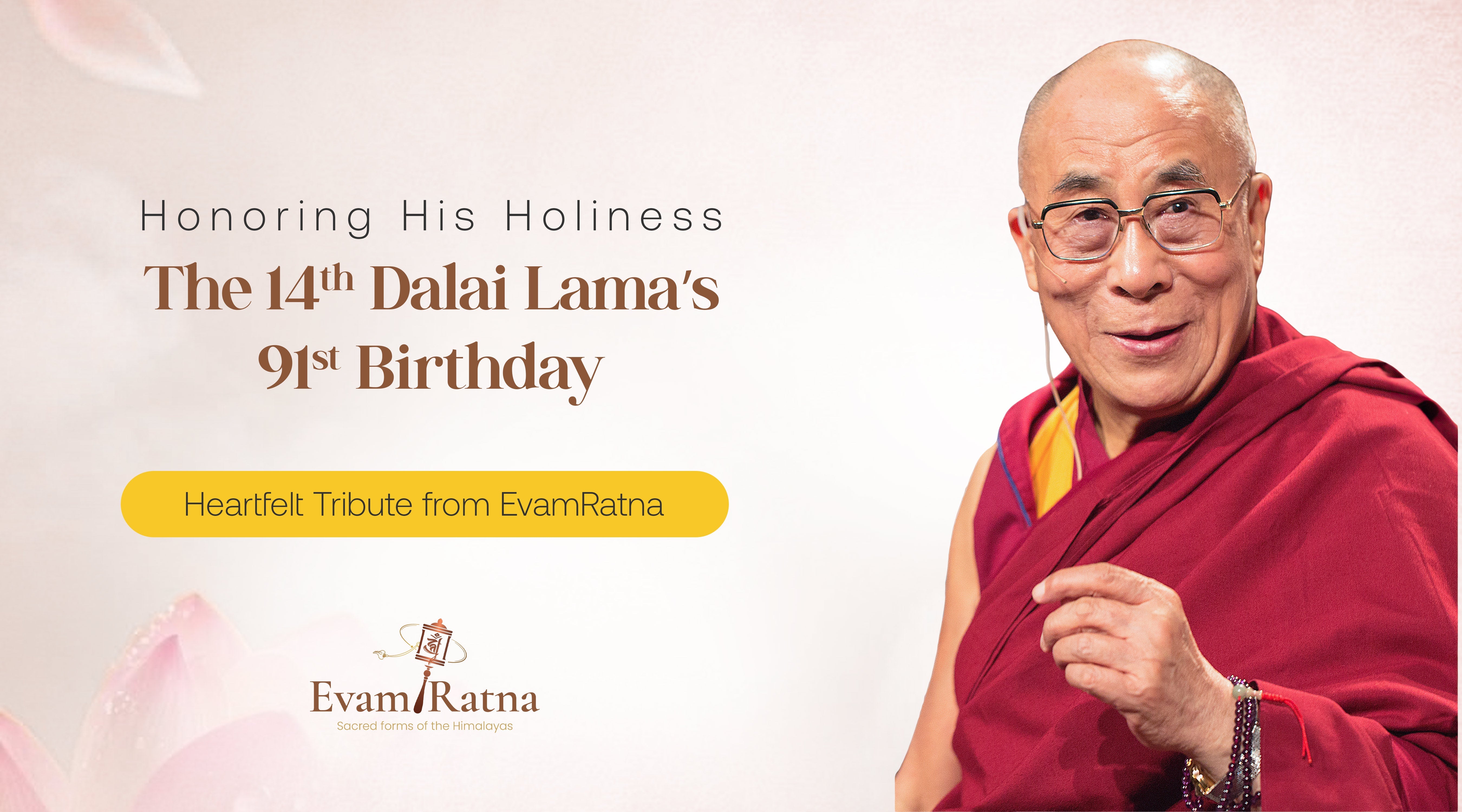
91 Years of Spiritual Leadership and Global Influence: His Legacy and Contributions
On the 6th of July, Buddhist communities across the Himalayas and the wider world, let's pause to honor the 91st birthday of His Holiness the 14th Dalai Lama, Tenzin Gyatso. He turns 91 this year, a milestone that carries weight far beyond the counting of years. For Tibetans, for practitioners of Vajrayana Buddhism, and for millions who have never set foot in a monastery but have still felt the pull of his teachings on kindness, this birthday is a moment to reflect on nine decades of a life lived, quite literally, in service of others, spiritual guidance, and global inspiration. At EvamRatna, we pay tribute to his enduring legacy, celebrating a life devoted to wisdom, compassion, and the fostering of peace and harmony across the world.
The Early Life of the 14th Dalai Lama

The child, Lhamo Thondup, who would become the 14th Dalai Lama, was born on 6th July 1935, in the small village of Taktser in the Amdo region of Tibet, to a family of farmers. He was barely two years old when a search party sent by the Tibetan government arrived at his family's home, carrying with them a collection of objects, rosaries, walking sticks, ritual items, some belonging to the 13th Dalai Lama and some not. According to tradition, the young child correctly identified each item that had belonged to his predecessor, repeating, "It's mine, it's mine."
This act of recognition set in motion a process rooted in centuries of Tibetan Buddhist practice: the identification of a tulku, a reincarnate lama believed to consciously choose rebirth to continue an unfinished spiritual mission. By the age of four, he was enthroned in Lhasa as the spiritual and, in time, temporal leader of Tibet, taking on the name Jetsun Jamphel Ngawang Lobsang Yeshe Tenzin Gyatso. His early education was extraordinary: he studied Buddhist philosophy, logic, Sanskrit, and Tibetan scriptures, preparing not only for spiritual leadership but also to guide an entire nation. These formative years laid the foundation for a life of global influence, studied and respected by monks, scholars, scientists, and world leaders alike.
The Dalai Lama as a Living Emanation of Chenrezig

Dalai Lama is revered as a living emanation of Avalokiteshvara, known in Tibetan as Chenrezig, the Bodhisattva of Compassion. In the Vajrayana understanding, a Bodhisattva is a being who has attained the wisdom and merit necessary for liberation but who chooses, out of boundless compassion, to remain within the cycle of samsara to relieve the suffering of all sentient beings. As Chenrezig is regarded as the very embodiment of this compassionate intention, the deity is most closely associated with the six-syllable mantra Om Mani Padme Hum, recited by devotees across the Himalayan world on prayer wheels, mala beads, and carved stones from Ladakh to Kathmandu.
To call the Dalai Lama a living Bodhisattva is a theological claim that shapes how devotees relate to him, as a continuously renewing presence of compassion itself, returning life after life to guide and console. His own title, Gyalwa Rinpoche, "the Precious Jewel-like Buddha-Master," reflects this same devotional weight. The word "dalai," borrowed from Mongolian, means ocean, an ocean of wisdom, vast and unbroken across incarnations.
Exile and the Preservation of a Civilization

1959 was the most drastic turning point in the Dalai Lama's life. Following the Chinese occupation of Tibet and a failed uprising in Lhasa, the young Dalai Lama, then only 23, had to disguise himself as a soldier and flee his palace in Lhasa under the cover of night. He fled across the Himalayas into India, disguised and traveling by night. He would never again set foot in his homeland.
In Dharamsala, in the foothills of Himachal Pradesh, he established the Central Tibetan Administration, effectively building a government, a school system, and a monastic infrastructure from exile. Tens of thousands of Tibetan refugees followed him into India, Nepal, and beyond, and under his guidance, Tibetan Buddhism, its texts, its lineages, its ritual arts of statuary, thangka painting, and sacred metalwork, were preserved and actively transmitted to a new generation, and eventually to the Western world.
It is difficult to overstate how significant this act of cultural preservation has been. Entire monastic curricula, oral transmissions, and artistic traditions that might have been lost within Tibet were carried out, replanted, and allowed to flourish in exile. The very existence of a global audience for Himalayan Buddhist art and practice today owes a considerable debt to this period of determined rebuilding.
In 2011, in a move consistent with his lifelong emphasis on democratic values, the Dalai Lama formally devolved his political authority to a democratically elected leadership, retaining only his role as spiritual head. It was a rare and deliberate act, a reigning head of state voluntarily dissolving his own temporal power in favor of self-governance for his people.
The Middle Way Approach: A Contribution to Global Peace
Perhaps the most consequential of the Dalai Lama's political contributions has been the Middle Way Approach, a policy he has championed since the 1980s. Rather than pursuing full independence for Tibet, the approach calls for genuine autonomy within the framework of the Chinese state, a negotiated path intended to preserve Tibetan culture, religion, and identity while avoiding further conflict.
This position has not been without its critics, both those who feel it concedes too much and those in Beijing who reject any accommodation at all. Yet it has consistently reflected the Dalai Lama's broader philosophy: that lasting peace cannot be built on resentment or violence, however justified a grievance may feel, and that dialogue, patience, and compassion remain the only sustainable path forward, even in the face of profound injustice.
This same conviction has carried him onto the world stage as a mediator and moral voice far beyond the Tibetan cause itself, a consistent advocate for nonviolence, interfaith harmony, and the idea that ethical behavior need not be tethered to any single religious doctrine, a concept he has termed "secular ethics."
The Dalai Lama’s Role in Bridging Buddhism and Modern Science
Few religious leaders in history have engaged as directly and rigorously with modern science as the Dalai Lama. Beginning in the 1980s, he became a driving force behind the Mind and Life Institute, convening structured dialogues between Buddhist scholars and leading neuroscientists, physicists, and psychologists.
These conversations led to genuine collaborative research, most notably in the study of meditation's effects on the brain, contributing to what is now a substantial body of scientific literature on mindfulness and contemplative neuroscience. The Dalai Lama has often remarked that if scientific investigation were to disprove a claim of Buddhist cosmology, Buddhism should be willing to adapt, a stance of intellectual humility that surprised many outside observers and endeared him further to secular audiences.
Through this work, he has done as much as any single figure to translate contemplative Buddhist practice into a vocabulary accessible to the modern, scientifically literate world, helping practices like meditation move from the margins into mainstream wellness and psychology.
The Nobel Peace Prize and International Recognition

In 1989, the Dalai Lama was awarded the Nobel Peace Prize, in recognition of his consistent advocacy for the peaceful resolution of the Tibet question and his broader message of compassion and nonviolence. The Nobel Committee specifically cited his commitment to nonviolent methods of struggle at a time when many in similar positions might have turned toward armed resistance.
The award transformed him into a truly global figure, one whose moral authority was recognized well outside the boundaries of Buddhist practice. In the decades since, he has been received by heads of state, addressed parliaments, and been the subject of warm, personal birthday greetings from figures as varied as former U.S. presidents, testimony to a reach that few religious leaders in modern history have achieved.
This Year's Celebrations: Ladakh, Recovery, and the Year of Compassion
This year's birthday carries an added layer of significance. It falls near the close of the "Year of Compassion," a year-long observance declared by the Central Tibetan Administration running from July 2025 to July 2026, launched to mark his 90th birthday and to honor his decades of work promoting compassion, interfaith harmony, and the preservation of Tibetan culture and the environment.
Rather than his usual residence in McLeodganj, this year's 91st birthday finds the Dalai Lama in Ladakh, where he has traveled for his customary extended summer stay. Following recent knee surgery in New Delhi, his public schedule has been intentionally lighter this year, with celebrations organized locally by devotees and the Ladakh administration alongside religious and cultural programs. Thousands gathered along the roads to welcome him upon his arrival, offering ceremonial khatags in a display of devotion that transcends any single itinerary or location.
Our EvamRatna Team extends our heartfelt tribute to His Holiness, celebrating a life that continues to inspire millions worldwide. His teachings and tireless work remind us of the power of kindness, patience, and wisdom in transforming lives, communities, and cultures. This celebration is a celebration of his enduring influence on global compassion and spiritual harmony.
Conclusion
The 14th Dalai Lama, Tenzin Gyatso, embodies a living Bodhisattva, dedicating his life to compassion, nonviolence, and the preservation of Tibetan culture. From his early recognition as a tulku to decades of exile, education, and global engagement, he has bridged spiritual practice and secular understanding. His work in promoting the Middle Way, fostering dialogue between Buddhism and modern science, and advocating for peace and ethical responsibility worldwide has made him a universally respected moral leader. Celebrations of his 91st birthday across the Himalayas and the globe honor not only his personal legacy but the enduring inspiration of a life devoted to awakening, service, and the cultivation of universal compassion.
May His Holiness the 14th Dalai Lama’s teachings continue to inspire compassion, wisdom, and peace in our hearts and across the world. On this sacred day, we offer prayers for His Holiness's long life and good health, that his boundless compassion may continue to light the path for all sentient beings for many years to come.