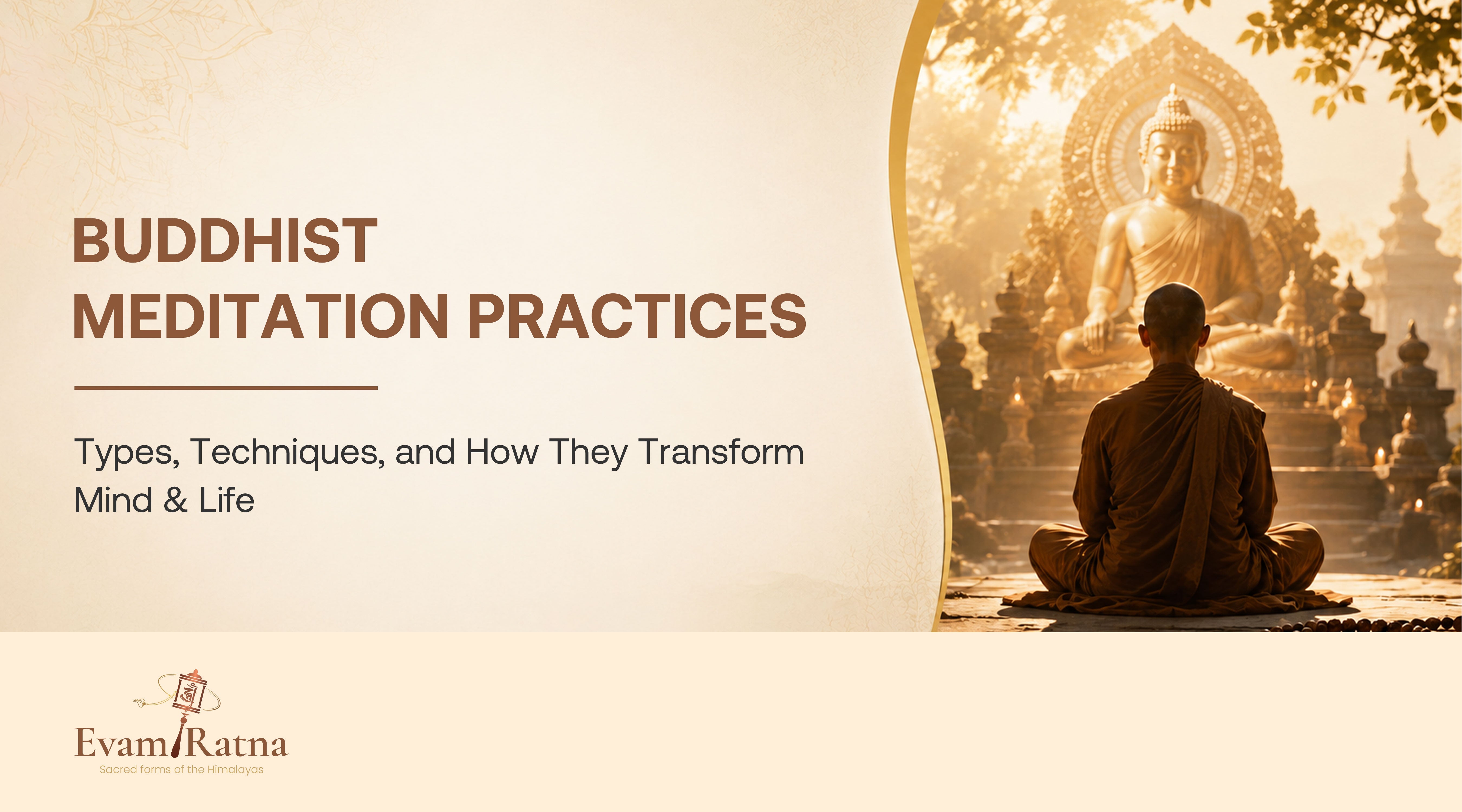
The Complete Guide to Buddhist Meditation Practices and Their Benefits
Meditation is fundamentally the art of transforming the mind. By training your mind, you can shift mental habits, reduce stress, and cultivate deeper emotional stability. In Buddhism, meditation (often referred to as bhavana or "mental development") is a practice for transforming the mind. Its fundamental goal is not simply relaxation but the purification of the mind from negative states such as greed, hatred, and delusion. This ultimately leads to spiritual awakening, the end of suffering, and enlightenment (Nirvana). At its root, Buddhist meditation is the systematic training of the mind toward clarity, ethical purity, and ultimately liberation from suffering.
Understanding the Mind from a Buddhist Perspective

Buddhism does not view suffering as an external problem to be solved by changing circumstances. It locates the root of suffering in the mind itself: specifically, in the three kilesas (mental afflictions), greed (lobha), hatred (dosa), and delusion (moha). These are habitual patterns to be seen clearly and released. The untrained mind, in Buddhist thought, is like a monkey swinging from branch to branch, reactive, distracted, driven by craving and aversion, generating suffering out of ignorance. It does not see things as they are (yathabhutaṃ).
It superimposes permanence onto what is impermanent, selfhood onto what is selfless, satisfaction onto what is ultimately unsatisfying. Meditation is the training that reverses this. Through sustained practice, the mind is first stabilized, then clarified, and finally turned toward direct insight into the nature of experience. The Pali word for mind-cultivation is bhavana, literally "bringing into being" or "development." What is developed is not a new self, but the natural luminosity that was always already present beneath the noise.
This is why meditation cannot be separated from Buddhist ethics (sila) and wisdom (prajna). The three trainings are a single integrated path: ethical behavior calms the restless mind, meditation quiets what remains, and wisdom removes the root of delusion.
The Two Pillars: Samatha and Vipassana

All Buddhist meditation, across all traditions, can be understood through two foundational categories: Samatha (calm-abiding) and Vipassana (insight). These are not competing schools but complementary dimensions of practice that the tradition has always held together.
- Samatha from the Pali sama, meaning "peace," refers to practices aimed at tranquilizing and unifying the mind. The meditator focuses attention on a single object (the breath, a colored disk, a mantra, a visualization) and repeatedly returns the wandering mind to that object. Through sustained practice, the mind grows progressively calmer, more unified, and less reactive. The classical texts describe a series of deepening states called jhānas (Sanskrit: dhyānas), states of meditative absorption marked by increasing stillness, joy, and equanimity. Samatha is the stabilizing foundation without which insight cannot take root.
- Vipassana from vi (special, clear) + passana (seeing, refers to the direct investigation of experience as it arises. Rather than holding the mind on a fixed object, Vipassana practice opens the field of awareness to whatever is present: sensations, thoughts, emotions, perceptions, and examines their characteristics with precise, non-reactive attention. What the meditator discovers, again and again, is that all phenomena share three marks: impermanence (anicca), unsatisfactoriness (dukkha), and the absence of a fixed self (anatta). This seeing is not intellectual but experiential. It dismantles, at the root, the delusions that generate suffering.
The relationship between the two is famously debated across Buddhist history. The Theravada tradition generally teaches Samatha as the preliminary and Vipassanā as the liberating insight practice, though some Theravāda lineages teach "bare insight" (sukkha-vipassanā) without deep Samatha. The Tibetan tradition's Mahāmudrā and Dzogchen path speaks of Śamatha and Vipaśyanā as ultimately unified in the recognition of the nature of mind itself. Zen collapses the distinction through practices like shikantaza (just sitting) in which stillness and insight are not sequential but simultaneous.
Whatever the tradition, both dimensions are honored. The mind that is not calm cannot see clearly. The mind that is calm but without insight has not yet awakened.
Core Buddhist Meditation Techniques
1. Anapanasati: Mindfulness of Breathing
Anapanasati is the most universally practiced meditation in Buddhist history, grounded in the Buddha's own discourse, the Ānāpānasati Sutta (MN 118). The Sutta describes sixteen progressive stages, moving from basic breath awareness all the way to the contemplation of impermanence and cessation. The breath is a doorway into the entirety of the Dhamma, requiring no ritual, no equipment, and no special setting, only the willingness to return, again and again, to what is already here.
The practice is straightforward: sit in a stable posture, direct attention to the natural sensation of breathing at the nostrils, upper lip, or abdomen, and when the mind wanders, gently return without judgment.
2. Metta Bhavana: Loving-Kindness Meditation
Where breath meditation trains attention, Mettā Bhāvanā trains the heart. Metta, often translated as loving-kindness, is more precisely the sincere, unconditional wish for all beings to be happy and free from suffering. The practice moves outward in expanding circles: beginning with oneself, then a dear friend, a neutral person, a difficult person, and finally all beings without exception. Repeated with phrases such as May you be happy. May you be safe. May you live with ease, this practice is one of the four Brahmavihāras (Divine Abodes) alongside compassion, sympathetic joy, and equanimity. Cultivated fully, Mettā is said to dissolve the boundaries of self and other like a flame spreading without limit.
3. Vipassanā: Insight Meditation
Vipassanā is the direct, moment-to-moment observation of experience as it arises and passes: sensations, thoughts, emotions, perceptions, examined with precise, non-reactive attention. The goal is not relaxation but direct seeing: the lived recognition that all phenomena are impermanent, that none of it is truly "mine," and that the sense of a stable, fixed self is itself just another arising. As this seeing deepens, the emotional grip of craving and aversion loosens, not through suppression, but through clarity. In the Theravāda framework, sustained Vipassanā practice leads through the four stages of awakening toward full liberation. In the modern world, teachers like Mahāsi Sayādaw and S. N. Goenka have carried this practice to millions through intensive ten-day silent retreats.
4. Zazen: Zen Sitting Meditation
In the Japanese Zen tradition, meditation is zazen, seated Zen, and the posture itself is inseparable from the practice. Spine upright, hands in the cosmic mudra, eyes half-open: this is not preparation for meditation but meditation itself. The Sōtō school teaches shikantaza, "just sitting", with no technique, no goal, no object; simply full, alert presence with whatever arises. The Rinzai school works with kōan, paradoxical questions like "What is the sound of one hand clapping?", that exhaust conceptual thought until a breakthrough of direct insight (kenshō) occurs. Both share the same insistence: enlightenment is not distant or future. It is here, in this very moment of sitting.
5. Vajrayana Visualization and Deity Practice
Vajrayāna Buddhism, the tradition of Tibet, Nepal, and the Himalayan world, approaches meditation through sacred complexity rather than simplicity. Rather than emptying the mind, the practitioner fills it with precise, consecrated content: visualizing themselves as a deity (yidam) such as Chenrezig or Tārā, reciting mantra, performing mudra, and dissolving the entire visualization back into emptiness. The logic is profound, if all appearances are mind, then training the mind to perceive itself as the already-pure deity is not fantasy but recognition. This is why sacred statues, thangkas, and ritual objects are inseparable from Vajrayāna practice: a Chenrezig statue is a visualization support, a reminder of one's own Buddha-nature. The foundation for all such practice is ngöndro, 100,000 each of prostrations, Vajrasattva mantras, mandala offerings, and Guru Yoga repetitions, purifying the ground before the higher practices are entered.
6. Tonglen: Taking and Sending
Tonglen, "giving and taking" in Tibetan, is a Mahāyāna and Vajrayāna practice of radical compassion that directly reverses the ego's habitual self-protective logic. The practitioner visualizes the suffering of another being, illness, grief, fear, as dark smoke, breathes it in, and breathes out light, ease, and happiness. Extended practice opens this exchange to all beings everywhere. Associated in the modern world with Chögyam Trungpa Rinpoche and Pema Chödrön, Tonglen is not a masochistic exercise but a training in fearlessness, the gradual dismantling of the self-concern that isolates us from shared human experience. Practitioners consistently report it as one of the most immediately effective practices for dissolving the sense of personal isolation that underlies both depression and anxiety.
The Role of Meditation Objects and Sacred Tools

Buddhist meditation has always been supported by physical objects that anchor, inspire, and concentrate the practitioner's mind and devotion. These are not mere decorations but active participants in the practice.
Statues and rupas: images of the Buddha, bodhisattvas, and yidams serve as visualization supports and as reminders of the qualities the practitioner is cultivating. When one bows before a Chenrezig, one is bowing to the compassion one is developing in oneself. The statue externalizes an inner possibility.
Thangkas: Tibetan scroll paintings depicting deities, mandalas, and lineage masters — are the living textbooks of Vajrayāna visualization practice. Each figure's color, posture, implements, and ornaments encode precise teachings. Meditating before a Wheel of Life thangka, for example, brings the Buddhist understanding of conditioned existence into sharp, vivid focus.
Malas: prayer beads, typically 108 in number, count mantra repetitions, training the mind in rhythmic sustained attention. The texture of the beads, the movement of the fingers, and the sound of the mantra create a multi-sensory environment for practice.
Vajras, bells, and ritual implements: in Vajrayāna practice, these are not symbolic ornaments but active ritual technologies. The vajra held in the right hand represents skillful means (upāya) and indestructible reality; the bell in the left represents wisdom (prajñā); together they enact the inseparability of wisdom and compassion that is the heart of Mahāyāna aspiration.
Butter lamps and incense: the offering of light and fragrance is itself a meditation on generosity (dāna) and the purity of perception. In many Himalayan traditions, lighting a butter lamp before practice is not perfunctory ritual but a conscious act of dedication, burning away the darkness of ignorance.
How Does Buddhist Meditation Help?
Buddhist meditation was practiced for liberation. But twenty-five centuries of accumulated wisdom, now augmented by decades of neuroscientific research, reveals that its benefits operate at every level: mental, emotional, physical, relational, and spiritual.
Mind & Psychology benefits
- Reduces Stress and Anxiety: The most widespread benefit of mindfulness-based meditation (largely derived from Buddhist Vipassanā) is a significant reduction in perceived stress and clinical anxiety. The mechanism is well understood: sustained present-moment attention interrupts rumination loops and catastrophic thinking; the practitioner learns directly that thoughts are not facts and feelings arise and pass.
- Improves Attention and Concentration: Repeatedly returning the mind to a chosen object, breath, mantra, or visualization strengthens neural circuits, enhancing sustained focus, measurably reducing mind-wandering over time.
- Enhances Emotional Regulation: Mettā and the other Brahmavihāra practices cultivate positive emotional states through active cultivation rather than passive waiting. Research on loving-kindness meditation shows increased positive affect, reduced implicit bias, and greater compassion toward self and others. Tonglen practice specifically develops the capacity to tolerate difficult emotional material without being overwhelmed by it.
- Relieves Depression: Mindfulness-Based Cognitive Therapy (MBCT), which adapts Vipassanā practices for clinical settings, has been shown in multiple randomized controlled trials to significantly reduce relapse rates in recurrent major depression. For those with three or more previous depressive episodes, MBCT is now recommended by the UK's National Institute for Health and Care Excellence (NICE) as an evidence-based intervention.
- Builds Psychological Resilience: Long-term meditators consistently show greater equanimity in the face of life's challenges, as they have developed the capacity to meet difficulty without being swept away by reactivity. This is the practical fruit of Vipassanā insight: having seen impermanence in thousands of small moments of practice, one is less undone by the large moments of loss and change that life inevitably brings.
Physical Benefits
The mind-body connection that Buddhist practice presupposes is now extensively documented in physiological research.
- Reduces Inflammation: Studies comparing meditators with non-meditators show lower levels of inflammatory cytokines, biological markers associated with stress, depression, and a range of chronic diseases. The hypothesis is that meditation's stress-reduction effects translate into reduced activation of the body's inflammatory stress-response systems.
- Strengthens Immune Function: A landmark study by Davidson and colleagues showed that participants in an eight-week mindfulness program produced measurably increased antibody response to an influenza vaccine alongside greater positive-affect brain activation.
- Improves Cardiovascular Health: Multiple meta-analyses have found that regular meditation is linked to reduced blood pressure, lower heart rate reactivity to stress, and improved heart rate variability.
- Manages Pain: Buddhist meditation has profound implications for the relationship with pain. Vipassanā reveals the gap between raw sensation and the psychological suffering built around it; meditators feel the same pain intensity but suffer it significantly less.
- Neurological Changes: Long-term practice increases cortical thickness in attention and interoception regions and reduces amygdala reactivity; the brain can be trained, and Buddhist practice has been doing it for millennia.
Conclusion
Buddhist meditation transforms the mind, integrating ethics, concentration, and insight. Practices like Samatha, Vipassana, Metta, Tonglen, and Vajrayana visualization cultivate clarity, emotional balance, and compassion, addressing the root of suffering in greed, hatred, and delusion. Beyond relaxation, these practices strengthen attention, resilience, and well-being, offering a path toward awakening and the direct experience of impermanence, selflessness, and interconnectedness. Beyond mental benefits, reducing stress, anxiety, depression, and rumination, these practices positively impact physical health: strengthening the immune system, reducing inflammation, improving cardiovascular function, and managing pain. By stabilizing the mind and fostering awareness, meditation supports holistic well-being and guides practitioners toward awakening, direct insight, and liberation from suffering.