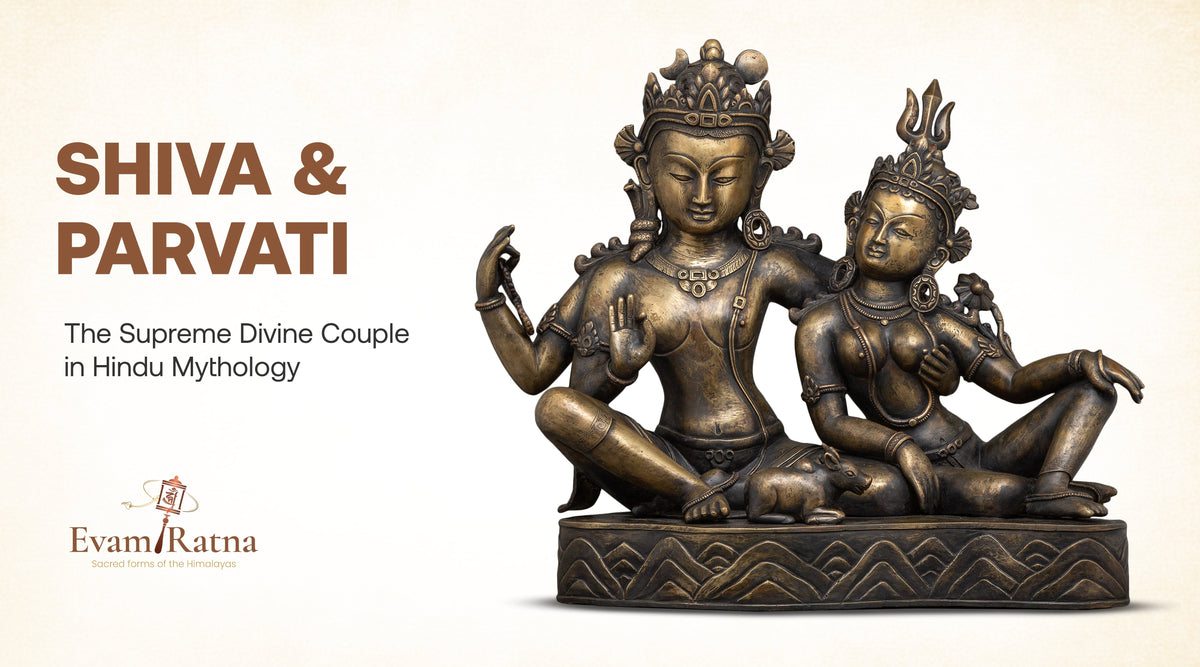
Shiva and Parvati as Purusha and Prakriti: The Cosmic Union Behind All Creation
Shiva and Parvati are such an ancient and deep union, such a philosophically rooted one, and so tenderly alive a union that in the vast and luminous landscape of Hindu mythology, there is no other union quite like it. They are the supreme divine couple, the Lord of Kailash and the Daughter of the Himalayas, whose sacred marriage is not only a story from the Puranas, but a reality that permeates the entire universe, a truth that is lived. Lord Shiva is a great ascetic and destroyer, and Goddess Parvati, the embodiment of Shakti and the mother of the universe, together form the axis around which Hindu devotion, sacred art, and tantric philosophy have turned for millennia. To know Shiva and Parvati is to know something about the nature of love itself, love not as sentiment or emotion, but as the very force that holds the cosmos together.
Lord Shiva: The Adi Yogi and Mahadeva

Shiva is a central deity in the Hindu tradition, revered as the supreme being within Shaivism. His names alone reveal the breadth of his nature: Mahadeva (the Great God), Maheshvara (the Great Lord), Shankar (the Auspicious One), Nataraja (Lord of the Cosmic Dance), Pashupatinath (Lord of All Creatures), and Adi Yogi (the First Yogi).
Recognized as the destroyer in the Hindu Trimurti alongside Creator Brahma and Preserver Vishnu, Shiva embodies the three modes of creation, preservation, and dissolution. In Kashmir Shaivism and Shaiva Siddhanta, he transcends the divine trinity to be identified as Paramashiva, the absolute consciousness from which all existence arises. Recognized as the destroyer in the Hindu Trimurti alongside Creator Brahma and Preserver Vishnu, Shiva embodies the three modes of creation, preservation, and dissolution. In Kashmir Shaivism and Shaiva Siddhanta, he transcends the divine trinity to be identified as Paramashiva, the absolute consciousness from which all existence arises. A serpent coils around his neck. He smears himself with the ash of cremation grounds. He dances the Tandava, the great cosmic dance through which the universe is both sustained and eventually dissolved.
His complex iconography features significant symbols: the third eye represents transcendent wisdom; the trident (trishula) signifies mastery over the three worlds; the damaru signifies the primordial sound of creation; and the crescent moon symbolizes the cycles of existence. Additionally, the Ganges River flowing from his hair accentuates his role as the source of purification. In Nepal, Shiva is venerated as Pashupatinath, the "Lord of all living beings" or "protector of animals", with a prominent temple on the Bagmati River, which is one of the most sacred Shaivite sites. For many Hindus, Pashupati embodies a protective presence in their lives, imparting a sense of divine guardianship over their families and communities.
Goddess Parvati: Daughter of the Himalayas, Mother of the Universe

Parvati's name means "daughter of the mountain", from the Sanskrit parvata, meaning mountain. She is the daughter of Himavat (the god of the Himalayan mountains) and his wife Mena, and she is, in the deepest sense, the daughter of the earth itself, elemental, enduring, capable of both absolute stillness and overwhelming force.
In the Shakta tradition, Parvati is the supreme goddess and one of the three principal manifestations of the divine feminine, alongside Lakshmi and Saraswati. While Lakshmi symbolizes prosperity and Saraswati signifies knowledge, Parvati embodies power as the living energy of the cosmos, recognized as Shakti, the primordial feminine force in Tantric philosophy.
Her names, like Shiva's, reveal the full spectrum of her being. As Uma, she is the gentle, luminous maiden. As Gauri, she is the radiant golden goddess. As Ambika, she is the universal mother. As Durga, she is the fierce warrior who rides a lion and defeats cosmic evil. As Kali, she is the terrifying mother who dissolves time and ego in a dance of liberation. As Annapurna, she is the goddess of nourishment who fills the rice bowls of the world. All of these are Parvati, different facets of the one Goddess, just as a diamond reveals different colors depending on how the light falls.
Theologically, Parvati represents Prakriti, or primordial nature, signifying the manifest world and dynamic existence. Her relationship with Shiva illustrates the unity of consciousness (Shiva) and energy (Parvati), emphasizing their eternal companionship and the interplay that forms the visible universe. In regions like the Himalayas and particularly Nepal, Parvati is treated as a tangible presence rather than a mere abstraction. She is venerated in various forms throughout the Kathmandu Valley, witnessed in the Kumari tradition, during festivals like Teej, where women pray for their husbands’ well-being, and in daily worship at temples and home shrines.
The Tale of Reincarnation and the Awakening: From Sati to Sacred Reunion

To understand Parvati fully, one must begin with Sati, because Parvati is Sati, reborn.
Sati was the daughter of Daksha, a powerful and proud lord of creation. She fell in love with Shiva against her father's wishes. Daksha despised Shiva; he saw the great yogi's matted locks, his ash-covered body, his associations with cremation grounds and outcasts as signs of impropriety, not divinity. But Sati's devotion to Shiva was absolute. She married him and lived on Kailash in a state of profound conjugal bliss.
The tragedy unfolded when Daksha organized a great yajna (sacred fire ritual) and deliberately excluded Shiva. Sati, humiliated by her father's insult to her husband, could not bear the dishonor. In an act of supreme protest and supreme surrender, she immolated herself in the sacred fire of the yajna. When Shiva learned of Sati's death, his grief was so vast it shook the cosmos. He retrieved her body and wandered the three worlds in anguished mourning, carrying her corpse upon his shoulders. The universe fell out of balance; creation itself trembled. To restore cosmic equilibrium, Lord Vishnu followed Shiva and used his Sudarshana Chakra to dismember Sati's body as Shiva carried it. The places where her body parts fell to earth became the Shakti Peethas, the fifty-one sacred seats of the goddess scattered across the Indian subcontinent, each one a place of tremendous spiritual power.
Shiva, bereft of his beloved, retreated into the deepest ascetic withdrawal, sitting in unchanging meditation on Mount Kailash, consumed by stillness and grief. Sati was reborn as Parvati of the Himalayas. And from childhood, she remembered. She remembered Kailash, remembered Shiva, remembered their love. Her father, Himavat, unlike Daksha, recognized the greatness of Shdaughter iva and blessed his daughter's devotion. But Shiva would not be easily won. Lost in meditation, he had no interest in the world, in love, in marriage. He had no need. Parvati, however, was patient in a way that only someone who has waited across lifetimes can be. She took up residence near Shiva's meditation spot on Kailash and began to serve him, bringing him flowers, water, and offerings, with no expectation of return, only love.
Their wedding on Mount Kailash is described in the texts as the marriage of heaven and earth, witnessed by all the gods, all the sages, all the celestial beings. It was not merely a personal union but a cosmic restoration.
Shiva and Parvati as Ardhanarishvara: Two Become One

Among the most significant images in Hindu iconography is Ardhanarishvara, representing Shiva and Parvati as a united form, Shiva's right side embodying masculine traits and Parvati's left side reflecting feminine qualities. This image, prevalent in Indian and Nepalese art, serves as both a theological statement and a meditative visual. It teaches that masculine and feminine principles are not opposites but rather complementary aspects of a singular reality. This unity suggests that creation stems from their apparent duality, while liberation is achieved through recognizing their oneness.
In Tantric philosophy, Ardhanarishvara illustrates the dissolution of boundaries between subject and object, urging practitioners to transcend distinctions between self and world. More than an artistic piece, it functions as a yantra for meditation. Furthermore, it emphasizes the importance of the divine feminine, the assertion that Parvati is an equal, essential force in the divine equation, underscoring that Shiva requires her for completeness.
In the Himalayan context, the teachings of Ardhanarishvara resonate within both Hindu and Buddhist Tantric traditions. The theme of non-duality is echoed in Vajrayana Buddhism's Yab-Yum iconography, symbolizing the union of skillful means and wisdom. Despite differing philosophies, both traditions converge on the same profound truth of unity.
The Many Forms of Shiva and Parvati Together

The divine couple appears in sacred art in several distinct iconographic forms, each carrying its own emphasis and its own grace.
Each of these forms invites a different quality of meditation and a different relationship with the divine couple's teaching.
Shiva and Parvati in the Himalayan and Newar Traditions
Nepal occupies a unique position in the devotion to Shiva and Parvati. The Himalayas themselves are Parvati's father and her domain. Kailash, Shiva's eternal abode, rises in western Tibet not far from Nepal's northern reaches. Pashupatinath, one of Shiva's most ancient and sacred forms, is the protective deity of the Kathmandu Valley. The valley's founding myths in the Nepal Mahatmya and related texts describe it as a sacred lake drained by divine intervention to become a homeland for human devotion, with Shiva and the goddess present from the beginning.
Newar people are the indigenous people of Kathmandu Valley who have one of the most rich tradition of sacred art and architecture in worshipping both Hindu and Buddhist deities. Newar tradition has intentionally and beautifully blurred the lines between Shaivism, Shaktism, and Vajrayana Buddhism. Parvati appears in some Newar contexts alongside or blending with Buddhist goddess figures. Shiva appears in forms that carry echoes of Vajra Heruka or Mahakala. The Newar tantric tradition understands the male-female divine pair as a universal symbol accessible through both Hindu and Buddhist theological vocabularies.
Symbols and Sacred Objects Associated with the Divine Couple
Devotion to Shiva and Parvati has generated a rich material culture of sacred symbols and ritual objects, each carrying layers of meaning.
- Central to this tradition is the Shivalinga, an ancient symbol representing the union of Shiva and Parvati. This smooth, rounded pillar is set within a circular base known as the yoni or pitha, symbolizing Parvati, and is worshipped daily across the Hindu world with offerings such as water, milk, bilva leaves, and flowers. The Pashupatinath jyotirlinga in Nepal is recognized as the most sacred Shivalinga.
- Another vital symbol is the trishula, or trident, which serves as Shiva's primary weapon, symbolizing his control over the three planes of existence, the three gunas (qualities of nature), and the three aspects of time. The trishula also connects to Parvati in various iconographic traditions.
- The damaru, a small hourglass drum, embodies the primordial sound, the nada bindu, from which all of reality, including the Sanskrit language, is said to arise. Its two-headed form reflects the Ardhanarishvara principle of duality joined in silence.
- Rudraksha beads, sacred seeds from the Elaeocarpus ganitrus tree, are worn by Shiva and devotees, symbolizing compassion derived from Shiva's tears during his meditative penance. Parvati, too, is linked to these beads in multiple traditions.
- Bilva leaves, with their three-lobed shape representing the trishula, are considered Shiva's most cherished offering, especially during Mahashivaratri and Monday worship.
- The conch, or shankha, is revered in many Shaivite practices and symbolizes the sacred sound associated with cosmic creative energy.
Conclusion
Shiva and Parvati exemplify the eternal union of consciousness and energy, Purusha and Prakriti. Their stories, forms, and symbolism offer profound insights into the cosmic balance that sustains creation. From Ardhanarishvara to Uma-Maheshvara, their divine interplay is reflected in sacred art, ritual objects, and the devotional practices of the Himalayas and beyond. Understanding their union invites meditation on the interconnectedness of all life, the harmony of masculine and feminine forces, and the spiritual lessons embedded in myth, iconography, and daily worship.