The Meaning of Mahakala in Buddhist Art, Ritual, and Spiritual Practice
Mahakala is one of the most powerful and revered protector deities in Vajrayana Buddhism, representing the wrathful manifestation of enlightened compassion and wisdom. His name comes from Sanskrit, where “Maha” means great and “Kala” means time or blackness, often interpreted as “Great Black One” or “Great Time.” Unlike ordinary wrathful beings, Mahakala’s fierce appearance symbolizes the forceful removal of ignorance, obstacles, negative emotions, and spiritual hindrances that prevent beings from achieving liberation.
Mahakala in Buddhist Art

Click Here To View Our Collection of Mahakala Bernagchen Statues
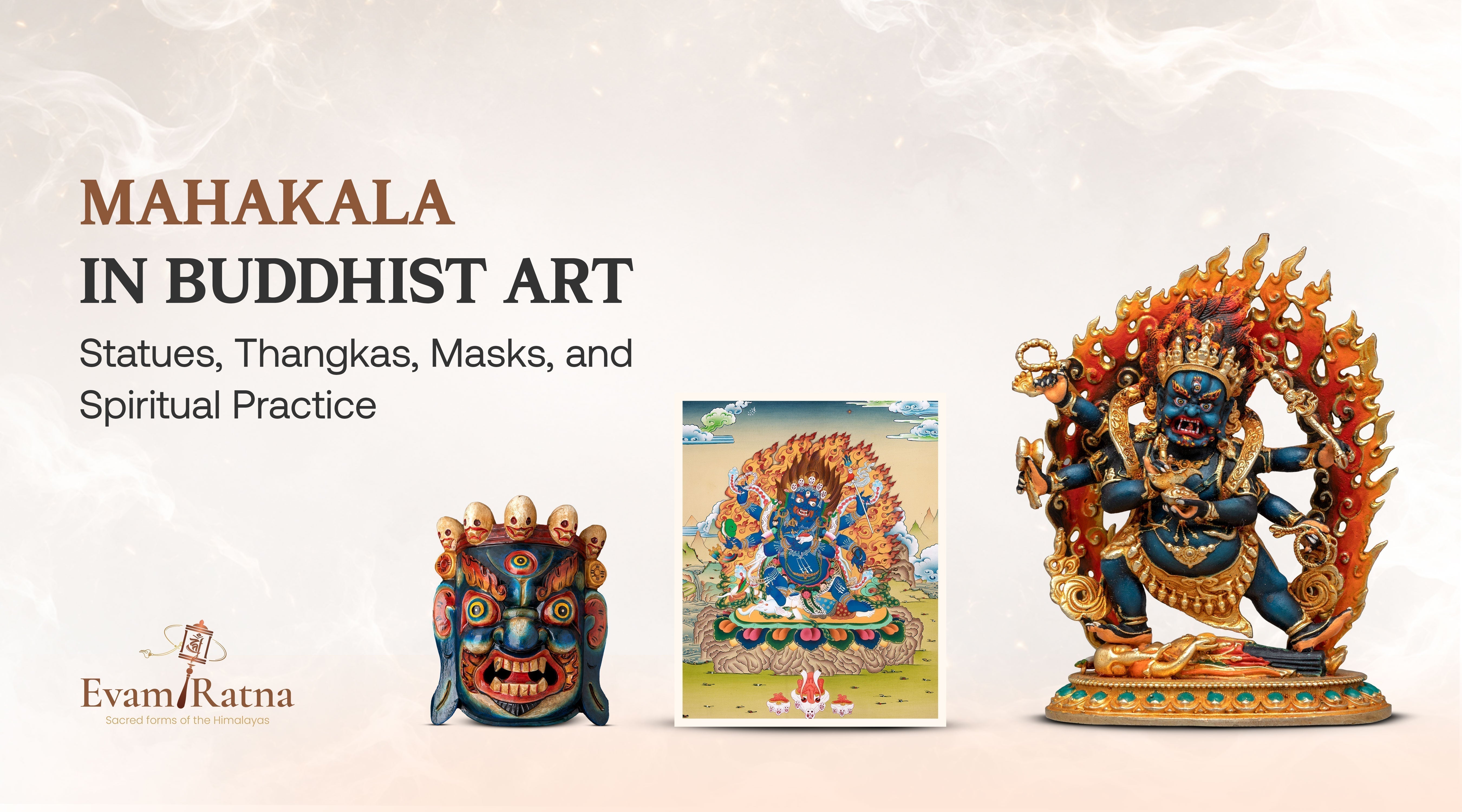
In Buddhist art, Mahakala is portrayed through various sacred forms, including statues, thangka paintings, and ritual masks, each expressing his role as a guardian of the Dharma and protector of practitioners. Mahakala occupies an important place in Tibetan Buddhist art, especially within Vajrayana traditions such as Nyingma, Kagyu, Sakya, and Gelug schools. His imagery is designed not to represent the dynamic power of enlightened awareness overcoming destructive forces. Artists carefully follow traditional meditation manuals when creating Mahakala statues and thangkas. Every element, from his number of arms and facial expression to his ornaments and weapons, carries deep symbolic meaning.
In early Indian traditions, Kala represented the irresistible force of time that consumes all physical things. As Tantric Buddhism evolved between the 7th and 10th centuries, this ancient symbolism was transformed into a Buddhist framework. Mahakala in Buddhism destroys delusion, ignorance, attachment, and spiritual hindrance.
Mahakala is commonly depicted with:
- A dark blue or black-colored body symbolizing the ultimate nature of reality and the transcendence of dualistic perception.
- A wrathful expression representing the destruction of ignorance and ego.
- Three large eyes symbolizing awareness of the past, present, and future.
- A crown of five skulls representing the transformation of the five poisons into the five wisdoms.
- Flaming hair representing powerful enlightened energy.
- Bone ornaments symbolizing impermanence and liberation from attachment.
- A garland of freshly severed heads representing the cutting away of negative thoughts and defilements.
Major Forms of Mahakala in Himalayan Art

Different Vajrayana lineages depict Mahakala in distinct forms, each representing specific ritual practices and spiritual goals.
1. Six-Armed Mahakala (Shadbhuja Mahakala)
Considered a direct wrathful emanation of Avalokiteshvara (the Buddha of Compassion), this is the most widely depicted form in Himalayan art.
- Visual Identifiers: Standing atop an elephant-headed figure (representing the subjugation of stubborn worldly obstacles), he holds a flaying knife (kartika) and skull cup (kapala) at his heart. His upper hands stretch outward, holding a rosary of human skulls, a damaru drum, a trident, and a lasso.
- Symbolism: The six arms represent the mastery of the Six Perfections (Paramitas): generosity, discipline, patience, diligence, meditative concentration, and wisdom.
2. Two-Armed Mahakala (Bernagchen/The Black Cloak)
Bernagchen is the personal protector of the Karmapa and the primary guardian deity of the Karma Kagyu lineage.
- Visual Identifiers: He is characteristically stout, broad-shouldered, and draped in a thick, flowing black cloak (Bernag). He holds a curved blade high in his right hand and a skull cup in his left, standing amid a swirling cloud of fire.
- Symbolism: Unlike forms holding numerous weapons, Bernagchen's simplified two-handed posture symbolizes direct, single-pointed intervention to cut off ego-delusion instantly.
3. Four-Armed Mahakala (Chaturbhuja Mahakala)
Closely tied to the Chakrasamvara Tantra cycle, this form is central to the Sakya and Nyingma traditions.
- Visual Identifiers: Depicted sitting or standing in a dynamic martial stance, his two primary hands hold the knife and skull cup, while his secondary hands raise a fiery sword of wisdom and a khatvanga (tantric staff topped with skulls).
- Symbolism: His four arms correspond to the four Buddha activities (Karma): pacifying illness and hindrances, enriching wisdom and merit, magnetizing positive circumstances, and forcefully destroying ignorance.
4. White Mahakala (Sita Shadbhuja Mahakala)
In striking contrast to the dark indigo forms, White Mahakala features a brilliant, snow-white body and a joyous yet fierce expression.
- Visual Identifiers: He holds a wish-fulfilling jewel (chintamani) at his chest alongside a vase filled with nectar inside his skull cup. He tramples upon two elephant-headed figures holding wealth-bestowing implements.
- Symbolism: Associated with the Shangpa Kagyu master Khyungpo Naljor, White Mahakala embodies compassionate abundance. He removes financial hardship and inner spiritual poverty so practitioners can focus entirely on Dharma practice.
5. Panjaranatha Mahakala (Vajra Panjarnata)
Known as the "Lord of the Pavilion," Panjaranatha is the primary protective deity of the Hevajra Tantra cycle and the chief guardian of the Sakya lineage.
- Visual Identifiers: He is instantly recognized by his distinct squatting stance and the wooden gong-stick (gandi) resting across the crooks of his elbows. He has two arms holding a curved knife (kartika) and skull cup (kapala) at his heart while standing atop a corpse.
-
Symbolism: Derived from the Vajra Panjara (diamond pavilion), he seals the spiritual boundary of retreat spaces. The gandi stick symbolizes his power to summon protective forces and banish harmful influences, shielding practitioners from spiritual and physical disruption.
Read More About God Mahakala: Variations and Forms Across Tibetan Buddhist Traditions
Mahakala Statues: Sacred Sculptures of Protection

Click Here To View Our Collection of White Mahakala Statues
Mahakala statues are among the most powerful examples of Himalayan Buddhist sculpture. Crafted by generations of skilled Newar and Tibetan artisans, these sculptures serve as sacred physical anchors of enlightened protection within shrines, monasteries, and home altars.
Anatomic & Artistic Features
Master metalsmiths utilize traditional craftsmanship to bring out Mahakala’s wrathful yet compassionate essence, using details such as:
- Copper & Bronze Alloy Bodies: Cast through the lost-wax method (cire perdue) for a sturdy, long-lasting structure.
- 24K Gold Gilding: Applied using cold gold gilding or mercury fire-gilding to highlight his ornaments, crown, and weapons.
- Gold Dust & Acrylic Face Painting: Painted facial details that give his three bulging eyes and fangs a vivid, energetic presence.
- Gemstone Inlays: Embellished with turquoise, coral, and lapis lazuli along his skull crown and jewelry.
- Hand-Carved Ornaments: Intricately carved aprons of human bones, serpent wristlets, and flaming halos.
A Mahakala statue physically grounds the principle of untamed compassion in space. Its weight and unyielding metallic form represent the unshakeable nature of the awakened mind (Vajra), providing a steady guardian presence that wards off spiritual obstacles and establishes an undisturbed boundary for meditation.
Craftsmanship & Sacred Materials
Master artisans in the Kathmandu Valley and Tibetan diaspora use time-honored methods passed down through generations to create these sacred sculptures:
- Lost-Wax Casting: Sculptors first hand-carve the deity from beeswax to capture subtle anatomical details before encasing it in clay and pouring molten bronze or copper into the mold.
- Repoussé & Hand Chasing: Metalsmiths hammer and chase complex details—such as flowing scarves, flaming crowns, and intricate skull aprons—directly into the metal surface.
- Face Painting & Consecration: The face is painted with powdered gold and mineral pigments to bring out the wrathful expression. Traditionally, statues are filled with rolled mantras, incense, and sacred relics (Sungzhug) during a monastic consecration ritual to awaken the deity's spirit within the form.
Mahakala Thangka: Visual Representation of Enlightened Protection

Click Here To View Our Sacred Six-Armed Mahakala Thangka
Mahakala thangkas are sacred Buddhist paintings, a highly detailed meditation tool used for meditation, visualization practices, and devotional purposes. Unlike ordinary paintings, a traditional Mahakala thangka is created according to strict iconographic guidelines found in Buddhist scriptures and meditation texts.
Sacred Composition & Traditional Painting Process
Master thangka painters construct each piece according to strict canonical rules of Iconometry (Thangka proportional grids), ensuring that every arm, weapon, and facial proportion adheres to sacred geometry.
- Canvas Preparation: Woven cotton canvas is stretched over a wooden frame, treated with a mixture of gesso and yak-hide glue, and hand-burnished with a smooth shell until the surface is completely seamless.
- Natural Mineral Pigments: Artisans paint with pulverized precious minerals, including lapis lazuli for his deep indigo body, malachite for green accents, cinnabar for fiery red background clouds, and 24K gold dust for outlining his aura and ornaments.
- Black Thangka Style (Nagtang): Wrathful protectors like Mahakala are often painted in the Nagtang style, a dramatic aesthetic featuring a pitch-black background with fine gold ink linework and vivid red flames, highlighting his fiery emergence from ultimate emptiness (Sunyata).
Depiction of Mahakala in Thangka
- Mahakala in a Dynamic Stance: Depicted standing, stepping, or dancing atop a trampled figure or corpse, symbolizing the complete subjugation of ego, delusion, and spiritual hindrances.
- A Halo of Wisdom Fire: A blazing aura of roaring orange and red flames surrounding his body, representing the intense heat of Jnana (awakened wisdom) purifying negative karma and mental poisons.
- Sacred Implements in Hand: Classical attributes held in his hands—most notably a curved flaying knife (kartika) to slice through ignorance and a skull cup (kapala) filled with nectar at his heart. Depending on his arm count, he may also hold a trident, damaru drum, lasso, or wooden gong-stick (gandi).
- Lotus, Sun, and Moon Disc Seats: Positioned on a multi-colored lotus seat topped with solar and lunar discs, signifying his rootedness in ultimate truth, compassion, and enlightened awareness.
- Symbolic Animals, Guardians, and Offerings: A surrounding cosmos filled with his protective retinue, directional guardians, wrathful animal attendants (like ravens, jackals, or tigers), and ritual offerings (tormas and skull cups) at his base.
Mahakala Masks in Tibetan Buddhist Rituals

Click Here To View Our Collection of Traditional Mahakala Wooden Masks
Mahakala masks play an important role in Tibetan Buddhist cham dances, sacred ritual performances traditionally performed in monasteries. Performed by trained monks during annual monastic festivals (such as Losar or Gutor), these sacred dances use oversized, hand-carved ritual masks to invoke the deity directly into the physical realm. When a monk wears the Mahakala mask during a Cham dance, he undergoes a profound spiritual transformation. It is a consecrated ritual vessel that allows the performers to embody Mahakala’s fierce energy, purifying the courtyard and dispelling obstacles for the entire community.
During these ceremonies, monks wear elaborate Mahakala masks representing the presence of the protector deity. The dance symbolizes:
- The victory of wisdom over ignorance
- The purification of negative energies
- The removal of obstacles from individuals and communities
The Craftsmanship of Sacred Wooden Masks
Crafting an authentic Mahakala mask requires intense focus, traditional toolwork, and strict adherence to sacred iconometric proportions.
- Material Selection & Carving: Master woodcarvers typically use lightweight, durable local softwoods (such as pine, birch, or paulownia) or traditional cloth-and-papier-mâché layers. The wood is hand-chiseled to carve out his signature features: three bulging eyes, flared nostrils, exposed fangs, and a crown of five dry skulls.
- Surface Gesso & Polishing: The raw sculpture is coated with multiple layers of fine clay, chalk gesso, and natural hide glue. Once dry, artisans burnish the surface until smooth to prepare it for painting.
- Pigments & Detailing: Artisans paint the mask using traditional mineral pigments, deep indigo or black for the skin, blazing vermilion for the mouth and flaming eyebrows, and gold leaf highlights along the skull crown and ear ornaments.
- Ritual Consecration: Before a mask can be worn in performance or displayed on an altar, it is blessed by high lamas through chanting and ritual mantras to awaken its protective spirit.
Traditional Characteristics of Mahakala Mask
- A Fierce Facial Expression: A roaring, intensely wrathful countenance designed to shock the viewer out of ordinary, dualistic thinking and forcefully strike down ego-clinging and negative karma.
- Large Bulging Eyes: Three wide, bloodshot eyes, including a prominent third eye of wisdom on his forehead, symbolizing the ability to see simultaneously through the past, present, and future, piercing straight into absolute truth.
- Sharp Fangs and Powerful Features: Exposed fangs, a gaping mouth, flared nostrils, and an accentuated jawline represent the active consumption and transmutation of human ignorance and harmful emotions.
- A Crown of Five Skulls: A distinct headpiece adorned with five dry human skulls mounted along the brow, signifying the transformation of the five primary mental poisons (ignorance, anger, attachment, pride, and jealousy) into the five Buddha wisdoms.
- Flame-Like Decorations: Swirling, blazing eyebrows and facial highlights rendered in vibrant vermilion and orange, echoing the roaring aura of wisdom fire (Jnana) that burns away spiritual hindrances.
Why Practice Mahakala?
Mahakala practice is performed by many Vajrayana practitioners seeking protection, purification, and the removal of obstacles on the spiritual path. His practice is especially important among practitioners who engage in advanced tantric meditation.
1. Protection from Obstacles
Mahakala is regarded as a powerful protector who helps overcome:
- External difficulties
- Negative influences
- Spiritual obstacles
- Unfavorable circumstances
Practitioners believe his enlightened activity creates supportive conditions for Dharma practice.
2. Overcoming Inner Negativity
The greatest obstacles in Buddhism are not only external but also internal. Mahakala symbolizes the destruction of:
- Anger
- Attachment
- Ignorance
- Pride
- Jealousy
His fierce appearance reminds practitioners to confront and transform these inner challenges.
3. Strengthening Courage and Determination
Mahakala represents fearless compassion. Practicing his meditation helps develop:
- Courage
- Mental strength
- Discipline
- Commitment to the spiritual path
His powerful form encourages practitioners to face difficulties with wisdom rather than fear.
4. Protecting the Dharma
Mahakala is traditionally regarded as a Dharmapala (Dharma protector). His role is not to punish enemies but to preserve the teachings of the Buddha and support those who follow the path of awakening.
Symbolism of Mahakala’s Wrathful Appearance
In Vajrayana Buddhism, the fierce appearance of wrathful deities represents compassion that acts forcefully when necessary.
Mahakala’s terrifying form symbolizes:
- Flames: burning away ignorance
- Weapons: cutting through delusion
- Skull ornaments: impermanence and transformation
- Dark body: the ultimate nature beyond concepts
- Fierce expression: unstoppable enlightened activity
His appearance teaches practitioners that wisdom and compassion can take many forms.
Read More About How Authentic Nepalese Statues are Made in Nepal: The Lost-Wax Metal Casting Process
Conclusion:
Mahakala in Buddhist Art represents far more than a fierce and powerful deity; he embodies the active force of enlightened compassion, wisdom, and protection within Vajrayana Buddhism. Through sacred statues, detailed thangka paintings, and ritual masks, Mahakala’s imagery teaches profound spiritual principles such as overcoming ignorance, transforming negative emotions, and removing obstacles on the path toward awakening.
Every element of Mahakala’s iconography carries a deeper meaning, from his dark body symbolizing ultimate reality, his wrathful expression representing the destruction of ego and delusion, to his skull ornaments and weapons expressing transformation and wisdom. These artistic traditions preserve centuries of Buddhist philosophy while providing practitioners with powerful visual tools for meditation and spiritual reflection.
In Himalayan sculpture, traditional thangka painting, or sacred Cham masks, Mahakala continues to inspire devotion and respect among Buddhist practitioners worldwide. His fierce appearance reminds us that true compassion can also take a powerful form, one that protects the Dharma, strengthens courage, and guides beings toward liberation by overcoming inner and outer obstacles.