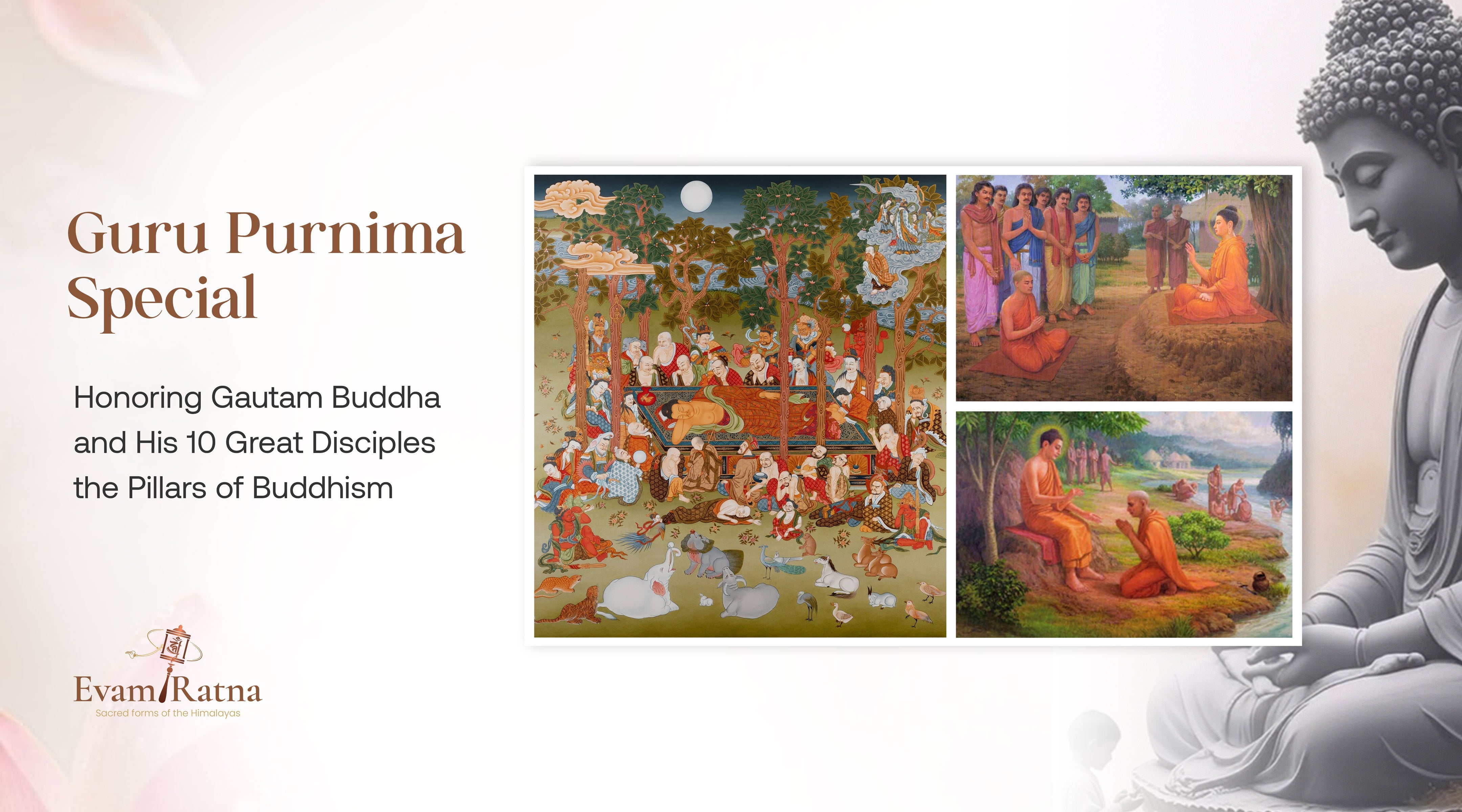
Gautam Buddha and His 10 Great Disciples: The Story of Buddhism’s First Spiritual Masters
Guru Purnima is a sacred occasion dedicated to honoring teachers, masters, and the wisdom they transmit from one generation to another. In Buddhist tradition, the relationship between the teacher and disciple is considered one of the most important foundations for preserving the Dharma. A guru is a spiritual teacher or mentor who plays a significant role in guiding and instructing students on the path to spiritual development and enlightenment. It is one of many names for a teacher in Buddhism and is used most commonly in Vajrayana Buddhism, referring to a highly trained teacher. The Buddha’s teachings were preserved not only in scriptures but also by the enlightened disciples who received, practiced, understood, and shared his wisdom with countless beings.
More than 2,500 years ago, Siddhartha Gautama attained enlightenment beneath the Bodhi tree and became known as Gautam Buddha, the Awakened One. After realizing the truth of suffering, its causes, and the path toward liberation, Buddha spent the rest of his life teaching the Dharma. Around him formed the Sangha, a community of monks and practitioners who dedicated themselves to practicing and spreading his teachings.
The Formation of Buddha’s Sangha: The Beginning of a Spiritual Legacy

After attaining enlightenment, Gautam Buddha began teaching the Four Noble Truths and the Noble Eightfold Path, offering a practical path to overcome suffering and achieve liberation. His teachings attracted people from different backgrounds, including kings, scholars, merchants, and ordinary villagers.
The Buddha established the Sangha, a community where practitioners could dedicate themselves fully to meditation, ethical conduct, and understanding the nature of reality. Over time, many disciples attained profound realization and became teachers themselves. Among these followers, certain disciples became recognized as leaders due to their extraordinary qualities. Buddhist traditions identify ten principal disciples who represented the highest examples of practice and understanding. Although different Buddhist traditions may present slight variations in their descriptions, these ten disciples remain among the most respected figures in Buddhist history.
Who Were the Ten Great Disciples of Gautam Buddha?

The list of ten principal disciples appears, with some variation in order and membership, across Mahayana texts and is especially honored in Chinese and Central Asian Buddhist art, where the group recurs as an iconographic set in cave temples such as the Mogao Caves. Each disciple represented a unique aspect of Buddhist practice, including wisdom, compassion, meditation, discipline, supernatural insight, and preservation of teachings. Together, they became the first spiritual masters who carried Buddha’s message forward after him.
The Ten Great Disciples of Buddha are remembered because each embodied a different expression of enlightened practice. Their lives demonstrate that the path to awakening can be approached through different strengths and disciplines while remaining rooted in the same Dharma.
The Ten Great Disciples of Gautama Buddha are:
- Shariputra (Sariputra): Foremost in Wisdom
- Maudgalyayana (Mahamaudgalyayana): Foremost in Spiritual Powers
- Ananda: Foremost in Memory and Preserving Buddha’s Teachings
- Mahakashyapa: Foremost in Ascetic Practice
- Subhuti: Foremost in Understanding Emptiness
- Purna Maitrayaniputra: Foremost in Teaching the Dharma
- Mahakatyayana: Foremost in Explaining Buddha’s Teachings
- Anuruddha: Foremost in Divine Insight
- Upali: Foremost in Monastic Discipline
- Rahula: Foremost among Buddha’s Disciples in Learning and Training
Sariputra: Foremost in Wisdom

Sariputra is considered one of the Buddha's two chief disciples, standing at his right hand in much of Buddhist art. Sariputra, originally known as Upatissa, was born into a Brahmin family near Rajagriha. From an early age, he showed exceptional intelligence and a deep desire to understand the truth of existence. Along with his close friend Maudgalyayana, he left worldly life in search of spiritual realization. Their search led them to meet the Buddha’s disciple Ashvajit, whose teaching on cause and effect deeply inspired Shariputra. Realizing the profound truth of the Buddha’s Dharma, he and Maudgalyayana became disciples of the Buddha.
Shariputra possessed a remarkable ability to analyze, understand, and explain the Buddha’s teachings. His wisdom allowed him to clearly grasp the nature of reality, suffering, and liberation. He was respected for his logical approach and ability to guide others toward deeper insight. The Buddha recognized Shariputra as the foremost among his disciples in wisdom. Because of his profound realization and mastery of Dharma, he was often called the “General of the Dharma,” reflecting his role in preserving and spreading the Buddha’s teachings. Shariputra played an important role in clarifying difficult Buddhist concepts for monks and followers. His skill in teaching transformed profound philosophical ideas into clear and understandable explanations, helping many practitioners progress on the path of liberation.
Shariputra is traditionally associated with the development and transmission of Abhidharma teachings, the detailed analysis of Buddhist philosophy and the workings of mind, phenomena, and reality. His analytical wisdom became an important foundation for later Buddhist scholastic traditions. He represents the perfection of wisdom, understanding, and disciplined study of Dharma. He symbolizes the ideal disciple who combines intellectual insight with spiritual realization. His life reminds practitioners that true wisdom arises not only from learning but from direct experience and compassionate sharing of the Dharma.
Maudgalyayana (Moggallana): Foremost in Psychic Powers

Maudgalyayana, also called Mahamoggallana, was the Buddha's other chief disciple, inseparable from Sariputra in both friendship and function. The two searched for spiritual truth together before their ordination, and where Sariputra represented wisdom, Maudgalyayana became known for extraordinary psychic abilities, which he used skillfully as a teaching tool to guide and sometimes startle students toward insight. Maudgalyayana symbolizes the power of meditation, compassion, and spiritual discipline. Together with Shariputra, he represents the two essential qualities of the Buddhist path: wisdom and skillful spiritual accomplishment.
After encountering the Buddha’s teachings, Maudgalyayana realized the path to liberation and devoted himself to deep meditation and Dharma practice. Through discipline, concentration, and insight, he attained profound spiritual realization and became an accomplished arhat. The Buddha recognized Maudgalyayana as the foremost among his disciples in supernatural abilities (siddhi). Through advanced meditation, he developed remarkable powers, including the ability to perceive different realms of existence and understand the experiences of beings beyond ordinary perception. He played a critical stabilizing role during a serious threat to the unity of the monastic community, when the monk Devadatta attempted to cause a schism; Maudgalyayana was instrumental in bringing the community back together. In later, widely told tradition, he is remembered for a story of profound filial devotion, using his spiritual power to try to relieve his deceased mother's suffering, which gave rise to the Ghost Festival observed in many Buddhist countries today, a day dedicated to honoring one's ancestors.
Maudgalyayana died at eighty-four, killed by rivals hostile to the Buddha's growing following, an event Buddhist texts frame as the ripening of karma from a past life. Despite his spiritual accomplishments, Maudgalyayana used his abilities with compassion. He sought to help beings suffering in lower realms and guided others toward understanding karma, ethical conduct, and the path of liberation. Maudgalyayana’s life represents the compassionate use of spiritual realization. His wisdom, meditation, and supernatural abilities were not for personal gain but were dedicated to benefiting others and supporting the Buddha’s mission of spreading the Dharma.
Ananda: Foremost in Retaining the Teachings

Ananda, the Buddha's first cousin, is one of the most beloved figures in the entire Buddhist tradition. He served the Buddha for many years with great devotion, care, and humility, becoming one of his most trusted companions. Through his close presence, he had the opportunity to hear many teachings directly from the Buddha. Ordained as a monk under the guidance of Purna, he became the Buddha's personal attendant roughly twenty years into his teaching career. He was renowned above all for his extraordinary memory, and it is his recollection of the Buddha's discourses that forms the foundation of most of the early Sutta-Pitaka, earning him the title "Treasurer of the Dharma."
After the Buddha’s passing, Ananda played a central role in the First Buddhist Council held at Rajagriha. He recited the Buddha’s discourses (Sutta Pitaka) from memory, allowing the teachings to be collected, organized, and passed down to future generations. He also played a decisive role in the founding of the Buddhist nuns' order, petitioning the Buddha on behalf of his foster mother, Mahapajapati Gotami, to allow her ordination. He attained enlightenment only in the very final hours before the First Buddhist Council began, a requirement for participation, and it was his recitation of the Buddha's teachings at that council, checked and confirmed by the assembled monks, that preserved the discourses for future generations.
Despite his central role, he was also chastised by Mahakasyapa and the Sangha at the council for several perceived lapses, a moment often read by scholars as reflecting real tensions between differing values within the early monastic community. Ananda continued teaching until his own death, passing his lineage on to students who would later lead the Second and Third Buddhist Councils. He represents devotion, mindfulness, and the preservation of wisdom. His life shows that listening deeply, remembering faithfully, and sharing teachings with compassion are essential qualities for preserving the Dharma for future generations.
Mahakasyapa: Foremost in Ascetic Practice
Mahakasyapa, originally known as Pipphali, was born into a wealthy Brahmin family. Despite having access to great comfort and privilege, he developed a deep desire for spiritual liberation and renounced his luxurious life to seek the path of awakening. He eventually met the Buddha, ordained under him, and became renowned for the strictness of his ascetic discipline, the dhutanga practices of minimal possessions, simple food, and solitary dwelling. So central was his role that the Buddha exchanged robes with him, a gesture widely read as a symbolic transmission of the teaching itself.
After meeting the Buddha, Mahākāśyapa became one of his most respected disciples. The Buddha recognized his sincere practice and praised him as the foremost among disciples in ascetic conduct. Their relationship represented the importance of renunciation, discipline, and inner realization. After the Buddha's parinirvana, Mahakasyapa stepped into the community's leadership, presiding over the First Buddhist Council, where the Buddha's teachings were formally recited and preserved. He is regarded as the first patriarch in several early Buddhist schools and holds a particularly important place in Chan and Zen tradition, which credits him with receiving a direct, wordless transmission of insight from the Buddha. Despite his stern reputation, textual tradition also remembers him for a marked compassion toward the poor, a detail that has sometimes cast him as a quietly anti-establishment figure within an increasingly formalized monastic order.
Subhuti: Foremost in Understanding Emptiness

Subhuti came from a wealthy family connected to Anathapindika, the Buddha's principal lay patron. He realized that all phenomena arise through causes and conditions and do not possess a fixed, independent nature. His wisdom allowed him to see reality beyond attachment and dualistic thinking. In Mahayana Buddhism, He is honored as a great master of wisdom and insight. His profound understanding of emptiness made him an important figure in the transmission of Prajñāpāramitā teachings, which emphasize the perfection of wisdom as the path to awakening.
In Mahayana Buddhism, Subhuti is honored as a great master of wisdom and insight. His profound understanding of emptiness made him an important figure in the transmission of Prajñāpāramitā teachings, which emphasize the perfection of wisdom as the path to awakening. The Diamond Sutra is structured almost entirely as a dialogue between the Buddha and Subhuti, through which Subhuti's understanding of emptiness, the absence of fixed, independent existence in all phenomena, deepens in real time, making him one of the most philosophically significant figures in the entire Mahayana canon. Subhuti represents the perfection of wisdom, humility, and inner freedom. His life teaches that true realization comes from understanding the empty nature of all things and cultivating a mind free from attachment and limitations.
Purna: Foremost in Preaching the Dharma

Purna Maitrayaniputra, often known simply as Purna, was recognized as the most gifted teacher and preacher among the Buddha's disciples. He had the ability to present profound teachings in a clear and understandable way, helping people from different backgrounds grasp the path toward liberation. After receiving teachings from the Buddha, Purna dedicated his life to spreading the Dharma in distant regions. He traveled to different communities, sharing the Buddha’s message of wisdom, compassion, and ethical living with those who had not yet encountered the teachings.
Purna was especially known for his patience, courage, and compassion when teaching challenging audiences. Even when facing criticism or hostility, he remained calm and responded with kindness, following the Buddha’s example of compassion and understanding. The Buddha praised Purna as the foremost among his disciples in preaching the Dharma. He recognized Purna’s exceptional ability to teach according to the needs and understanding of different people, making the profound teachings accessible to all. Purna represents the power of compassionate communication and the responsibility of sharing wisdom with others. His life teaches that true understanding of Dharma is expressed not only through personal realization but also through guiding others toward awakening.
Katyayana: Foremost in Explaining the Dharma in Detail

(Image from wisdomlib.org)
Katyayana was born into a Brahmin family in Ujjayini, the capital of Avanti, and was known for his intelligence and knowledge of religious teachings. He served as a spiritual advisor to the ruler of Avanti. Sent to learn about the Buddha’s teachings, he encountered the Dharma and became one of the Buddha’s disciples. He was renowned for his ability to expand and clarify the Buddha’s brief teachings. He could analyze deep concepts, explain their meaning in detail, and present them in a way that made the Dharma easier for others to understand.
With his strong debating skills and wisdom, Katyāyana adapted Buddha’s teachings according to the needs and understanding of different people. He helped spread the Dharma by transforming profound teachings into clear explanations suitable for various audiences. After becoming a disciple, he returned to Avanti and shared the Buddha’s teachings with many people, including the local ruler. His efforts helped establish Buddhism in regions beyond the Buddha’s immediate community. He represents wisdom in communication, analytical understanding, and the skillful explanation of Dharma. His life teaches that true knowledge becomes meaningful when it is shared clearly and compassionately with others.
Anuruddha: Foremost in Divine Insight

Anuruddha was born into a noble and wealthy Shakya family and was a cousin of the Buddha who took ordination alongside Ananda, becoming renowned for clairvoyant insight and mastery of the four foundations of mindfulness. Along with other members of the Shakya clan, he left behind worldly attachments to seek liberation through Dharma practice.
Through intense meditation and disciplined practice, Anuruddha attained the extraordinary ability known as dibba-cakkhu or the “divine eye.” This insight allowed him to perceive beings and events beyond ordinary human perception, including the workings of karma and different realms of existence. Anuruddha was deeply devoted to meditation, mindfulness, and constant awareness. His dedication to contemplative practice helped him develop profound concentration and spiritual insight, making him one of the Buddha’s most accomplished disciples.
Anuruddha represents the power of meditation, mindfulness, and awakened vision. His life teaches that true insight arises through discipline, inner cultivation, and a sincere commitment to the path of liberation.
Upali: Foremost in Monastic Discipline

Upāli was born into a humble family and worked as a barber serving the Shakya royal family. Despite his lower social status, he possessed great sincerity, wisdom, and devotion, showing that spiritual realization depends on practice and understanding rather than birth or social position. When several Shakya princes decided to follow the Buddha, Upāli accompanied them. The princes requested that Upāli be ordained before them so that they could overcome pride and respect the equality taught by the Buddha. Through this act, Upāli became one of the earliest disciples and was honored within the Sangha.
Upāli became the foremost expert in the Vinaya, the rules and guidelines governing monastic life. Through careful study, memory, and practice, he gained a deep understanding of proper conduct and the principles that maintained harmony within the Buddhist community. After the Buddha’s Mahāparinirvāṇa, Upāli played a crucial role in the First Buddhist Council by reciting the Vinaya teachings from memory. His knowledge helped preserve the rules of the monastic community and ensured that the Buddha’s discipline was accurately transmitted to future generations. He represents humility, equality, and dedication to ethical discipline. His life teaches that true spiritual greatness comes from sincere practice and commitment to the Dharma, not from wealth, status, or social background.
Rahula: Foremost in Eagerness for Training

(Image from Enlightenment Thagka)
Rahula was the only son of Siddhartha Gautama and his wife, Yasodhara, born before Siddhartha renounced his royal life. Rahula later followed his father’s path and became part of the Buddhist monastic community. At a young age, Rāhula became one of the Buddha’s earliest novice monks (sāmaṇera). His ordination marked an important moment in Buddhist history, showing that spiritual training could begin from a young age through discipline and guidance.
The Buddha entrusted Rahula’s training to Shariputra, the foremost disciple in wisdom. Under Shariputra’s guidance, Rahula learned the importance of humility, patience, meditation, and understanding the Dharma. The Buddha gave Rahula teachings emphasizing truthfulness, self-reflection, mindfulness, and careful conduct. He taught him that a practitioner must examine their thoughts, words, and actions to develop wisdom and purity of mind.
Under his father's direct guidance, Rahula was taught truthfulness, self-reflection, and the doctrine of not-self, eventually reaching his own enlightenment. He became known throughout Buddhist tradition for his sincere eagerness to learn and has long been held up as a source of inspiration for novice monks and nuns, illustrating both the challenge and the profound potential of bringing children into a life of spiritual training. He symbolizes discipline, humility, and the importance of continuous learning. His life teaches that spiritual growth comes through patience, honest self-examination, and dedicated practice.
Conclusion
The Ten Great Disciples of Gautam Buddha represent the diverse qualities needed on the path toward enlightenment. Each disciple embodied a unique aspect of Buddhist practice, from Shariputra’s profound wisdom and Maudgalyayana’s spiritual abilities to Ananda’s preservation of teachings, Mahakasyapa’s renunciation, and Upali’s dedication to monastic discipline. Together, these enlightened disciples became the first spiritual masters who carried Buddha’s teachings beyond his lifetime. Their lives demonstrate that the Dharma can be practiced through different paths, whether through wisdom, meditation, compassion, discipline, or sharing knowledge with others.
More than 2,500 years later, the stories of Buddha’s great disciples continue to inspire practitioners around the world. They remind us that enlightenment is not limited to one quality alone but arises through dedication, understanding, ethical conduct, and compassionate action. Through their efforts, the Buddha’s timeless wisdom continues to guide countless beings toward awakening and liberation.
Happy Guru Purnima! May the wisdom and compassion of our Gurus illuminate our path toward peace, mindfulness, and awakening. May the blessings of the Dharma guide us always