The Return of Maitreya Buddha: The Future Buddha of Compassion, Hope, and Enlightenment
Somewhere in the heavens, Buddhists believe, a being sits in quiet contemplation, waiting. When the teachings of Shakyamuni Buddha have entirely faded from the world, Maitreya Buddha will descend to earth, attain enlightenment beneath a flowering tree, and set the wheel of the dharma turning once more. He is a promise pointed toward the future, a Buddha still becoming, whose statue watches over monasteries and shrine rooms across Asia as a quiet reminder that the story of awakening is not yet finished.
Who is Maitreya Buddha?

The name Maitreya comes from the Sanskrit word maitri, meaning loving-kindness, friendship, or universal compassion, and in Pali he is called Metteyya. His name is his message: he is, above all, the Buddha of universal love and compassion. He currently holds the rank of a bodhisattva, not a fully enlightened Buddha. In Buddhist cosmology, he is understood as the direct successor to Shakyamuni Buddha, the historical founder of Buddhism who lived 2,500 years ago. Where Shakyamuni is the Buddha of the present age, Maitreya is the Buddha of the future.
According to Buddhist cosmology, a Buddha does not appear randomly. When the teachings of the previous Buddha have disappeared, a Buddha arises at a certain time, and beings need a new teacher to rediscover the path to liberation. Shakyamuni Buddha, the Buddha of our present age, is considered the fourth Buddha of the current fortunate era (Bhadrakalpa), and Maitreya is believed to be the fifth Buddha.
He is considered the next Buddha who is coming to this world to attain full enlightenment and bring back the teachings of Dharma when mankind is ready to receive them again. For millions of Buddhists of all traditions, the prophecy of Maitreya’s coming is a hope that wisdom, compassion, and spiritual awakening will continue in the endless cycle of existence.
Symbolism and Iconography of Maitreya Buddha

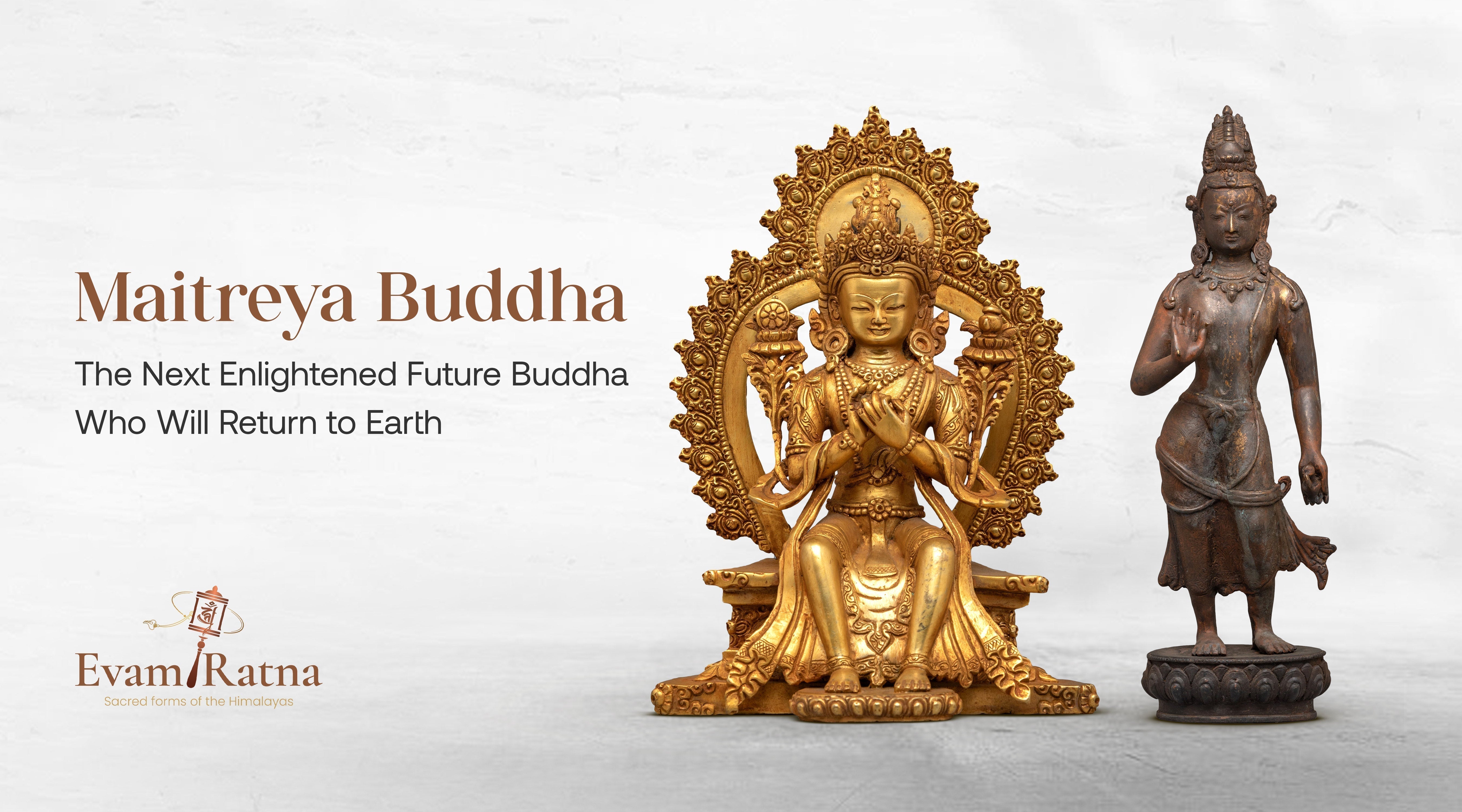
In Buddhist art, Maitreya Buddha is depicted as the Future Buddha, a symbol of loving-kindness (maitri), compassion, and the continued existence of the Dharma. The iconography of Maitreya is reflective of his particular position as a Bodhisattva who is currently residing in Tusita Heaven awaiting the correct time to descend into the human realm, achieve full enlightenment, and teach the Dharma again.
Maitreya is usually depicted as a Bodhisattva with royal ornaments and celestial garments. These qualities signify his existence as an enlightened being who has not yet entered the world as a fully enlightened Buddha.
- Lion Throne: Maitreya is often depicted seated on a lion throne, symbolizing the power, strength, and unwavering fearlessness of enlightened wisdom. In Buddhist art, the lion is the symbol of the powerful voice of the Buddha’s teachings, known as the “lion’s roar,” which destroys ignorance and reveals the truth of Dharma. The lion throne also signifies Maitreya’s future role as the next Buddha, who will once again proclaim the Dharma throughout the world.
- Lotus Seat and Moon Disc: Maitreya is depicted seated on a lotus above a moon disc, symbols in Tibetan Buddhism. The lotus signifies purity and spiritual awakening, reflecting an enlightened mind unaffected by ignorance. The moon disc represents clarity, peacefulness, and compassion, linked to the purified mind and the basis for enlightened qualities in Buddhist practices.
- Five Jeweled Crown and Bodhisattva Ornaments: Maitreya wears a five-jeweled crown and elaborate ornaments, such as necklaces, earrings, bracelets, and celestial garments. These ornaments hint that he is a great Bodhisattva residing in Tusita Heaven, not a historical Buddha who has already achieved final Buddhahood. The five jewels of the crown are often associated with the Five Wisdoms and the transformation of the five forms of ordinary consciousness into enlightened awareness. The crown also represents his connection with the lineage of future enlightened beings.
- Teaching Mudra (Dharmachakra Mudra): Maitreya is often depicted in the Dharmachakra Mudra, the gesture of turning the Wheel of Dharma. This is symbolic of his future role of teaching the way to liberation after the teachings of Shakyamuni Buddha have disappeared. It is a symbol of conveying wisdom, compassion, and spiritual guidance to sentient beings. It reminds practitioners that the Dharma is a continuous teaching, manifesting whenever beings are ready to receive it.
- Dharma Wheel: The Dharma Wheel (Dharmachakra) placed beside Maitreya represents the Buddha’s teachings and the turning of the Dharma. In Maitreya’s iconography, it emphasizes his destined role as the next Buddha who will restore and spread the teachings in the future age. The eight spokes of the Dharma wheel traditionally represent the Noble Eightfold Path, the foundation of Buddhist practice leading toward liberation.
- The kalasha and nagakesara flower: Maitreya is commonly shown holding a kalasha, or ritual vase, in one hand, a symbol of abundance and the nectar of the dharma. In the other hand, or resting beside him on a lotus, appears the nagakesara flower, a reference to the tree beneath which he is prophesied to attain enlightenment.
- Upright Posture and Seated Position: Maitreya is often depicted seated in a pralambapadasana (the dangling leg posture) in Tibetan Buddhist art, symbolizing his readiness to rise and engage with the human realm when conditions are right. This posture reflects his active compassion and dedication to future beings.
- Stupa Symbol: A small stupa placed within Maitreya’s crown is another important identifying feature in many Tibetan representations. The stupa symbolizes his future enlightenment and his connection with the awakened state of Buddhahood. This symbol helps distinguish Maitreya from other Bodhisattvas and represents the prophecy that he will become the next Buddha of this world age.
Standing Maitreya Buddha: Dynamic Posture

Maitreya Buddha is also represented in a standing posture, particularly in Himalayan Buddhist sculpture traditions. In this representation, he is depicted as being prepared to come into the human world when the time is right, from Tusita Heaven. The standing Maitreya communicates to us movement, compassion, and active engagement with sentient beings, unlike the calm immobility that is often attributed to the sitting postures of meditation forms.
Maitreya is often shown with his right leg slightly forward, placing weight on one leg while the other remains relaxed. This subtle shift creates a natural sense of movement, suggesting that he is prepared to rise and act for the benefit of beings. The relaxed attitude displays the Bodhisattva attitude of compassionate activity, being ready instead of turning away from the world. The lower body is traditionally covered with a dhoti, a long flowing garment worn by Indian and Himalayan Bodhisattvas. In many sculptures and thangka paintings, the dhoti is rendered with delicate folds or a translucent appearance, revealing the graceful form of the youthful figure beneath. This artistic presentation is a representation of the idealised beauty and spiritual perfection of celestial Bodhisattvas.
The standing position also reflects Maitreya's future of being the teacher of Dharma. The smiling face and his slight forward motion indicate that he is preparing to come into the human world, and the elegant, balanced form signifies harmony between compassion, wisdom and enlightened intention.
The Future Buddha Awaiting His Time to Return
According to Buddhist traditions, Maitreya Buddha is living in the celestial realm called Tusita Heaven (Tushita). He is waiting patiently for the right time to come down to the human world and achieve his destiny as the next Buddha. His time in Tusita Heaven is a state of readiness, in which he continues to cultivate wisdom and compassion before he is born as a Buddha to restore the Dharma for future generations.
When Will Maitreya Buddha Return to Earth?
There is no particular date in history given for the coming of Maitreya. In Buddhist scriptures, his appearance is described as occurring in a far distant future age, after the teachings of Shakyamuni Buddha have totally disappeared from the world. In Buddhist cosmology, there is a natural cycle of the Dharma. When the teachings of the Buddha are established, they gradually decline as beings become more and more distant from wisdom, compassion, and ethical conduct. When the Dharma is forgotten, a new Buddha arises, finds the way, and restores the teaching. In some Buddhist scriptures, this future age is called an age in which human beings will be more harmonious, live longer, and have more favourable conditions for spiritual practice.
Maitreya’s Residence in Tusita Heaven
Tusita Heaven is a pure and joyful celestial realm within Buddhist cosmology. This celestial realm is regarded as one of the highest divine realms and is traditionally the residence of advanced Bodhisattvas awaiting their final birth before attaining complete Buddhahood. The name Tusita means “the satisfied” or “the contented one” and refers to a state of bliss, harmony, and spiritual fulfillment. Tusita Heaven is not one of those common heavenly realms which are associated with temporary pleasure. Tusita Heaven is said to be a place where Bodhisattvas continue their preparation for their future mission of guiding sentient beings toward liberation. In many Mahayana and Tibetan Buddhist traditions, devotees hope to be reborn in Tusita Heaven and receive teachings directly from Maitreya. This aspiration reflects the deep spiritual connection between practitioners and the future Buddha, emphasizing the importance of preparing one's mind through compassion, ethical conduct, and wisdom.
Maitreya's Place in the Buddhist Traditions

Theravada Buddhism
In the Theravada tradition, which draws its authority from the Pali Canon, Maitreya appears as Metteyya. The Cakkavatti-Sihanada Sutta describes a future era of moral decline followed by renewal, in which Metteyya arises as the next Buddha to teach the dharma afresh. Here, Maitreya's role is relatively restrained: he is a future teacher, awaited with devotion, but not typically the object of elaborate ritual practice the way he becomes in later traditions.
Mahayana Buddhism
Mahayana Buddhism gives Maitreya a much larger stage. He is counted among the principal bodhisattvas and is closely associated with the Yogacara school of Buddhist philosophy, which some traditions credit him with inspiring or even directly transmitting to the scholar-monk Asanga. In Mahayana art and literature, Maitreya is often shown as a crowned, bejeweled bodhisattva-prince, a figure of radiant compassion actively engaged with beings in the present, not merely a distant prospect.
Vajrayana and Tibetan Buddhism
Tibetan Buddhism absorbs both of these threads and adds its own devotional and tantric dimensions. Maitreya (Tib. Jampa) appears extensively in Tibetan monastic art, is invoked in aspiration prayers, and is central to certain tantric cycles and initiation practices. Colossal Maitreya statues are among the most famous monuments in the Tibetan Buddhist world, reflecting how central his cult became within Himalayan monastic life. In Newar Buddhism of the Kathmandu Valley, Maitreya is likewise honored as part of the broader bodhisattva pantheon, appearing in shrine iconography alongside Avalokiteshvara and Manjushri.
The Life and Enlightenment of Future Buddha Maitreya
According to Buddhist traditions, Maitreya will descend from Tusita Heaven and be born into the human world under fortunate circumstances. He shall know human life, know the limitations of worldly existence, and know the search for the ultimate truth, like other Buddhas. Maitreya will be born in the world, will leave the worldly life, and then will go into deep meditation and spiritual practice, and will attain complete enlightenment. When he becomes a Buddha, he will begin a new Buddhist dispensation, and he will teach the Dharma according to the needs of beings living in that future era.
The teachings of Maitreya are often linked with universal compassion and loving-kindness. His name itself expresses his main quality, maitri, the boundless desire for the happiness and well-being of all beings. For practitioners, Maitreya is an ideal to cultivate in the present moment. His qualities inspire individuals to nurture patience, kindness, generosity, and concern for others.
Depiction of Maitreya Buddha in Thangka Paintings and Statues

Maitreya Buddha's artistic depiction is based on his unique role as the Future Buddha who is presently living as a Bodhisattva waiting for his final incarnation in the human world. He is depicted in Tibetan Buddhist thangkas and Himalayan sculptures as a symbol of his current state as a Bodhisattva, along with signs of his future enlightenment.
Symbols of Appearance and Colour
Maitreya is usually painted in a golden, warm yellow or light orange colour in Tibetan thangka paintings, representing his radiant wisdom, spiritual achievement and the light of the Dharma teachings that he will pass on. The golden color also signifies the preciousness and high status of a future Buddha, who will renew and lead the world spiritually.
Maitreya is depicted in many ways, including as a simple monastic monk, but mostly he appears as a celestial prince. Unlike many fully enlightened Buddhas who are portrayed in simple monastic robes, he is depicted wearing a five-jewel crown, necklaces, earrings, bracelets, and silk clothes symbolizing his current state as a great bodhisattva in Tusita Heaven.
Representation in Thangka Paintings
In Tibetan thangka art, Maitreya is depicted in a sacred setting, symbolizing his celestial residence and his future role as the Bodhisattva of compassion. Artists carefully follow traditional iconographic guidelines regarding his posture, ornaments, gestures, and accompanying symbols.
Maitreya thangkas often include:
- A lotus throne and moon disc symbolizing purity and awakened consciousness.
- A celestial throne or palace representing Tusita Heaven.
- Attendants, lineage masters, and other enlightened beings.
- Symbols connected with Dharma transmission and future Buddhahood.
These paintings are used for devotional purposes and as visual aids for meditation, which help the practitioner to remember the virtues of compassion, patience, and the continuity of the Buddhist teachings.
The Meaning Behind Maitreya’s Artistic Representation
Each of Maitreya's features is symbolic, whether in a delicate thangka painting or in the form of a tall statue. The golden complexion symbolizes radiant wisdom, the ornaments signify his Bodhisattva nature, the teaching gesture signifies the future transmission of Dharma, and his posture is a way of expressing readiness to benefit beings.
Maitreya is a strong visual reminder of the power of compassion and enlightenment, not just in the past, but as a promise for the future, through the art of the Himalayas.
Applying the Teachings of Maitreya Buddha in Daily Life
The teachings of Maitreya Buddha can be applied to and in the everyday world in simple and meaningful ways. Maitreya is the next Buddha who will restore the Dharma teachings to the world, but his very traits of loving-kindness (maitrī), compassion, patience, and understanding are something that can already be cultivated by individuals in the present moment.
The first step in following Maitreya's example is to cultivate caring for others. Actions of kindness, providing support to those in need, giving patience to listen and understanding to respond are practical expressions of the compassion that Maitreya embodies. By doing so, people establish positive relationships and contribute to a harmonious atmosphere around them. Maitreya’s teachings remind practitioners that spiritual growth does not only occur in meditation or formal practice; it also happens in our attitude towards others. By being generous, forgiving, reducing anger and cultivating empathy, the qualities of the Future Buddha are manifested in everyday conduct.
Maitreya's path is a path of openness and compassion. His teachings embody the practice of kindness and awareness in everyday life, making them experiential, and thereby showing that the seeds of future awakening begin in our living now with our acts toward ourselves and others.
Frequently Asked Questions (FAQs) About Maitreya Buddha
1. Who is Maitreya Buddha?
Maitreya Buddha is known as the Future Buddha in Buddhist traditions. He is currently regarded as a Bodhisattva who resides in Tusita Heaven and is believed to become the next Buddha after the teachings of Shakyamuni Buddha have disappeared from the world. His name comes from the Sanskrit word maitri, meaning loving-kindness, friendship, and universal compassion.
2. Where is Maitreya Buddha now?
According to Buddhist belief, Maitreya Buddha currently resides in Tusita Heaven (Tushita), a celestial realm where advanced Bodhisattvas prepare for their future mission of guiding sentient beings. He awaits the appropriate time to descend into the human world, attain complete enlightenment, and restore the Dharma teachings.
3. When will Maitreya Buddha return to Earth?
Buddhist scriptures do not provide a specific historical date for Maitreya’s arrival. His appearance is described as occurring in a distant future age when the teachings of Shakyamuni Buddha have declined and disappeared. At that time, Maitreya will arise as the next Buddha and renew the teachings of Dharma.
4. Which Buddhist traditions believe in Maitreya Buddha?
Maitreya Buddha is recognized across Theravada, Mahayana, and Vajrayana Buddhism. In Theravada Buddhism, he is known as Metteyya, the future Buddha who will appear after the decline of the current Dharma. In Mahayana and Tibetan Buddhism, he is revered as a great Bodhisattva associated with compassion, future enlightenment, and the continuation of Buddhist teachings.
5. How is Maitreya Buddha depicted in Buddhist art?
Maitreya is commonly depicted in Tibetan thangkas and statues as a Bodhisattva wearing royal ornaments and celestial garments. He is often shown seated on a lion throne, performing the Dharmachakra Mudra, holding a ritual vase (kalasha), and with a small stupa in his crown symbolizing his future Buddhahood. His golden or warm yellow complexion represents radiant wisdom and the light of future Dharma teachings.
Conclusion
The Return of Maitreya Buddha symbolizes the continuity of compassion, wisdom, and the principles of Dharma. Maitreya is the Future Buddha, representing the re-emergence of spiritual leadership, and serves as a reminder that enlightenment is always possible for all beings, not just for those who have already achieved it. The teachings of Maitreya go beyond beliefs about the future. He teaches people to live in the world by practicing maitrī (loving-kindness and universal compassion). Giving, patience, forgiveness, and understanding are acts of preparation for the qualities Maitreya brings.
Through his teachings and sacred representations in thangka paintings and statues, inspiring individuals to embody the qualities of loving-kindness, patience, and understanding in their everyday lives. His message is a reminder that we are all the Future Buddha and can establish a path towards universal compassion and awakening now.