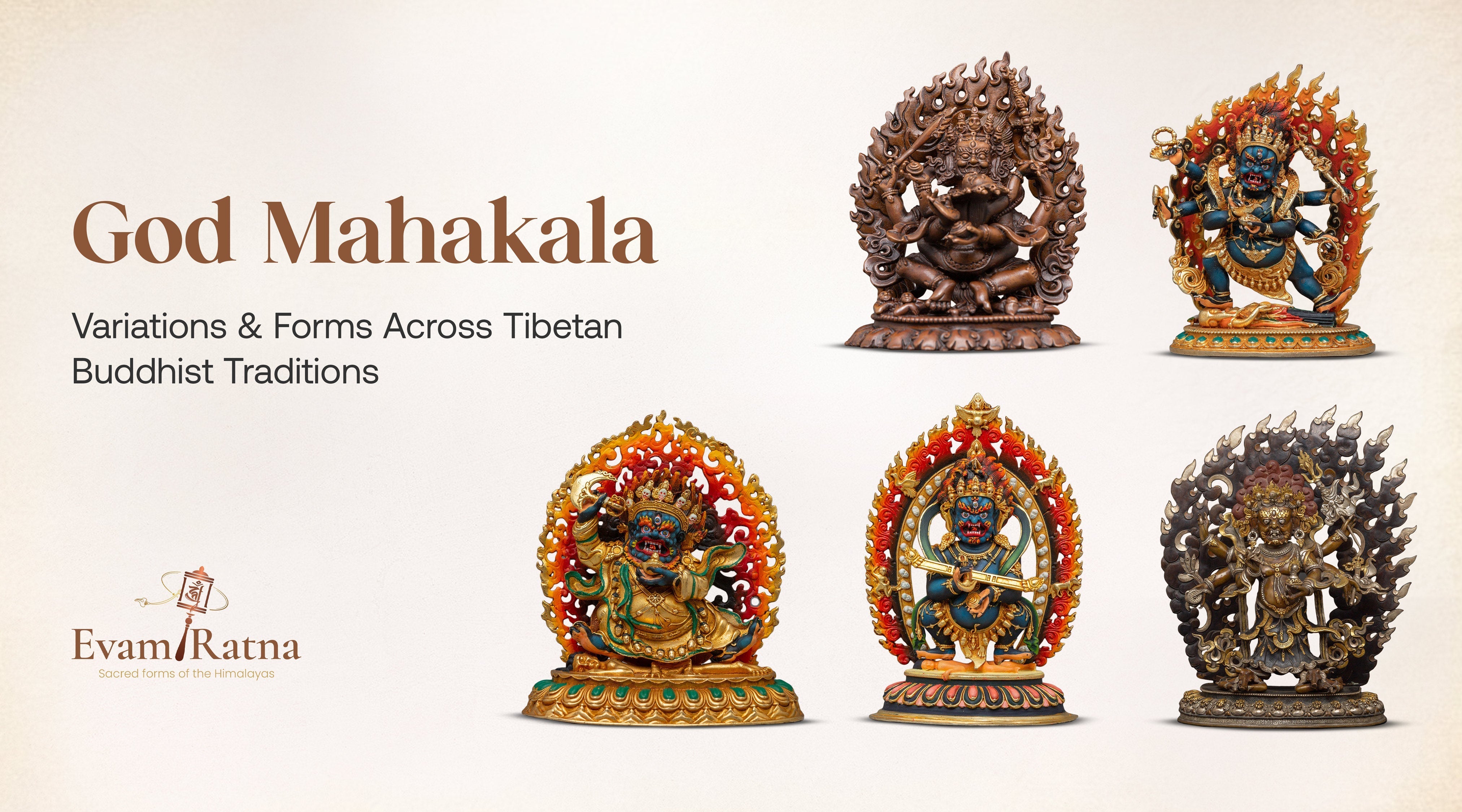
Understanding God Mahakala Iconography: Two-Armed, Four-Armed, and Six-Armed Forms
In Vajrayana and Tibetan Buddhism, the God Mahakala ("The Great Black One") is the chief Dharmapala (Dharma Protector). Mahakala is a wrathful manifestation of an enlightened manifestation of compassion (Karuna) who takes a wrathful form to defeat ignorance, eliminate spiritual obstacles, and protect practitioners on their path towards liberation, even though he is portrayed with a wrathful appearance, flaming hair, and fierce iconography.
Often depicted with fierce expressions, multiple arms, and ritual implements, he represents the power to cut through ignorance, ego, and spiritual obstacles. Across Tibetan Buddhist lineages, Mahakala assumes diverse forms, each reflecting specific functions, energies, and teachings. Understanding these variations not only deepens one’s appreciation of Himalayan sacred art but also reveals the practical spiritual purpose behind every depiction.
Origin of Mahakala in Vajrayana Buddhism

The origin of Mahakala in Vajrayana Buddhism can be traced to the development of Tantric Buddhism in India between the 7th and 10th centuries CE, when Buddhist practitioners were engaged with powerful symbolic and ritual traditions from the wider Indian religious environment. Mahakala emerged as a wrathful protector (Dharmapala), embodying the force of enlightened wisdom that removes obstacles, protects the Dharma, and transforms destructive energies into spiritual power.
The name Mahakala comes from the Sanskrit words “Maha” (great) and “Kala” (time, blackness, or death), meaning “The Great Black One” or “The Great Lord of Time.” In Indian religious traditions, Mahakala was associated with the powerful forces of time, transformation, and dissolution. As Vajrayana Buddhism developed, these fierce energies were transformed into expressions of enlightened activity.
Within Buddhist Tantra, Mahakala was incorporated into the Buddhist pantheon through the process of subjugation and transformation of powerful worldly forces. Tantric texts describe how fierce beings and energies were brought under the influence of enlightened beings and bound by sacred vows (samaya) to protect the teachings of the Buddha. Rather than representing destruction, Mahakala came to symbolize the destruction of ignorance, ego, negative emotions, and spiritual obstacles.
Forms of God Mahakala: Origins, Traditions, and Iconography
Across Tibetan Buddhist schools, Mahakala appears in numerous forms, each connected to specific tantric lineages, practices, and spiritual functions. The different manifestations of Mahakala are not separate deities but various expressions of enlightened activity. Among the most important forms are:
- Two-Armed Mahakala (Dorje Bernagchen)
- Four-Armed Mahakala (Chaturbhuja)
- Six-Armed Mahakala (Shadbhuja)
- White Mahakala (Shadbhuja Sita Mahakala)
- Panjaranatha Mahakala (Vajra Panjarnata)
Two-Armed Mahakala (Dorje Bernagchen): The Swift Protector of the Karma Kagyu Tradition

Two-Armed Mahakala, known as Dorje Bernagchen (Bernakchen or Black Cloaked Mahakala), is one of the most important protector deities of the Karma Kagyu school of Tibetan Buddhism. His name literally means “The One Wearing the Black Cloak”, referring to his distinctive dark robe that surrounds his powerful form. Unlike other Mahakala forms with multiple arms and elaborate attributes, the Two-Armed Mahakala represents direct, immediate, and forceful enlightened activity. He is invoked to remove obstacles, protect practitioners, safeguard monasteries, and preserve the teachings of the Kagyu lineage.
Dorje Bernagchen became especially prominent within the Karma Kagyu tradition, where he serves as the principal protector associated with the Karmapas, the spiritual heads of the lineage. The practice was introduced into the Karma Kagyu tradition by the 2nd Karmapa, Karma Pakshi (1206-1283 CE). The practice itself originates from the Nyingma tradition’s Revealed Treasure (Terma) tradition. According to Tibetan Buddhist traditions, Mahakala manifestations were incorporated into Vajrayana Buddhism through tantric teachings where fierce energies were transformed into protectors of the Dharma. In the Kagyu lineage, Dorje Bernagchen represents the uncompromising protective force that eliminates hindrances to meditation practice and spiritual realization.
Iconography of Two-Armed Mahakala
Two-Armed Mahakala is typically depicted as a powerful wrathful deity with:
- A dark blue or black body, symbolizing the vastness of ultimate reality and the destruction of ignorance.
- A fierce expression with three eyes, representing awareness of past, present, and future.
- Flaming hair rising upward, symbolizing blazing wisdom.
- A crown of five skulls representing transformation of the five poisons into the five wisdoms.
- A black cloak covering his body, representing his protective nature.
- He stands in a dynamic posture above obstacles, representing the triumph of enlightened awareness over ignorance and harmful forces.
Ritual Attributes of Two-Armed Mahakala:
- Right Hand: Holds a curved kartika (ritual knife), symbolizing the cutting of ego, attachment, and ignorance
- Left Hand: Holds a kapala (skull cup) filled with symbolic offerings, representing transformation of negative experiences into wisdom
Four-Armed Mahakala (Chaturbhuja): The Protector of Enlightened Activity

Four-Armed Mahakala, known as Chaturbhuja Mahakala, is one of the most widely practiced forms of Mahakala in Tibetan Buddhism. His four arms represent the complete expression of enlightened activity through body, speech, mind, and action. This form embodies the ability of awakened consciousness to protect practitioners, overcome obstacles, and transform negative conditions into spiritual progress. He is a fully enlightened Bodhisattva manifested as a wisdom Dharma protector. He is a wrathful, powerful, and ferocious manifestation of Heruka Chakrasamvara, embodying the Buddha's power, wisdom, and fierce compassionate activities. Mahakala’s wrathful compassion can overcome all obstacles and negativities one faces on the path to enlightenment.
Revered across multiple Tibetan Buddhist schools (especially Kagyu, Sakya, and Gelug), he is a principal protector deity associated with the Chakrasamvara and Guhyasamaja tantric cycles. He is the main form practiced in Mindroling monastery, in the Drukpa Kagyu lineage, and in the Nyingma tradition. He appears in various tantric cycles and protector practices, where he is invoked for removing obstacles, protecting meditation practice, and maintaining harmony within spiritual communities. In many traditions, Chaturbhuja Mahakala is connected with the activity of Avalokiteshvara (Chenrezig), representing the wrathful expression of compassion. His fierce appearance is the powerful compassion that destroys the forces preventing liberation.
Iconography of Four-Armed Mahakala
Four-Armed Mahakala is usually shown with:
- A black or dark blue body
- Three wide-open eyes
- A wrathful facial expression
- Flaming hair symbolizing wisdom fire
- A crown of five skulls representing purified emotions
- A garland of severed heads representing victory over ego and ignorance
Ritual Attributes Four-Armed Mahakala:
- Upper Right Hand: Holds a blazing sword, representing the cutting through of ignorance
- Upper Left Hand: Holds a Trident (Trishula), representing overcoming the three poisons: Ignorance, Attachment, and Aversion
- Lower Left: Holds a kapala (skull cup) filled with blood, signifying the destruction of adverse energies and spiritual fulfillment.
- Lower Right: Holds a curved kartika (ritual knife), symbolizing the cutting of ego, attachment, and ignorance
Six-Armed Mahakala (Shadbhuja): The Great Protector of Vajrayana Buddhism

Among the many manifestations of Mahakala in Vajrayana Buddhism, the Six-Armed Mahakala (Shadbhuja Mahakala) is one of the most revered and widely practiced Mahakala forms in Tibetan Buddhism. His six arms represent his ability to perform limitless compassionate activities throughout the six realms of existence. Known as a powerful Dharma Protector, he embodies the fierce compassion of enlightened wisdom, protecting Buddhist teachings and practitioners from obstacles, negativity, and spiritual hindrances.
He is an emanation of Avalokiteshvara, primarily practiced in the Shangpa Kagyu, Gelug, and Sakya traditions of Tibetan Buddhism. As a primary protector, he fiercely guards practitioners and removes obstacles on the path to enlightenment. In the Gelug tradition, he became the principal protector of the Ganden teachings, while in Kagyu traditions he is also highly revered as a guardian of tantric practices. He is also one of the three main protectors of the great Lama Tsongkhapa, together with Kalarupa and Vaishravana. His manifestation is especially important within the Gelug School, Kagyu Tradition, and other Vajrayana lineages. He is closely connected with tantric Buddhist protector practices and is regarded as an emanation of enlightened compassion. His form represents the highest expression of Mahakala’s enlightened activity, combining protection, wisdom, and compassionate action.
Iconography of Six-Armed Mahakala
Six-Armed Mahakala is depicted with:
- A dark blue-black body representing Dharmakaya wisdom
- Three eyes symbolizing complete awareness
- A crown of five skulls representing transformation of the five poisons
- Flaming hair representing blazing wisdom
- A necklace of skulls symbolizing impermanence and purification
Ritual Attributes of Six-Armed Mahakala:
- Upper Right Hand: Holds a rosary of skulls (mala), representing continuous enlightened activity and the compassionate efforts to liberate beings from suffering.
- Middle Right Hand: Holds a damaru drum, whose sacred sound awakens beings from the sleep of ignorance and symbolizes the dynamic activity of enlightened wisdom.
- Lower Right Hand: Holds a curved kartika (ritual knife), symbolizing the cutting through of ego, attachment, ignorance, and other mental defilements.
- Upper Left Hand: Holds a trident (trishula), representing the overcoming of the three poisons: ignorance, attachment, and aversion.
- Middle Left Hand: Holds a lasso (noose), symbolizing the binding of negative forces, controlling harmful influences, and guiding practitioners toward the correct path.
- Lower Left Hand: Holds a kapala (skull cup) filled with blood or nectar, symbolizing the transformation of negative emotions and obstacles into the wisdom and bliss of enlightenment.
White Mahakala (Shadbhuja Sita Mahakala): The Compassionate Wealth and Prosperity Protector

Click Here To View Our Collection of White Mahakala Statues
White Mahakala (Shadbhuja Sita Mahakala), also known as Gonkar in Tibetan, represents the compassionate and beneficial activity of this powerful protector deity. Unlike the dark, wrathful forms of Mahakala, White Mahakala appears with a white complexion, symbolizing purity, compassion, and the fulfillment of positive aspirations. He is primarily associated with the removal of obstacles related to resources, prosperity, and the conditions necessary for spiritual practice. He is regarded as an emanation of Avalokiteshvara (Chenrezig), the Bodhisattva of Compassion, expressing the compassionate aspect of Mahakala’s enlightened activity.
Iconography of White Mahakala
White Mahakala is usually depicted with:
- A white body symbolizing purity and compassionate activity
- Six arms like the darker Shadbhuja form
- Three eyes representing wisdom beyond ordinary perception
- A jewel crown and ornaments showing abundance
Ritual Attributes of White Mahakala:
- Upper Right Hand: Holds a curved knife (kartika), which symbolizes cutting through ego, ignorance, and negative emotions.
- Middle Right Hand: Holds a damaru (hand drum), whose sound awakens sentient beings from ignorance and summons the dakinis.
- Lower Right Hand: Holds a wish-fulfilling jewel (cintamani) held close to his chest, which grants the spiritual and material desires of practitioners.
-
Upper Left Hand: Holds a trident (trishula), representing his power over the three realms (desire, form, and formless) and the destruction of the three poisons (ignorance, attachment, and aversion).
- Middle Left Hand: Holds a vajra hook (ankusha), used to reel in, bind, and magnetize wealth, food, and positive spiritual conditions.
- Lower Left Hand: Holds a skullcup (kapala) containing a vase of long life (kalasha) filled with nectar and jewels, symbolizing the accumulation of spiritual merits and prosperity.
Panjaranatha Mahakala (Lord of the Tent /Pavilion)

Panjarnata Mahakala (also known as Mahakala Panjarnata or Vajra Panjara Nata Mahakala) is one of the most important protector forms of Mahakala in Vajrayana Buddhism. The name Panjarnata comes from the Sanskrit word panjara, meaning “enclosure,” “canopy,” or “pavilion,” referring to the sacred vajra enclosure that protects a tantric mandala. Unlike translations such as “tent” or “cage,” the term represents a sacred protective space created through tantric wisdom and enlightened energy.
He is the premier protector of the Sakya tradition and practitioners of the Hevajra Tantra. The wooden staff symbolizes his role in gathering the monastic community and shielding tantric retreats from hostile forces. He is a powerful manifestation of enlightened activity who safeguards tantric practitioners, protects sacred teachings, and removes obstacles that interfere with spiritual practice. His practice and iconography are described in the 18th chapter of the Vajra Panjara Tantra, a Sanskrit tantric text considered an explanatory tantra of the Hevajra Tantra. His role reflects the essential function of Mahakala as a Dharma Protector, transforming obstacles and harmful forces into conditions that support awakening.
Iconography of Panjarnata Mahakala
Panjarnata Mahakala is usually depicted with:
- A dark blue or black body, symbolizing the vastness of enlightened wisdom and the transformation of ignorance
- A fierce expression representing the destruction of obstacles and negative forces
- Flaming hair symbolizing the fire of awakened wisdom
- Wrathful ornaments representing the transformation of negative emotions into enlightened qualities
- A powerful seated posture demonstrating his immovable protective activity
Ritual Attribute of Panjarnata Mahakala:
- Right Hand: Holds a curved flaying knife (kartika), symbolizing the sharp wisdom that cuts through ego, ignorance, delusion, and negative mental afflictions.
- Left Hand: Holds a skull cup (kapala) filled with blood, representing the transformation of negative energies and the union of method and wisdom in Vajrayana practice.
- Across the Forearms: Rests a gandi staff (wooden gong staff), traditionally used in monasteries to summon monks for prayers and important gatherings. In the hands of Panjarnata Mahakala, it symbolizes his role in gathering and protecting the monastic community, maintaining harmony, and safeguarding tantric teachings.
Mahakala Across Tibetan Buddhist Lineages
The primary forms of Mahakala revered across the four major lineages of Tibetan Buddhism are deeply tied to specific tantric transmissions and monastic roots:
1. Gelug Lineage
- Shadbhuja Mahakala (Black Six-Armed Mahakala): The principal protector of the entire Gelug school and the Dalai Lamas. He is a swift-acting emanation of Avalokiteshvara.
- Sita Mahakala (White Six-Armed Mahakala): Highly revered as a wealth and prosperity deity, especially within Mongolian Gelug practices.
- Kalarupa (Yama Dharmaraja): Though technically an emanation of Manjushri rather than a strict form of Mahakala, this buffalo-headed protector is bundled directly with Mahakala as a foundational Gelug guardian.
2. Kagyu Lineage
- Bernagchen (Black Cloak Mahakala): The exclusive two-armed personal protector of the Gyalwa Karmapas and the Karma Kagyu school. He wears a heavy black cloak and is practiced daily in their monasteries.
- Chaturbhuja Mahakala (Four-Armed Mahakala): The primary protector for all branches of the Marpa Kagyu (including Drikung and Drukpa Kagyu), linked directly to the Chakrasamvara Tantra.
- Shadbhuja Mahakala: The six-armed form serves as the primary protector of the Shangpa Kagyu, where the practice originally entered Tibet through Khengpo Naljor.
3. Sakya Lineage
- Panjaranatha Mahakala (Lord of the Tent / Pavilion): The supreme protector of the Sakya school. He is two-armed, holds a wooden ritual gong (gandi) across his forearms, and guards the Hevajra cycle of teachings.
- Brahmanarupa Mahakala: A unique form where Mahakala appears disguised as an Indian Brahmin with wild hair, holding a thighbone trumpet. He is part of the core "Three Principal Protectors" of the Sakya.
4. Nyingma Lineage
- Chaturbhuja Mahakala (Four-Armed Mahakala): Widely practiced in Nyingma, heavily synthesized with early translation tantras.
Mahakala Meditation and Ritual Practice
Mahakala practice typically involves a structured sadhana: visualization of the deity, recitation of mantra, and offerings performed with implements consecrated for this purpose. Practitioners commonly maintain a dedicated Mahakala shrine area, furnished with a statue or thangka of their lineage's specific form, alongside ritual objects such as a kapala, kartika, and offering bowls.
For those newly approaching Mahakala practice, it is customary to receive the appropriate empowerment (wang) and reading transmission (lung) from a qualified lineage holder before undertaking formal sadhana practice, since Mahakala belongs to the protector class of deities whose wrathful energy is traditionally approached with proper guidance and commitment.
Mahakala practices are especially performed:
- Before important tantric rituals to remove obstacles.
- To protect monasteries, teachings, and practitioners.
- To overcome difficulties in meditation and spiritual development.
- To transform negative emotions into wisdom and compassion.
Read More About The Evolution of Mahakala in Buddhism and Hinduism: Shiva's Fierce Form to Buddhism's Protector
Conclusion:
Understanding the distinct forms of God Mahakala reveals the profound depth of Vajrayana Buddhist iconography. Across Tibetan Buddhist traditions, Mahakala manifests in various forms, including Two-Armed Mahakala (Dorje Bernagchen), Four-Armed Mahakala (Chaturbhuja), Six-Armed Mahakala (Shadbhuja), White Mahakala, and Panjarnata Mahakala. Each manifestation carries a unique iconography, lineage connection, and spiritual function, reflecting different aspects of enlightened activity. From Tibetan monasteries to Himalayan sacred art, his presence continues to remind practitioners that true protection comes not from avoiding obstacles, but from awakening the wisdom and compassion necessary to transcend them.