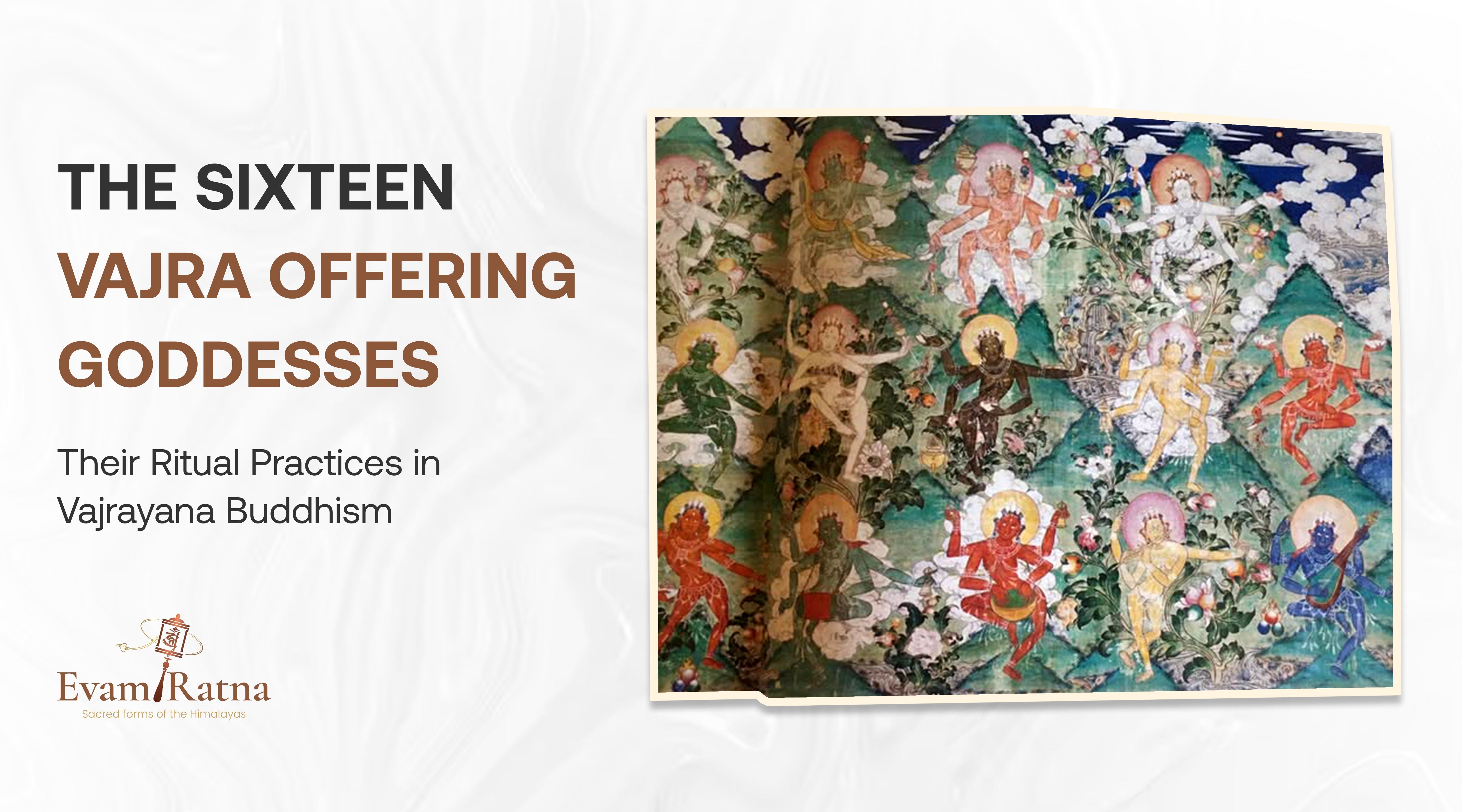
16 Vajra Offering Goddesses: The Divine Expressions of Beauty, Wisdom, and Enlightened Activity
The Sixteen Vajra Offering Goddesses (Tibetan: Chopa’i Lhamo/Chokyongma across different traditions) are an important group of enlightened feminine deities in Vajrayana Buddhism, particularly in tantric meditation, mandala offerings, and deity yoga. They represent the transformation of ordinary sensory experiences, artistic expressions, and worldly pleasures into pure offerings of enlightened awareness. They are the transformation of ordinary experiences, artistic expressions, and pleasures of the world into pure expressions of enlightened consciousness. They appear in tantric mandalas, meditation practices, ritual texts, murals, sculptures, and thangka paintings as enlightened manifestations that offer beauty, music, fragrance, taste, and other sublime experiences to Buddhas and tantric deities.
These Vajra Goddesses represent the purified elements of the five senses, arts, and offerings that arise from awakened consciousness. They are attendants and offerings to deities within tantric mandalas, offering enlightened beings divine music, fragrance, beauty, taste, touch, and other sublime experiences. They symbolize the purification of the five senses, five elements, and five aggregates, transforming ordinary perception into the pure wisdom of enlightenment. The Goddesses are especially associated with the Longchen Nyingtik tradition of the Nyingma school, where they are described in the prayer “The Lute of the Gandharvas: The Garland of Offerings of the Sixteen Vajra Goddesses.” This sacred practice cycle was revealed by the great Nyingma scholar and terton Jigme Lingpa (1730–1798) as part of the Longchen Nyingtik teachings.
Origin of the Vajra Offering Goddesses
The origin of the Vajra Offering Goddesses lies in the evolution of early Indian roots into the esoteric ritual frameworks of Vajrayana (Tantric) Buddhism. In ancient India, it was customary to welcome honored guests with specific sensory gifts, such as water, flowers, incense, and music. Buddhism adopted these practices, and these physical things became internal. They were personified in the form of beautiful, enlightened female deities in the Anuttarayoga Tantra cycles, such as the Cakrasamvara and Hevajra tantras. Structurally, the concept expanded from a core group of eight inner and outer offering deities into a fully realized mandalic assembly of sixteen goddesses, popularized in Tibet through treasure-texts like Jigme Lingpa’s Longchen Nyingtik cycle. In essence, these goddesses represent the tantric transformation of ordinary sensory desires into pure, enlightened wisdom, serving as symbolic bridges that turn worldly experiences into tools for spiritual awakening.
Sixteen Vajra Offering Goddesses in Vajrayana Tradition
-
The Lute Goddess (Tib. Piwangma)
-
The Flute Goddess (Tib. Lingbuma)
-
The Clay Drum Goddess (Tib. Dzangama)
-
The Round Drum Goddess (Tib. Ngadumma)
-
The Goddess of Charm (Tib. Gekmoma)
-
The Goddess of Laughter (Tib. Shyema)
-
The Goddess of Song (Tib. Luma)
-
The Goddess of Dance (Tib. Garma)
-
The Goddess of Flowers (Tib. Métokma)
-
The Goddess of Incense (Tib. Dukpöma)
-
The Lamp Goddess (Tib. Nangselma) / The Goddess of Light (Tib. Marméma)
-
The Goddess of Perfume (Tib. Drichapma)
-
The Mirror Goddess (Tib. Mélongma) / The Goddess of Form (Tib. Zukma)
-
The Goddess of Taste (Tib. Roma)
-
The Goddess of Touch (Tib. Rekchama)
-
The Goddess of Dharmadhatu (Tib. Chökyiyingma)
The Sixteen Vajra Offering Goddesses are traditionally divided into four distinct groups of four, categorized by the specific types of sensory, aesthetic, or musical offerings they present to the mandala's central deity.
The Four Goddesses of Sacred Sound
The first four Vajra Goddesses represent divine music and the transformation of sound into enlightened communication.
1. The Lute Goddess (Tib. Piwangma/ Skt. Gita)

The Lute Goddess Piwangma represents the offering of divine music to enlightened beings. She is traditionally depicted with a lapis lazuli blue complexion, gracefully floating among heavenly clouds while playing a traditional Tibetan string instrument known as a piwang. Her music symbolizes the purity of enlightened sound and the Buddha’s teachings spreading throughout the universe.
Iconography:
- Blue-colored body
- Holding and playing a lute-like instrument
- Appearing among celestial clouds
Mudra:
Her hand gesture resembles the act of playing the lute. The left hand faces upward, with the thumb pressing the middle and ring fingers, symbolizing the creation of harmonious sacred sound.
Spiritual Meaning:
Piwangma represents:
- Purification of ordinary sound
- Enlightened speech
- The melody of Dharma teachings
- Harmony between wisdom and compassion
2. The Flute Goddess (Tib. Lingbuma)

The Flute Goddess Lingbuma represents the offering of melodious flute music to enlightened beings. She is usually visualized as a yellow-colored goddess gracefully playing a cross flute while surrounded by clouds. Her flute represents the subtle and compassionate voice of awakened beings, reaching all sentient creatures without limitation. She reminds practitioners that sound itself can become a path toward awakening when recognized as an expression of wisdom.
Symbolism:
- The spread of Dharma teachings
- Compassionate communication
- Purification of speech
- Harmony between inner and outer worlds
3. The Clay Drum Goddess (Tib. Dzangama)

The Clay Drum Goddess Dzangama represents rhythmic musical offerings through the sacred drum. She is commonly depicted as a red-colored celestial goddess, gracefully beating a clay drum hanging at her hips. The drum’s sound symbolizes the powerful activity of enlightened beings awakening consciousness and overcoming ignorance. Her drumbeat represents the call of wisdom that awakens beings from spiritual ignorance.
Symbolism:
- Awakening awareness
- Powerful Dharma activity
- Removal of obstacles
- The rhythm of enlightened action
4. The Round Drum Goddess (Tib. Ngadumma)

The Round Drum Goddess Ngadumma is another celestial musician among the Sixteen Vajra Offering Goddesses. She is depicted holding a round drum near her hips and rhythmically playing it while dancing. Her musical offering represents the continuous activity of Buddhas benefiting all beings.
Symbolism:
- Infinite compassion
- Completeness
- Joyful enlightened activity
- The endless turning of Dharma
These musical goddesses are often visualized within the raised platforms of mandala palaces, offering their sacred sounds to tantric deities.
The Goddesses of Enlightened Activity
5. Goddess of Charm (Tib. Gekmoma)

The Goddess of Charm represents attraction and divine elegance. She is traditionally depicted with a sapphire-blue complexion, holding a vajra and bell near her hips.
The vajra and bell symbolize the union of:
- Method and wisdom
- Compassion and emptiness
- Skillful means and realization
Her charm does not represent ordinary attachment. Instead, she embodies the enlightened ability to attract beings toward Dharma and liberation.
Symbolism:
- Magnetizing enlightened activity
- Divine beauty
- Spiritual attraction
- Balance of wisdom and compassion
6. Goddess of Laughter (Tib. Shyema)

The Goddess of Laughter Shyema represents joy, happiness, and the blissful quality of awakened consciousness. Her laughter symbolizes freedom from ignorance and the realization of the empty yet luminous nature of reality. Her joyful expression reminds practitioners that enlightenment is not merely freedom from suffering but also the realization of profound bliss.
Symbolism:
- Enlightened joy
- Celebration of awakening
- Freedom from suffering
- Blissful wisdom
7. Goddess of Song (Tib. Luma)

The Goddess of Song offers sacred melodies that express enlightened wisdom. Her song represents the Dharma teachings that inspire beings and guide them toward liberation.
Symbolism:
- Enlightened speech
- Wisdom expressed through sound
- Inspiration and devotion
8. Goddess of Dance (Tib. Garma)

The Goddess of Dance represents movement as an expression of awakened activity. Her graceful dance symbolizes the spontaneous manifestation of wisdom and compassion.
Symbolism:
- Enlightened action
- Transformation
- The dynamic play of wisdom
The Four Outer Sensory Offering Goddesses
9. Goddess of Flowers (Tib. Metokma)

Metokma offers divine flowers representing beauty, purity, and spiritual awakening. Flowers bloom naturally, symbolizing the unfolding of Buddha qualities within every being.
Symbolism:
- Purity
- Enlightenment potential
- Spiritual growth
10. Goddess of Incense (Tib. Dukpöma)

Dukpoma offers sacred incense, representing purification and the spreading of virtuous qualities. The rising smoke symbolizes prayers, aspirations, and wisdom extending throughout space.
Symbolism:
- Purification
- Positive karma
- Sacred environment
11. Goddess of Light (Tib. Marmema) / Lamp Goddess (Tib. Nangselma)

The Goddess of Light offers a radiant lamp that removes darkness. The lamp symbolizes wisdom illuminating ignorance and revealing the true nature of reality.
Symbolism:
- Enlightened wisdom
- Clarity
- Removal of ignorance
12. Goddess of Perfume (Tib. Drichapma)

The Goddess of Perfume offers divine fragrance representing purity and refinement. Her fragrance symbolizes the spread of enlightened qualities throughout the universe.
Symbolism:
- Pure perception
- Virtue
- Spiritual refinement
The Four Inner Secret Sense Goddesses
13. Goddess of Form (Tib. Zukma) / Mirror Goddess (Tib. Melongma)

The Goddess of Form represents purified vision and beautiful appearance. The Mirror Goddess represents the clarity of wisdom consciousness, reflecting reality without distortion.
Symbolism:
- Pure perception
- Wisdom awareness
- Freedom from attachment to appearances
14. Goddess of Taste (Tib. Roma)

Roma represents the purification of taste and enjoyment. She teaches that sensory pleasure can be transformed into awareness when experienced without attachment.
Symbolism:
- Wisdom of enjoyment
- Transformation of desire
- Abundance and generosity
15. Goddess of Touch (Tib. Rekchama)

Rekchama represents the purification of physical sensation. She symbolizes the transformation of touch into blissful awareness and the recognition that sensations arise within enlightened consciousness.
Symbolism:
- Non-attachment
- Pure experience
- Unity of bliss and wisdom
16. Goddess of Dharmadhatu (Tib. Chokyiyingma)

The Goddess of Dharmadhatu represents the highest and most profound offering, the offering of ultimate reality itself. Dharmadhatu refers to the true nature of existence, beyond concepts and dualistic perception. She represents the wisdom realization where all sensory experiences dissolve into the vast openness of enlightened awareness.
Symbolism:
- Ultimate truth
- Emptiness and wisdom
- Perfect enlightenment
Ritual Practices of the 16 Vajra Offering Goddesses
The Sixteen Offering Goddesses (Tib. Chöpa’i Lhamo / Dorje Chöpa Lhamo) are practiced within Vajrayana Buddhist tantric rituals as enlightened manifestations who transform ordinary sensory experiences into pure offerings of wisdom and compassion. Their practices are primarily connected with deity yoga, mandala rituals, visualization meditation, initiation ceremonies, and offering prayers, where practitioners cultivate pure perception and recognize all experiences as expressions of awakened awareness.
The spiritual ritual practices of the Sixteen Vajra Offering Goddesses in Vajrayana Buddhism focus on transforming ordinary sensory experiences into expressions of enlightened wisdom. Through visualization, mantra, offerings, and meditation, practitioners recognize that sound, form, fragrance, taste, and touch are not merely sources of attachment but can become pathways toward awakening when perceived with pure awareness.
- Deity Yoga Visualization Practice: In deity yoga practice, the Sixteen Offering Goddesses are visualized within a sacred mandala surrounding enlightened deities. Practitioners imagine these goddesses making divine offerings of music, flowers, incense, light, fragrance, beauty, and other symbolic objects, representing the purification of the senses and the transformation of ordinary perception into pure vision.
- Mandala Offering Rituals: During mandala offering rituals, the goddesses symbolize the complete offering of the universe to enlightened beings. Each goddess represents a specific enlightened quality, such as sacred sound, wisdom, compassion, beauty, or the ultimate nature of reality. Their presence creates a purified environment where every experience becomes an expression of awakened consciousness.
- Purification of the Five Senses: The practice of the Sixteen Vajra Offering Goddesses is closely connected with the purification of the five senses. In Vajrayana teachings, the senses are not rejected but transformed. Beautiful forms become manifestations of wisdom, sounds become enlightened speech, fragrances become purification, tastes become wisdom nectar, and physical sensations become expressions of blissful awareness.
- Mantra Recitation Practice: Through mantra recitation and visualization, practitioners invoke the qualities of these goddesses and unite body, speech, and mind with enlightened activity. Their symbolic gestures, instruments, and offerings serve as meditation supports that help practitioners develop concentration, devotion, and recognition of the sacred nature of reality.
- Thangka, Murals, and Sacred Artistic Representations: The goddesses also appear in thangka paintings, temple murals, ritual cards (tsakli), and sacred dances. These artistic representations are used as objects of contemplation, allowing practitioners to understand the deeper meanings behind their colors, ornaments, gestures, and offerings.
- Transformation of Ordinary Experience into Enlightenment: Ultimately, the practice of the Sixteen Vajra Offering Goddesses teaches one of the central principles of Vajrayana Buddhism: ordinary experiences can be transformed into the path of enlightenment. Through pure perception and wisdom, the entire world becomes a sacred mandala where beauty, sound, and sensation reveal the enlightened nature of mind.
Conclusion:
The Sixteen Vajra Offering Goddesses represent one of the most profound teachings of Vajrayana Buddhism, where ordinary sensory experiences are transformed into expressions of enlightened wisdom. These sacred goddesses are figures of beauty, offering, and manifestations of awakened awareness, representing the purification of the senses, elements, and aggregates into the qualities of enlightenment. Through their divine offerings of music, flowers, incense, light, fragrance, beauty, taste, and touch, the Vajra Goddesses reveal the tantric principle that the world itself can become a sacred mandala when perceived through wisdom and pure awareness. Their presence in deity yoga practices, mandala rituals, thangka paintings, temple murals, and sacred arts continues to preserve the deep spiritual symbolism of Vajrayana traditions. The practices associated with the Sixteen Offering Goddesses encourage practitioners to move beyond ordinary attachment and recognize the enlightened potential within every experience. Sound becomes enlightened speech, beauty becomes pure perception, sensory pleasure becomes wisdom, and every aspect of existence becomes an opportunity for awakening.