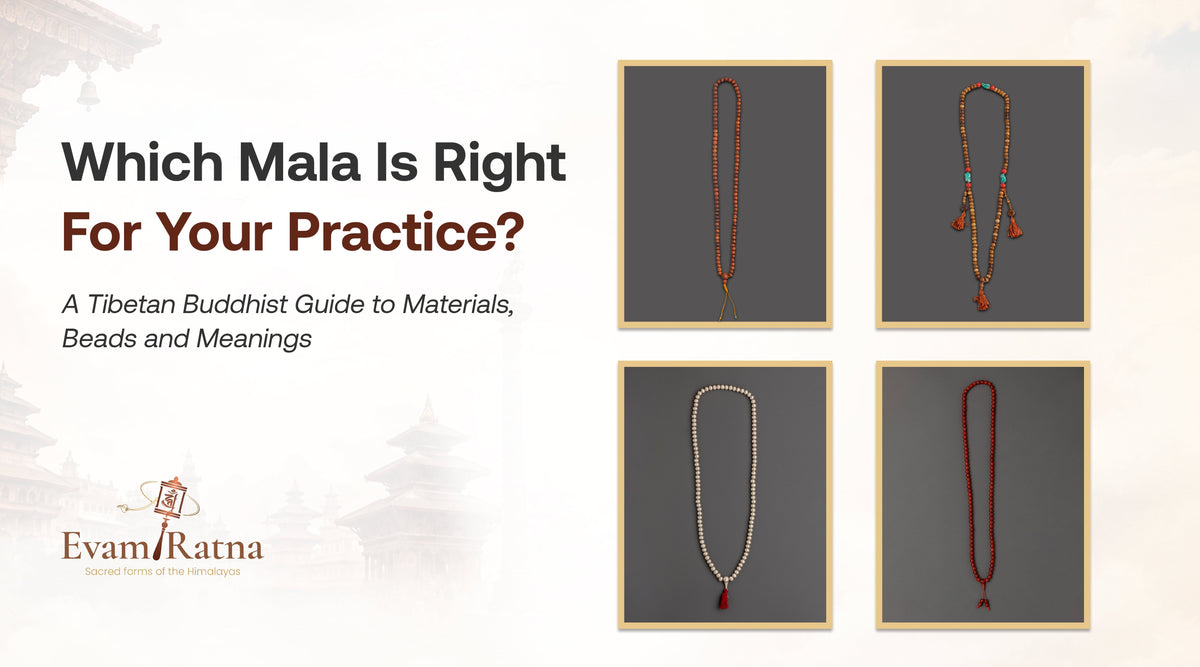
Malas and Mantra Practice: Matching Your Mala to Peaceful, Increasing, Magnetizing and Wrathful Activities
In Tibetan Buddhism, choosing a mala that is right for your practice is important as it is a sacred tool, an extension of your practice, and a mirror for the mind. When we engage in mantra recitation, the material spinning through our fingers carries a subtle resonance that directly connects to our spiritual intentions. In the Vajrayana tradition, practices are woven into four primary enlightened actions: peaceful, increasing, magnetizing, and wrathful. Choosing a mala whose material, string, and energy align with these specific activities can profoundly deepen your focus and amplify the power of your practice.
What Is a Mala, and Why Does the Choice Matter?

The Tibetan word for mala is threngwa, which means to arrange in order, to string many beads together one after another to form a rosary or garland. Traditionally, a mala is understood in two ways. It is a samaya substance (a sacred object connected to a practitioner's commitments) used for counting mantras, and it is also one of the hand implements held by wisdom deities. That second point matters: when you hold a mala, you hold something that appears in the hands of enlightened beings in Buddhist iconography.
The teaching describes its purposes as beyond count. Among them, a mala helps a practitioner develop the power of perfect recall and swiftly accomplish the four classic activities: pacifying, increasing, magnetizing, and subjugating. For this reason, the tradition says it is very important for practitioners to keep and use a mala whose material and number of beads accord with the section of tantra they are practicing. Doing so is described as a very important auspicious condition. In other words, choosing a mala is the first small act of your practice, not a shopping errand before it.
Start With Your Practice
Before looking at materials, ask what kind of practice the mala will serve. The tradition sorts activities into four categories:
- Pacifying (peaceful): calming obstacles, illness, and disturbances
- Increasing: enhancing life, merit, wisdom, and well-being
- Magnetizing: drawing in favorable conditions and qualities
- Subjugating (wrathful): overcoming powerful obstacles
Every choice that follows, from material to string color, corresponds to one of these four. If you practice a peaceful deity such as Green Tara or Chenrezig, you will look to the peaceful column. If your yidam is a wrathful deity, you will look to the wrathful column. If you are not sure which category your practice falls into, ask your teacher before buying. It is far better to wait than to buy a mala that does not fit.
For practitioners with no formal tantric commitments, such as those simply reciting Om Mani Padme Hum or another mantra as a devotional habit, the general guidance is simpler: choose a genuine, well-made mala of 108 beads, treat it with respect, and keep it for practice.
Choosing the Material of Your Mala

Choosing the right mala depends on your personal mantra practice and the type of enlightened activity you wish to develop, whether it is associated with peaceful, increasing, magnetizing, or wrathful qualities.
- For peaceful practices, beautify the mala with crystal, mother of pearl, sapphire, and conch.
- For increasing practices, use gold, silver, and ivory. The verse says this supports long life, good health, and virtue.
- For magnetizing practices, coral, copper, and red sandalwood swiftly accomplish the activity.
- For subjugating practices, the materials are rudraksha, the lungtang seed, and skull bone.
- For all activities, bodhicitta seed is said to be swift.
A Few Practical Notes on Materials
- Bodhicitta seed is the one material listed as suitable for every kind of practice. That is why so many practitioners, especially beginners unsure of their category, keep a bodhi seed mala as an everyday choice.
- Red sandalwood is one of the more accessible materials in the magnetizing group. Genuine sandalwood has a distinctive, lasting fragrance and a fine grain. Ask any seller how the wood was sourced.
- Rudraksha (the seed used in wrathful practice) is widely available in the Himalayan region. Look for seeds with natural, well-defined ridges rather than artificially carved surfaces.
- Never buy a bone mala whose material you cannot trace to a lawful and ethical source.
Match, Then Refine
You do not need to memorize the whole list. Identify your practice category, choose from the materials listed for it, and confirm that the beads are genuine, evenly sized, and well finished. Authenticity matters as much as material: the tradition specifically advises using a genuine mala.
How Many Beads Should Your Mala Have?
The Lucid Lamp of Mantra is cited on the number of beads. In general, 108 beads are advised. Alternatively, half that (54), or 21, or 11 may be used.
The teaching then links each number to an activity:
|
Activity |
Number of Beads |
|
Peaceful |
11 |
|
Increasing |
108 |
|
Magnetizing |
54 |
|
Wrathful |
21 |
If you are choosing a single mala and are not sure, 108 is the general default in the tradition. It is also the count most widely available. A mala with the wrong number of beads for its purpose is, according to the commitments section of the same teaching, not one to use, so count the beads yourself before purchase.
Read More About The Number 108 in Buddhism: Sacred Meaning, Symbolism & Significance
The Head Bead and What It Symbolizes

The head bead (Known as the guru bead) is the special bead where the mala begins and ends. Traditionally, you do not pass over it while counting; you turn back at it. The teaching, again citing The Lucid Lamp, describes head beads suited to each activity:
- Peaceful: white, round, with strings entwined
- Increasing: yellow and knotted, or tiered in the pattern of a stupa
- Magnetizing: a red flower shape; flat, crescent-shaped, or elongated forms are considered auspicious
- Wrathful: black, triangular, with triangular patterns, pointed sides and deep holes; in short, rough and sharp
For a mala meant to serve various activities, the head bead should represent the three kayas, the seal of enlightened mind, decorated with white, red, and blue beads.
The Three-Tiered Head Bead
In general, the tradition teaches that the head bead should have three tiers, symbolizing the three vajras:
- Top (blue): enlightened mind, the immutable wisdom of dharmadhatu
- Middle (red): vajra speech
- Bottom (white): vajra body
The same three tiers can also be read as the three kayas, which are beyond meeting and parting: the empty essence (dharmakaya) on top, the luminous nature (sambhogakaya) in the middle, and all-pervasive compassion (nirmanakaya) below.
If you are choosing a general-purpose mala, a three-tiered head bead in blue, red, and white is a meaningful and widely used choice. Many quality Himalayan malas come with exactly this arrangement.
Mala Counters (Chupsel): Keeping Track of Your Recitations

Counters are small accessories that known as chupsel help you track how many rounds of the mala you have completed. The tradition describes them as miniature malas with a vajra and bell at the end, made from gold, silver, copper, or similar metals.
Their shape and color follow the four activities:
- Peaceful: white and round
- Increasing: yellow and square
- Magnetizing: red, flower-shaped or crescent-shaped
- Wrathful: black and triangular
If you plan to accumulate a large number of mantras, for example during a retreat or a set commitment, a counter is a practical addition. For casual daily practice, many people go without one.
How to Hold Your Mala
Even the finger you use is part of the tradition. The scriptures, as cited in the teaching, say:
- Peaceful: place the mala on your index finger
- Increasing: on your middle finger
- Magnetizing: on your ring finger
- Wrathful: count mantras on your little finger, rotating the beads away from you in reverse
You do not have to master this on day one. But it is a good example of how the tradition treats the mala as an integrated system: material, number, string, head bead, and posture all work together. Ask your teacher to show you in person, as the movement is easier to learn by demonstration than description.
The Commitments Connected to Your Mala
The teaching divides the mala's commitments into a single root commitment and a group of subsidiary ones. Understanding them is part of choosing well, because they describe how you will live with the mala.
The Root Commitment
Someone striving for liberation and enlightenment should keep their sacred commitment (samaya) of practicing and reciting their yidam deity. While continuously seeking that deity's blessings and siddhis, they should keep a genuine mala on their body at all times. This is the root commitment.
The Subsidiary Commitments
The subsidiary commitments are practical and specific. In summary:
Care and respect
- When reciting your deity's essence mantra, do not use another mala.
- Never place your mala on bare ground, leave it lying around, or let it pass under your feet.
- Do not use it to beat dogs or other animals.
- Do not use it for calculating or other everyday purposes.
Who touches it
- Do not let others touch your mala. Keep it especially away from people with damaged sacred commitments, people who are obscured, or those who do not share the same commitments.
- Do not use a mala that comes from a very negative person.
How you use it
- Do not pass it excessively slowly through your hands while counting.
- Do not hold it with pretense or to show off.
- Do not wear it as jewelry.
Quality of the mala itself
- Do not use a mala with uneven beads, crooked beads, cracked beads, the wrong number of beads, or beads of inferior color or shape.
- Do not use malas of a different type or mixed types.
- Do not use a mala that has not been consecrated.
Repair
- If the string breaks, replace it quickly, and do not leave it broken for more than a day.
The teaching concludes that if you keep and use a mala properly, observing these and related commitments, siddhis will come swiftly.
What This Means When You Choose
Read the list above as a buying guide in disguise. It tells you to look for evenly sized, uncracked beads of the correct number; to prefer a genuine mala over a decorative one; to seek a mala that has been consecrated; and to treat the object as a practice tool, not a fashion accessory.
A Practical Checklist Before You Choose
- Identify your practice category (peaceful, increasing, magnetizing, or wrathful), ideally with your teacher's guidance.
- Choose a suitable material from the list for that category, or bodhicitta seed if you want an all-purpose option.
- Confirm the bead count matches your practice (or choose 108 as the general default).
- Inspect the beads: even size, no cracks, no crooked or mismatched beads.
- Check the string: sturdy, correct color, consistent tension.
- Look at the head bead: ideally three-tiered in blue, red, and white for general practice.
- Ask about sourcing: where the beads came from, who made the mala, and whether the materials are lawful and ethical.
- Ask about consecration: a mala for practice is traditionally consecrated before use.
- Plan for care: a clean cloth or pouch to keep it in, and a place on your altar or on your person.
- Keep it singular: use one mala for your main mantra recitation rather than switching between several.
Read More About Buddhist Prayer Beads: Spiritual Meaning, Uses, Types, and Materials
Conclusion
A mala is one of the simplest objects in Buddhist practice: a string, some beads, and a head bead. Yet the tradition treats each element with care, from the crystal or sandalwood in your palm to the finger you hold it on. Choosing a mala with that same care is a way of beginning your practice well.
Start with your practice. Match the material, the number of beads, the string, and the head bead to it. Choose a genuine, well-made mala with beads that are even and sound. Look after it as something sacred. And when in doubt, ask your teacher.
At Evamratna, every piece in our collection is sourced from Newar artisans in Patan, who have worked with sacred materials across generations. If you are ready to choose a mala for your own practice, we invite you to explore our collection with the guidance above in mind.