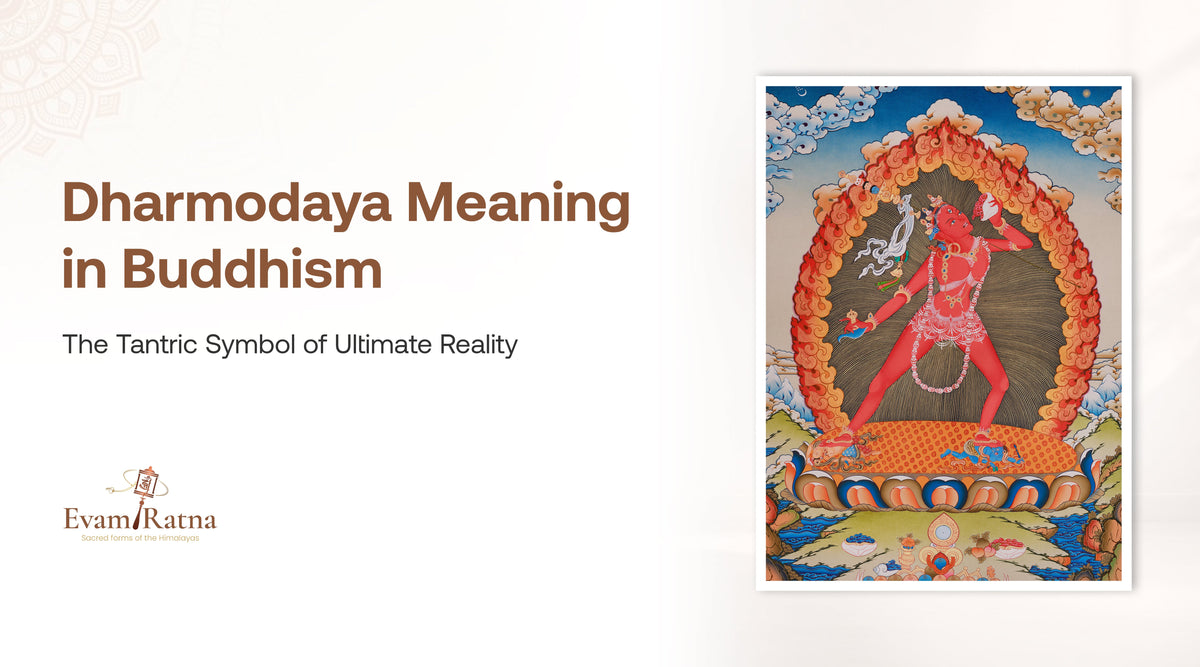
Dharmodaya: Understanding the Cosmic Space of Existence
For anyone searching for the dharmodaya meaning, the short answer is this: it is the "source of phenomena," the boundless space of emptiness from which every mandala, deity and experience arises. The longer answer takes us through Sanskrit etymology, sacred geometry, Highest Yoga Tantra and the living shrines of the Kathmandu Valley. In the thangka of the red dakini Vajrayogini and you will notice something easy to miss. She does not stand on bare ground. She stands inside a luminous, inverted triangular form, its open top blooming into a six-pointed star. That form is the dharmodaya, one of the most profound and least understood symbols in Tantric Buddhism.
Dharmodaya Meaning

Dharmodaya is a Sanskrit term for the source of all phenomena. In Vajrayana Buddhism it is a sacred form, usually a downward-pointing triangle or a pair of interlocked triangles, that symbolizes the ultimate space from which everything appears. The Rigpa Wiki, describes dharmodaya as the source of all dharmas, triangular in shape, representing the space out of which all phenomena arise. It also notes that two triangles are often combined into a star shape. In simple terms:
- Literal meaning: The arising (udaya) of all phenomena (dharma)
- Shape: an inverted triangle, a hexagram, or a three-dimensional tetrahedron
- Symbolic meaning: Emptiness as the womb-like ground of all appearances
- Tibetan name: Chöjung (chos 'byung)
- Where it appears: Vajrayogini iconography, Chakrasamvara and Hevajra tantra, mandala visualizations and Newar Buddhist art
Etymology: Dharma, Udaya and the Tibetan Chojung
The word joins two Sanskrit roots. Dharma here does not mean "the Buddha's teaching" alone. It refers more broadly to phenomena, the things and events that make up experience. Udaya means arising, rising or origin. Together they give "the origin of phenomena," a phrase the Hevajra Tantra commentary uses when it explains that worldly phenomena and noble dharmas alike rise from this source.
In Tibetan the term becomes chojung. The Rigpa Wiki points out a useful detail: in ordinary Tibetan usage, chöjung can also mean a historical text explaining how the Dharma arrived in a certain place. Only in the context of Tantra does it refer to the ground of all phenomena. So if you meet the word in a scholarly text, the surrounding context tells you which meaning is intended.
The feminine form dharmodaya also appears in Sanskrit sources. The tenth-century Dakarnava Tantra, as quoted in a translation from MDPI Books, uses it to mean the "origin of phenomenal existences."
What Does the Dharmodaya Look Like?

The dharmodaya appears in three related forms, and knowing which one you are looking at makes Himalayan art far easier to read.
- The single inverted triangle: In its simplest form, the dharmodaya is one triangle with its point facing downward. Writer Lyudmila Klasanova, in a Buddhistdoor Tea House article, notes that this single downward triangle carries the same feminine meaning it has in the Hindu tradition.
- The hexagram or six-pointed star: When two triangles interlock, they form a six-pointed star. Klasanova describes this star as one of the oldest spiritual symbols in the world, with deep meaning in Tantric Buddhism.
- The tetrahedron: This is the most technical and most important form. Jeff Watt, director and chief curator of Himalayan Art Resources, explains in Tricycle that Tantric Buddhism treats the shape as three-dimensional, both in painting and in visualization. Although a tetrahedron has four faces, only three are closed. The point faces down and the open side faces up.
The double tetrahedron, in which two tetrahedra join at their open sides and meet at one point below, produces the familiar star when seen from above. This configuration is even called the "palace" at the center of the mandala.
The Robert Beer Archive describes it in a painting of Vajrayogini as an inverted three-dimensional double tetrahedron, its open top appearing as a six-pointed star. Inside it rest the pink lotus and golden sun disc on which the deity stands.
Dharmodaya and Dharmadhatu: Source and Sphere of Reality
Two terms are often confused here: dharmodaya and dharmadhatu. They are closely related but not identical.
Dharmadhatu is the "sphere of reality," the all-encompassing expanse of things as they truly are. Dharmodaya is the "source" from which phenomena emerge within that expanse. WisdomLib records the Hevajra Tantra commentary's statement that dharmodaya is dharmadhatu because phenomena rise from it. Klasanova's article draws the same link, connecting the source of reality with the sphere of reality and, through it, with Buddha nature.
Think of open sky. The sky itself is the dharmadhatu. The dharmodaya is the same sky considered as the place from which clouds, light and weather appear. Abhayakaragupta, the influential Indian tantric author, makes this comparison directly. WisdomLib reports his view that the triangular dharmodaya, viewed outwardly, is the endless sky, and viewed inwardly is prajna, wisdom.
The Three Emptinesses of the Tetrahedron
Why are only three sides closed? Jeff Watt's explanation is elegant. The three closed sides stand for the three types of emptiness: wishless (or aimless), signless, and emptiness itself. Because the tetrahedron represents emptiness, Watt says, it also stands for the true source of all tantric mandalas and deities.
In deity yoga, a practitioner dissolves ordinary appearances into emptiness before visualizing the mandala. The tetrahedron is the visual form of that emptiness. The palace, the deities and the whole mandala arise from it. Watt gives the Vajrabhairava Mandala as an example, where the whole structure arises out of the tetrahedron and the three emptinesses.
Beyond mandalas, Watt points to the Tara who "burns suffering," from the Twenty-one Taras of the Suryagupta tradition, holding a blue tetrahedron like a bowl filled with cleansing fire. The Himalayan Art Resources archive also notes the fire pot of the deity Agni in the Medicine Buddha mandala as a tetrahedron. Watt adds that the shape plays a role in internal practices involving the body, breath and yoga.
Evam: Where Wisdom and Method Meet
A symbol of emptiness alone would be incomplete in Vajrayana. Tantric Buddhism holds that emptiness (wisdom) and compassion (skillful method) cannot be separated, and the dharmodaya is the visual home of that partnership.
The Newar Buddhist art scholarship summarized on WisdomLib explains that the interlocking double triangles were known as evam or evamkara. The syllable e stood for the female principle, the downward triangle. The syllable vam stood for the male principle, an upright triangle. Together they signify non-dual unity.
You may already know these syllables without realizing it. Buddhist sutras traditionally open with the words "Evam maya srutam," "Thus have I heard," and tantric commentators often read the opening evam as carrying this same wisdom-and-method meaning.
Klasanova puts the same teaching in plain terms. The female essence, symbolizing space and emptiness, cannot be fully realized without union with the male principle of skillful means, compassion or great bliss. Their union expresses the inseparability of subject and object, and the nonduality of bliss and emptiness, called dewa-tongnyi in Tibetan.
It describes a realization: that wisdom perceiving emptiness and the blissful clarity of mind are one taste.
Dharmodaya in Vajrayogini and Chakrasamvara Iconography

The dharmodaya is most visible in the iconography of Vajrayogini (Tibetan: Dorje Naljorma), the principal female yidam of the Highest Yoga Tantra class. She is the chief female yidam or dakini of the Vajrayana pantheon.
Klasanova explains that Vajrayogini appears with either one triangle or two intertwined triangles, and that the symbol is both her ritual diagram and her emblem. In the Tantric reading, her womb, depicted by this sign, embraces all worlds, giving rise to everything and taking everything back. The dharmodaya is the cosmic womb, the origin and dissolution of everything that exists.
She is shown with her consort Chakrasamvara in the well-known union pose called yab-yum. This union also expresses the dharmodaya's meaning, bliss and emptiness inseparable.
The Robert Beer Archive shows the classic arrangement in a painting of Vajrayogini as Naro Khandroma. She stands within a dharmodaya, on a pink lotus and golden sun disc, with her feet pressing on the figures of Bhairava and Kalaratri. The arrangement makes the point clearly. Her seat is emptiness itself, and from this ground she overcomes the obstacles of ego.
Buddha Weekly, a Buddhist publication, likewise describes Vajrayogini's mandala as featuring the double tetrahedron, or "reality source," and stresses that although it looks like a double triangle on a flat page, it is visualized in three dimensions. The same article carries a caution worth repeating: actual Vajrayogini practice requires empowerment and instruction from a qualified teacher.
Dharmodaya in the Tantric Texts
Dharmodaya is not a modern interpretation. It runs through the classical tantric literature.
- The Samvarodaya Tantra describes dharmodaya as both a source, sometimes rendered yoni, and a gate, according to WisdomLib's summary of Newar art scholarship.
- The Dakarnava Tantra places the dharmodaya inside the "body circle" mandala, describing nested triangular, square, pentagonal and hexagonal layers as part of a protective visualization.
- The Vimalaprabha, a commentary on the Kalachakra Tantra, treats dharmodaya as the "dharma source." A passage translated in the book When the Clouds Part connects it with Mahamudra, which it describes as Prajnaparamita and the source of all Buddhas.
- The Cakrasamvara Tradition: Naropa, in discussing the sacred pilgrimage sites of this tradition, mentions sacred stones, including stone dharmodayas. Scholars suggest these may be a Buddhist recasting of earlier Shaiva forms, while authors such as Abhayakaragupta emphasized living dakinis as the true sacred centers.
Dharmodaya in Newar Buddhism and the Kathmandu Valley
For readers in and around Kathmandu, the most striking fact is that the dharmodaya is not only a concept. It is also a place.
The Newar Buddhist scholarship on WisdomLib records that Newar Buddhists identify the "inverted triangle" with an aboriginal female divinity of waterholes. Her shrines are physical. One is at Hmasinga, known in Nepali as Phulbari near Balaju, where the shrine is called Pulan Guhyeshvari. Another lies at Mrigasthali, east of Pashupati. Both are underground freshwater springs, covered by a lotus made in repoussé.
The image fits the theology beautifully. A spring is a source that rises from hidden depths, unseen, and gives life to everything around it. For Newar practitioners, the dharmodaya is literally water welling up from the earth, and metaphorically the emptiness from which the world arises.
The Robert Beer Archive adds that Vajrayogini has four main aspects in the Newar tradition, each with a special temple in the Kathmandu Valley. Among them is the forest temple at Sankhu, associated with Naro Khandroma.
Finding Dharmodaya in Thangkas and Sacred Statues
Once you know what to look for, the dharmodaya appears throughout Himalayan art.
- In Vajrayogini thangkas, look beneath her lotus and sun disc for the inverted triangular form, often shown as a red or white triangle whose open top forms a star.
- In mandalas, the central palace often rises from a tetrahedron, representing the emptiness from which the mandala is born.
- In Tara's hands, a tetrahedral fire vessel may appear, as in the Tara who burns suffering.
-
In ritual objects and statues, artisans work the triangle and hexagram into lotus bases and ritual diagrams.
If you are drawn to Vajrayogini, the dakini practices or the sacred geometry of the mandala, a well-made piece can be a steady reminder of the emptiness at the heart of these teachings. Explore our Himalayan Buddhist art collections to see how these forms are made by hand.
Frequently Asked Questions
What does dharmodaya mean?
Dharmodaya means "source of phenomena" in Sanskrit. In Tantric Buddhism it names the boundless space of emptiness from which all phenomena, deities and mandalas arise, and it is usually shown as an inverted triangle or tetrahedron.
Why is the dharmodaya a downward-pointing triangle?
A downward point with an open top is a symbol of receptive space. According to Jeff Watt of Himalayan Art Resources, the tetrahedron's point always faces down and its open side faces up, with three closed sides representing three types of emptiness.
Who is associated with the dharmodaya?
Vajrayogini is the deity most closely associated with it, and she is shown standing within a double tetrahedron. It also appears in the Chakrasamvara and Hevajra traditions and in Kalachakra commentary.
What is the connection between dharmodaya and evam?
Evam is the syllable pair e and vam. The downward triangle e represents the female principle and wisdom, while vam represents the male principle and method. Together, in the interlocked double triangle, they symbolize non-dual union.
Is the dharmodaya found in Nepal?
Yes. Newar Buddhists in the Kathmandu Valley associate it with a female water divinity and with sacred springs such as the shrines at Phulbari near Balaju and at Mrigasthali near Pashupati.
Conclusion:
The dharmodaya meaning in Buddhism can be held in a single phrase, the source of all phenomena, yet it opens onto some of the deepest ideas in Vajrayana. As an inverted triangle, a six-pointed star or a three-dimensional tetrahedron, it gives shape to emptiness, not as a void, but as the open ground from which every mandala, deity and experience arises. Its three closed sides recall the three emptinesses, and its union with the syllable evam points to the inseparability of wisdom and compassionate method.