The Spiritual Significance of Long Life Deities and Practices in Tibetan Buddhism
The three long-life deities (Tshe lha rnam gsum) are the most profound sacred triads in Tibetan Buddhism. In Tibetan Buddhism, the idea of long life is very important; it is not just about living longer for personal reasons but about having more time to walk in a spiritual path, develop compassion, and help all living beings over many lifetimes.
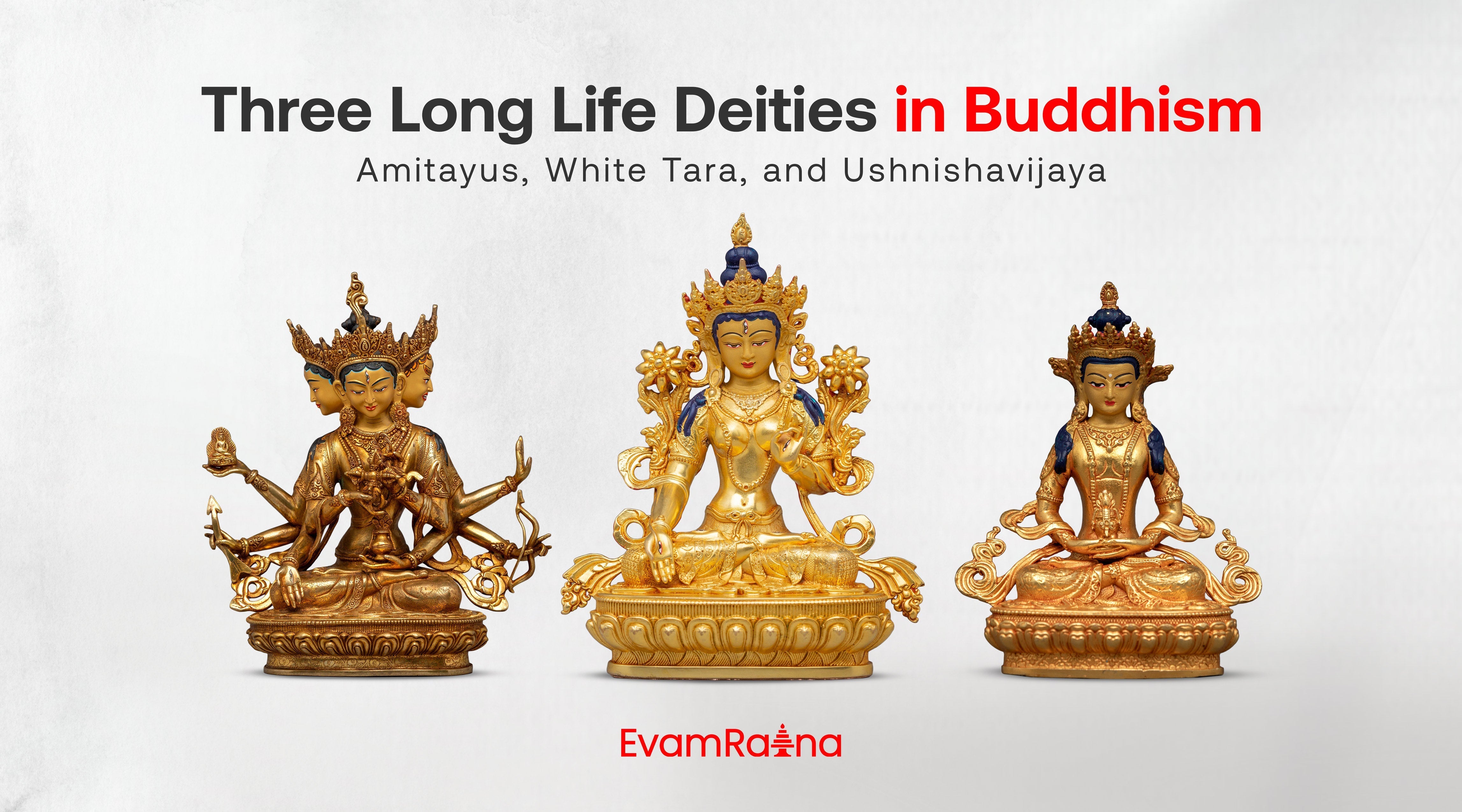
Amitayus, White Tara, and Ushnishavijaya represent different aspects of long life and spiritual growth, but together they form a complete and powerful symbol of living a meaningful and compassionate life. Amitayus is known as the Buddha of Boundless Life and represents vitality, longevity, and spiritual strength. White Tara is a gentle and compassionate goddess who is connected with healing, protection, and caring energy. Ushnishavijaya is associated with purification and overcoming obstacles, especially those related to illness and untimely death.
They are invoked together at long-life empowerments (tshe dbang), at pujas for the sick and elderly, at the passing of great teachers, and wherever Tibetan Buddhist communities gather to pray for the continuation of precious human life. Their images appear together on thangkas, on temple walls, and in private shrines across Nepal, Tibet, Bhutan, and the Himalayan world.
Why does long life matter in Tibetan Buddhism?
In Tibetan Buddhism, long life is not valued out of a worldly attachment to existence or a fear of death, but rather as a crucial opportunity to practice the Dharma and progress toward enlightenment. Because human life is considered rare and precious, extending it provides the necessary time to cultivate wisdom and compassion.
"This precious human life, so hard to obtain and so easy to waste — may it not pass in vain, like a dewdrop dissolving in the morning sun."
Long life is also important because it allows individuals, especially spiritual teachers, to help others. In Buddhism, the idea of Bodhicitta, the wish to achieve enlightenment for the benefit of all beings, plays a central role. Living longer means having more time to serve, guide, and support others on their path. In this way, longevity is not just personal, but deeply connected to helping the world.
At the same time, longevity is also about living many years with purpose, clarity, and spiritual energy. Tibetan teachings often describe long life as spiritual vitality, where a person maintains the strength, focus, and health needed for meaningful practice. This is why practices connected to the Three Long Life Deities Amitayus, White Tara, and Namgyalma focus on restoring life force, improving well-being, and supporting both physical and spiritual balance.
Even while seeking a long life, Tibetan Buddhism keeps a strong awareness of death. Rather than ignoring it, practitioners reflect on it to stay mindful and focused. Longevity practices are used to reduce fear of death and to avoid a sudden or untimely passing that could interrupt spiritual progress. In this deeper sense, long life is not about becoming physically immortal, but about connecting with the deathless truth of reality through wisdom and awareness.
Amitayus: The Buddha of Infinite Life

Click Here To View Our Collection of Buddha of Infinite Life Amitayus Statues
Amitayus, known in Tibetan as Tsepakme (tshe dpag med), is revered as the Buddha of Infinite Life. Amitayus, revered in Sanskrit for "Boundless Life," is the long-life emanation of Amitabha, the Buddha of Boundless Light, one of the five Dhyani Buddhas who represent aspects of enlightened awareness. Where Amitabha embodies infinite light and compassionate wisdom, Amitayus embodies infinite life-force, the inexhaustible vitality of the enlightened mind.
He is depicted as deep ruby-red in color, seated in vajrasana (full lotus), adorned with the thirteen ornaments of a Sambhogakaya Buddha: silks, jewels, and a five-pointed crown. In his lap, he holds a long-life vase (Tsebum) filled with the nectar of immortality, the amrita from which streams of life-sustaining light flow to all beings who invoke him.
Read More About Amitayus Buddha: Buddhist Deity Associated with Life, Longevity, and Health
White Tara (Sita Tara): Goddess of compassion & longevity

Click Here To View Our Collection of Tibetan Goddess of Compassion and Long Life White Tara Statues
White Tara, also known as Sita Tara in Sanskrit, Drolkar in Tibetan, is the most beloved of all female Buddhist deities and one of the most widely practiced long life deities across the Himalayan world. She is the embodiment of compassion made luminous and still, like moonlight on still water, healing, sustaining, and radiating boundless care for all suffering beings.
Her most extraordinary feature is her seven eyes. two on her face, one on her forehead (the third eye of wisdom), one on each palm, and one on each sole of her feet. These seven eyes represent her omniscient awareness, her ability to perceive suffering in all realms simultaneously, and her instant response to every call for help. No suffering escapes her notice; no prayer goes unheard.
Read More About White Tara: The Buddhist Goddess of Compassion, Long Life & Healing
Ushnishavijaya (Namgyalma): Goddess of Victory Over Death

Click Here To View Our Collection of Longevity Dakini Namgyalma Statues
Ushnishavijaya (Gtsug tor rnam par rgyal ma) in Tibetan, meaning "Victorious One of the Ushnisha," is perhaps the least well-known outside scholarly and practitioner circles, yet her origin story is one of the most dramatic and moving in all of Buddhist literature.
Ushnishavijaya is depicted as golden-yellow, with three faces (white, yellow, and blue) and eight arms, seated on a lotus and moon disc. Her many hands hold the long life vase, the lotus, the noose of compassion, an arrow, the bow of wisdom, and other implements, each providing a specific aspect of her liberating activity. Her crown is marked with an image of Amitabha Buddha, confirming her connection to the same compassionate lineage as Amitayus and White Tara.
Read More About Ushnisha Vijaya (Namgyalma): The Deity for Longevity and Protection
The Role of the Three Deities Together
In Tibetan Buddhism, the Three Long-Life Deities (Tibetan: tse lha nam sum) Amitayus, White Tara, and Usnisavijaya (Namgyalma) are grouped as the principal figures presiding over longevity, health, and spiritual vitality. This grouping is a Tibetan iconographic convention rather than an Indian one, created to provide a complete and harmonious support for practitioners seeking to extend their lifespan for spiritual purposes.
Amitayus: Refilling the Life
Amitayus is considered the source and wellspring of the long life triad, the primordial Buddha of life from whom the other two deities draw their power to extend and protect human existence. His practice is especially central in the Nyingma and Kagyu schools of Tibetan Buddhism. Amitayus provides the nectar of life. It works at the level of pure life-force, the fundamental vitality that underlies all experience. His practice floods the practitioner's energy body with amrita, the nectar of boundless life, restoring what has been depleted by illness, age, trauma, or negative karma.
White Tara: Clearing the Obstacles
In the context of long life practice, White Tara's role is to remove the specific obstacles to long life, the karmic imprints of past harmful actions, the energetic blockages caused by illness and negative circumstances, and the mental obscurations of fear and grief that diminish the life force. She works at the level of the subtle body and immediate circumstances, removing the energetic blockages, illnesses, fears, and outer obstacles that prevent life-force from circulating freely. Her compassionate gaze sees every obstruction, and her open hand removes it.
Ushnishavijaya: Purifying the Karma
In long-life practice, Ushnishavijaya's specific role is karmic purification, the removal of the deep karmic roots of untimely death. She works at the deepest level, the karmic imprints that create the conditions for untimely death across multiple lifetimes. Her dharani purifies karma accumulated over countless lives, removing the very seeds from which suffering and short life grow.
Tshe Dbang Empowerment & Long Life Puja

The most important formal context for the Three Long Life Deities is the Tshe Dbang, the Long Life Empowerment, a Tantric initiation ceremony conducted by a qualified lama in which the life-force of the three deities is transmitted directly into the practitioner's body, speech, and mind. It is one of the most commonly performed empowerments in Tibetan Buddhism and is regularly given by great teachers to their communities.
During the Tshe Dbang, participants receive the long life vase known as Chegumba or tsebum (filled with saffron water empowered by mantras), known as amrita; a long life arrow (da dar) adorned with silk and mirrors, which is touched to the crown and heart; and a long life pill (tshe ril), blessed through extensive mantra recitation. Each element carries the empowerment of one or more of the long-life deities.
Long life pujas, less formal than empowerments but deeply significant, are performed for lamas who are aging or ill, for students on behalf of their teachers, for parents by their children, and for those who are sick or have received inauspicious astrological readings. The three deities are invoked together, their mantras recited in the tens of thousands, and their merit dedicated to the person being prayed for.
In Nepal's Newar Buddhist tradition, elaborate long life ceremonies with ancient Sanskrit liturgies, Newar music, and offerings of 108 types of substances are conducted by vajracharya priests, a living tradition that has been maintained continuously for over a thousand years.
Practicing the Three Long Life Deities at Home

While formal Tshe Dbang empowerments require an authorized lama, a sincere daily home practice with the Three Long Life Deities is accessible to anyone with a respectful and open heart. The following is a simple framework based on traditional Tibetan practice.
1. Set up a clean altar
2. Begin with refuge and bodhichitta
3. Visualize the three deities
Visualize Amitayus above your head, radiant red, raining amrita. White Tara to your right, luminous white, her seven eyes seeing you clearly. Ushnishavijaya to your left, golden, purifying all karmic obscurations with her dharani syllables.
4. Chant the three mantras
Recite each mantra 21 or 108 times on a mala. You may practice all three in one session or dedicate specific days to each deity. Consistency over months and years is more important than the quantity in any single session.
5. Dedicate the merit
At the close of practice, dedicate all accumulated merit to the long life, health, and happiness of all sentient beings and especially to the long life of any teachers, parents, or friends who are sick or aging.
The Significance of the Immortality Vase on Your Altar

Click Here To View Our Collection of Long Life Vase Tsebum
You can also place an Immortality Vase (Tsegum Vase) on your altar. It represents long life, life force, and spiritual nourishment, making it a powerful addition to long-life practices. It carries deep spiritual meaning and supports your practice:
- Symbol of Life Force: It represents the nectar of long life and vitality, helping to strengthen your energy and well-being.
- Spiritual Nourishment: The vase symbolizes wisdom and compassion that sustain your spiritual journey.
- Connection to Amitayus: It is closely associated with Amitayus, who is often shown holding a vase filled with life-giving nectar.
- Reminder of Purposeful Living: It reminds you that life is precious and should be used for growth, awareness, and helping others.
Read More About Understanding the Vase of Immortal Nectar (Tsegum Vase) in Buddhism
Conclusion: Living a long life with purpose
The Three Long Life Deities, Amitayus, White Tara, and Ushnishavijaya, are ultimately not about clinging to the body or living longer for our own sake. They are about creating the conditions for purposeful life, the life that is long enough, healthy enough, and clear enough to fulfill the deepest aspiration of the human heart: the liberation of all beings from suffering.
"May all beings have happiness and the causes of happiness. May all beings be free from suffering and the causes of suffering. May all beings never be separated from joy that is free from sorrow. May all beings abide in equanimity, free from attachment and aversion."
- The Four Immeasurables, foundation of all long life practice
To practice with these three great beings is to enter into a relationship with the most compassionate forces in the universe, forces that have pledged, across countless eons and countless rebirths, to remain available to every being who sincerely calls upon them. Their vow is unconditional. Their patience is infinite. Their love has no boundary.
May Amitayus fill your life with the nectar of boundless vitality. May White Tara's seven eyes always see you and her open hands always reach you. May Ushnishavijaya's dharani purify the roots of all that shortens and diminishes life. And may all the merit accumulated through this practice flow outward, like rivers to the sea, for the long life and happiness of all sentient beings without exception.