Understanding the Buddha of Infinite Life: His Significance for Life, Health, and Spirituality
Amitayus is the Buddha of Boundless Life, a celestial deity who embodies the infinite life force and compassion needed to overcome obstacles and restore our inner radiance. We often find ourselves searching for a source of true, lasting peace and seeking health, longevity, and a way to transform the suffering. So if you want to connect with an enlightened presence who is associated with infinite life, promoting longevity, health, and removing obstacles to life, then you should invoke Amitayus. In this blog, we will look at the sacred symbolism of his ruby-red form, uncover the secrets of the nectar of immortality held in his lap, and explore how his ancient vows and teachings can strengthen your body and mind today.
Amitayus Buddha: The Deity of Infinite Life, Longevity, and Health

Amitayus Buddha is the "Buddha of Boundless Life." He is a sambhogakaya form (an apparitional body), who is revered in Mahayana and Vajrayana Buddhism for his longevity, good deeds, and wisdom. Aparmita (Aparimitayus) is another name that translates as "Unlimited Life" in Sanskrit. Often referred to as Tshe dpag med in Tibetan, he is invoked by practitioners to seek protection from untimely death and to cultivate the radiant health necessary for a meaningful spiritual journey. He is depicted red in color, adorned with jewels, holding a vase of immortal nectar, and is one of the "three deities of long life".
Historical Origin of Amitayus: The Vows of Dharmakara
The origin story of Amitayus is deep, transformative, and compassionate, which is the foundation of his role within Buddhist practice. Before attaining Buddhahood, Amitayus was once a king named Dharmakara, who ruled over a prosperous kingdom. But despite the wealth, power, and privileges, Dharmakara was severely shaken by the great suffering he could see everywhere around him. He witnessed the suffering of his people, the diseases, the deaths, and the confusion that plagued them. The suffering in the world provoked something within him that could not be disregarded.
As a reaction to the misery he observed, Dharmakara made the great choice: he gave up his throne, abandoned his royal life and turned into a monk. In Buddhist traditions, this renunciation is quite important as it is the major transition between worldly craving and the spiritual one. Of course, it was not only a personal change in Dharmakara, but also a point in the development of Buddhism. In search of a greater goal, Dharmakara was now resolved to destroy suffering and not only his own but also that of all beings.
The Vision and the 48 Vows
Dharmakara contemplated a long time of five kalpas, a long time indeed, it is said, which is equal to the time that stars are forgotten. In this meditation, he thought carefully of a pure land and took forty-eight serious vows to ensure that it would be a place of perfect spiritual development.
These vows established the following characteristics for his realm:
- Freedom from Suffering: He vowed that in his world, no being would ever be born into states of intense pain, such as the hell realms, or states of extreme craving, such as the realm of hungry ghosts.
- Environment of Wisdom: He envisioned a place, Sukhavati (the Western Pure Land), the ground of which is paved with jewels, and the wind itself can hear the sound of mantras. Trees give shade in this world and they give spiritual lessons to people below them.
- Effortless Awakening: Sukhavati is a place where awakening is effortless and reaching Buddhahood is inevitable for all who reside there.
Attaining Buddhahood

Once these vows were perfected and his vision was complete, the universe is said to have trembled, and flowers rained down from the heavens. At that moment, Dharmakara achieved enlightenment and became Amitayus, the Buddha of Boundless Life. He now waits eternally in Sukhavati, as a source of healing, longevity, and a "light that patiently awaits you exactly as you are."
"Buddha of Infinite Life,
foremost guide for beings in this world,
Your glory overcomes all ultimely death,
You are a refuge for those of us
who suffer without protection
To you, Buddha Amitayus,
I pay homage!"
From the words of the Buddha
A central "secret" or key element of these vows is the accessibility of this realm to ordinary beings. Amitayus vowed that anyone who sincerely remembers him or recites his name, even just ten times in their final moments, would be saved from falling into lower states of existence and would be welcomed into his Pure Land.
Sacred Iconography and Symbolism of Amitayus

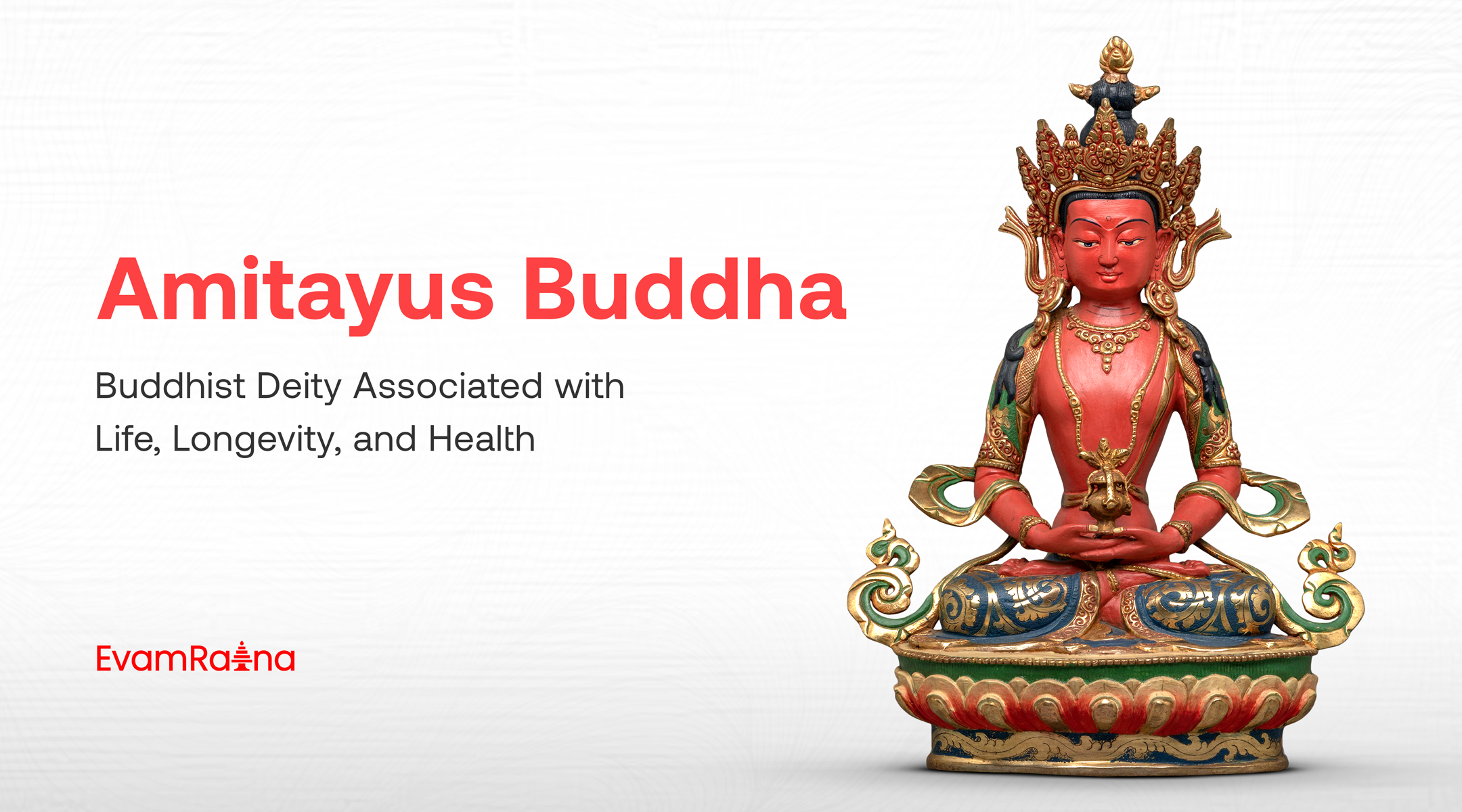
The imagery of Amitayus serves as an enlightenment and a source of life map. He is traditionally depicted with a deep ruby or red-colored body, symbolizing power, joy, and supreme life force.
His Iconography includes:
- Appearance: Amitayus is a Bodhisattva-form deity wearing jewels and silk clothes and a crown, a symbol of the prosperity of enlightenment.
- Color: Usually deep red, symbolizing vitality, energy, and the warmth of compassion.
- The Long-Life Vase (Kalasha): This vase is in his lap, filled with amrita, the nectar of eternal life, which is associated with the cleansing of illness, bad karma, and prolonging life.
- Hand Gesture (Mudra): Hands are typically placed in the Dhyana Mudra (meditation gesture) on his lap, supporting a vase of immortality.
- The Wish-Fulfilling Sprout: Emerging from the vase, it signifies the flourishing of merit and positive qualities.
- Regal Adornments: He wears a five-jewel crown and the eight ornaments, representing enlightened dignity and a connection to the five wisdoms.
- Meditation Posture: Seated in the vajra posture on a lotus seat and moon disc, with the quality of unshaken equanimity and inner tranquility.
Read More About Understanding the Vase of Immortal Nectar (Tsegum Vase) in Buddhism
The Connection Between Amitayus and Amitabha
In Mahayana and Vajrayana traditions, Amitayus and Amitabha are considered two aspects of the same enlightened being. While Amitabha represents "Infinite Light" and resides in the Western Pure Land of Sukhavati, Amitayus represents "Infinite Life".
The distinction lies in their "bodies" of manifestation:
Amitayus is regarded as Sambhogkaya (enjoyment body), a divine aspect of Amitabha Buddha, the Buddha of Infinite Light. While Amitabha Nirmanakaya (emanation body) is regarded as appearing in a form of Buddha, Amitayus appears in a form of Bodhisattva.
Read More About Amitabha Buddha: Understanding the Buddha of Infinite Light and Compassion
The Power of Ritual Practices:
Practitioners engage with Amitayus through visualization, long-life empowerments (tsewang), and the recitation of his sacred mantra. Specific visualization practices are utilized to guard against the fear of death. Specific visualization practices are utilized to guard against the fear of death. In Vajrayana Buddhism, long-life empowerment rituals are often practiced to restore vitality and purify the specific karma that may obstruct or shorten one’s life. These practices, transmitted through unbroken lineages by masters like Guru Padmasambhava, are used to guide the practitioner's consciousness toward a peaceful rebirth and ultimate liberation.
Significance for Health, Longevity, and Spirituality

While Amitayus is a central figure for those seeking physical health, his blessings give you physical immortality as well as a you can reborn at spiritual pure land. In the Buddhist context, long life is valued because it provides more time to practice the Dharma and reach enlightenment.
Amitayus is often part of the "Long-Life Trinity" alongside White Tara and Ushnishavijaya. They are collectively a spiritual technology of restoring vitality and achieving the undying consciousness of an awakened mind.
The Amitayus practice has a spiritual purpose, namely, not to gain physical immortality, but to live long enough to gain time to develop and realize spiritually. Amitayus is the continuation of consciousness and the everlasting existence of an enlightened mind. His alignment with his energy allows practitioners to awaken a deathless consciousness that is beyond the cycle of birth and death.
Conclusion:
Amitayus Buddha, Buddha of Boundless Life, promises a way to prolong physical life, and far beyond that, his teaching helps to lead us to spirituality and complete liberation. His deep commitments, such as the creation of Sukhavati, the Pure Land without any suffering, clear the way to enlightenment of every creature. By engaging in basic rituals such as chanting the name of Amitayus, his mantra, and visualizing his divine presence, the devotees can be blessed with his health, long life, and wisdom.
Amitayus embodies the principles of compassion and wisdom to face the barriers in our lives, and that is a powerful tool for personal transformation. His vows ensure that, no matter our circumstances, we are never beyond the reach of liberation and the chance to cultivate a deeper, more fulfilling spiritual practice.
By practicing the teachings of Amitayus Buddha, we can be connected with the minds of the enlightened, which prolongs our lives physically and spiritually to gain the peace and wisdom we need to reach enlightenment. Through interaction with Amitayus, fear of pain and death can be eliminated and we may find permanent peace and energy in every moment.