The Role of Mitrupa in Transforming Negative Emotions
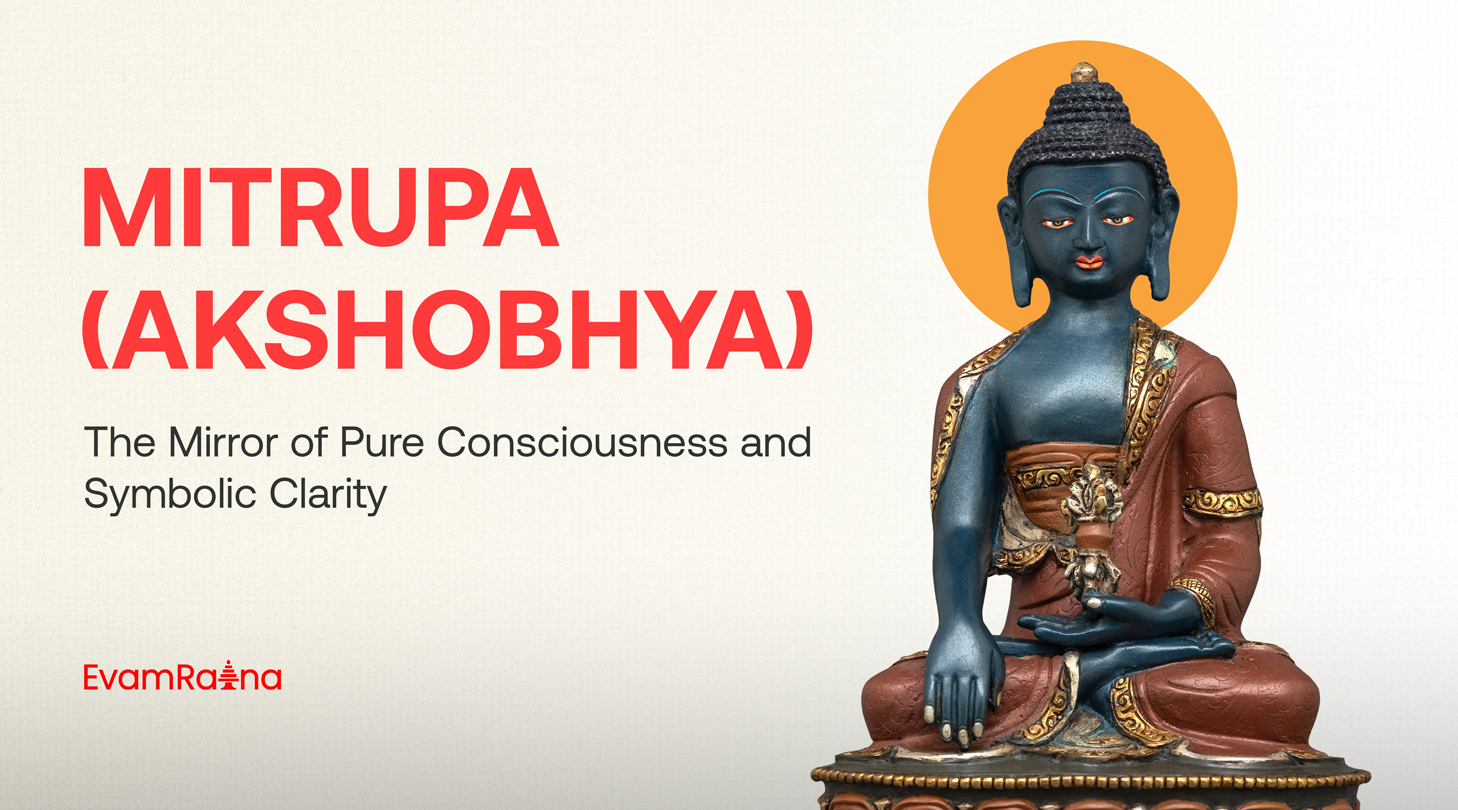
Mitrupa, also known as Akshobhaya, is a deity in Buddhism known as one who can transform negative energies, offers a profound refuge by transforming anger and chaos into clear, unwavering insight in a world increasingly defined by emotional turbulence and impulsive reactions. He is the presiding Buddha of the Vajra family, one of the five Buddha families (Tathagata kulas) that together represent the totality of the enlightened mind. Someone who struggles with their own quick temper, Mitrupa helps them to transform their most poisonous emotions into clear, mirror-like wisdom, revealing a strength that is rooted not in control, but in unyielding awareness.
Introduction of Akshobhya Buddha:

Akshobhya Buddha, known in Tibet as Mitrupa (or Mitrugpa), which literally means "The Unshakable" or "The Immovable One," reflects a state of mind that remains unaffected by the waves of anger, hatred, and aversion that frequently disturb our inner peace. As the head of the Vajra Family, Mitrupa represents the transmutation of the "poison" of aggression into the Mirror-like Wisdom, a clarity that sees reality exactly as it is, without the distortion of personal bias.
Seated in the East, unmoving as a mountain, Akshobhya embodies a wisdom that does not flinch, not before anger, not before hatred, not before the storms of samsara. For practitioners on the Vajrayana path, understanding Mitrupa and invoking him is a profound doorway into the transformation of the mind's most volatile energies.
The Origin of the Unshakable Vow
The spiritual legacy of Mitrupa begins with a miraculous and extraordinary awakening of Bodhichitta (the mind of awakening). The Akshobhya Sutra says that before he became a Buddha, Mitrupa was a monk who made a radical promise in front of the Tathagata Vishalaksha. He promised that he would never let himself feel anger or dislike for anyone, no matter how bad things got, from that moment until he reached full enlightenment. This monk meditated without stopping for thousands of years, staying strong through every challenge. He eventually manifested as the Buddha Akshobhyabecause he was never "shaken" by anger. His narrative serves as a reminder that discipline and commitment can turn even the most negative feelings into pure, awakened awareness. Today, many people see him as the face of peace, and he is especially helpful for people who have a temper or have to deal with other people's anger.
Iconography of Mitrupa:

In Thangka paintings and sacred sculpture, Mitrupa (Akshobhya) is depicted with the following iconographic precision:
Deep Blue Color: He is typically depicted in a deep lapis blue, a color that symbolizes the Dharmadhatu (the expanse of reality) and the element of water. Just as clear water reflects the sky without changing its own nature, Mitrupa’s blue color represents the mind’s capacity to be vast and calm once all defilements are released.
The Earth-Touching Mudra (Bhumisparsha): Mitrupa is almost always shown with his right hand touching the earth. It signifies his unshakable resolve and the groundedness of authentic being.
The Vajra Scepter: In his left hand, which rests in his lap in the mudra of meditative equipoise, he often holds a vajra. The vajra, or "diamond scepter," is the ultimate symbol of the Vajra Family. It represents indestructible knowledge, clarity, and the adamantine nature of pure consciousness that cannot be destroyed by ignorance.
The East: In the Buddhist mandala of the Five Dhyani Buddhas, Mitrupa rules the Eastern Pure Land, the "Realm of Intense Delight" (Abhirati). This is the direction of the rising sun, representing awakening, initiation, and the moment ignorance begins to give way to awareness.
Mirror-Like Wisdom(Adarsha-jnana): The Core Teaching of Akshobhya
The wisdom associated with the Vajra Family is Mirror-like Wisdom. Just as a mirror reflects whatever is placed before it, whether beautiful or ugly, without being affected or stained by the images, this wisdom allows the mind to perceive reality without distortion. When we feel anger, we usually see things through bias and fear. But Mitrupa teaches us to observe the anger itself, like looking at a reflection in a mirror. When we do this, we realize that anger is not solid or permanent; it is just a temporary wave in the mind that comes and goes.
A mirror has a remarkable quality: it reflects everything that comes before it with perfect accuracy, without preference, without distortion, and without being stained by what it reflects. It does not cling to beautiful images. It does not recoil from ugly ones. It simply shows what is.
This is the nature of Akshobhya's wisdom. It is awareness in its most pristine form, luminous, clear, and unobstructed. It reflects the true nature of all phenomena exactly as they are, free from the filters of ego, free from the distortions of hope and fear.
In the context of the Alaya-vijnana (storehouse consciousness) in Yogacara Buddhist philosophy, mirror-like wisdom is what the base consciousness becomes when it is purified. All the seeds of karma, memory, and conditioning are seen nakedly, reflected without self-deception.
For a practitioner, seeking this wisdom even briefly is transformative. It is seeing oneself and the world without the veil of reactive emotion.
The Role of Mitrupa in Transforming Negative Emotions

This is perhaps the most essential teaching Akshobhya offers to the modern practitioner: the transformation of anger and hatred into wisdom.
The Poison: Anger and Hatred
In the Vajrayana tradition, each Buddha family is associated with both a wisdom and its corresponding poison, the obscured, neurotic version of that same energy. For the Vajra family and Akshobhya, the poison is (dvesha) anger, aversion, hatred, and aggression.
Anger is one of the most harmful emotions. It hurts the person who feels it, damages relationships, and makes it hard to think clearly. It can also lead to negative consequences in life. In Buddhism, anger happens when we face something we don’t like and react with resistance instead of understanding and calmness.
Yet Vajrayana wisdom offers a radical reframing: the energy of anger is not to be suppressed or eliminated, it is to be recognized and transformed.
The Transformation: From Poison to Wisdom
The key insight of Akshobhya's teaching is that anger and mirror-like wisdom share the same root energy: a sharp, strong, intense clarity. When it turns into anger, it becomes narrow, rigid, and focused only on ourselves. But when this same energy is free from ego, it becomes like a mirror: calm, clear, and able to see things exactly as they are.
In Tibetan Buddhist practice, particularly in Dzogchen and Mahamudra teachings, the practitioner is instructed not to fight anger or push it away, but to look directly at its essence. When anger is seen nakedly, not followed into its story, not suppressed, what remains is a fierce, wakeful clarity. That clarity is Akshobhya.
This transformation is described in the Bardo Thodol (Tibetan Book of the Dead):
At the moment of death, the brilliant blue light of mirror-like wisdom — the light of Akshobhya — arises. If the practitioner can recognize it, liberation is immediate. But if they turn away from its intensity and are drawn instead to the dim, comfortable light of hatred, they wander further into samsara.
The teaching is clear: we are already close to mirror-like wisdom whenever we feel the sharp heat of anger. The question is whether we recognize it or get lost in it.
The Metaphor of Water
Water is the elemental association for Mitrupa and the Eastern Buddha family. Water has a dual nature: it can be the gentle trickle of a stream or the vast, tempestuous power of the ocean. Most importantly, water serves to cool the heat of anger. Practicing the meditations of Mitrupa is like splashing cool water on a heated face, startling the practitioner into a state of tranquility and discernment.
Read More About Cosmic Harmony Unveiled: Embracing the Insights of the Five Dhyani Buddhas
Akshobhya in the Highest Yoga Tantra: The Guhyasamaja

For advanced practitioners, Mitrupa’s role is most clearly articulated in the Guhyasamaja Tantra, often called the "King of Tantras." In this system, Akshobhya is the central deity and the progenitor of the entire mandala.
The Aggregate of Consciousness
In the tantric framework, Mitrupa represents the perfect purity of the aggregate of consciousness (vijnana-skandha). This is significant because consciousness is the "site" where all other perceptions and afflictions arise. By meditating on Mitrupa, the practitioner aims to purify the very root of their experience, transforming ordinary consciousness into the wisdom of the sphere of reality.
The Visualization Process
The Sacred Words of Lord Akshobhya provides a detailed guide for the Generation Stage of the Guhyasamaja path. The process is a meditative technology designed to dismantle the practitioner's ordinary sense of self and replace it with a "pure vision" of themselves as Mitrupa.
-
Dissolution into Emptiness: The practice begins by dissolving the ordinary body of flesh and bone into emptiness (Shunyata). This represents the Dharmakaya (the Truth Body).
-
Arising as Blue Light: From within emptiness, a beam of blue light emerges, representing the Sambhogakaya (the Enjoyment Body).
-
Full Emergence: Finally, the practitioner arises in the full form of Mitrupa, representing the Nirmanakaya (the Emanation Body). It is a "body of light," of a similar nature to a rainbow or a reflection in a crystal ball.
The Body Mandala
A unique feature of this practice is the Body Mandala, where different parts of the practitioner's own anatomy are visualized as the thirty-two deities of the Guhyasamaja.
- Vairocana is placed at the crown.
- Amitabha is placed at the throat.
- Akshobhya is placed at the heart.
- Ratnasambhava is placed at the navel.
-
Amoghasiddhi is placed at the secret place.
By placing Mitrupa at the heart, the practitioner identifies their most subtle consciousness with the unshakable wisdom of the Buddha. This practice is said to leave powerful imprints that eventually lead to the actualization of the "Union" of bliss and emptiness.
Akshobhya in Tibetan Buddhist Ritual and Practice

Akshobhya holds a central place in many Tibetan Buddhist ritual contexts:
Purification Practices: Akshobhya's mantra and visualization are considered among the most powerful methods for purifying negative karma, particularly karma generated through the breaking of Vajrayana vows (samaya). The Akshobhya Sutra, one of the earliest Pure Land texts, details his vows and the nature of his Pure Land, Abhirati.
Thangka and Mandala Art: In the five-buddha mandala, Akshobhya's blue form in the East is among the most frequently depicted. Thangka paintings from the Kagyu, Nyingma, Sakya, and Gelug schools all include his image in foundational mandala works.
The Bardo: As described in the Bardo Thodol, the recognition of Akshobhya's blue light during the dying process or in the intermediate state is considered a key opportunity for liberation. Practitioners are taught to familiarize themselves with his qualities during life so that recognition arises naturally at the time of death.
Sadhana Practice: In formal Vajrayana sadhana (ritual meditation), practitioners may take on the visualization of Akshobhya, arising as the deity, reciting his mantra, and dissolving back into emptiness, as a complete path of transformation.
Why Akshobhya's Wisdom Is Essential for Modern Practitioners
Akshiobhaya teaches us how to deal with anger in today’s fast and stressful world. Information moves faster than reflection. Outrage cycles are compressed into hours. People get angry easily, individually and even as a society. His teaching is not about escaping anger, but learning how to handle it wisely.
Being “unshakable” doesn’t mean being cold or emotionless. It means staying calm and steady even when strong emotions arise. Like Akshobhya, we can feel anger, but we don’t have to lose control. Instead, we stay grounded and observe clearly without reacting blindly.
The key message is simple:
The clear and aware part of your mind is already there, even when you are angry. You don’t need to create it; you just need to stop getting lost in your thoughts and stories.
When you recognize this, even for a moment, you begin to see things clearly. That is the beginning of true wisdom.
Conclusion: The Immovable Ground of Awakening
Mitrupa or Akshobhya, the Unshakable, in the Vajrayana understanding, is a living quality of your own mind. It is the state of awareness that stays steady, doesn’t react, and sees things clearly without distortion.
The path he shows is not easy. When anger arises, instead of reacting or suppressing it, we are asked to sit with it and observe it calmly. This takes courage, practice, and understanding. We learn to look directly at anger and notice that there is also a kind of clarity within it.
But the promise of Akshobhya is equally vast: that the energy which causes the most suffering, when seen clearly, becomes the sharpest sword of wisdom. That hatred, transformed, becomes the capacity to see without illusion. That the immovable mountain of your own awakened nature has always been there unshaken beneath every storm.
Read More About Unraveling the Mystical Difference of Shakyamuni and Akshobhya Buddha: Are they same?