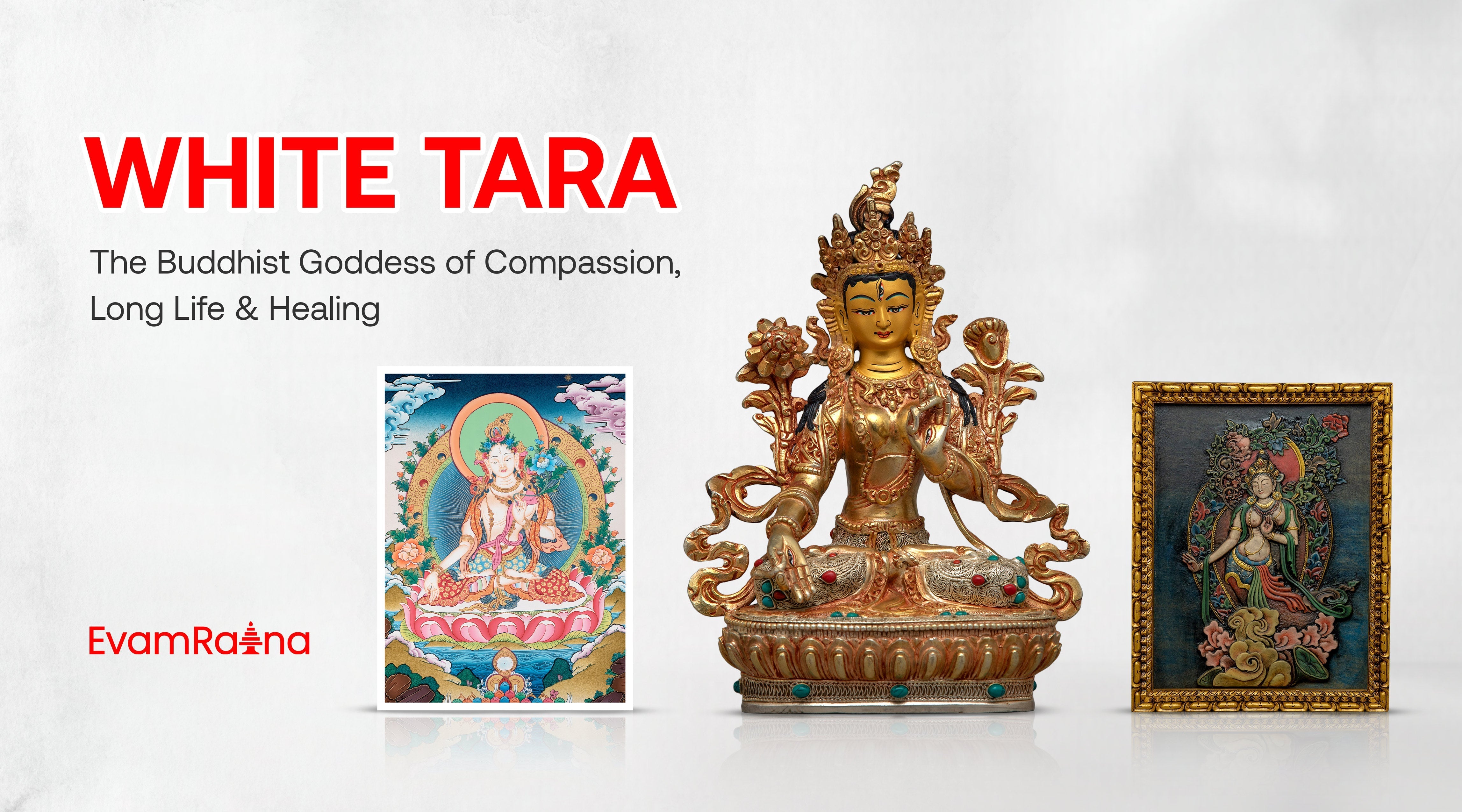
The Symbolism of Sita Tara: Seven Eyes, Lotus & Hand Mudras
White Tara is a revered Buddhist deity who is primarily associated with healing, long life, and compassion. She is the mother of all Buddhas and an embodiment of the maternal aspect of compassion. Her nurturing presence is said to be even closer and more attentive than a mother’s love for her child, offering a sense of protection that feels deeply personal. If you want to heal a tired mind, get your energy back, or just learn how to live with more grace, White Tara's story can help you find balance. Let's talk about how her calm energy can help you find the safe place you've been looking for.
White Tara: Mother of Liberation

Across the Buddhist world, White Tara holds a prominent and beloved place, though her specific roles and rituals vary subtly between traditions. White Tara, often called the “Mother of Liberation,” is one of the most beloved and revered female deities in the Mahayana and Vajrayana Buddhist traditions. Known in Sanskrit as Sita Tara and in Tibetan as Drolkar, she is a radiant symbol of compassion, healing, and long life. She is specifically associated wth practices that help to lengthen one’s lifespan and overcome life-threatening hindrances. She offers healing from illness, warding off the shadow of untimely death, and nurturing the inner peace that comes from deep spiritual practice.
In Newar Buddhism, White Tara is worshipped as both a Bodhisattva and a Tantric deity, with elaborate puja rituals conducted in ancient Sanskrit. The Newar community's exquisite thangka paintings and hand-hammered metalwork of White Tara are among the finest sacred art in the world. In the broader Mahayana tradition, she represents the perfection of the three virtues most essential for liberation: compassion (karuna), wisdom (prajna), and skillful action (upaya), all rooted in the stillness of an unshakeable meditative heart.
The Origin & Legend of White Tara

The origin of Tara is poetically told across many Buddhist texts. Tara was born from the tears of Avalokitesvara (Chenrezig), the Bodhisattva of Compassion, who wept upon witnessing the endless suffering of sentient beings. From his right tear arose Green Tara, from his left tear, White Tara, each a crystallization of pure compassionate intention.
"From the tears of compassion, she was born — not to escape the world's suffering, but to face it with open eyes and an open heart."
Another tradition traces Tara's origin to Princess Yeshe Dawa, a devotee who lived countless eons ago. Monks encouraged her to pray for rebirth in a male body to pursue enlightenment, but she vowed instead to remain female lifetime after lifetime until all beings were liberated, a revolutionary vow that established the sacred feminine as an equal vessel of awakening.
In Tibetan tradition, White Tara is associated with historical figures of great spiritual accomplishment. The Chinese princess Wencheng and the Nepali princess Bhrikuti, both wives of Emperor Songtsen Gampo, who brought Buddhism to Tibet, are revered as earthly manifestations of White Tara and Green Tara, respectively.
Iconography and Symbolism of White Tara

This visual metaphor is profound: she does not merely hear the cries of the suffering, she sees them, wholly and completely, and responds without delay. Every detail of White Tara’s appearance is rich in meaning. To connect with her energy, it is necessary to understand her iconography and its symbolism:
- The Luminous White Color: Her body is described as being as luminous as a crystal moon, as her radiant white body symbolizes absolute purity, clarity, and the perfection of wisdom. It represents an "immaculate truth" that remains unstained by the delusions or negative karma of the world.
- The Seven Eyes of Wisdom (Saptalochani): The most extraordinary and defining feature of White Tara is her seven eyes, two on her face, a third on her forehead, and one on each of her palms and soles. Together, these seven eyes symbolize her omniscient, all-seeing awareness, the ability to perceive suffering in all realms, at all times, in all directions.
- The Lotus Flower (Utpala): White Tara typically holds a blue lotus that blooms near her left shoulder. This lotus often has three blossoms which bloom in three stages upon the same stem: a closed bud representing the future, a half-open flower representing the present, and a fully blossomed flower representing the past.
- Varada Mudra (Right Hand): Her right hand is extended downward in the gesture of supreme giving, symbolizing her readiness to grant blessings, health, and fulfillment of spiritual needs. It signals that she is always available, always giving, never withholding her grace.
- Dhyana / Vitarka Mudra (Left Hand): Her left hand is often held in a gesture of protection or refuge, signifying her role as a comforting presence that shields us from fear and obstacles. This gesture signals deep meditative absorption. In some depictions, this hand also forms the Vitarka mudra of teaching and bestowing spiritual wisdom.
- Moon Crown: Wearing a crown adorned with a crescent moon, White Tara signifies the calming influence of wisdom and her connection to the lunar cycle, representing the passage of time and the cycle of existence.
- Silk Scarf (Sanghati): Occasionally depicted with a flowing silk scarf draped gracefully around her shoulders, symbolizing compassionate protection extended to all beings.
- Full-Blown Lotus Seat: Often seated on a fully blossomed lotus flower, White Tara symbolizes purity, enlightenment, and liberation from the cycle of birth and death (samsara), placed above a moon disc denoting the calming qualities of wisdom.
For practitioners, meditating on White Tara's mudras and inwardly mirroring them during practice cultivates the very qualities they represent: openhandedness, meditative calm, and the wisdom that flows when the mind rests in stillness.
White Tara's Practice and Role in an Individual's Life

Click Here To View Our Sacred White Tara Relief Art Thangka for Decor
White Tara's practice serves as a comprehensive spiritual map for individuals seeking to navigate life's challenges through healing, longevity, and the cultivation of profound compassion. Often called the "Mother of all Buddhas," she is viewed as a personal, nurturing protector who is as close to sentient beings as a mother is to her children.
Core Practices for the Individual
The primary ways a practitioner connects with White Tara’s energy include:
- Mantra Recitation: The heart of her practice is the mantra: “Om Tare Tuttare Ture Mama Ayuh Punya Jnana Pustim Kuru Svaha”.
- Meaning: The syllables are a heartfelt request for liberation (Tare), swift rescue from suffering (Tuttare), and the elimination of negative influences (Ture).
- Specific Blessings: The latter part of the mantra specifically petitions for an increase in long life (Ayuh), merit (Punya), and wisdom (Jnana).
- Adaptability: The mantra is unique because it can be customized; for example, a practitioner can replace the word "Mama" (mine) with the name of a loved one or a spiritual teacher to dedicate the healing and longevity blessings to them.
- Visualization and Meditation: Practitioners visualize White Tara as a luminous figure enveloped in pure white light, surrounded by an aura of compassion. This practice is designed to balance the mind and body, foster inner peace, and help individuals connect directly with her divine qualities to overcome internal hurdles.
- Ritual Offerings: Devotees offer items such as water bowls, flowers, incense, food, and butter lamps. Butter lamp offerings are particularly significant as they symbolize dispelling the darkness of ignorance and developing Dharma wisdom.
Role in an Individual's Life
White Tara plays a multifaceted role in the daily and spiritual life of a practitioner:
- Compassionate Protector and Healer: She is revered for her ability to soothe both physical and mental wounds. Individuals turn to her to alleviate emotional pain, anxiety, and stress, finding her presence a sanctuary in a "complex and chaotic world".
- Guardian of Longevity: She is a central member of the "Trinity of Longevity". Practitioners seek her blessings not just for a longer life, but to ensure they have an extended opportunity for spiritual practice and the accumulation of merit.
- Shield Against Adversity: Her practice is believed to protect against "untimely death" caused by negative karma or accidents. Her seven eyes represent her omniscient awareness, ensuring she sees and responds to an individual's suffering in every direction.
- Guide to Spiritual Evolution: By cultivating qualities like patience and wisdom, her presence helps practitioners remove the obstacles, both external and internal, that hinder their progress toward enlightenment.
Ultimately, devotion to White Tara provides a guiding light, offering the solace and strength needed to live with a calm, awakened heart while working toward the liberation of all beings.
White Tara Puja & Rituals

Formal White Tara puja is performed by monks and lamas on behalf of individuals, particularly for those who are ill, elderly, or facing life-threatening situations. The ritual includes visualizing White Tara, chanting her mantra, making offerings, and dedicating the positive energy (merit) to the person you are praying for.
If you wonder how to practice White Tara meditation, then for lay practitioners, a simple daily practice can be established at home. Place a White Tara thangka or statue on a clean altar. Offer fresh water, a flower, and a stick of incense. Sit quietly, take three slow breaths, and visualize White Tara's luminous white form above you. Imagine white light flowing from her seven eyes into your body, dissolving illness, fear, and the shadow of untimely death. Then chant her mantra 108 times with a mala. Close by dedicating the merit to all beings.
Even this simple practice, performed with sincere devotion and a calm heart, is said to create a living connection with the goddess, a thread of compassion that, once established, never fully breaks.
Embracing White Tara's Grace in Daily Life
White Tara is a deity who can be reached easily as a mother is always there for her child. She is present in the stillness between thoughts, accessible to anyone who pauses, opens their heart, and calls her name.
"She sees with seven eyes so that no suffering goes unseen, gives with open hands so no prayer goes unanswered, and sits in stillness so we may find in her the peace that no circumstance can disturb."
In a world that often feels overwhelming, the practice of White Tara is an invitation into a different quality of time, slower, more spacious, luminous with the certainty that compassion is not a scarce resource but the very ground of being. To practice with her is to remember that longevity is not simply a matter of years lived, but of depth and presence brought to each moment. If you are feeling overwhelmed, tired, or searching for deeper meaning, White Tara’s practice can become a gentle and personal support system for you. Even a few minutes of chanting or quiet meditation can help you feel more grounded, protected, and connected.
May her seven eyes always see you. May her open hands always reach you. May her white light dissolve whatever shadows trouble your days.