Understanding Tantric Sadhana Artifacts: The Ritual Tools Behind the Practice
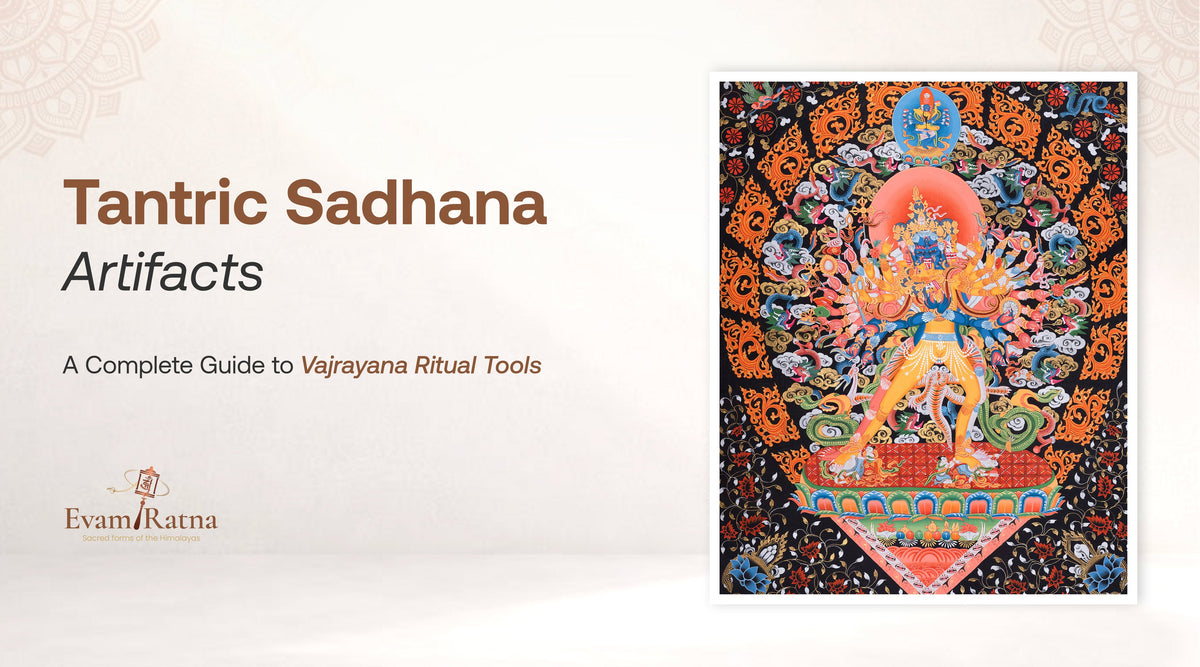
Tantric sadhana is one of the most direct and demanding paths within Vajrayana Buddhism, and it is also one of the most physical. Unlike quiet contemplative practices that unfold entirely within the mind, tantric sadhana is carried out with the body as much as with thought: mantra is spoken aloud, mudras are formed with the hands, and specific ritual implements are held, sounded, or placed on the altar at precise moments. The Tantric Sadhana Artifacts collection, including Vajrayana ritual tools such as the Kapala, Kangling, Khatvanga, ritual Phurba, ceremonial head crown, bone Rugyan, ritual knives, and snuff horn, exists because this path cannot be walked by visualization alone. Each object gives a specific stage of practice something to hold, sound, or wear.
What is Tantra?

Tantra refers to a body of esoteric teachings and methods, found in Vajrayana Buddhism as well as in Hindu Shaiva and Shakta traditions, that aim to reach realization by transforming ordinary experience directly rather than gradually setting it aside. Where a sutra-based path tends to work by slowly releasing attachment and aversion, a tantric path works by taking the raw material of desire, anger, and ordinary perception and using it as fuel for awakening. Practitioners visualize themselves as an enlightened deity (a yidam), recite the deity's mantra, and treat their own body, speech, and mind as inseparable from the practice itself. This is part of why Vajrayana is often described as the swift path: it works directly with what other approaches try to quiet.
What is Sadhana?
Sadhana comes from a Sanskrit root meaning "a means of accomplishing," and it refers to a structured spiritual practice undertaken to realize a particular goal, most often union with a chosen deity or a specific state of realization. A sadhana text is a script: it walks the practitioner through visualization, mantra, mudra, and offering in a fixed sequence, meant to be repeated across days, months, or a lifetime rather than performed once. In the completion and generation stages of Unsurpassed Yoga Tantra, a practitioner first dissolves ordinary perception into emptiness, then rebuilds it as the deity's mandala, a process that a sadhana text guides step by step. The value of a sadhana lies in its repetition; like counting a mala, its effect comes from being rehearsed until it reshapes the practitioner's habitual mind.
Why Ritual Artifacts Are Essential to Tantric Sadhana
Tantric sadhana is deliberately embodied. It is not meant to stay in the imagination, and this is precisely the role the artifacts in this collection play: they give an abstract stage of practice, transformation, invocation, protection, identification with a deity, a physical action a practitioner can actually perform. A skull cup held during an offering visualization makes the transmutation of poison into wisdom something the hands do, not only something the mind pictures. A dagger pressed downward at a specific point in a sadhana makes "subduing obstruction" a real gesture rather than only a concept. Across the Vajrayana tradition, the precise iconography carved into an object matters less than its role in this embodiment: one senior tantric lineage holder has observed that a ritual object's purpose is to facilitate a practitioner's identification with the deity through the act of using it, not to be admired for its symbolism alone.
The Ritual Artifacts of Tantric Sadhana

Kapala (Skull Cup)
The Kapala, or thod pa in Tibetan, is one of the most recognizable ritual vessels in Vajrayana practice. Traditionally modeled on a human skull cup and today crafted in precious metal for contemporary practice, it is held by wrathful and semi-wrathful deities including Chakrasamvara, Vajrayogini, and Hevajra. In sadhana practice, the Kapala holds substances that represent the transmutation of ordinary perception into wisdom, making it a vessel less for consumption than for the visualized offering of that transformation itself.
Kangling (Thighbone Trumpet)
The Kangling is a trumpet historically fashioned from a human thighbone, its name combining the Tibetan words for "leg" and "flute." It is sounded to invoke deities and dakinis and to summon spirits, most notably during Chöd practice, where its call is used alongside the hand drum to confront and offer up the practitioner's own ego-clinging. The sound itself, rather than any melody, carries the ritual function: a single sustained note marking the moment of invocation.
Ritual Daggers (Phurba)
The Phurba is a three-sided ritual dagger, most closely associated with the wrathful deity Vajrakilaya, and one of the most iconographically precise objects in the tantric toolkit. Its three-faceted blade is generally understood to represent the transformation of the three root poisons, ignorance, attachment, and aversion, into wisdom, and its downward, pinning motion in a sadhana symbolically subdues obstructing forces and negative energies rather than physically harming any being. The pommel is often carved with a deity's face or the crown of Vajrakilaya, reinforcing that the phurba and its deity are, in tantric visualization, treated as closely interchangeable.
Ritual Head Crown (Rig na)
The Ritual Head Crown, or Rig Nga, in Tibetan, meaning "Five Families,"each point commonly bearing the image of one of the Five Dhyani Buddhas, is worn by a practitioner or officiating lama during deity yoga and empowerment ceremonies. Putting on the crown is a physical enactment of the sadhana's generation stage: the practitioner does not merely visualize identification with the enlightened deity families, but wears an outward sign of that identification for the duration of the rite.
Bone Rugyan (Bone Apron and Ornaments)
A complete Bone Rugen, meaning "bone ornament" (rus rgyan in Tibetan), traditionally comprises a crown, earrings, a neck or chest ornament, an apron or belt, and bands for the arms, wrists, and ankles, carved with figures from the Chakrasamvara cycle and the Heruka assemblies of mahayoga and yogini tantra. Worn by a practitioner representing a deity during advanced tantric rituals and cham dance performances, the ornaments carry a double meaning: their material recalls the impermanence of the body, while wearing them during a rite confers the nondual wisdom associated with the deity being embodied.
Ritual Knives
Distinct from the phurba's pinning function, ritual knives such as the crescent-bladed kartika are used in wrathful deity sadhanas to enact the severance of ego and the transformation of ordinary consciousness into wisdom, a gesture closely associated with dakinis and Mahakala forms. These blades appear in torma preparation, empowerment ceremonies, and formal puja alongside the other implements on this list, iconographically accurate proportion and detail being treated as essential to their ritual validity.
Khatvanga
The Khatvanga is a tantric staff, traditionally topped with a trident, three heads, a vase, and a crossed vajra. Its origins trace back to the Indian Shaivite ascetics known as Kapalikas ("skull-bearers"), and it entered Vajrayana Buddhist iconography as an attribute of both wrathful deities and realized masters, most famously Padmasambhava (Guru Rinpoche), who is depicted carrying it in the crook of his left arm. The three heads, represent the three kayas (bodies) of a Buddha: the freshly severed head is Nirmanakaya (emanation body), the decaying head is Sambhogakaya (bliss body), and the bare skull is Dharmakaya (truth body). In some lineages they're read instead as the transformation of the three poisons (ignorance, attachment, aversion) into wisdom.
Snuff Horn
Less central to the generation and completion stages than the objects above, the snuff horn nonetheless belongs to a practitioner's personal ritual kit, historically carried by lamas and used to store powdered snuff believed to sharpen focus during long periods of practice. Its presence in this collection reflects the broader Himalayan tradition of practical accessories that accompany formal sadhana rather than perform a role within the rite itself.
Choosing Tantric Sadhana Artifacts for Your Vajrayana Practice
- Match the object to your stage of practice. Many of these implements, particularly the phurba, kapala, and khatvanga, are traditionally introduced only after receiving the corresponding empowerment from a qualified teacher, rather than acquired freely for display.
- Prioritize iconographic accuracy over decoration. A ritual object's proportions, the number of facets on a blade, or the specific deities depicted on a crown are not stylistic choices; they carry meaning that determines whether the object functions correctly within a sadhana.
- Consider material and craftsmanship together. Whether copper, bone, crystal, or gold-plated, the durability and precision of the carving will matter more over years of regular handling than the material alone.
- Consult your lineage or teacher where practices vary. Details of how an object is held, when it is used within a sadhana, and how it is stored differ across Tibetan Buddhist schools and Newar traditions.
Read More About The Complete Guide to Vajrayana Buddhism: Core Beliefs, History, and Practices
Conclusion: The Physical Path of Tantric Practice
The Tantric Sadhana Artifacts collection brings together the ritual tools that make Vajrayana's most direct path a physical one as well as a contemplative one. From the Kapala's offering of transformed perception to the Phurba's subjugation of obstruction and the Khatvanga's embodiment of wisdom energy, each object exists to give a stage of sadhana practice a concrete form a practitioner can hold, sound, or wear. Their value lies not in ownership or display, but in the role they play, under proper guidance, within a structured practice repeated with sincerity over time.